| Author |
 Replies: 11 / Views: 2,113 Replies: 11 / Views: 2,113 |
|
|
Pillar of the Community
Canada
1046 Posts |
thanks for looking pls forgive the wretched pictures hoping for f15 or slightly worse variety unknown tia 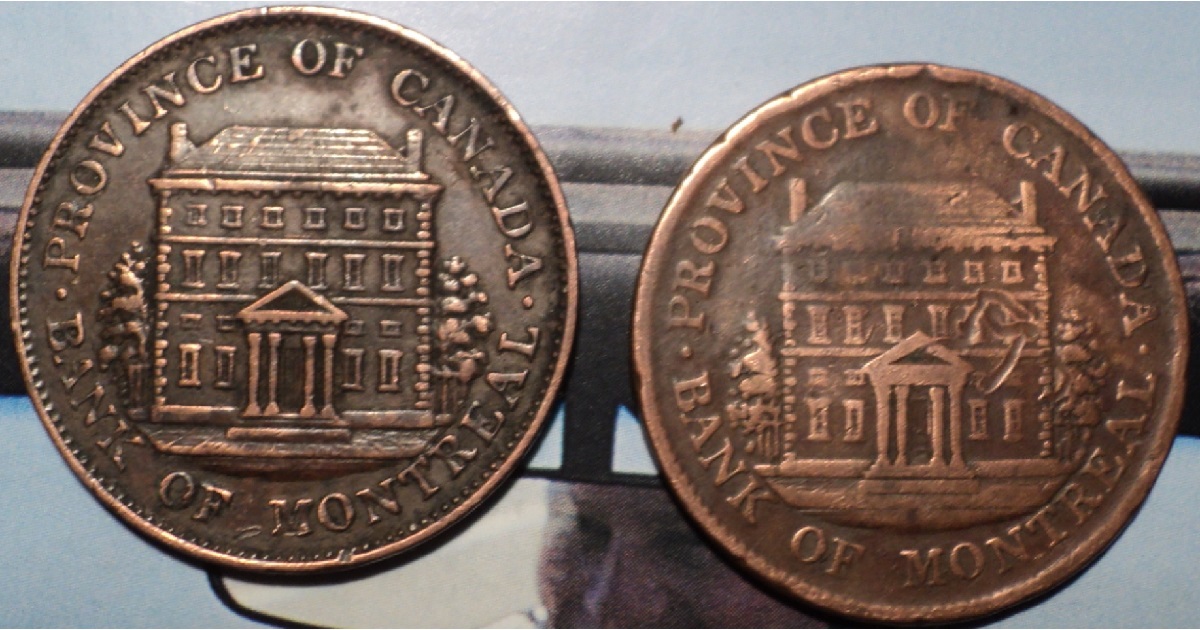 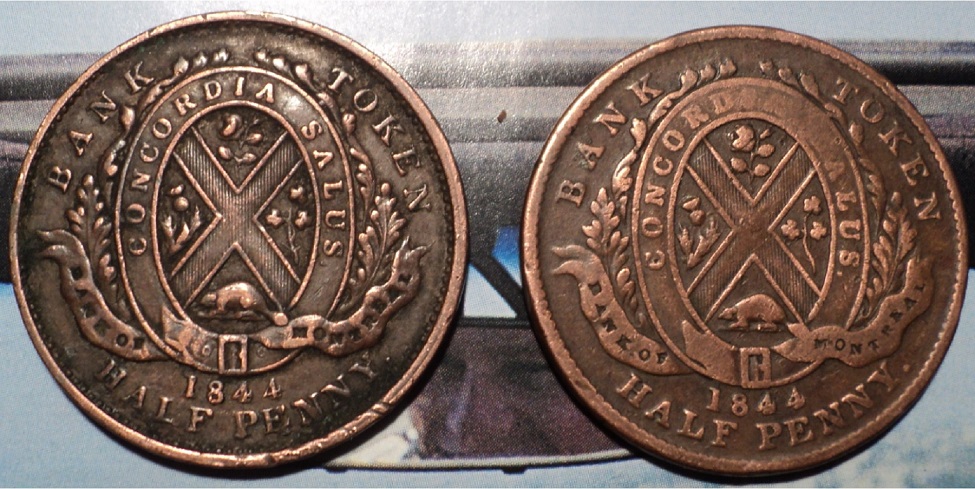 Edited by torgemco
05/08/2017 6:11 pm
|
|
|
|
Pillar of the Community
Canada
2786 Posts |
Left VF20
Right VG8 damaged
This year is fairly easy to find in high grades at low prices.
|
|
Pillar of the Community
 Canada
1046 Posts |
|
|
Pillar of the Community
United States
840 Posts |
The left photo is of the Tall Tree variety.
The right photo is of the Short Tree variety.
Doctor Courteau identifies numerous varieties of this series.
doug
|
|
Bedrock of the Community
Canada
10743 Posts |
Yes, the varieties in these tokens..  It's just about driving me nuts...  , can never seem to know the difference in tall trees/short trees, short nosed beavers, aarrggg.  |
|
Pillar of the Community
Canada
3049 Posts |
I'm still waiting for colonial tokens to write a book on this...
|
|
Pillar of the Community
United States
840 Posts |
Concerning the trees:
The tree along the left side of the building is the area of concern. Ignore the tree along the right-side of the building.
A horizontal line spanning the building separates the second and third floors of the building.
Concerning the Tall Trees, the upper two leaves are nearly on-line with the horizontal line. (very close to, but slightly below).
The Heavy Tree and Small Tree varieties terminate well below the horizontal line.
On the Heavy Tree and Small Tree varieties, examine the upper left corner of the base of the building (this is
on-line with the serif of the right upright of the N in BANK).
A short diagonal line protrudes upward into the field from the tip of this area on the Heavy Trees.
The Tall Tree and Short Tree varieties do not shew this line.
Concerning the long and short nose (snout), the short nose
variety is more rounded (rabbit-like), while the tip of the
long nose appears narrower and longer (rat-like).
doug
Edited by colonialtokens
05/10/2017 11:52 am
|
|
Pillar of the Community
United States
840 Posts |
Concerning the "Front-View" tokens:
Doctor Courteau is concerned with the style of the M in MONTREAL. To wit:
"In the Opened M variety, the angle formed by the central part of the letter
comes down on-line with both feet, but points towards the left one; whereas
in the closed M variety, the angle does not come so low and points towards
the right foot."
And:
The completeness of the Fence along the left-side of the building (these are
often erroneously mistaken for individual trees). Are they complete, shewing
three pilings or are they incomplete (often only shewing the central piling).
The placement of the 4's in the date. Are they close together, distant, same height, etc.
Whether the 1 in the Date was struck with the numeral 1 or the letter I.
Does the Gable of the porch shew an inner moulding.
Is there a small break where the right and left side of the roof meet.
Is the left-side of the top or the Porch Roof re-cut.
Whether the Period after SOLUS is circular or oval.
Whether the Thistle Sprig shews a stem.
What is the positioning of the stem in relationship to the Flower.
Some shew the top of the flower re-cut.
Concerning the stems of the Shamrock, some are short,some are long, others curved, etc.
The points of the terminal of the left Ribbon. Are they long, short, bent, etc.
There is more, but this is but a taste.
doug
|
|
Pillar of the Community
Canada
514 Posts |
I like these coins... I dunno why, but they appeal to me.
|
|
Bedrock of the Community
Canada
10743 Posts |
Doug, you are a great asset to CCF, thanks for the info,  I just started collecting these and, if I'd known there were that many varieties, I wouldn't have bothered. But, I do like them.  |
|
Pillar of the Community
United States
840 Posts |
This is an addictive pastime.
The Front View series is not my primary focus. I have not specifically concentrated on these,
but, like yourself, over the years I have obtained several hundred pieces in random lots.
Of these, I only lack 2 or 3 Courteau varieties. This series is easy to complete (or nearly so)
as now-a-days, no one else or very few, are paying any attention to them.
On an aside, most of this series was a work-horse for commerce. Dated in 1842 and 1844, they were
circulated nearly a decade prior to the advent of the St. George's (1850). And a year following
the last St. George (1857), decimal coinage emerged (1858). The survival rate of higher grade St.
George's far surpassed those of the Front View. Most Front Views are found in mid and lower grades,
whereas many St. George's are of a considerably higher grade. People saved the nicer St. George's and
regulated the Front Views to the junk boxes as inconsequential. Not worth keeping, but to valuable
to throw away. (I've had girl-friends like that).
My primary focus is the St. George's.
Extensive studies have already been done on the side-views because they are popular
and pricy. (p.s. I have none.) I believe they are overpriced. The Front views are
just as complex, but they have never generated any popularity.
Enough for now
doug
|
|
Pillar of the Community
Canada
1046 Posts |
thank you very much
i share SHAFTA9a gratitude
for all your commentaries
regards
p.s edit..where these half pennies
only struck for 3 yrs..
1842/44/45..no 43..?
tia
Edited by torgemco
05/11/2017 2:00 pm
|
| |
Replies: 11 / Views: 2,113 |
|




 Posted 05/08/2017 9:29 pm





