| Author |
 Replies: 11 / Views: 1,717 Replies: 11 / Views: 1,717 |
|
|
New Member
United States
5 Posts |
My Grandmother recently passed away and I inherited her coin collection. She has right many late 1800s, early 1900s coins. What's the best way for me to find out what they are worth, if anything? Thanks! For example, I found this Liberty Quarter that doesn't seem to have a date. It has E PLVBIBVS VNVM stamped on it. 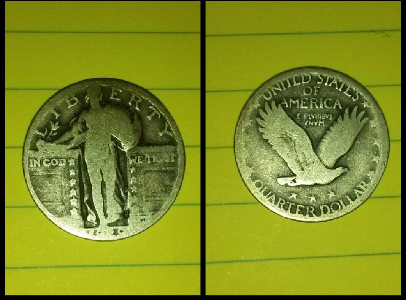 |
|
|
|
New Member
 United States
5 Posts |
1895 Quarter 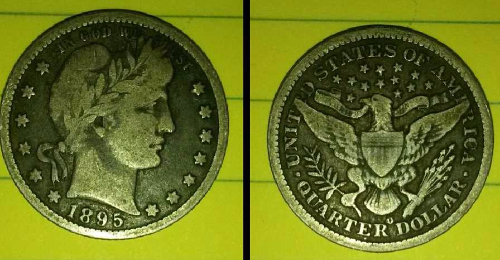 |
|
Rest in Peace
10197 Posts |
 To the forum! Great start, post pix so we can help you. First, you need some good basic coin reference books. The one most use is the the Official Red Book, "A guide Book of United States coins" published yearly. This gives you all the values of US minted coins, and a lot more basic info as well. You will learn what your coins are and a general idea of worth. This value isn't what a dealer will offer, just a figure letting you know if rare or not basically. Then keep posting with your questions. What you have is a Standing Liberty quarter, minted from 1916-1930. There is a partial date under The statue mintmark if any is left of her feet. Might be a 1920 or 1930 Philadelphia mint?  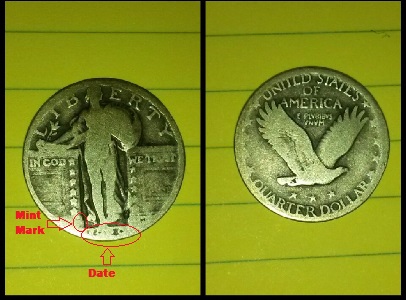 Your second is a Barber quarter 1895-O (New Orleans mint), The "O" is below the Eagles tail feathers, that coins in nice shape too. Grades an G-8 to F-10 worth $8-$15. It is not a rare coin, but quite collectable. Edited by Crazyb0
07/04/2017 01:30 am
|
|
New Member
United States
5 Posts |
Dollars: 1884, 1921, 1922 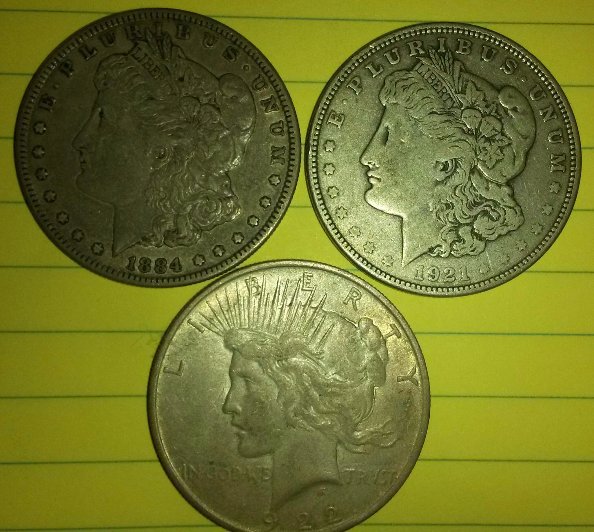 |
|
New Member
United States
5 Posts |
Thank you! I will check out the Red Book. ;) |
|
Valued Member
United States
338 Posts |
In my opinion, you should take you time and understand that most pawn shops and coin shops will only pay a fraction of the collector value of your coins. I think there are many members that are willing to help you with realistic values. As a collector, I am willing to pay a little less than list value. On the other hand, many coin dealers offer 50% or less than list values. So, keep in mind a true coin's value is only what you can get a someone (collector vs. dealer) to pay.
|
|
New Member
United States
5 Posts |
Thank you @man2004! That advice is greatly appreciated! With there being 100s of coins, at this point I'm feeling a little overwhelmed...lol :)
Edited by sweetfreebird
07/04/2017 03:38 am
|
|
Pillar of the Community
United States
1606 Posts |
Hundreds of coins is a good thing, not bad. I think we'd all like that problem. And I second the RedBook with emphasis on the descriptions of grades of the different coin types. |
|
Rest in Peace
United States
18456 Posts |
To CCF , The first thing you should be doing is stop worrying about how much they are worth . Educate yourself on what was just handed down to you . Then you have a choice , either continue where your grandmother left off with the collection or try to dispose of them because of lack of interest . If you don't need the money, then I recommend you continue with the collection .Trust me ; once you get hooked ,there's no turning back !  Oh yeah , and ask all the questions you want, that's what we are here for .  |
|
Pillar of the Community
United States
1696 Posts |
Those are nice coins; congratulations on inheriting the collection. I hope you are able to learn about coins and keep them for a long time!
|
|
Bedrock of the Community
United States
20753 Posts |
I too say forget about the value for now unless you really need money. Otherwise concentrate on what you have. And yes, the Red Book is what you should have to start only do not pay attention to the prices they list. Usually over what they are really worth. |
|
Bedrock of the Community
United States
17884 Posts |
Quote:
Might be a 1920 or 1930 Philadelphia mint?
1930, it is a type 3 with the date area recessed. A 1920 would be a type 2 with the date on a raised surface. (and in this condition quite possibly unreadable.) |
| |
Replies: 11 / Views: 1,717 |
|










 Posted 07/04/2017 01:22 am


