|
This page may contain links that result in small commissions to keep this free site up and running.

Welcome Guest! Registering and/or logging in will remove the anchor (bottom) ads. It's Free!
To participate in the forum you must log in or register. | Author |
 Replies: 11 / Views: 2,212 Replies: 11 / Views: 2,212 |
|
|
Pillar of the Community
United States
949 Posts |
Egnatia Mariniana was probably the wife of Roman Emperor Valerian and mother of Emperor Gallienus. Unlike many of the ephemeral emperors and rebels who bid for Imperial Power during the Crisis of the Third Century of the Roman Empire, Valerian was of a noble and traditional senatorial family. Details of his early life are elusive, but for his marriage to Egnatia Mariniana, who gave him two sons: later emperor Publius Licinius Egnatius Gallienus and Valerianus Minor. {Wikipedia on Valerian: https://en.wikipedia.org/wiki/Valerian_(emperor)} DIVAE MARINIANAE
veiled bust r. on crescent, without diadem
CONSECRATIO
empress waves while riding on left side of peacock in flight to the right.RIC 6 (253-258) 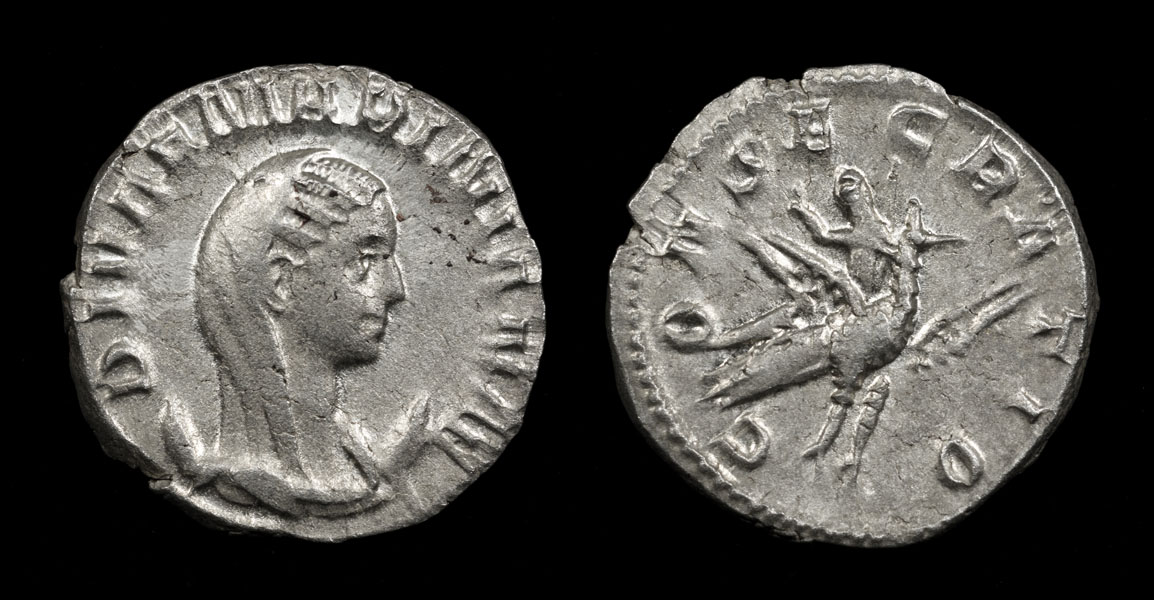 Previously it had been assumed that Egnatius Victor Marinianus, Legatus of Arabia Petraea and Moesia Superior, was the father of Mariniana. More recently however, it has been postulated that she was the daughter of Lucius Egnatius Victor (suffect consul before AD 207) and therefore sister of Egnatius Victor Marinianus.[1] This was the opinion of Inge Mennen writing in Power and Status in the Roman Empire 193-284; (Brill: Leiden, 2011). On p.72 she notes, "The sister of the Hedii Lolliani who were consules ordinarii in 209 and 211 married one of the Egnatii (Egnatius Victor, consul suffectus before 207.) Their daughter, (Egnatia) Mariniana married the future emperor Publius Licinius Valerianus and gave birth to the future emperor Publius Licinius Egnatius Gallienus. Although the name Lollianus thus disappears from the consular fasti after 225, the family merged with the Egnati and later with the Licinii. In this way the family remained important, though less prominent, until Gallienus was killed in 268 and probably took most of his relatives down with him." Several coins bearing the obverse legend DIVAE MARINIANAE date back to the beginning (253-258) of the reign of Valerian and Gallienus. Given the practice of deifying the wives who died before their husbands' assumption of the Principate, it is possible that Mariniana died before AD 253. All of the coins listed in RIC bear only this obverse legend. The bust of the empress rests on a crescent, facing right with one of two hair styles, i.e. veiled with or without diadem. With but one very rare exception, two reverse types of the antoniniani for Mariniana share the CONSECRATIO reverse inscription. These are the same types as we saw earlier with Empress Paulina. The exception is a reverse featuring Felicitas standing left holding a caduceus and cornucopia under the words FELICIT DEORVM. The most commonly seen CONSECRATIO reverse features a depiction of the apotheosis of Mariniana (the elevation to divine status) in which the figure of the Empress rides the sacred bird of Juno, the peacock, in skyward flight. (see example above) Usually the empress is seen riding on the left side of the bird which is flying to the right, but RIC notes that the opposite orientation also exists, yet groups both types under a single number, i.e. RIC 6. Less commonly seen, but more diverse in its form, is the CONSECRATIO type featuring a peacock standing in splendor, fan tail, looking either to right or left. These occur with or without diadem on the obverse. There is also a rare variant in which the bird is walking right, and the empress only wears a diadem. DIVAE MARINIANAE
veiled bust r. on crescent, with diadem
CONSECRATIO
peacock stands in splendor facing right.
RIC 4 (253-258) 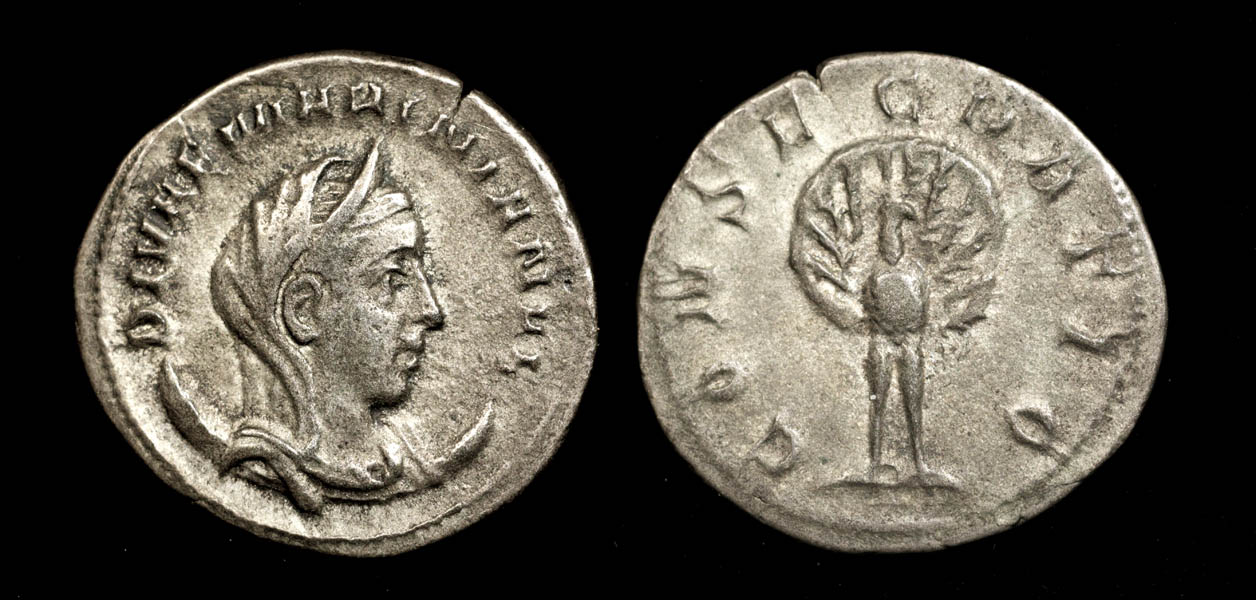 We will expand this display as more items become available. Edited by lrbguy
08/08/2017 10:28 am
|
|
|
|
Pillar of the Community
United States
6130 Posts |
Super coins!
She has been on my list for a while, but most examples I have seen have been either underwhelming, or else well over my available budget.
|
|
Moderator
 United States
23731 Posts |
I agree, super coins. Excellent write up as always.
|
|
Pillar of the Community
United States
7067 Posts |
Great coins. Truly bizarre reverse imagery on that first one. Thanks for sharing!
|
|
Pillar of the Community
Canada
1269 Posts |
Wonderful writeup and great coins.
|
|
Pillar of the Community
United States
6130 Posts |
@ Bob, I believe the Peacock was actually discussed in a previous thread (maybe Sabina?) Interestingly, it corresponds to actual Roman cremation practices--they would buy a live peacock, ship it all the way from India, and then spook it during the cremation so that it would fly away and take the spirit of the deceased up to the Gods for deification.
|
|
Pillar of the Community
United States
1475 Posts |
Great looking coins  And matching write ups Love to read the history behind the coins. |
|
Valued Member
335 Posts |
Great coins |
|
Moderator
United States
34542 Posts |
Great write-up @irbguy!
"If you climb a good tree, you get a push."
-----Ghanaian proverb
"The danger we all now face is distinguishing between what is authentic and what is performed."
-----King Adz
|
|
Pillar of the Community
 United States
949 Posts |
Thanks for the kind remarks to one and all. I particularly want to thank Steve for adding the note about Roman funerary practice in this matter. I am not familiar with the Roman understanding of human spirits and afterlife, and was reluctant to comment. However, I once read a comment somewhere that equated the apotheosis with the moment of the departing of the spirit from the body, which I now know is not correct. There is a difference between the end of life and apotheosis, inasmuch as the latter requires ceremony. What is still a blank spot for me is the Roman conception of the realm in which the spirits of the deceased normally dwell, the higher realms of the blessed dead, and how there may be movement between them.
|
|
Pillar of the Community
United States
1304 Posts |
Excellent examples! I need to find one yet!
|
|
Pillar of the Community
United States
6130 Posts |
The Romans borrowed nearly all of their mythology from the Greeks: https://en.m.wikipedia.org/wiki/Greek_underworldNow, one thing I have always struggled with is the separation of actual, genuine faith and recorded mythology. Greek mythology was formulated well before the Classical golden age of philosophers and scientists, so by the time of Valerian, there must have been huge swaths of mythology that were demonstrably false. At any rate, there are clear parallels between the Greco-Roman afterlife and what has been popularized in Christianity: 1. "Heaven" - Elysium, an eternal paradise of fair weather where the pious, righteous, and heroic could indulge in worldly and intellectual pursuits forever. 2. "Purgatory" or "Limbo" - Asphodel Meadows, where those who were not wicked, but neither remarkable would drink from the river Lethe and exist for eternity as mindless shadows. 3. "Hell" - Represented as several places of suffering where the wicked would be punished according to their crimes. Centrally located was Tartarus, where the worst of all would be imprisoned alongside the Titans. It's of course more complicated than that, but you get the idea. What puzzles me the most about these posthumous deification coins is how the Romans thought the deification process worked. From what I read, consensus of the Senate and the People (usually instigated by order or plea of the Emperor) constituted grounds for deification. However, if Mariniana died before Valerian took office (which seems probable) then her soul would have already been in Elysium when she was deified. Ditto with Paulina, wife of Maximinus Thrax. Doesn't make sense how a peacock could carry her soul out of the underworld, unless the ceremony wasn't just confined to wives of the emperors, but anyone who could afford a peacock? No wonder the Western Satraps were so rich! |
| |
Replies: 11 / Views: 2,212 |
|
To participate in the forum you must log in or register.
 
- Help With Identification Please.
- 1969-S Lincoln Cent Machine Doubling Or Double Die Obverse
- 1999 Lincoln Cent - Die Clash
- 1809 Half Cent For Grading
- 1987 - D Lincoln Cent Grade Check
- 1987- D Lhc Possible RPM Or DDO In Date
- You Know What I Want That Final Number To Be
- Bronze Coin To Id. Greek Or Roman?
- A Ridiculously Badly Written Computer Aided Book, Coin Collecting Bible, 2024
- Liberty Head 10/11 Stars Obverse With A Sick Looking Eagle On The Reverse Holed 0.59g 13.06mm
- The Tyrant Collector - PCGS Youtube Interview
- Counterfeit Detection: ANA Video - Introduction, With Brian Silliman And Jim Robinson Ep. 1
- Counterfeit Detection: ANA Video - Mistakes, Risk Factors, And Counterfeits & Alterations, Ep. 2
- Counterfeit Detection: ANA Video - Pimples And Pits, Looking At Cast Counterfeits, Ep. 4
- Counterfeit Detection: ANA Video - What Year Is That Cent? Key Date Coins, Ep. 5
- Counterfeit Detection: ANA Video - Diagnostics Of The 3, 5, And 10 Cent Coins, Ep. 6
- Counterfeit Detection: ANA Video, Counterfeit Quarter Dollar Diagnostics, Ep. 7
- Counterfeit Detection: ANA Video, Counterfeit Classic Commemorative Coins Diagnostics, Ep. 8
- Counterfeit Detection: ANA Video, Counterfeit Silver Dollar Diagnostics, Ep. 9
- Counterfeit Detectection: ANA Video, Classic US Gold Coin Diagnostics, Ep. 10
Disclaimer: While a tremendous amount of effort goes into ensuring the accuracy of the information contained in this site, Coin Community assumes no liability for errors. Copyright 2005 - 2026 Coin Community Family- all rights reserved worldwide. Use of any images or content on this website without prior written permission of Coin Community or the original lender is strictly prohibited.
Contact Us | Advertise Here | Privacy Policy / Terms of Use
|
| Coin Community Forum |
© 2005 - 2026 Coin Community Forums |
| It took 0.31 seconds to rattle this change. |
 |
|
| |
| |





 Posted 08/08/2017 3:38 pm


