| Author |
 Replies: 8 / Views: 1,459 Replies: 8 / Views: 1,459 |
|
|
CCF Advertiser
 United States
1318 Posts |
As I wait for more coins I find myself going through tiny fractions I always put off looking at. My coin is in the photos, but I give a reference below where I got the ID. CYCLADES. Kythnos. Tetartemorion (Circa 475-460 BC). Obv: Head of boar right. Rev: Quadripartite incuse square. BMC -; HGC -; Klein -; . 5 mm, 0.09 grams https://www.acsearch.info/search.html?id=1943342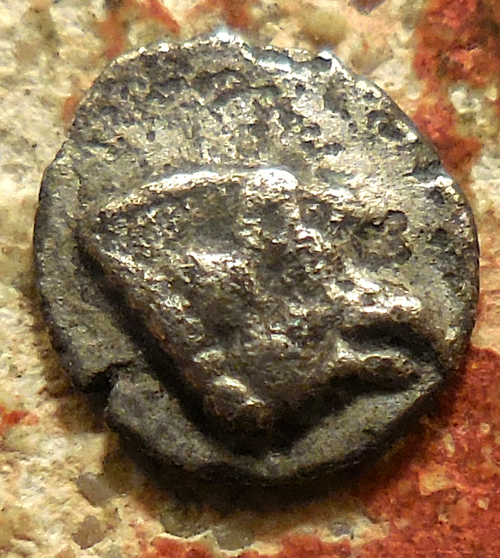 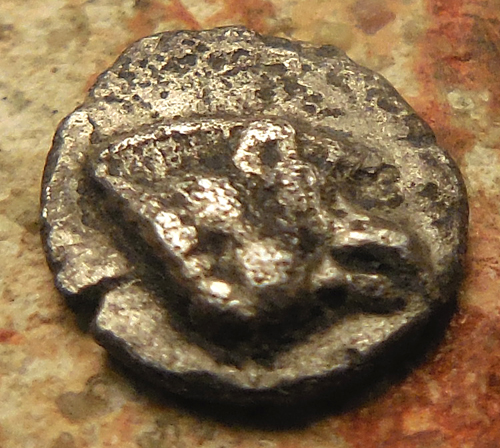 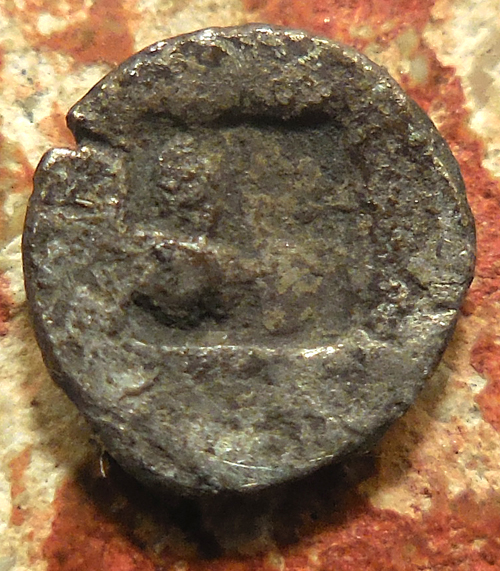 Edited by louisvillekyshop
09/05/2017 8:41 pm
|
|
|
|
Moderator
United States
23731 Posts |
That's a tiny coin. Way too small for me.
|
|
Pillar of the Community
United States
7067 Posts |
Neat little - and I do mean little - coin there, Joe. 5mm!
Wow. Not a type one often sees. If I attempted to photograph that with my old camera, I think it'd look like an indistinct silver fuzzball.
|
|
Moderator
United States
34549 Posts |
@lks, that is one tiny coin. I'd hate to drop it in the grass or dirt and have to find it. I wonder what sort of purchasing power it had back in 500 BC?
"If you climb a good tree, you get a push."
-----Ghanaian proverb
"The danger we all now face is distinguishing between what is authentic and what is performed."
-----King Adz
|
|
CCF Advertiser
 United States
1318 Posts |
As for purchasing power, I used to think these were just banking change for tight transactions. But so many were made they were probably not reserved to money traders. It looks like the number of these suggests the average person did use the coins. What gets me is we have a lot of existing writings. Like Herodotus of Halicarnassus. Is there no mention of very small coins anywhere? Even in a joking manner? Rome was not using them but there were tiny Athens coins etc. Some record must be out there and I confess I have not looked in case this is an obvious citation I am not mentioning.
|
|
CCF Advertiser
United States
1318 Posts |
Quote from the website below. Looks like when they were switching from Electrum to gold and silver pure they had issues that needed smaller fractions in Miletus. Notice they talk about a DEMAND for more fractions: --->"If we assume an exchange rate of 3/4 : 1 between gold and silver, the new gold currency corresponded with the conventional electrum system, so the gold stater, weighing 10.72 g, could be exchanged with the old electrum stater, weighting 14.28 g. Likewise, the fractions of the two systems were changeable. Within the gold and electrum currency, the 1/12 stater corresponded as shown above. Difficulties arose with the new silver stater and its half piece. No denominations of the old system met them adequately. The silver stater could be exchanged to nine 1/12 staters, but the half stater was not convertible. The moneyers responded to this situation in two ways. They extended the silver currency by issuing 1/8, 1/16, 1/32 and 1/64 staters, which had an exchange function to the Lydian silver stater and half stater. Six 1/8 staters were equivalent to one Lydian stater, three of them to a Lydian 1/2 stater. The two smaller denominations obviously satisfied the demand for small fractions which arose after the expansion of the currency. Therewith, we can date the denominations described above (all of them showing a mane-less lion's head seen from above on the obverse) to 550-540 BC. Those emissions took place in parallel with the issue of Series 1-3 1/12 staters."<--- http://rjohara.net/coins/references/pfeiler-1966 |
|
Pillar of the Community
United States
711 Posts |
Great link and coin.
Love the Ionian / archaic coins of Miletus.
|
|
Pillar of the Community
United Kingdom
2624 Posts |
My smallest is 7mm and I thought that was small enough, you went 2mm smaller :P
|
|
Moderator
United States
34549 Posts |
Ok awesome @lks--thanks for the additional info.
"If you climb a good tree, you get a push."
-----Ghanaian proverb
"The danger we all now face is distinguishing between what is authentic and what is performed."
-----King Adz
|
| |
Replies: 8 / Views: 1,459 |
|










 Posted 09/05/2017 9:06 pm


