| Author |
 Replies: 12 / Views: 2,315 Replies: 12 / Views: 2,315 |
|
|
Pillar of the Community
Czech Republic
803 Posts |
Hello fellow forumites. I recently picked-up an inexpensive 1820 8 Reales from Mexico City because it looked to be an over-date 2/1. When I received the coin, I was able to confirm what looks like the remains of digit 1 under the 2. What's interesting is that there is no trace of an overdate under the 0. What I think it could mean: 1. It's not an overdate altogether and just a die scratch resulting in raised metal; 2. It's a misplaced digit that was punched in error and then repaired. This is definitely not unheard of and I have a number of examples from those years with multiple letters being reworked / moved around; 3. The die was prepared to be used in 181X years with the last digit applied when the die was needed in production. I know that we have examples of this practice during the later Mexico Republic period in the Cap'n'Ray series. Are there any records of this being done during the colonial days? Would love to hear your thoughts on this. Here's the coin in question. 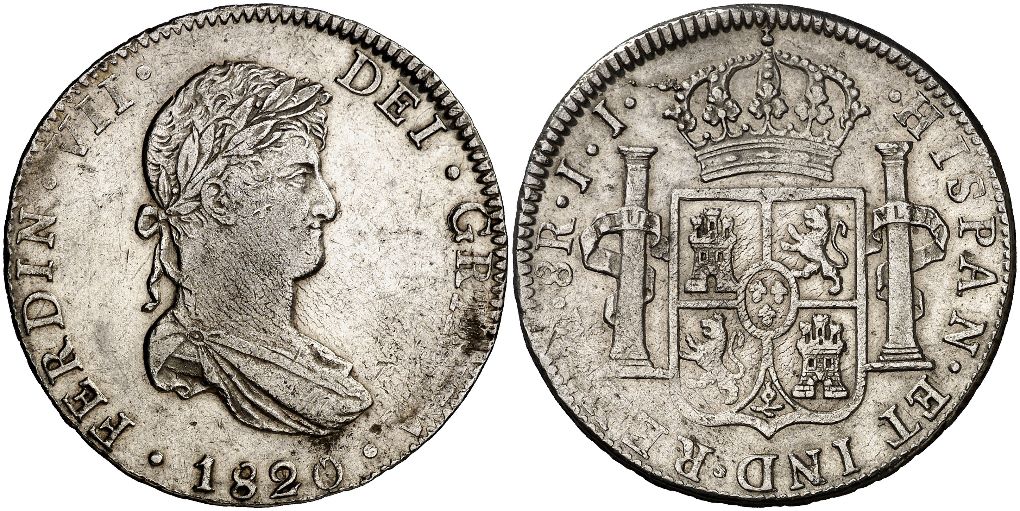 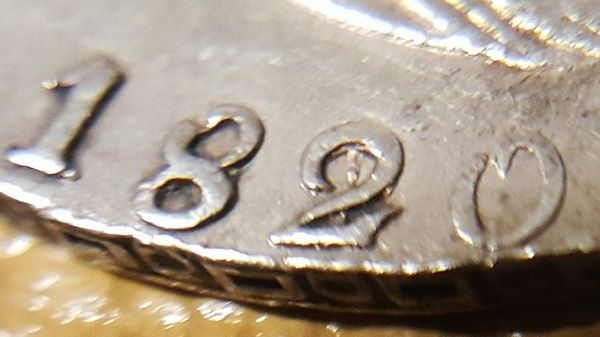 |
|
|
|
Pillar of the Community
 United States
2843 Posts |
Interesting write-up, but why do you say for certain that there is no trace of am overdate on the 0? What am I seeing at 12:00? Remains of a 9?
|
|
Pillar of the Community
 Czech Republic
803 Posts |
BigSilver - that's actually the style of the digit used on those.
I did just notice something troubling in the close-up photo with regards to the edge. Will check tonight to confirm.
|
|
Pillar of the Community
United States
1962 Posts |
Roman, saw you post this on PCGS a little while back... curious piece to analyze.
I see zero trace of any playing around on the "0". Given that, it can't POSSIBLY be over 19, 18... anything with a fourth engraved digit. If they were THAT sloppy doing the 2 over 1... they certainly wouldn't be that neat on the last digit.
That does of course, in theory, still allow the idea of an "181_" die... but how likely is it for that to have existed? If they were sitting on a die, wouldn't they just use it FIFO? What, slow week at the office, so they did one in advance? They did the diecutting several at a time b/c Jose didn't like doing it? Possible, I suppose, but... with all the overdates/overassyers through the series, in the middle of this tumultuous period, were they really keeping many spares around?
Anyway... I would guess Theory 1 (coincidentally placed die scratch) over #2 or #3 (reengraving/recutting the digit).
IF, hypothetically, that dagger under the 2 had been a "1" or even a really botched attempt at the "2"... that would be a REALLY sloppy fix. Even if they overpunched the "2" and THEN did some erasing around... with that big open area within the hoop on the "2", they should easily have been able to make that much cleaner. Where they cheat/get sloppy is where intersections happen and it would take a deft hand to touch it up (e.g., changing 5 to a 6... you end up with a "6" that has a point and a flat top), since to do better would take a lot of effort for not much visual improvement.
And IF that was a full preexisting "1"... what happened, they partially filled the incuse digit and then gave up? What's there is a jagged, tapering vertical dagger - not really "1"-shaped, just happens to be right in that spot - that's still quite raised to be an erasure. Again, would they really be that sloppy?
I could be wrong... and it is really coincidental placement, isn't it?
|
|
Pillar of the Community
Czech Republic
803 Posts |
Quote:
IF, hypothetically, that dagger under the 2 had been a "1" or even a really botched attempt at the "2"... that would be a REALLY sloppy fix. Even if they overpunched the "2" and THEN did some erasing around... with that big open area within the hoop on the "2", they should easily have been able to make that much cleaner. Where they cheat/get sloppy is where intersections happen and it would take a deft hand to touch it up (e.g., changing 5 to a 6... you end up with a "6" that has a point and a flat top), since to do better would take a lot of effort for not much visual improvement.
And IF that was a full preexisting "1"... what happened, they partially filled the incuse digit and then gave up? What's there is a jagged, tapering vertical dagger - not really "1"-shaped, just happens to be right in that spot - that's still quite raised to be an erasure. Again, would they really be that sloppy?" Brian, it's a neat one for sure. Personally I think it looks in-line with what a corrected digit would look like. The metal the die was made of was much harder than whatever they used to fill the mistake. The engraver would realize their mistake, get the digit or letter filled, and then strike a new digit over the repair job. So even though initially the correction was not noticeable, over time due to the force of all that striking the softer filling metal would compress slightly revealing the original repaired digit. |
|
Pillar of the Community
Czech Republic
803 Posts |
Speaking of repairs - not sure if you saw this one I posted a while back. Lots of legend corrections.   Edited by TwoKopeiki
09/27/2017 9:03 pm
|
|
Pillar of the Community
United States
5362 Posts |
Interesting coin and initially all of the reasons put forth for it's existence seem equally plausible.
I have always believed that the simple answer is often the best one. (Occam's Razor).
Here a simple punching error (Theory 2) is the most simple answer. The error is simple considering there would have been only 4 numeral punches involved in a die sinker's tool kit for 1820. These die making kits were very closely guarded and no extra punches were ever issued. All 4 numerical punches are correct in outline as indicated above. So the error is simple in theory. After punching the 8 the sinker picks up the 1 punch instead of the 2. Once the incorrect digit was partially set (it was normal to use more than one setting stroke to complete a digit) we would be left with an appearance which fits the results that are visible on the coin. If you notice - every one of the date digits is actually punched multiple times. After the error was noted, it would have normally been filled with metal and ground almost level. This metal was inherently softer than the steel used for the die face. I would expect it to eventually erode or loosen and fall out of the error exposing parts of the digit 1. (Just as was indicated above.) Since that digit was not likely set to full depth when filled - not seeing a complete one is actually anticipated - the only surprise is that the one was as deep as it was. The height of the remnant "1" is far lower than the 2. In summation, there are no anomalies with this theory that require a more complex theory of origin or additional suppositions.
The first theory which postulates a die scratch or gouge is less likely to be the cause in this case because of the position of the break within and below the surface of the numeral 2. There are no traces of damage to the face of the die that I would expect to see in a scratch or gouge.
I also do not see any reason for a die break to have developed at such a low stress point on the die either.
That leaves the "intentional" re-dating of a partially dated die 181X (Theory 3). This is by far the most complicated theory to substantiate and is therefore the least likely to be factual. Die steel in Mexico was not plentiful enough to be wasted making spare dies well in advance of use. A die corrected from 1819 to 1820 would be far more likely - but I see no trace of anything under the 0. The digit 9 has a loop that does not match the 0 and certainly the tail should show near the tip.
This of course is all theory and can not be proven, but it does provide an example of how the process of theory evaluation takes place.
|
|
Pillar of the Community
United States
1962 Posts |
That all makes sense, in theory... but it assumes the diesinker was a moron. The date would be the easiest part of the legend to get right - the least complicated. I guess stranger things happened...
|
|
Pillar of the Community
United States
5362 Posts |
In Mexico, Die sinkers were well paid and professional but that does not mean they were perfect in performing their tasks.
Fully setting the wrong digit would be very difficult for me to believe, but here the initial punching error was set very shallowly (slightly under 1/2 depth by my estimate). Having worked in a very similar environment (mold making) for nearly three years, I would say that at times the most simple layouts can be botched because they are simple. So simple that you fail to fully think through the process required. Facing a more complex layout usually entailed more conscious thought about the process. When I made mold errors it was normally because a "thoughtless" or nearly thoughtless task was involved.
My mother's brother was a professional die sinker (primarily coin like medals) for over 40 years. Before his death, I loved to discussed his job functions because in large measure what he did paralleled the processes used in the older mints in the early 1800s. These discussions were in large measure due to my interest in coin forgery. That interest started before I was in High School. Until I was married I actively selected part time jobs that would provide me with hands on experience in processes related to my interest in how dies were made before modern production methods.
|
|
Pillar of the Community
Czech Republic
803 Posts |
Bob, thank you for taking the time to provide feedback about the coin. I wasn't aware that die steel was a scarce commodity in Mexico those days.
|
|
Pillar of the Community
United States
5362 Posts |
As far as I know, the best die steel in 1819 was still coming from mainland Spain. New World steel (even US) before the mid 1830s was simply not as good. The revolution in Mexico created additional die steel shortages as evidenced in the products of most of the branch mints. If you take note, the early Republican issues had their share of problems caused by poor quality die steel as well.
When steel for new dies was in short supply - over cut letters and repairs to dies are observed to increase in number. These are just logical conclusions drawn from the history of the times and examination of coins from the era.
If you check into the history of steel production it is easy to determine a break in time between the old methods of steel production and modern production - the date is 1856 and is due to the Bessemer process. Prior to this all steel was produced manually in small batches.
|
|
Pillar of the Community
United States
1156 Posts |
Quote:
in large measure what he did paralleled the processes used in the older mints in the early 1800s. swamperbob, how much of this information has been published or documented somewhere? I hope you get the opportunity to publish it yourself. |
|
Pillar of the Community
United States
5362 Posts |
Most of the practices used are found in bits and pieces in numismatic literature about the mint like Riddell's where he briefly discusses technologies used to make coins ca 1845. These tend to be snapshots of conditions that prevailed at a specific time. There many others that give glimpses into the older technologies. Gilboy has assembled a good bit of the process used for Pillar dollars 1732 - 1770. Dunigan provides clues here and there for technological changes. These were written recently but they were based on solid research. You must always use caution when reading modern books. Some people do adequate research while others do not.
When attempting to reconstruct how things were done in the past you need to keep in mind that where you were counts almost as much as the time period of production. Technology spread less rapidly in 1800 than it does today. So a technology introduced in Germany may take years to become well known in Mexico.
These problems (poor research and failure to establish proper context) are pet peeves of mine. This began after I read several numismatic reference books written in the 1930-1970s that made a great number of mistakes. It seems that at times suppositions by the author were based on nothing other than thin air.
As an example, I have read in one of these books that electro-deposition of metals dates back to 1790. I can only presume this to be based on the dates of early experiments with electricity. While electrical theory was first developed in the 1790s actual electro-plating can not be traced back to the period before 1841. Unfortunately the incorrect information was picked up by other authors who have repeated the same data as fact.
So I started verifying facts at every opportunity.
That is also why I have tried to actually learn by doing or at least watching many of the processes not simply theorizing about what occurs.
|
| |
Replies: 12 / Views: 2,315 |
|









 Posted 09/27/2017 08:23 am


