Concerning the 1854 ONE HALF PENNY...
This series is identified by Breton as 720; and by Charlton as either PC-5C1 (normal 4) or PC-5C2 (crosslet 4). This is Charlton's PC-5C1.
Dr. Courteau greatly expands this series by identifying some 48 sub-varieties (mainly different die-marriages), of which only variety 114 is of the crosslet type.
Dr. Courteau separates these varieties into two primary groupings dependent upon whether or not the right Rosette on the Reverse is found having an inner Dot or having no Dot. Courteau's Group I (varieties 111-132 inclusive)exhibit no inner Dot; whereas Courteau's Group II varieties (133-158 inclusive) exhibit an inner Dot. Yours is of the Group II listing.
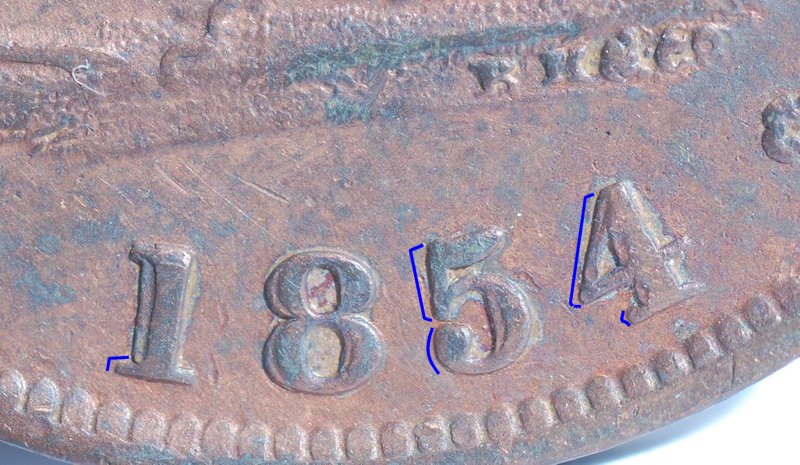
Concerning the question of 're-punched' letters...The following is a cut and paste of my work.
'The St. George Bank of Upper Canada series are typically full weight and professionally minted. Minor axis rotation is rather common and affords virtually no premium. Likewise, hub doubling or shift entry
doubling is also commonly encountered and affords scant premiums. Minor axis rotation and hub doubling are the result of the manufacturing process and do not constitute independent die varieties.'
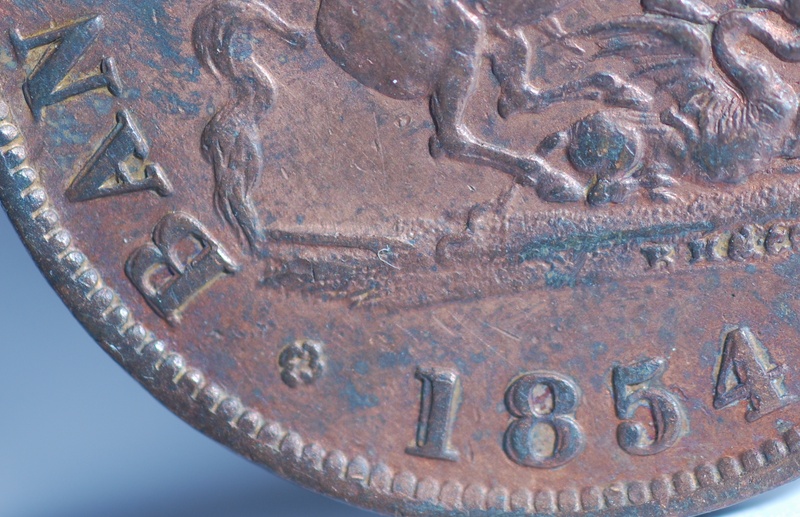
Your token should have a technical grade in the AU range, but considering the quality of the strike, the grade should be expected to decrease. The strike is not clear and sharp but soft and mushy. A strong culprit for this is the dies were not fully seated in the press during the striking. Perhaps the tonnage was not properly set. An improperly seated die is not fully secured. Often, this results in shift-entry doubling.
Additionally, this is a recognized variety and normal strikings of this variety exhibit normal lettering. True doubled / re-punched letters would be consistent with other strikings of the same specific variety. Shift-entry doubling terminates upon the proper seating the die. This is an example of the case in point. Yours is also from an early die-state absent the full compliment of diagnostic die-clashes.
This is Courteau variety 155.
Below is my cut-and paste of Courteau variety 155. Note, the current conversion process does not like my use of italics or indentations. In my original narrative, I document all of Dr. Courteau's sightings / comments in regular type and set-off my remarks and elaborations by the use of italics or different fonts. But this nuisance is lost in the conversion process of the current program. This entry greatly expands upon Dr. Courteau's original 47 word narrative.
'155 R-8
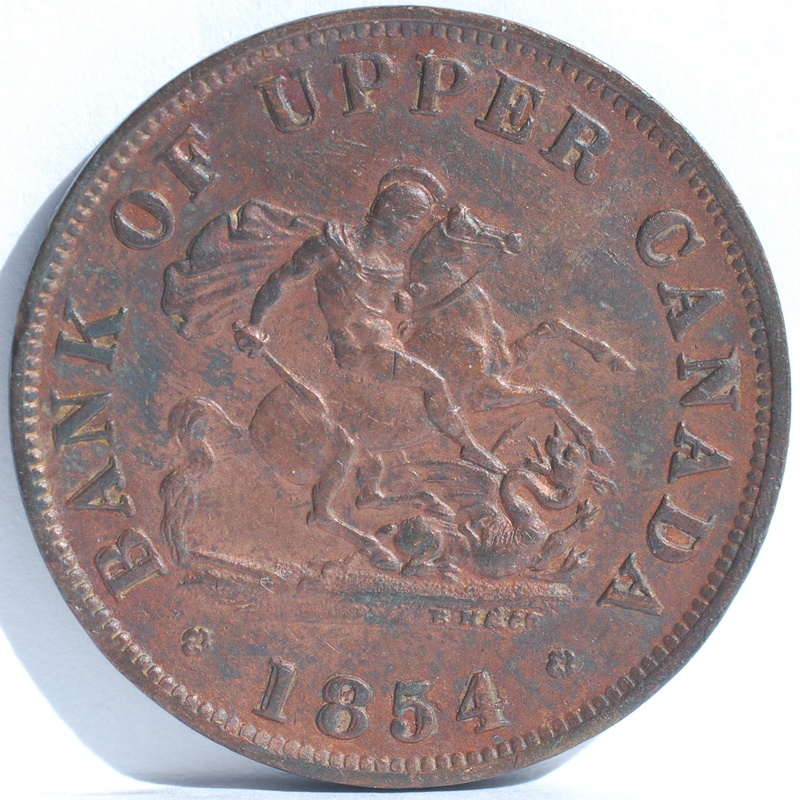
Obverse characteristics: According to Dr. Courteau, the same as variety 154.
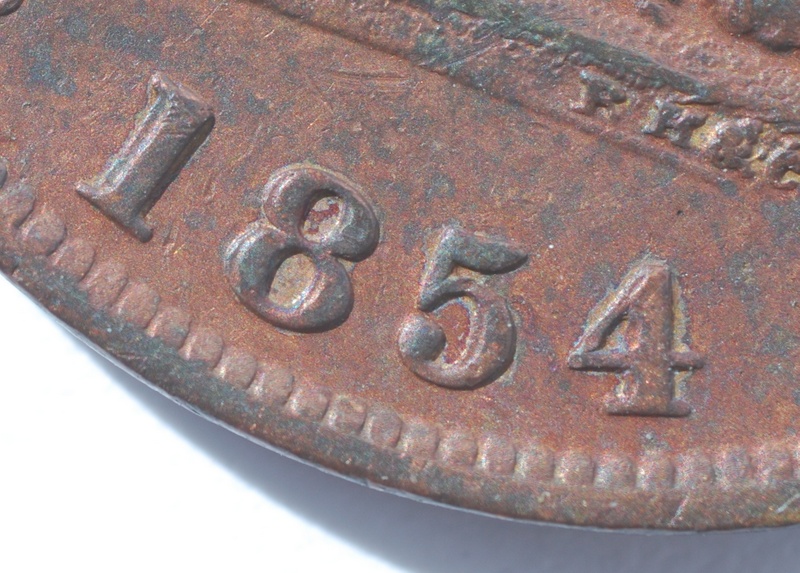
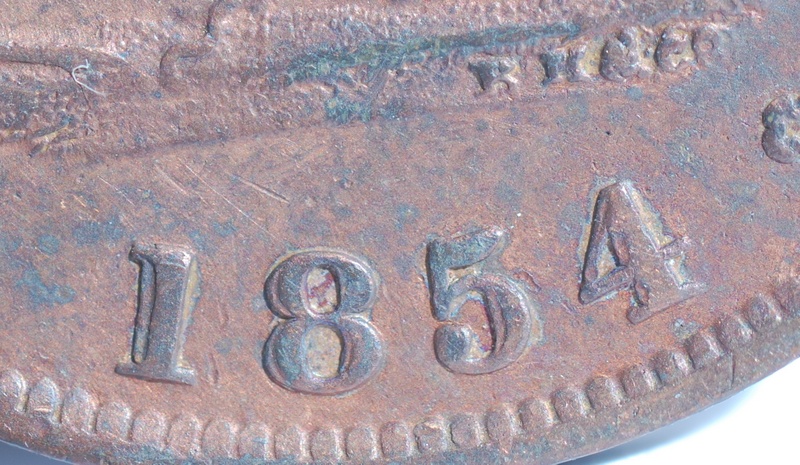
The numeral 4 is away from the numeral 5.
The Stand of the numeral 4 is on-line with the left-side of the 4th Denticle to the immediate right of the numeral 5.
Whereas the same Stand on variety 154 is on-line with the left section of the top of the same Denticle.
An imaginary line along the right-side of the Upright of the numeral 4 is on-line with the left-end of the Stand of the left Upright of the initial H, below the ground.
An imaginary line along the upper-side of the diagonal of the numeral 4 extends to the underside of the upper section of the Leg of the Ampersand, below the ground.
The Man's Foot is complete.
Whereas on variety 154, the same foot is weakly struck.
The outline of the Left Wing of the Dragon is Perfect.
Two strong horizontal lines are below the left Wing of the Dragon.
Whereas no lines shew on variety 154.
A short stubby line is below the Man's right Arm. The terminal of the line forks, having an upper and lower branch.
Whereas no apparent fork is found on variety 154.
The left Bridle Rein is normal.
The Knob to the Dagger-Hilt is nearly round.
The outline of the Belly of the Horse is double-cut.
The left Leg of the Dragon is detached from the Body of the Dragon.
No nub protrudes from the Shin of the Man's right Leg.
Whereas a nub is found on variety 154.
A small Dash is midway betwixt the left tip of the left Hoof of the Horse and the Stand of the left Upright of the N in CANADA.
Some ensamples exhibit Die-Clash Marks behind the Rib Cage of the Man.
Whereas no Clashes are discernable on variety 154.
From perfect dies.
Note - Variety 154 has a Die-Crack to the numeral 8. Doctor Courteau references variety 155 as the same as variety 154. Habitually, Doctor Courteau would reference similar dies as either having different Die-Cracks, or being from the perfect or broken die of the referenced variety. No disclaimer was provided by Dr. Courteau. Dr. Courteaufailed to indicate whether this was from the perfect or broken die. This present ensample is from the perfect die.
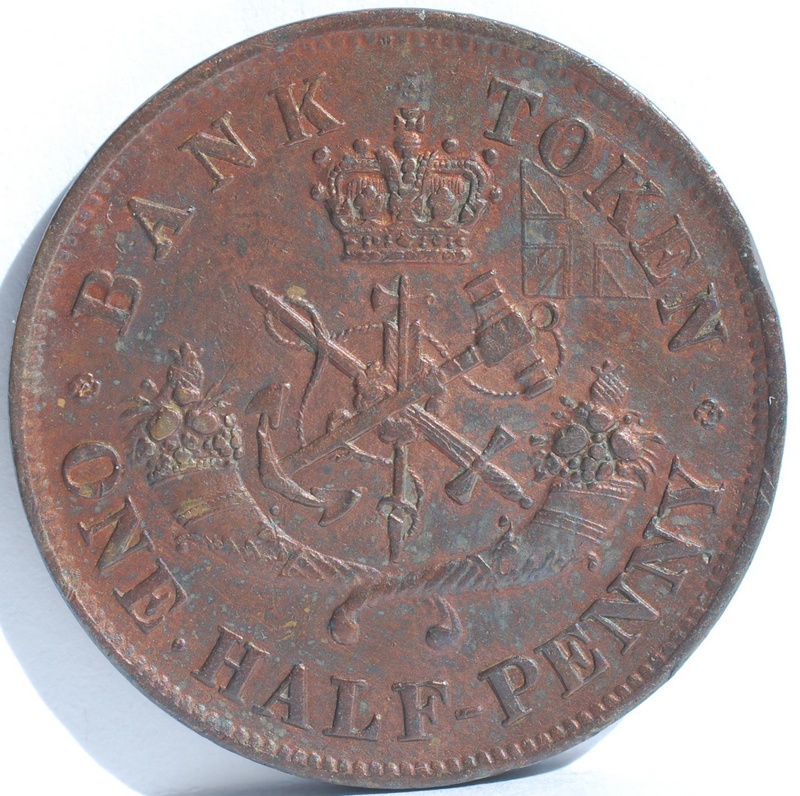
Reverse characteristics: According to Dr. Courteau, the same as 153, but from a stronger strike, and having a small Dot to the right of the upper Rosette.
The same as variety 156.
The Dot within the right Rosette is Arrow-head shaped, of normal size and joined by a Stem to the upper right inner corner. The Dot is very close to the lower right inner corner and distant from the upper left corner. The lower and right Lobes are not joined.
The Stand of the T in TOKEN is Perfect.
The Stand of the N in TOKEN is Perfect.
The entre outline of the Union Jack below TOKEN is complete, but thin.
Whereas, the section of the Union Jack below the Leg of the K in TOKEN and the Upright of the E in the same word is very faint on variety 153. This indicates that variety 154 preceded that of variety 153.
The St. Andrew's Cross frame is broken in the middle.
Whereas, on variety 153, the St. Andrew's Cross frame terminates on-line with the right-side of the Upright of the E in TOKEN.
The hole in the Battle Axe is normal.
The inner ornamental Balls are connected from the Cornucopia.
Whereas, on varieties 153 and 154, the same Balls are not connected.
Four normal sized squiggly Dots are betwixt the Feather and Anchor Shaft.
The Anchor Rope ends with one Dot and a small line (with a dot attached).
Whereas varieties 153 and 14 terminate with one Dot.
The grouping of three Anchor Rope Dots above the right Anchor Fluke are small, with the left smaller, and separated from the Anchor Shaft.
Whereas the same Dots on varieties 153 and 154 appear slightly larger and more distant.
The lower right-side ornamental Dot is present.
The Base of the Shield extends to the outline of the Union Jack, making a corner.
The Anchor Ring is complete.
The 2nd, 3rd, and 4th quadrants are heavy.
A Lump is above the upper part of the Anchor Rope around the Sword.
This is a rather large globular Lump in the field, nearly touching, and slightly to the left of the apex of the upper section of the Anchor Rope Dots above the terminal end of the Sword.
Note - This diagnostic is not readily discernable on lower grade specimens.
A small Dot is to the right of the upper Rosette.
This Dot is on-line horizontally with the bottom of the lower Lobe of the upper Rosette and on-line vertically slightly to the left of the inner right-side Jewel of the Crown.
A bold Dot is in the diagonal of the lower right quadrant of the Shield, on-line with the upright of the E in TOKEN.
From perfect dies.
Thus:
155 Perfect -- No Die-Cracks.
Enjoy
doug
Edited by colonialtokens
10/09/2017 4:17 pm









 Posted 09/29/2017 02:28 am