| Author |
 Replies: 13 / Views: 1,719 Replies: 13 / Views: 1,719 |
|
|
Valued Member
United States
277 Posts |
|
|
|
|
Rest in Peace
10197 Posts |
That's actually a bent over " Rim Fin". This was caused by a slight MAD (misaligned die) NW-SE. The pressure causes a dual rim to form, sometimes stretching the edge up along the collar. Circulation has bent it over. A Cud is actually a portion of the outer edge of the die that has broken off, causing the lacking space to remain un stamped. On the reverse opposite a Cud may show a weakness of strike due to the resultant lack of pressure applied at that area on the opposite die. Not able to use the optimizer and upload to post?, Try tutorials on posting. Edited by Crazyb0
10/24/2017 9:38 pm
|
|
Valued Member
 United States
277 Posts |
Crazy, thanks for the info. All the coins I go through I can't say I have seen another one of those. I do have to Cuds that I came across over the last couple of years and I know what you mean about being weak on the reverse. Here is one of them. https://www.use.com/NZL2D |
|
Rest in Peace
10197 Posts |
|
|
Bedrock of the Community
United States
62064 Posts |
Edited by coop
10/25/2017 12:53 pm
|
|
Pillar of the Community
United States
2775 Posts |
  Sorry, just flagging to follow up later if needed. Thanks, Doug. |
|
Valued Member
United States
277 Posts |
I'm looking at that Cuds on Coins site and it sure looks like I have a Rim Cud like Coop mentioned. |
|
Pillar of the Community
United States
3210 Posts |
Yes, coop is correct, you have a rim Cud. Both coins are nice Cuds.  Edited by Tunnioc
10/25/2017 12:22 pm
|
|
Rest in Peace
United States
17900 Posts |
A nice example of the type. Certainly worth saving.
|
|
Bedrock of the Community
United States
17884 Posts |
Quote:This is a rim Cud. Caused by a breakage of the collar. It is a rim Cud but it is caused by the breakage of the die not the collar. The rim is created by a small downward "step" around the circumference of the die before it drop. on down to form the neck of the die. Since it is a step down it rises UP on the coin to form the inner and top edges of the rim. The collar creates the outside edge. If that step is chipped on broken away it creates a raised area on the TOP surface of the rim, the rim Cud. This increases the thickness of the coin at that point. If the collar was broken the Cud would extend outward on the OUTER edge of the rim increasing the DIAMETER of the coin at that point. Edited by Conder101
10/25/2017 11:58 am
|
|
Bedrock of the Community
United States
62064 Posts |
Thanks for the correction Gary. You are correct. Great description. 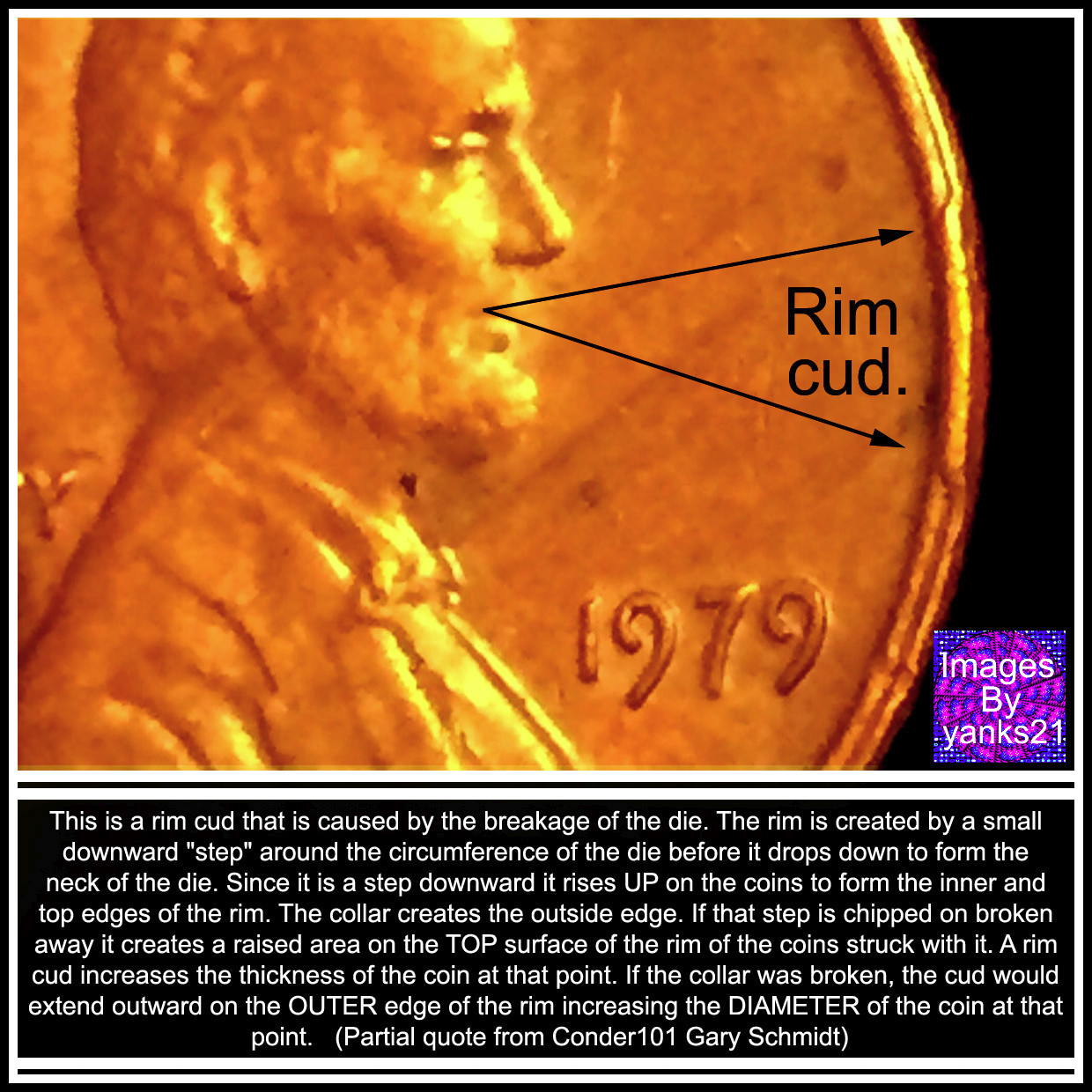  Edited by coop
10/25/2017 1:16 pm
|
|
Valued Member
United States
277 Posts |
Wow, thanks for the information everyone. I can't believe I don't find these errors more often the way the process sounds so intricate. It just seems like these should be more common.
|
|
Pillar of the Community
United States
2775 Posts |
Quote:
Sorry, just flagging to follow up later if needed. Was rushing earlier to meet mom at hospital. Conder101 described what I was thinking. Thanks, Doug. |
|
Bedrock of the Community
United States
17884 Posts |
|
| |
Replies: 13 / Views: 1,719 |
|










 Posted 10/24/2017 9:49 pm


