| Author |
 Replies: 9 / Views: 1,383 Replies: 9 / Views: 1,383 |
|
|
New Member
8 Posts |
Hello folks, I need help understanding what is the layer of a coin, since I started collecting ancient coins just recently. Is this coin without/removed patina or is the real patina under the brown layer? 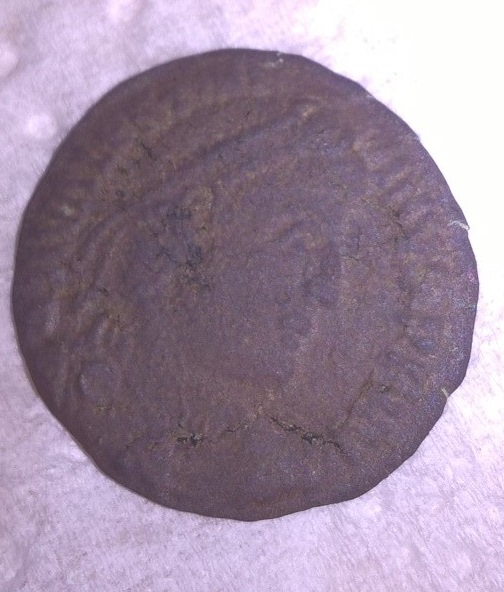 Thanks. |
|
|
|
Moderator
 United States
34549 Posts |
@emiliano, first welcome to CCF. Second, this looks like a bronze coin to me so the brown color on the surface is the patina. You should not treat this coin with chemicals to strip away the patina. Finally, it kinda looks like your coin may have a cracked flan so I would be extra careful with handling it. Consider putting it into a cardboard 2x2 for storage.
"If you climb a good tree, you get a push."
-----Ghanaian proverb
"The danger we all now face is distinguishing between what is authentic and what is performed."
-----King Adz
|
|
Pillar of the Community
United States
6130 Posts |
 Freshly dug coins will have both dirt and patina. Patina is the layer of bronze that has chemically bonded to the soil organics. It could be rough and patchy or glossy and smooth; it depends on the type of soil and whether it was dropped carelessly or hoarded in a sealed vessel. Patina can only be removed by corrosive means- acid or electrolysis, and the results are hideous. Dirt can be gently removed. Loose dirt can simply be brushed off with a toothbrush, while tough, 2,000 year old encrustations may need a 6-12 month bath in a gentle solvent, like distilled water or olive oil. On your coin, I think what you are seeing is mostly patina. You may be able to improve it very slightly with a long olive oil soak, but it probably won't improve much. |
|
New Member
 8 Posts |
Hello Spence and Finn, thank you!
Yes, it's a bronze one.
I've only left this one in distilled water with baking soda for 3 weeks now. Some gentle brushing with a common toothbrush, like you said, has been done.
So far so good.
My idea was to restore this coin as much close as possible to the origins, using a diamond coated pin, but since the brown layer is the patina I am not supposed to do it anymore.
Edited by Emiliano
11/08/2017 3:38 pm
|
|
Moderator
United States
23731 Posts |
to the community Both Spence and Finn has answered your question so I just want to welcome you. |
|
Pillar of the Community
United States
992 Posts |
You've soaked it and cleaned the dirt off, now leave it alone.
The thing about ancient coins, is almost all of them are ugly. Eye appeal is crucial. Now that you are a collector, you can expect to be constantly upgrading and replacing your collection, piece by piece. Take a photo of your coins and keep them on your phone, so you can refer to them when you locate a duplicate with nice eye appeal.
|
|
Rest in Peace
United States
17900 Posts |
Good advice above. There is a lot of learning involved with that subject. Good luck with other coins you might find. |
|
New Member
8 Posts |
Thank you gentlemen, glad to be here.
I already started creating a catalogue with pictures and informations, thanks Paxbrit.
It might be a Centenionalis of Valentinianus I. Only "romanorvm" is readable on the back side.
However, this coin is already inside a brand new cardboard holder.
|
|
Moderator
United States
195559 Posts |
to the Community! |
|
Bedrock of the Community
United States
94367 Posts |
to the CCF! |
| |
Replies: 9 / Views: 1,383 |
|










 Posted 11/08/2017 3:05 pm


