| Author |
 Replies: 15 / Views: 2,497 Replies: 15 / Views: 2,497 |
|
|
Valued Member
United States
51 Posts |
I know that coins that are the same size but have different weights have different compositions of metals, and it's fairly easy to tell for some of them because the information is posted simply online. But there are exceptions such as the 1976 Bicentennial us half-dollar, non currency coins, counterfeits, and other coins that are supposed to be made of one material but due to errors or to save a couple bucks at the mint, have been struck on different metals. I was wondering if anyone might have a weight 2 volume ratio list 4 commonly used metals and coin compositions.
I also did a little bit of research on the karat system for gold, really I'm just looking to collect any data I can on how to tell different Metals apart. I'd really appreciate any information the coin community would be willing to share.
|
|
|
|
Moderator
 United States
56855 Posts |
Left column,coin facts. John1  |
|
Pillar of the Community
7234 Posts |
Quote:
I know that coins that are the same size but have different weights have different compositions of metals, Not true. Some can have been minted on thinner or thicker planchets! |
|
Bedrock of the Community
United States
12477 Posts |
I think for potential counterfeits and unknowns, taking it one coin at a time would be best. There is a barrage of tests that can be performed depending on the coin and suspected content. Posting them here helps, too.   In Memory of Crazyb0 12-26-1951 to 7-27-2020
In Memory of Tootallious 3-31-1964 to 4-15-2020
In Memory of T-BOP 10-12-1949 to 1-19-2024
|
|
Rest in Peace
10197 Posts |
Weight of coin is no guarantee of correct content no matter how you look at it. A standard coin has allowed variances, even an occasional over/under weight planchet stock. Throw in slight weight loss for wear and you have no standard being applicable to any coin. Only true way to test is XRF, but bet you don't carry one around in your hip pocket, neither does anyone else. As already stated, US coin struck on foreign plachet, or how about this, the new Chinese trick, use old worn US coins (as planchet) and the old US presses left after the early 1900's in the Phillipines, you have correct material AND correct stamping pressure, now throw in a Computer assisted cut die and you have the almost prefect fake 1877 Indian Head cent, 1856-58 FE's and 1909S Indians and SVDB Lincolns that are real foolers. So weight don't matter anymore, besides figuring weigh of set plating, and a calculated mix of various weight metals to make a blank... 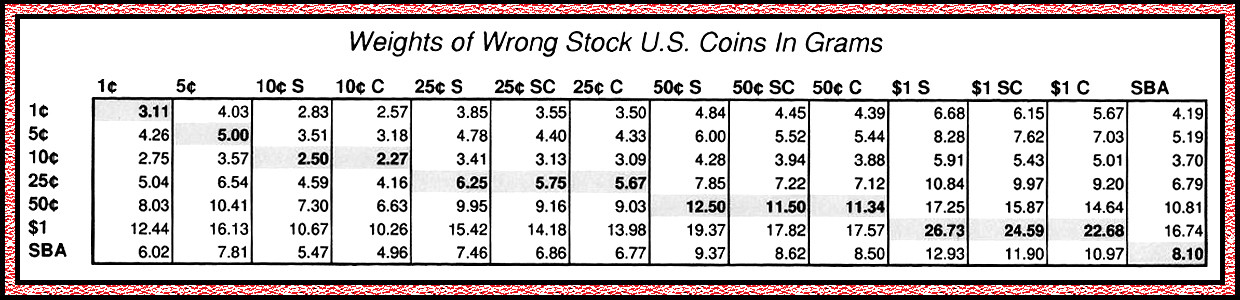 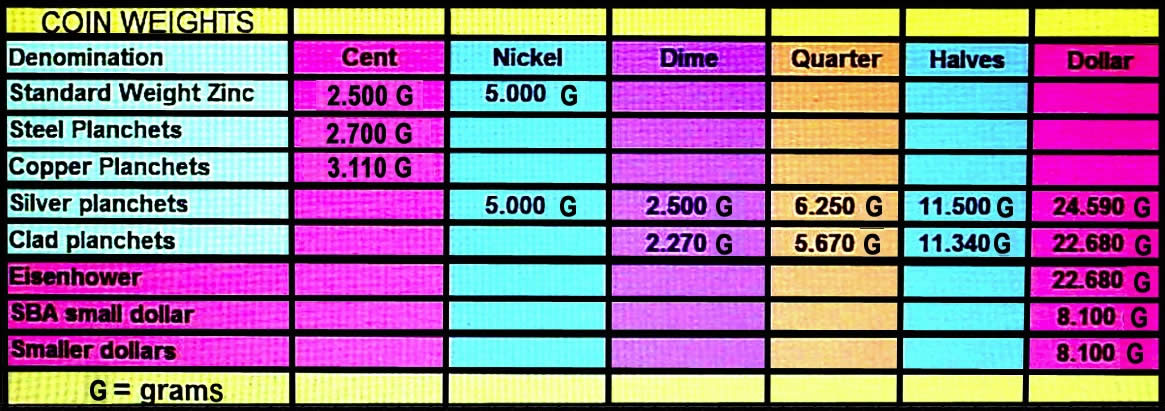 And NO, haven't got a clue how the first chart works...  Edited by Crazyb0
11/17/2017 7:38 pm
|
|
Pillar of the Community
 United States
4616 Posts |
Even then - XRF only tests a small depth into the coin. There are eddy-current testers that claim to differentiate between silver alloys (Sterling vs. 0.900). Specific gravity also works somewhat.
But nothing perfect and non-destructive (melting the coin and assaying the result doesn't really help...)
-----Burton 50+ year / Life / Emeritus ANA member (joined 12/1/1973) Life member: Numismatics International, CONECA Member: TNA, FtWCC, NETCC, EveryCountry (online) coin club Owned by three cats and a wife of 40+ years (joined 1983) Author: 3rd Edition of the Sample Slabs book, https://www.sampleslabs.info/ |
|
Pillar of the Community
Canada
5287 Posts |
You also cannot guarantee the metal content based on how a coin looks.
|
|
Rest in Peace
United States
17900 Posts |
Perhaps if you tell us how you would use such information we can assist you more directly.
|
|
Bedrock of the Community
United States
12477 Posts |
That's a cool chart, Crazyb0. Quote:
And NO, haven't got a clue how the first chart works... The denominations on the left are the struck denomination (correct planchet diameter). The denoms on the top are the stock that it is struck on. So, if you have a cent struck on silver dime stock, it weighs 2.83g. If your cent is struck on clad dime stock, it should weigh 2.57g. I hope that explains it well enough. In Memory of Crazyb0 12-26-1951 to 7-27-2020
In Memory of Tootallious 3-31-1964 to 4-15-2020
In Memory of T-BOP 10-12-1949 to 1-19-2024
|
|
Bedrock of the Community
Australia
21789 Posts |
Destructive chemical analysis, combined with mass spectrometry will provide the best answer.  Not so silly as it sounds. The British Museum Coins and Medals Department have used this technique with ancient gold coins, to provide some sort of baseline for trace elements found with the gold. XRF only useful in analysis of the metal composition in the surface. Density not much use; it is possible to adjust the mix of metals in the alloy to anything you want, within reason. Brinell's test for hardness will damage a coin. A combination of the right relevant tests for a particular suspect coin is will provide most of the answer. For a collector, the best non destructive approach is to do a document search on the metals relative to the coin you are considering. This is a good way to go: Any author of a technical publication or lecture paper will provide an extensive bibliography to back up his findings. Edited by sel_69l
11/17/2017 10:43 pm
|
|
Valued Member
 United States
51 Posts |
Thanks for all the info, I'm really just a hobbyist for research,last year I was in mexico and they denied many of my pesos because they said they are worthless. they printed the new ones to replace the old ones.that sort of started me on how to tell different compositions apart because even if it doesn't have economic use,it's still a metal with value behind it.Thanks for the info and I'll deffinently take note on what I learned but I'm going to keep researching for non destructive ways,maybe jewelry has a couple tricks I could apply to my study.
My ultimate goal is to be knowledgeable enough to take a misc container of recyclable trash,seppereate it,and smelt it down with very few mistakes,I could always research every tv,computer,and lamp I dismantle but If there's a easier way than reading over hundreds of manuals,it could be hiding in a comunity such as this one for coins to one for jewelry to a science textbook,no worries I have no plans on melting any historically relevant pieces like coins.
|
|
Moderator
United States
56855 Posts |
Quote:
I have no plans on melting any historically relevant pieces like coins. Check current laws on melting coins. Some you can and some you can't. John1 |
|
Pillar of the Community
United States
4616 Posts |
-----Burton 50+ year / Life / Emeritus ANA member (joined 12/1/1973) Life member: Numismatics International, CONECA Member: TNA, FtWCC, NETCC, EveryCountry (online) coin club Owned by three cats and a wife of 40+ years (joined 1983) Author: 3rd Edition of the Sample Slabs book, https://www.sampleslabs.info/ |
|
Pillar of the Community
United States
655 Posts |
The chart shows silver dollars at 24.59 g but Morgans weight 26.73 g.
|
|
Bedrock of the Community
United States
17884 Posts |
That 24.59 gram weight is for a silver dollar struck on a 40% silver clad dollar stock. On 90% silver dollar stock the 26.73 gram weight would be correct.
The half dollar weight for silver planchet in the second chart is also for 40% silver clad. 90% would be 12.5 grams.
The silver dime and quarter weights in the second chart are for 90% silver planchets.
Edited by Conder101
11/19/2017 03:11 am
|
|
Bedrock of the Community
United States
12477 Posts |
Ignore the second chart. It's incomplete as far as 90%, 40% and CuNi clad. It gives one weight for Ikes despite there being silver clad and CuNi clad versions. It also makes no mention of the three versions of Kennedy halves, all with different weights. The first chart is correct. For that, S=90% silver, SC=40% silver clad and C=CuNi clad (no silver). In Memory of Crazyb0 12-26-1951 to 7-27-2020
In Memory of Tootallious 3-31-1964 to 4-15-2020
In Memory of T-BOP 10-12-1949 to 1-19-2024
|
| |
Replies: 15 / Views: 2,497 |
|










 Posted 11/17/2017 6:55 pm


