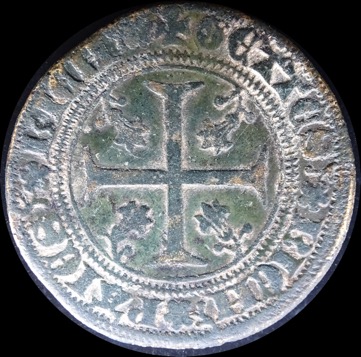
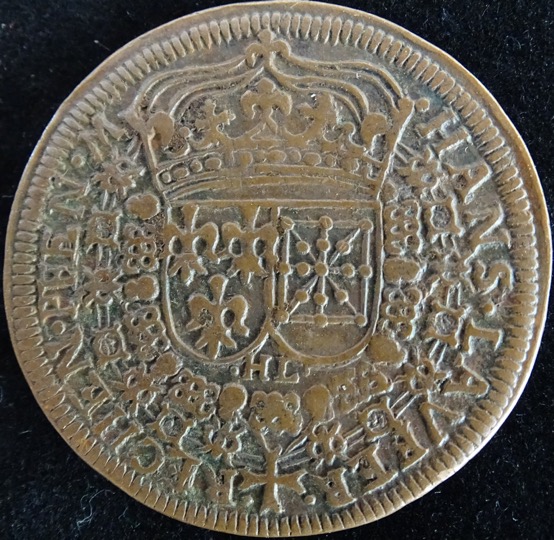
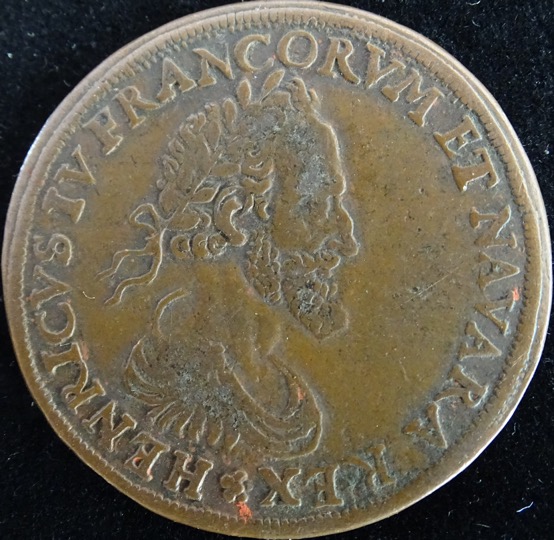
Copper jeton made around 1600 in Nürnberg by Hans Laufer for king Henri IV
OBV coats-of-arms of France (left) and Navarra (right) surrounded by the "collier de l'ordre de St Michel". signed HL. legend: HANS LAUFER RECHEN PFEN M
REV Portrait of the king HENRICUS IV FRANCORUM ET NAVARA REX
Henri IV "the great" (1553-1610) is the founder of the Bourbon dynasty which reigned over France for more than two centuries until the French Revolution. His reign in France started in 1589 after the assissination of his brother-in-law Henry III by a catholic monk. Like in the Netherlands and in other parts of Western Europe, France was immersed for decades in an intense and often violent struggle between the catholic church and the protestant reform (called the Huguenot movement initiated by Calvin in France). For a short introdution of the French Wars of Religion, see
http://www.wikiwand.com/en/French_Wars_of_Religion.
1600 Painting by Toussaint Dubreuil of Henry IV as Hercules, defeating the multi-headed monster (the Catholic League)

Henri IV chose the side of the Huguenot movement and he miraculously escaped from the Saint Bartholomew's Day Massacre in 1572 (one of the most violent events of the French Wars of Religion). As new king of France Henri IV promised the maintenance of the Catholic religion, hoping that this tolerance would end the civil war. In vain, however ! Henri IV was opposed by the Duke of Mayenne who was aided by the military "genius" Alexander Farnese, Duke of Parma, commander of the Spanish Netherlands about whom I have written in previous posts concerning tokens of the Dutch revolt against Spain. Henri IV defeated Mayenne in Normandy in 1589, but he failed to conquer Paris. A loyalist French parliamentwas installed in Tours, while a Spanish garrison settled in Paris. Spain had several claims to France before giving up Paris: a Catholic king, periodicity of States, restoration of provincial liberties, reception of the Council of Trent in France (official embodiment of the counter-reformation
http://www.wikiwand.com/en/Council_of_Trent). A truce was signed between Spain and France in July 1593. Henri IV gained power over France and abjured Protestantism; pope Clement VIII gave absolution to Henry in 1596.
1594, anonymous French engraving of the entrance of Henri IV in Paris, source
http://www.wikiwand.com/en/Henry_IV_of_France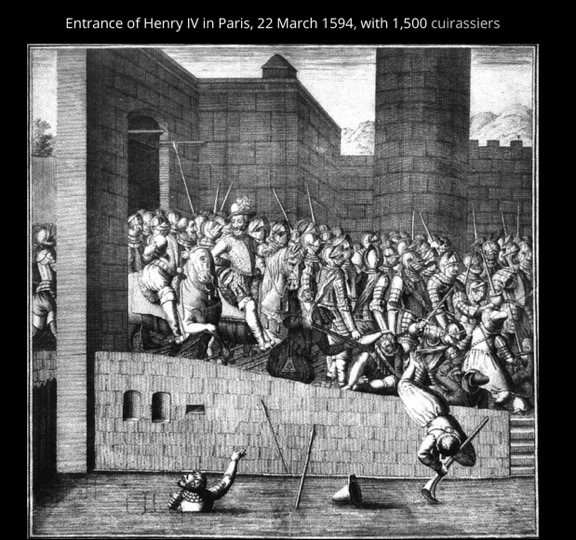
But all this did not end the war between Spain and France. Battles followed in Burgundy, in Brittany. (From a numismatic point of view, the Spanish siege of Cambrai is very interesting with different emissions in silver and copper).
Hostilities ended by treaty of Cateau-Cambresis. Religious peace was made by the edict of Nantes (April, 1598) with freedom of religion in France. Henri skilfully surrounded himself with politicians from the catholic and huguenot sides. In 1600, he married Marie de Medici, who gave him a son (future Louis XIII) in 1601. But peace was not very stable. In 1606 hostilities were resumed, France supporting the United Provinces in the war against Spain.
Henri IV, ally of the Dutch Republic, "<i>Coninck van Vranckryk en Navarre</i>" 1614 engraving by H. Jacobsen
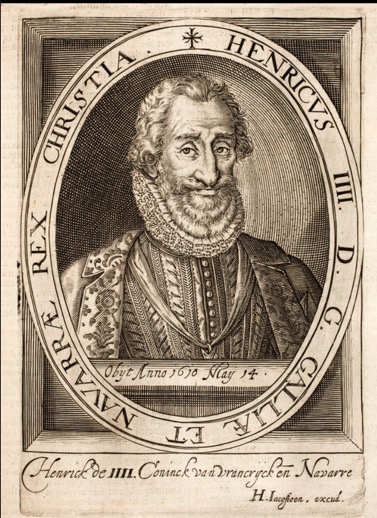
After two unsuccesfull attempts on his life, Henri IV was assassinated in Paris on May 14th, 1610 by François Ravaillac, a catholic fanatic. I posted an engraving of this event before when discussing the jeton of the coronation of Louis XIII in Reims.
http://goccf.com/t/301479&whichpage=53#2751275France was quite small and almost completely surrounded by Spanish territories when Henri IV started his reign in 1589. During the next century, the Bourbon dynasty would chisel off - piece by piece - important Spanish regions (e.g. Burgundy, Spanish Flanders) creating present day France. We discussed before.
http://goccf.com/t/301479&whichpage=56#2763327) "what if" in the history of the world if the two countries would have been united into one.







 First Page
 Previous Page


 Posted 07/23/2018 10:47 pm