Two new additions. Bronze, silver dollar sized, proof-like finish medals of a couple of very different famous people.
General George S. Patton ( I will improve on these images in the near future )
Patton deliberately cultivated a flashy, distinctive image in the belief that this would inspire his troops. He carried an ivory-gripped, engraved, silver-plated Colt Single Action Army .45 caliber revolver on his right hip, and frequently wore an ivory-gripped Smith & Wesson Model 27 .357 Magnum on his left hip.
Two guns originally owned by General George Patton are displayed against a cartridge belt. The upper is a Colt single action .45 caliber deluxe army revolver with silver plating and an ivory stock, purchased in 1916. The lower is a Smith and Wesson .357 Magnum revolver, purchased in 1935.

He was usually seen wearing a highly polished helmet, riding pants, and high cavalry boots.
Likewise, Patton cultivated a stern expression he called his "war face".
He was known to oversee training maneuvers from atop a tank painted red, white and blue. His jeep bore oversized rank placards on the front and back, as well as a klaxon horn which would loudly announce his approach from afar. He proposed a new uniform for the emerging Tank Corps, featuring polished buttons, a gold helmet, and thick, dark padded suits; the proposal was derided in the media as "the Green Hornet", and it was rejected by the Army.
The historian Alan Axelrod wrote that "for Patton, leadership was never simply about making plans and giving orders, it was about transforming oneself into a symbol".
Patton intentionally expressed a conspicuous desire for glory, atypical of the officer corps of the day which emphasized blending in with troops on the battlefield. He was an admirer of Admiral Horatio Nelson for his actions in leading the Battle of Trafalgar in a full dress uniform.
Patton had a preoccupation with bravery, wearing his rank insignia conspicuously in combat, and at one point during World War II, he rode atop a tank into a German-controlled village seeking to inspire courage in his men.
Patton was a staunch fatalist, and he believed in reincarnation. He believed that he might have been a military leader killed in action in Napoleon's army in a previous life, or a Roman legionary.
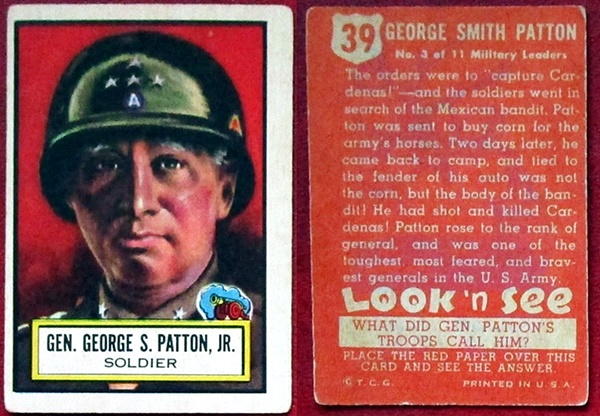
I also have this 1954 Topps Look"n"See non sport trading card of "Old Blood and Guts"
On Dec 9 1945, in the northeast suburbs of Mannheim, an oncoming two-and-a-half-ton U.S. Army truck swung across the path of Patton's Cadillac in an attempt to turn into a Quartermaster depot. Woodring, his driver, was unable to stop in time, and the two vehicles collided at a 90-degree angle, with the right front bumper of the truck smashing the radiator and bumper of the Cadillac.
Neither driver was injured, and Gay, a passenger, received only slight bruises. Patton, on the other hand, although conscious, was bleeding profusely from head wounds received when he was thrown forward against the steel frame of the glass partition separating the front and rear seats and then backward again into his seat. There were, of course, no seat belts in those days, and whereas Gay and Woodring, having seen the oncoming truck, had braced themselves for the impact, Patton, who had been looking out the side window, had not.
He knew he was seriously injured and apparently murmured, "I think I'm paralyzed," and later, "This is a heckuva way to die."
George Patton did rebound somewhat while in the hospital but a pulmonary embolism had obstructed his upper right lung and he died peacefully on December 21, 1945.
There were and still are suspicions of murder, a poisoning while Patton was hospitalized by the Soviets.
Saint Francis of Assisi
The anonymous text that is usually called the Prayer of Saint Francis "Make Me an Instrument of Your Peace" is a widely known Christian prayer for peace. Often associated with the Italian Saint Francis of Assisi (c.#8201;1182 - 1226), but to my surprise, is entirely absent from his writings. The prayer in its present form has not been traced back further than 1912.
St Francis of Assisi made a decision to turn away from a luxurious life as a young rebelious man after being imprisoned for a year under horrible conditions and became the most devoted and humble religious figure he is famous for. He referred to all people and things of creation as either "Brother" or "Sister"
I have another medal that is similar showing St Anthony of Padua preaching to the fishes.
Saint Francis of Assisi also preached to animals. He is the patron saint of animals.
I watched a rather interesting 1950 subtitled Italian movie recently, titled "The Flowers of St. Francis" from start to fini.








 First Page
 Previous Page




 Posted 08/27/2018 09:56 am