| Author |
 Replies: 12 / Views: 3,003 Replies: 12 / Views: 3,003 |
|
|
Valued Member
Russian Federation
417 Posts |
I spoted some time ago that all large cents and Half Cents have a rising dot in the center of the reverse, till braided hair type. Someone's random photo for example, but I'm sure you all know what dot I mean. What is the real reason for this dot to exist? I didnt find anything about it, but I think its somehow have linking to the minting feature. Also, I never see this center dot on any other coins. 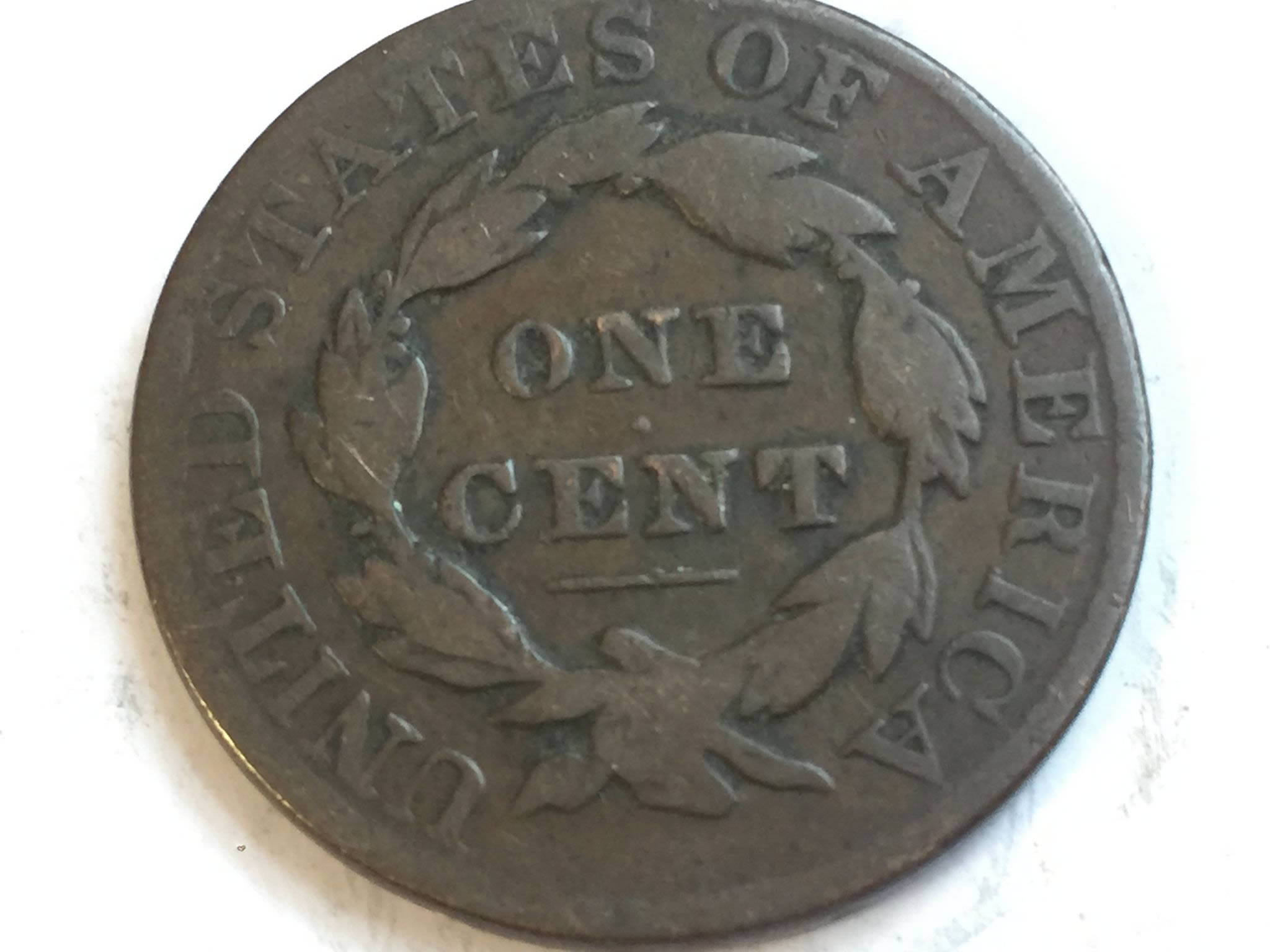 *** Moved by Staff to a more appropriate forum. *** *** Moved by Staff to a more appropriate forum. ***Edited by flying_teapot
12/10/2017 07:29 am
|
|
|
|
Valued Member
 Russian Federation
417 Posts |
Sorry, missed the forum category, please move it to US Classic and Colonial Coins
|
|
Pillar of the Community
United States
1261 Posts |
They are alignment dots and mint made. A long time dealer explained to me that it was the result of the engravers compass point when starting to work on the coin die. By the way, they are seen most prominently on the reverse of Half Cents and Large Cents but they were not just limited by those two series or just on that side of the coin. They can sometimes be seen on other coins from the era as well and sometimes are hidden in the design details of the hair on the obverse and shield or eagle feathers on the reverse. It's fun to find them every once in a while. |
|
Rest in Peace
United States
17900 Posts |
 . Chester nailed it. |
|
Valued Member
Russian Federation
417 Posts |
Liked this version, imagine I was a die cutter and its sound real. Thanks Chester. If anyone have photos of other US coins (except Half Cents and large cents) with same dots post it here please. |
|
Moderator
 United States
23522 Posts |
They are also found on Bust Halves, although I don't have one handy to post.
|
|
Bedrock of the Community
United States
11963 Posts |
According to the US Coin Digest: Center dot: A raised dot at the center of a coin caused by use of a compass to aid the engraver in the circular positioning of die devices, such as stars, letters, and dates. Center dots are prevalent on early U.S. coinage.While not center dots: Some Morgan dollars of 1884 have either a large dot (VAM-3) or a small dot (VAM-4) after Morgan's initial M on Miss Liberty's neck truncation on the obverse, and a similar dot after his initial M on the left side of the wreath bow on the reverse. This variation was first called to the attention of collectors by Francis X. Klaes in the Numismatic Scrapbook Magazine, May 1962.
In the second edition of The Comprehensive Catalog and Encyclopedia of Morgan & Peace Silver Dollars, Leroy Van Allen and A. George Mallis note the following:
Some of the silver dollars from the Philadelphia Mint in 1884 had small dots placed alongside the designer's initial M on both the obverse and reverse. In past years, small dots had been placed on coins to indicate a change of design; this was probably also the case for the 1884 silver dollar.(The author of the present text (Q.D.B.) is not aware of dots being placed on any United States coins to indicate a change of design. Some of the latest half dollar reverses of 1795 have a dot in the field below the ribbon knot; this is believed to be a privy mark of John Smith Gardner, but whatever it is, it does not signal a design change. Among Canadian coins, some 1936 cents, 10-cent pieces, and quarters had tiny dots added to indicate that issues depicting King George V on the obverse had been struck after that monarch's death, before new dies showing the intended next king, Edward VIII, were ready.) In that year the size of the date and the width of the numbers were reduced. Apparently, the dots were to distinguish the new dies with reduced date size during the transition early in 1884, in order to prevent a mix-up of the working hubs. After the transition, the raised dot on the working hub was easily ground off.
Two different sized dots have been found on the obverse. Their positions next to the initial M are also slightly different. Detection of the dot on the reverse requires a strong magnifying glass, and only one size has been found so far. The authors have seen the obverse and reverse dot die used only together-never separately. On worn coins, the reverse dot is very difficult to see.
In my opinion, here is one of the most intriguing mysteries among Morgan dollars. Undoubtedly there is an explanation for its origin, and exactly what it is may remain to be discovered.
In the years since the announcement of its discovery in 1962, the variety has received very little publicity and is largely unknown to the collecting fraternity, apart from owners of the VAM book. Perhaps the Dot variety is deserving of more attention. I suggest that with some looking, you can find one for the price of a regular coin.
A challenge!: Concerning the "dot subject," Jeff Oxman, of the Society of Silver Dollar Collectors, stated this:(Letter to the author, November 29, 1992.)
Interested in a mystery? Here it is. The two 1884 "dot" varieties, VAM-3 and 4, pose an intriguing question for variety specialists. Why were dots placed on these particular dies and no others in the Morgan dollar series? This act on the part of the engraver was obviously deliberate, because on both die pairs the dots were placed in the same locations, not only next to the designer's initial M on the obverse, but also next to his initial on the reverse ribbon bow.
Marking these dies, and possibly others, for some purpose would appear to have been the intention. But, if other dies of the same year were similarly marked, the dots were ground off the dies prior to being used in the presses. Make a name for yourself among variety collectors by coming up with the solution! IN NECESSARIIS UNITAS - IN DUBIIS LIBERTAS - IN OMNIBUS CARITAS THE MAN IN THE ARENA, Theodore Roosevelt at the Sorbonne Paris on April 23, 1910: " It is not the critic who counts; not the man who points out how the strong man stumbles or where the doer of deeds could have done better. The credit belongs to the man who is actually in the arena, whose face is marred by dust and sweat and blood, who strives valiantly, who errs and comes up short again and again, because there is no effort without error or shortcoming, but who knows the great enthusiasms, the great devotions, who spends himself in a worthy cause; who, at the best, knows, in the end, the triumph of high achievement, and who, at the worst, if he fails, at least he fails while daring greatly, so that his place shall never be with those cold and timid souls who knew neither victory nor defeat." My coin website: https://fairfaxcoins.com |
|
Bedrock of the Community
United States
94367 Posts |
ns - Great background, thanks. ammcollect -  to the CCF! |
|
Pillar of the Community
United States
940 Posts |
Here is what I believe is a center dot in the horizontal shield lines on the reverse of an 1822 Bust Half:  |
|
Pillar of the Community
United States
1347 Posts |
Well I learned something new today.
|
|
Rest in Peace
10197 Posts |
Yea, my one thing new, them another thing new, then another....
|
|
Bedrock of the Community
United States
17884 Posts |
Yes that is a center dot on the 1822 bust half.
|
|
Moderator
United States
194606 Posts |
Quote:
Well I learned something new today. So did I.  |
| |
Replies: 12 / Views: 3,003 |
|










 Posted 12/10/2017 09:00 am


