| Author |
 Replies: 38 / Views: 10,384 Replies: 38 / Views: 10,384 |
|
|
|
Pillar of the Community
United States
1101 Posts |
Thanks Doug! I really appreciate all of your hard work on these tokens!
It looks like this one might be scarce (R-7).
Sorry I didn't do a separate thread. I will next time. I thought it might be easier to compare the reverse die cracks of Don's token and mine if they were on the same thread.
|
|
Pillar of the Community
United States
840 Posts |
It is, and I noted in the heading that I find it scarcer than the rarity factor indicates.
doug
|
|
Pillar of the Community
Canada
2786 Posts |
nice '54 Phil
I have several 54 1/2s showing similar die cracks in various states of progression. I'll will have to go back now and check for the die clashes.
|
|
Pillar of the Community
United States
840 Posts |
Fourmack
Gladly.
Here is your request of my expansion of Dr. Courteau variety 126.
126 R-1
Obverse characteristics:
The numeral 4 is distant from the numeral 5.
The left end of the Stand of the numeral 4 in the date is on-line with the left-side of the 4th Denticle to the immediate right of the numeral 5.
The right-side of the Stand is nearer the Denticles.
An imaginary line along the right-side of the Upright of the numeral 4 extends to the mid-section of the Stand of the right Upright of the initial H, below the ground.
An imaginary line along the upper-side of the diagonal of the numeral 4 extends to the vertex of the Base and Leg of the Ampersand, below the ground.
The Man's left Foot is Perfect.
The upper outline of the left Wing of the Dragon shews well.
Two lines are below the left Wing of the Dragon.
One line is below the Man's right Arm.
The left Bridle Rein is very weakly struck, and joins to the underside of the mid-section of the right Bridle Rein.
The outline of the Belly of the Horse is double-cut.
The Knob to the Dagger-hilt is nearly round.
The upper side of the Thigh of the Man's right Leg is double-cut.
The left Leg of the Dragon is weakly attached to the Body of the Dragon.
From perfect and broken dies.
A Die-Crack is to the left ground.
This faint Die-Crack is from the centre of the Denticle betwixt the B in BANK and the left Rosette, extending to the tip of the left ground.
Latter die states have the Die-Crack heavier, and continuing a short distance through the ground, bending 90°, and extending to the tip of the Tail of the Horse.
A Die-Crack is to the ANK in BANK.
This Die-Crack is from the right corner of the Denticle to the immediate right of the B in BANK, extending through the upper section of the A in the same word, through the mid-section of the left Upright of the N in the same word, exiting the bottom of the right Upright of the same letter, and exiting to the stand of the K in the same word. Prior to reaching the K, the Die-Crack forks. The upper branch has been described (to the K); the lower branch extends to the lower corner of the 4th Mantle Fold.
Latter die states have the Die-Crack continuing along the inner edge of the Mantle, exiting the corner of the 2nd Mantle Fold, and extending into the field toward the UP in UPPER.
A Die-Crack from the vicinity is seen entering the left-section of the top of the Crest of the Man's Helmet, exiting the front of the same Crest, and exiting to the Ear of the Horse. At present, the author is unsure whether the Die-Crack to the Man's Head is the terminal end of the Die-Crack to the ANK in BANK, or an independent Die-Crack. Until further research proves otherwise, the author opted to record this under the Die-Crack to the ANK in BANK.
Note - This Die-Crack was not mentioned by Doctor Courteau.
A Die-Crack is to the Man's Helmet.
This Die-Crack is from the left-section of the Stand of the 1st P in UPPER, extending to the apex of the Crest of the Man's Helmet.
Note - This data is from a terminal die state. The author is confident additional data is evident, but the specimen in mention is entombed
within an ICCS MS- 60 holder, and currently the author does not desire to remove the specimen from the holder for a closer inspection.
A Die-Crack is to the Ankles of the Horse.
This long Die-Crack is from betwixt the Denticles betwixt the R in UPPER and the C in CANADA, extending to the upper section of the Ankle of the left Fore-leg of the Horse, exiting the rear of the Hoof of the same Foreleg, and exiting to the Ankle of the right Foreleg of the same Horse. This Die-Crack passes very close to the same C.
Note - This Die-Crack was not mentioned by Doctor Courteau.
A Die-Crack is to the 3rd A in CANADA.
This Die-Crack is from the centre of the Denticle above the left Leg of the 3rd A in CANADA, extending to the upper left corner of the same letter.
Terminal die states have the Die-Crack exiting the mid-section of the Stand of the left Leg of the same letter, and exiting through the tips of the Claws of the Dragon.
Note - This Die-Crack was not mentioned by Doctor Courteau.
Reverse characteristics: According to Doctor Courteau, the same as variety 124, which is the same as variety 122, but having a small defect below the Anchor Ring (to the right), and having several Die-Cracks. The same as variety 127.
The Stand of the T in TOKEN is weak.
The Stand of the N in TOKEN is weak.
The outline of the Union Jack below the K and E in TOKEN is very weak / missing.
#9758; According to Doctor Courteau the reverse of variety 126 is the same as that of variety 124, which is the same as variety 122, of which the outline of the Union Jack is ends in a small fork.
The author finds insufficient evidence to support this claim. The section of the outline of the Union Jack from the Leg of the K in TOKEN to the base of the Shield is so weakly struck that one could easily say, is missing. Even when using considerable imagination on mint grade specimens, no remnant of a small fork is evident. On lower grade specimens no outline shews.
The St. Andrew's Cross frame below the E in TOKEN is widely broken in the middle.
The right-side of the Stand of the Upright of the K in BANK is weakly struck.
The right-side of the Stand of the Leg of the K in BANK is weakly struck.
The right-side of the Stand of the Leg if the K in TOKEN is weakly struck.
The right-side of the Serif of the right Arm of the Y in PENNY is not fully struck.
The hole in the Battle Axe appears as a large impression.
The left inner ornamental Balls is disconnected from the Cornucopia.
Two small central Dots comprise the Anchor Rope Dots betwixt the Feather and Anchor Shaft. Remnants of the 1st and 4th Dots are barely detectable. The Dots are extremely weakly struck, irregular, and tiny.
The Anchor Rope ends with one Dot and a thin line. A small Dot is attached to the underside of the line.
The Anchor Ring is complete.
The 2nd and 3rd quadrants are much heavier than the 1st and 3rd. The 1st and 3rd quadrants are extremely weakly struck.
A small Dot betwixt the K in BANK and the upper Rosette.
This is a faint Dot in the field on-line with the upper corner of the left Lobe of the upper Rosette. The Dot is a trifle closer to the Rosette than to the K. This Dot is situated on-line betwixt the 2nd and 3rd Denticles to the immediate left of the upper Rosette.
Note - This Dot may not be readily discernable on lower grade specimens.
A small defect occurs below the Anchor Ring to the right.
The author had great difficulty endeavouring to ferret out what Doctor Courteau meant by this statement. The author studied specimen after specimen searching about the field for any uniform resemblance of a mark or minuscule Dot of some sort, all to no avail.
Then one day.... A large buttress like extension about the shoulder of the right-side Arm of the Anchor was noticed. This buttress wraps around the right shoulder of the top of the Anchor, extending nearly to the 'eye' atop the Anchor.
Much less confusing would have been ---- A large buttress-like mass is at the shoulder of the right-side Arm of the Anchor.
Die-Clash marks are to the right of the Blade of the Battle-Axe head.
Being struck from 'upset dies' or a coinage die-axis, the mimicked image is shewn in reverse. Vertical markings are to the left of the Blade of the Battle Axe Head. Other markings are evident betwixt the upper right Anchor Arm and the Hilt of the Sword.
From broken dies.
A Die-Crack is to the right Cornucopia and the end of the left Cornucopia.
This long faint Die-Crack is from the left-section of the Denticle above the centre of the E in TOKEN, extending to the left-end of the Serif of the left Upright of the N in the same word, exiting the lower section of the right-side of the right Upright of the same letter, extending through the Grass Blades and leaves of the right-side of the right Cornucopia, continuing along the inside of the same Cornucopia, and exiting into the field, on-line with the upper diagonal of the basket weave, and immediately forking.
The upper branch continues through the lower section of the Handle of the left Cornucopia, and extends into the field toward the Knob of the Handle of the right Cornucopia. The lower branch extends diagonally downward, exiting to the right-side of the Denticle below the Upright of the F in HALF.
Early die states only shew the section of the Die-Crack betwixt the lower side of the right Cornucopia and the Handle of the left Cornucopia.
A Die-Crack is to the ON in ONE.
This diagonal Die-Crack is from the lower right-side of the O in ONE, extending through the Stand of the N in the same word, and through the Denticle below the left-side of the Upright of the E in the same word, and exiting to the base of the Denticle below the right-side of the same Upright.
Note - This Die-Crack was not mentioned by Doctor Courteau.
A Die-Crack is to the B in BANK.
This Die-Crack is diagonally across the Denticle below the left-side of the left Rosette, extending to the Serif of the B in BANK, exiting the mid-section of the
curve of the upper loop of the same letter, and extending through the Stands of the ANK of the same word.
Note - This Die-Crack was not mentioned by Doctor Courteau.
A Die-Crack is to the NK in BANK.
This Die-Crack is from the right-side of the Denticle above the right-side of the A in BANK, extending through the Serifs of the N and K in the same word, and
exiting to the left-section of the 2nd Denticle to the immediate right of the same K.
Note - This Die-Crack was not mentioned by Doctor Courteau.
A Die-Crack is to the ALF in HALF.
This forked Die-Crack is from the left-section of the Denticle betwixt the L and F in HALF, extending upwards. On-line with the Stand of the same letters, the Die-Crack forks perpendicularity; the right branch extends to the Stand of the same F; the left branch extends through the stands of the A and L of the same word.
Note - This Die-Crack was not mentioned by Doctor Courteau.
Thus:
126 A Die-Crack is to the right Cornucopia and the end of the left Cornucopia.
Die-Crack as above, plus a Die-Crack is to the ON in ONE.
126A Die-Cracks as above, plus a Die-Crack is to the NK in BANK (reverse).
126B Die-Cracks as above, plus a Die-Crack is betwixt the B in BANK (reverse) and the left Rosette.
Die-Cracks as above, plus a Die-Crack is to the left ground.
Die-Cracks as above, plus a Die-Crack is to the N in BANK Reverse).
Die-Cracks as above, plus a Die-Crack is to the 3rd A in CANADA.
Die-Cracks as above, plus a Die-Crack is to the B in BANK (reverse).
Die-Cracks as above, plus a Die-Crack is to the ALF in HALF.
126C Die-Cracks as above, plus a Die-Crack is to the 1st P in UPPER.
Die-Cracks as above, plus a Die-Crack is to the Ankles of the Horse.
126D Die-Cracks as above, plus a Die-Crack is to the Helmet.
Note - Some Die-Cracks were not mentioned by Doctor Courteau.
This is the Die-Crack progression.
Enjoy
doug
Edited by colonialtokens
12/23/2017 5:21 pm
|
|
Pillar of the Community
United States
840 Posts |
Concerning the placement of the numeral 4.
An astute collector/researcher recently emailed me asking further clarification.
In my above responses to this thread, I should have explained myself better.
I opted to answer through the forum as other readers may have the same unanswered question.
Dr. Courteau works were published nearly a hundred years ago (pre computer and primitive optics), thus this data was not readily available to him.
In my detailed study, I discovered other methods to compliment Dr. Courteau's work. In this case, a comparision of the placement of the numeral 4.
I would do a line drawing to describe what I am trying to say, but my computer knowledge is very primitive. Another words, I do not know how.
Enlarge the photo on the monitor by depressing the 'control' key and use the scroll roller (up and down) of the mouse to enlarge the photo and use a straight-edge (usually a folded piece of paper or 5 X 7 note card). Use something soft as not to damage or scratch the monitor.
Concerning the numeral 4, align the straight-edge along the right-side of the Upright of the numeral 4 and determine where the line meets the letter H in the abbreviation (in the lower right-section of the ground). (In many cases, to be soon revealed, many variants can be noted.)
Next, align the straight-edge along the upper-side of the Diagonal and determine where the imaginary line joins to the Ampersand.
For consistency, I had to define and label certain elements.
The numeral 4 contains a Stand (base), cross-bar, Diagonal, and an Upright.
The letter H in the abbreviation in the lower right section of the ground has two Uprights (left and right), a cross-bar, two Stands (bases) and two Serifs.
Yes, some may say Stands are Serifs, but for uniformity and clarity, I use the term Serif to refer only to the upper Serifs as to distinguish these from the Stands. Stands and Serifs have a left and right end.
The letter H consist of two Uprights (left and right), a cross-bar, two Stands and two Serifs. Each Stand and Serif has a left and right end.
Concerning the Ampersand, I identify the Base (lower circular section), the Vertex (where the Base joins the Leg), and the Leg.
Below is a cut and paste of my shortcut.
An imaginary line along the right-side of the upright of the numeral 4 is on-line with:
The left Upright of the initial H. 111, 116, 118, 132, 133, 134, 135, 136, 145-2, 149.
Betwixt the Uprights of the initial H. 114, 129, 131, 139, 144, 144-1, 150, 152-1.
The left-section of the Stand of the right Upright of the initial H. 112, 132, 147, 148, 154, 156, 157.
The mid-section of the right Upright of the initial H. 113, 117, 119, 123, 126, 129-1, 137, 138, 140, 141, 141-1, 143, 145, 145-1, 146, 151, 152, 153, 158, 158-1.
The right-section of the right Upright of the initial H. 119-1, 120, 121, 122, 130.
Betwixt the initial H and the Ampersand. 124, 125, 127, 128, 130-1, 142.
An imaginary line along the upper-side of the diagonal of the numeral 4 is on-line with:
Betwixt the initial H and the Ampersand. 114.
The left-section of the Base of the Ampersand. 111, 133, 134, 135, 136.
The nadir of the Base of the Ampersand. 112, 116, 118, 129, 131, 132, 139, 147, 148, 149, 152-1.
The vertex of the Base and Leg of the Ampersand. 126, 144, 144-1, 150, 151.
The underside of the upper section of the Leg of the Ampersand 113, 119, 119-1 121, 129-1, 152, 154, 158-1.
The underside of the mid-section of the Leg of the Ampersand. 117, 122, 123, 128, 130-1, 138, 140, 141, 141-1, 145, 145-1, 153, 156, 157.
The nadir of the Leg of the Ampersand. 120, 130, 137, 143, 145-2, 146, 158.
The vertex of the Leg and Tail of the Ampersand. 142.
Terminal end of the Leg of the Ampersand. 124, 125, 127.
FYI
The left-end of the Stand of the Numeral 4 in on-line with the Denticle:
Left-side: All, save those listed below.
Centre 122, 124, 128, 137, 149, 152.
Betwixt 117, 118, 120, 127, 132, 142, 143, 148, 151, 153.
Right-side 113, 125, 129, 139.
4 Canted right: 119-1, 124, 125, 128.
4 Canted left: 118, 145-2, 149.
Absent good optics, magnification, and computers, such diagnostics would remain veiled.
Incidently, I have done similar diagnostic studies of the entire St. George series.
Note- This is not a definitive tool; one still has to compare and confirm the token with the other design elements identified by Dr. Courteau's narritive.
This is merely an excellent tool to assist in quickly eliminating many obvious variants, thus narrowing the search.
Trust this helps.
doug
Edited by colonialtokens
12/23/2017 7:36 pm
|
|
Pillar of the Community
 New Zealand
1679 Posts |
If I am correct this is what the lines look like 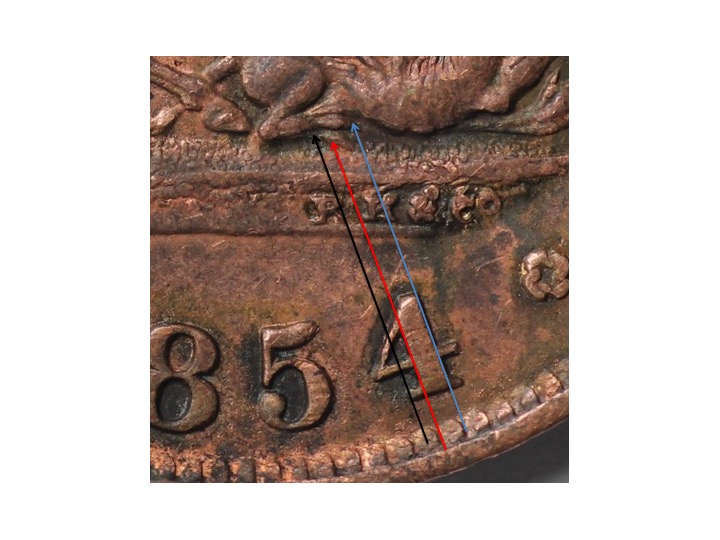 Cheers Don
Vickies cents and GB Farthings nut.
"Old" is a figure of speech and nothing more
|
|
Pillar of the Community
United States
840 Posts |
Fourmack
The blue line is correct.
The other line should run across the upper-side of the diagonal (slope, hypotenuse)of the 4.
This should transverse some aspect of the Ampersand.
This process of triangularization oftentimes differentiates differences between similar varieties.
Also, on some worn ensamples this technique is not suitable as wear may have worn the detail (made it wider) thus resulting in a false finding. But it is still a helpful tool.
doug
Edited by colonialtokens
12/23/2017 9:54 pm
|
|
Pillar of the Community
New Zealand
1679 Posts |
Like this 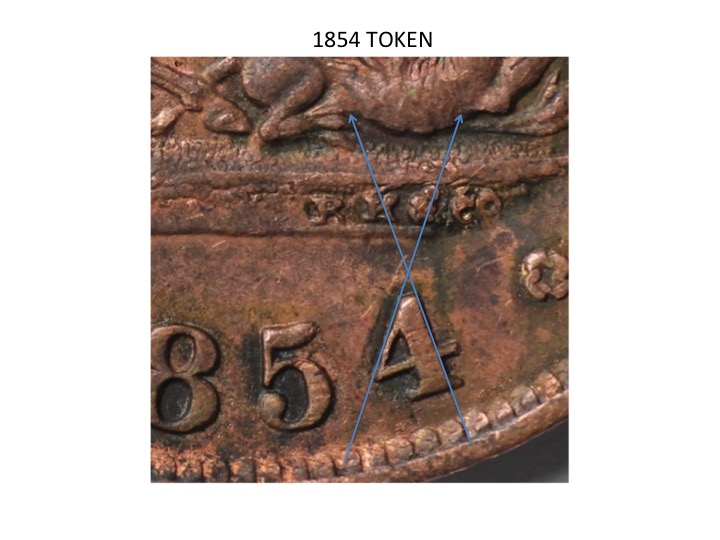 Cheers Don
Vickies cents and GB Farthings nut.
"Old" is a figure of speech and nothing more
|
|
Pillar of the Community
United States
840 Posts |
Bingo.
As you compare different varieties, you will find this and similar alignment procedure most valuable.
You make it look easy.
Soon you will learn all my secrets.
doug
Edited by colonialtokens
12/23/2017 11:44 pm
|
|
Bedrock of the Community
Canada
24885 Posts |
@ fourmack 1854 Bank of upper Canada Bank token. one half penny Look this one : 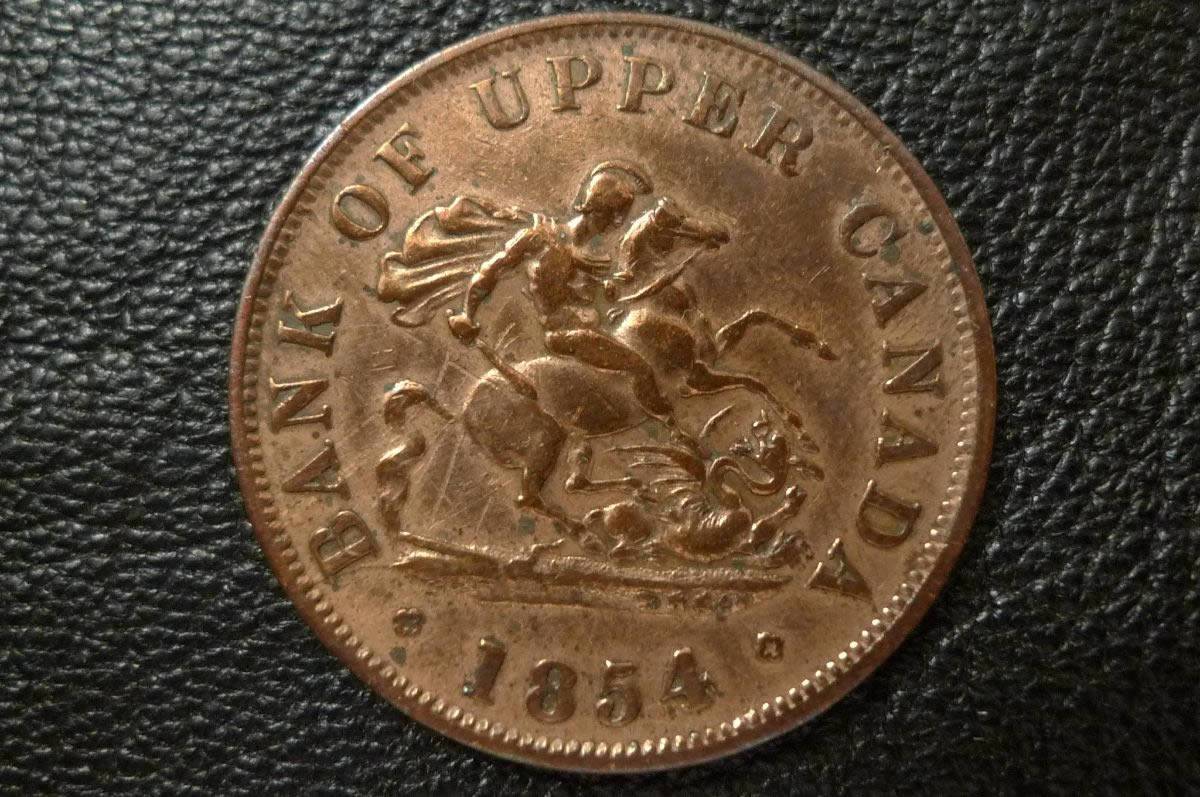 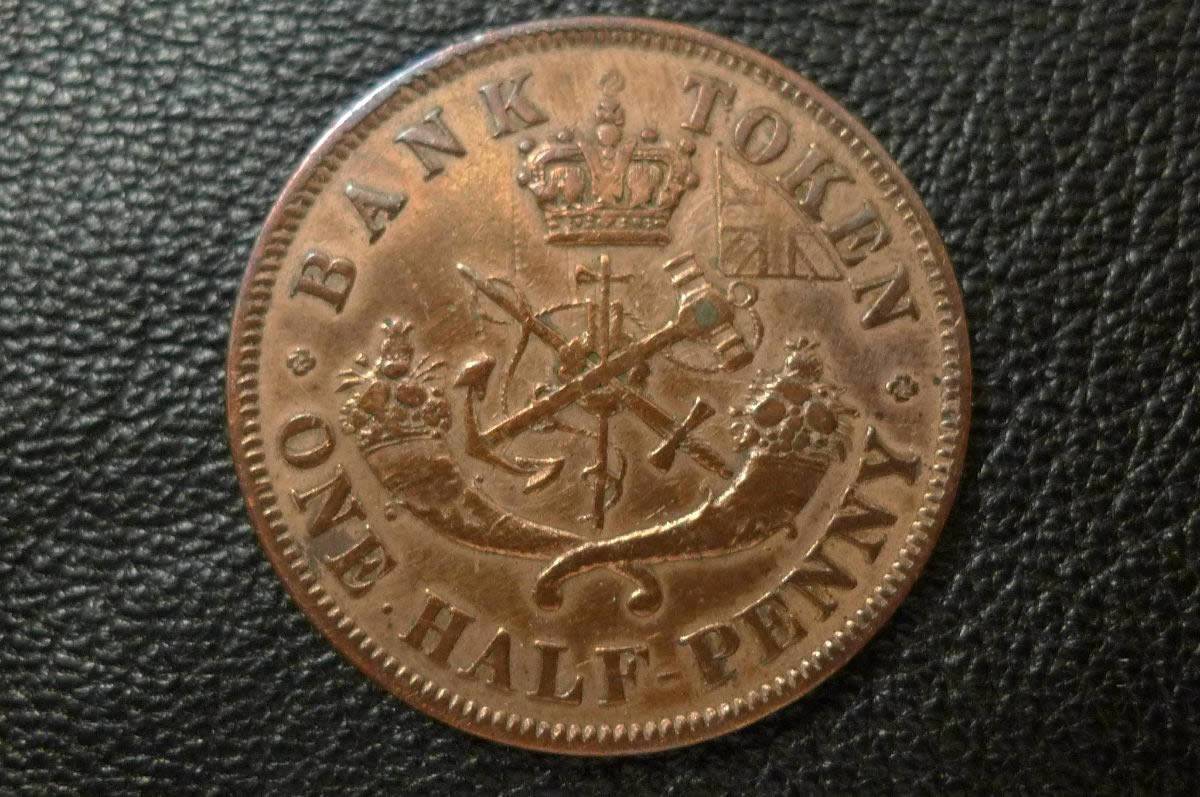 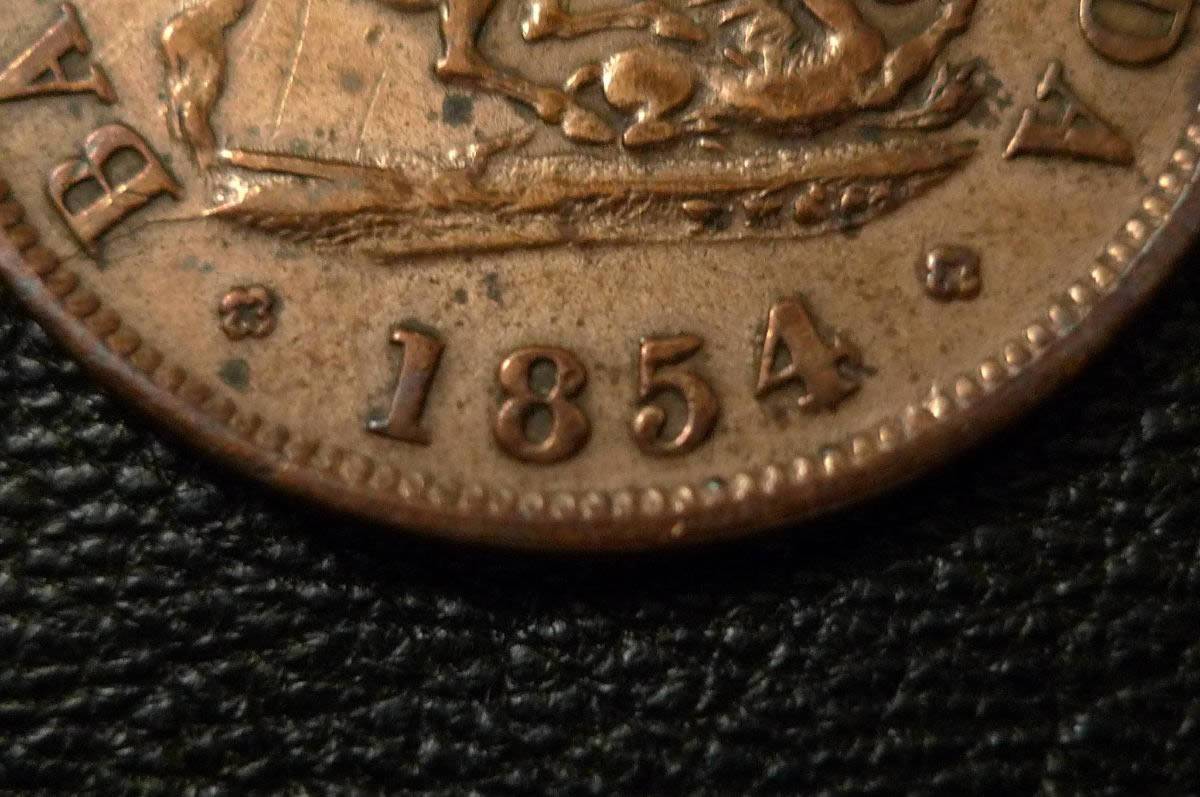 |
|
Pillar of the Community
United States
840 Posts |
This token is the popular 'Crosslet' variety identified by Charlton as PC-5C2 and by Dr. Courteau as variety 114.
This is a great ensample to demonstrate the various placements of the numeral 4. Absent the crosslet 4, the search can be narrowed down considerably by examining where the imaginary lines transects the H and & in the abbreviation and compare these findings to my listings on page 2 of this thread.
Below is the quotation provided by Dr. Courteau on his page 15 concerning this variety.
"114. Obv. Crosslet 4 in the date. Perf. and brok dies, crack to l. of ground touching B, another thro. F.
Rev. Same as No. 111. R-4."
---
The reverse of 111.
"Rev. Perfect stands to TN of TOKEN. The U.J. outline below letters in heavy, but slightly double-cut below E, no St. Andrews cross frame below this letter."
A cut and paste of my expansion of Dr. Courteau's variety 114:
114 R-4
The author finds this variety most perplexing. Early die-states are found exhibiting a complete left Foot to the Man and two horizontal lines below the left Wing of the Dragon. Mid die-states are found having a weakly struck Foot and faint lines below the left Wing of the Dragon. Terminal die-states shew no left Foot and no lines below the left Wing of the Dragon. Mid and late die-states shew obverse Die-Clashes.
Early die-states shew the outline of the Union Jack noticeably distant from the E in TOKEN, and having the lower section of the Union Jack widely re-cut (to the right); the right corner of the Shield ending diagonally; and the left Serif of the Stand of the N in TOKEN weakly struck. Mid and late die-states have the outline of the Union Jack noticeably nearer the E in TOKEN and also exhibit a normal N in TOKEN.
At present, the author opted not to identify this enigma as a new variety. The author is unsure whether two different dies were used, or if the die was extensively re-touched. Additional expertise is required.
Obverse characteristics:
The left end of the Stand of the numeral 4 in the date is on-line with the left-side of the 4th Denticle to the immediate right of the numeral 5.
The left end of the Stand of the numeral 4 in the date is defective.
The base of the numeral 4 has been re-punched at least three times. The prominent impression is on-line with the left-side of a Denticle. The underlying impressions are on-line with the centre and right-side of the Denticle, respectfully.
Having a Crosslet numeral 4 in the date.
Note - This is the only variety of the series having a Crosslet 4.
Note - The author would more accurately describe this as 'a broken Crosslet.' Currently, all specimens privy to the author have only the lower section of the vertical of the Crosslet complete, the upper section of the vertical shews as a short stub.
The numeral 4 is distant from the Denticles.
An imaginary line along the right-side of the Upright of the 4 extends betwixt the Uprights of the initial H, below the ground.
An imaginary line along the upper-side of the diagonal of the numeral 4 extends betwixt the initial H and the Ampersand, below the ground.
The Man's left Foot is either complete, weak, or missing (refer to introduction note).
The upper outline of the left Wing of the Dragon is either complete or weak.
Two normal, weak, or no horizontal lines shew below the left Wing of the Dragon.
(refer to introduction note).
One line is below the Man's right Arm.
This is a short line emanating from the upper section of the muscle mass of the Man's right forearm and extending into the field and terminating on-line with the muscle bulge of the Man's Biceps.
No left Bridle Rein is discernable.
The outline of the Belly of the Horse is not double-cut.
The left Leg of the Dragon is completely detached from the Body of the Dragon.
Die-Clash mark.
On mid and latter die states, a short diagonal line emerges from the Man's Back (near the upper Rib) and extends towards the crook of the Elbow of the Man's right Arm.
From perfect and broken dies.
A Die-Crack is to the B in BANK.
This faint Die-Crack is from the right-section of the Denticle above the centre of the Upright of the B in BANK, extending through the Serif of the same Upright, and running parallel to the left-side of the same Upright. On-line with the Cross-bar of the same letter, the Die-Crack bends, and extends to the Tip of the left ground.
Latter die-states have this Die-Crack becoming a Die-Break, engulfing the entire area betwixt the Denticles and the Serif of the same letter. On the Latter die-state, the Die-Crack extends through the mid-section of the plank of lumber and exits into the field towards the Haunch of the Horse.
A Die-Crack is to the F in OF.
This long rather straight diagonal Die-Crack is through the left corner of the Denticle to the immediate right of the F in OF, extending diagonally through the mid-section of the vertical of the Serif of the same letter, through the mid-section of the vertical of the cross-bar of the same letter, and exiting the left-side of the Stand of the same letter, and entering the Mantle at the mid-section of the 3rd Mantle Fold, and continuing through the Mantle, exiting the lower corner of the 4th Mantle Fold, and arching through the field to the 2nd curve of the Tail of the Horse (on-line with the centre of the A in BANK), and exiting the tip of the same Tail, and extending to the tip of the left ground.
A Die-Crack is to the 2nd A in CANADA.
This Die-Crack is from the left section of the Denticle above the centre of the 2nd A in CANADA, extending to the right section of the top of the same letter.
Note - This Die-Crack was not mentioned by Doctor Courteau.
Reverse characteristics:
According to Doctor Courteau, the same as varieties 111, 112, and 113, but ample differences abound to negate congruency.
The Stand of the T in TOKEN is Perfect.
The Stand of the N in TOKEN is either complete, or having a weak left-side.
(refer to introduction note).
The outline of the Union Jack is Perfect. (refer to introduction note).
Note - Doctor Courteau referenced this variety as the same as variety 111, but the Union Jack is perfect.
The relief of the right-side of the outline of the Union Jack is poorly executed.
Early die-states exhibit a line paralleling the right-side of the Union Jack extending from the right leg of the K in TOKEN nearly to the base of the Shield.
This line is distant from the outer edge of the primary outline of the Union Jack. Opposite the space betwixt the E and N in the same word, the line turns diagonally and joins to the base of the Shield.
Mid and later die-states are normal.
Note - This variety easily confused with variety 116.
The St. Andrew's Cross frame below the E in TOKEN is missing.
Note - Doctor Courteau referenced this variety as the same as variety 111, but the upper section of the St. Andrew's Cross frame shews on variety 111, whereas no trace of a Cross frame is evident on variety 114.
The Battle Axe has a barely discernable hole.
The inner ornamental Balls are disconnected from the Cornucopia.
Four well spaced oval Dots comprise the Anchor Rope Dots betwixt the Feather and Anchor Shaft, the last Dot being smaller.
The Anchor Rope ends with one Dot and a thin line. A small Dot is attached to the underside of the line.
The Anchor Ring is complete.
The 2nd and 3rd quadrants are heavier than the 1st and 4th.
Die-Clash marks.
Mid and latter die states shew parallel vertical lines to the left of, and below the Battle Axe Head. The inner line is close to and parallel with the Handle of the Battle Axe.
From perfect dies.
Thus:
114 Perfect - no Die-Cracks.
114A A Die-Crack is to the B in BANK (obverse).
Die-Crack as above, plus a Die-Crack is to the F in OF.
114B Die-Cracks as above, plus a Die-Crack is to the 2nd A in CANADA.
Note - Some Die-Cracks were not mentioned by Doctor Courteau.
This is the Die-Crack progression.
Enjoy
doug
Edited by colonialtokens
12/24/2017 09:41 am
|
|
Pillar of the Community
New Zealand
1679 Posts |
Thank you once again Doug----you are a walking talking Library  PS I used PowerPoint and made a slide then saved it to pictures so I could paste it here Cheers Don
Vickies cents and GB Farthings nut.
"Old" is a figure of speech and nothing more
|
|
Pillar of the Community
New Zealand
1679 Posts |
Very nice find Phil310  Swap? ? ?  Cheers Don
Vickies cents and GB Farthings nut.
"Old" is a figure of speech and nothing more
|
|
Pillar of the Community
Canada
846 Posts |
Colonialtokens, you rock ! To take the time to write all the details is fantastic. I started collecting these kinds of tokens in the early 2000's. There are only 16 listed in the Charlton catalogue I own and I found most of them. Then someone on CCRS (was that you?) wrote that there were more than 100 known varieties, Being a mental collector, I would have tried to get them all, so I decided to sell them to avoid the years of searching and disappointment of not being able to complete the set. I kept only 2; an 1854 1/2p because of die clash on both sides and die cracks, and an 1857 penny with a doubled 8 and die cracks (will start a new post for that one). Thanks to your massive posts here, I followed all the cracks, dots, and info you listed and it looks like the 1/2 p I kept is variety 127. How lucky is that !! I was on the way to it being 127B but instead of the die crack to the P in UPPER, I found a small die crack to the U, not to the P. I also found that the 18 are double-punched. What do you think ? 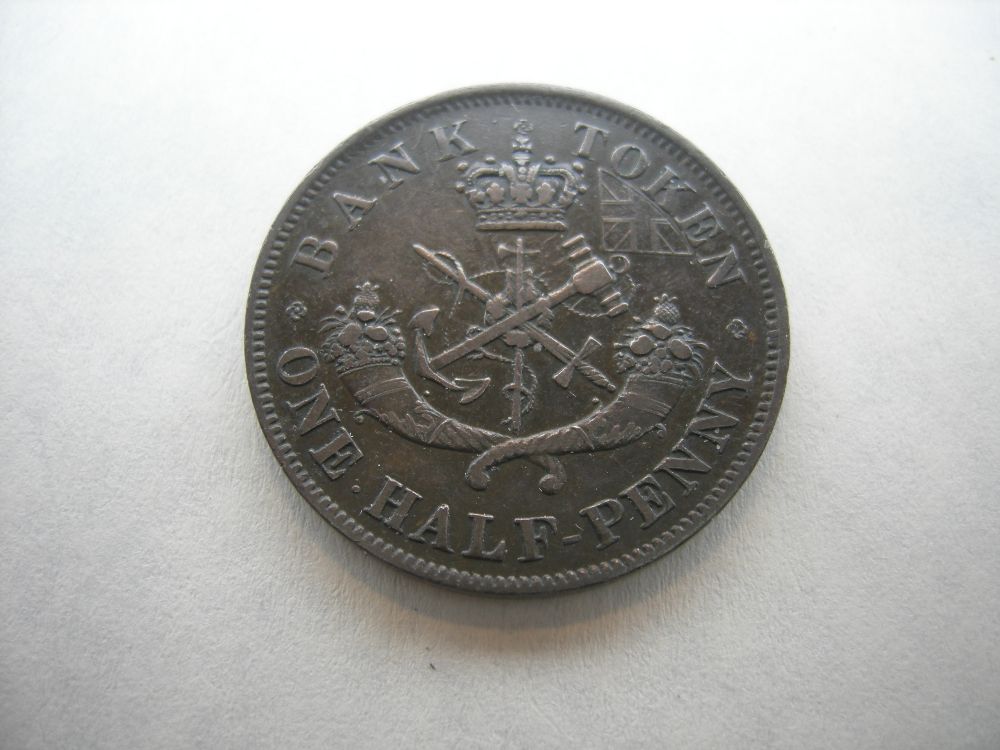 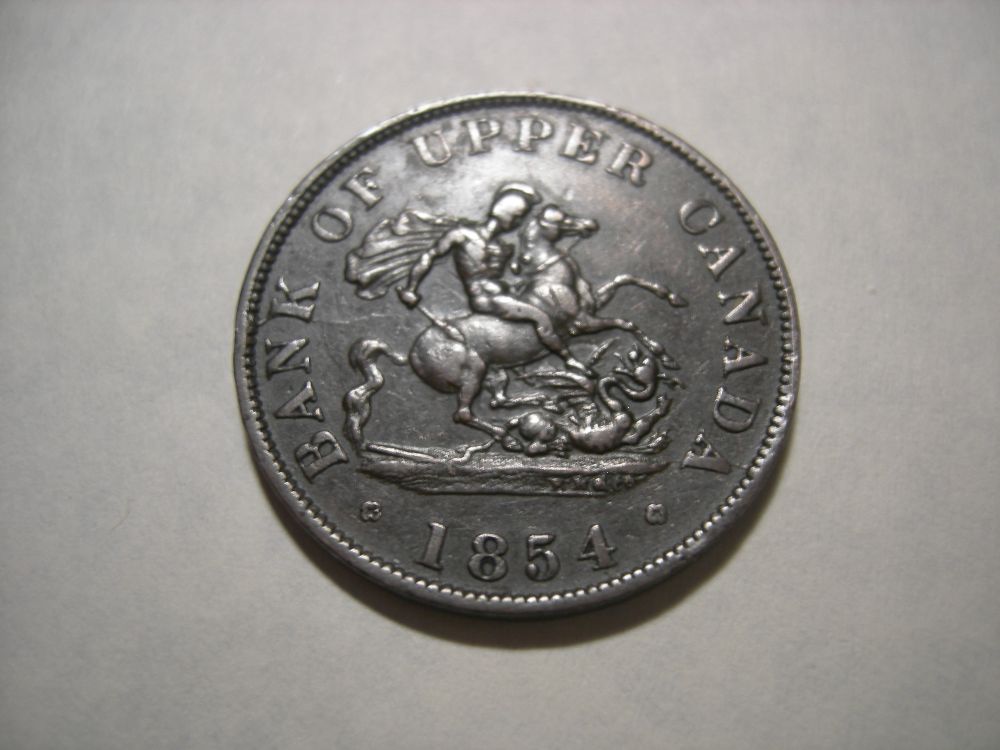 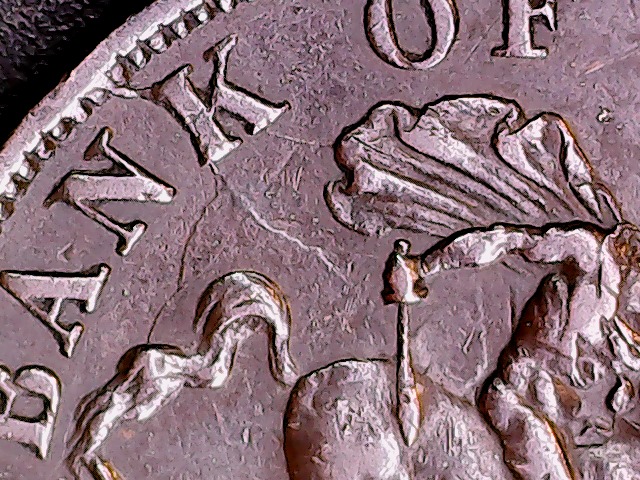 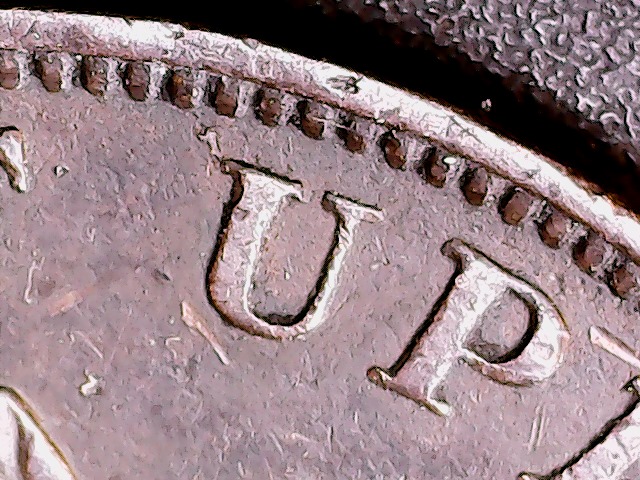 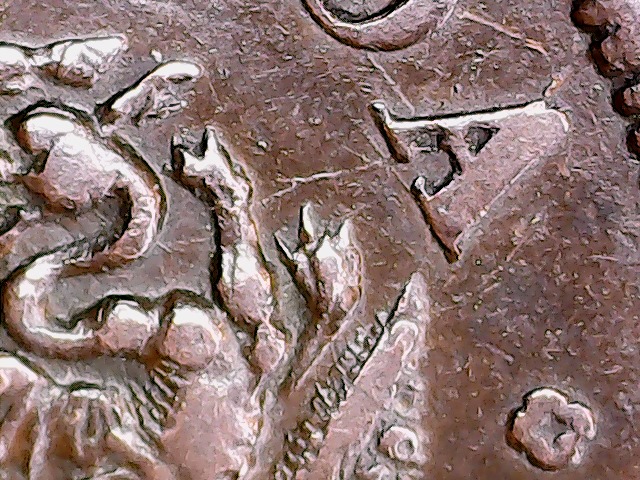 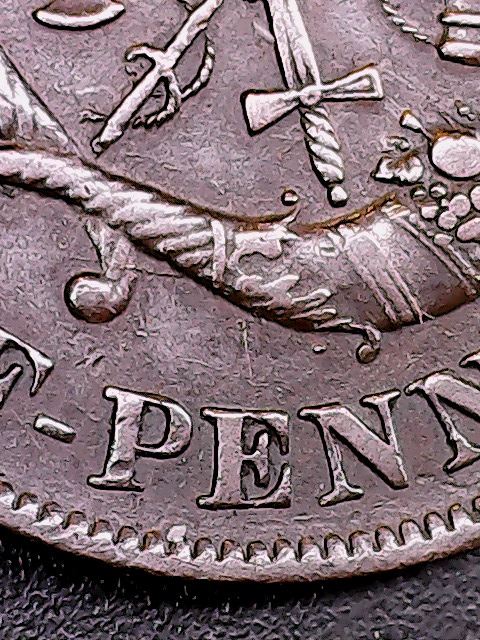 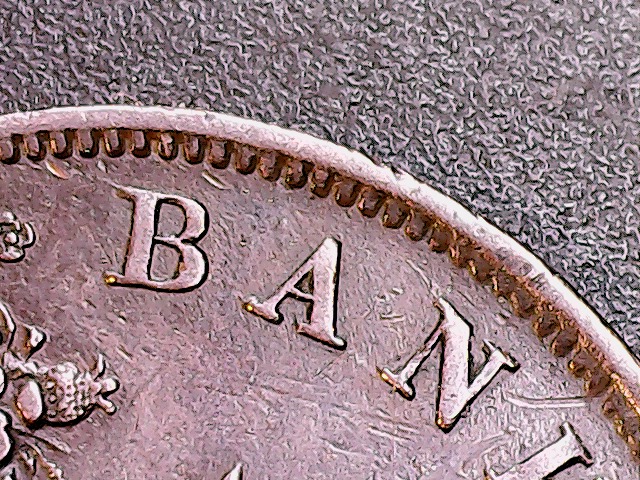 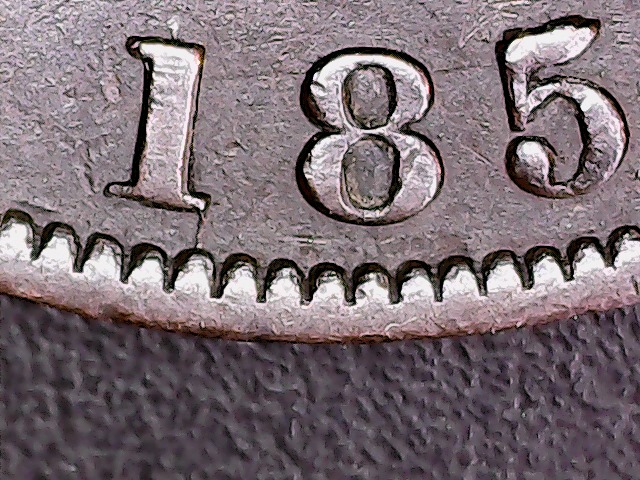 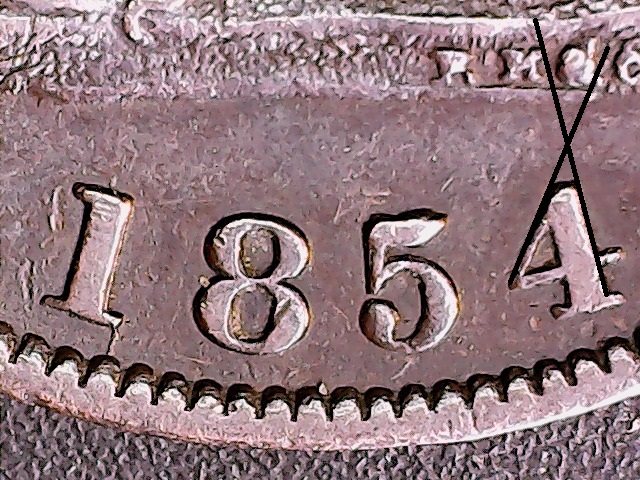 Edited by TerryT
12/24/2017 2:29 pm
|
|
Pillar of the Community
United States
840 Posts |
TerryT
Great job...Great photos
Yes, yours is a mid-grade late die-state of Dr. Courteau's variety 127.
And, yes, I suspect that was me you remember from the old CCRS site as I was the primary responder and promoter concerning anything relating to Canadian Colonial tokens. My moniker on that site was the same as on this site, Colonialtokens. It is a shame that much of data (especially the valuable lore posted by other eminent researchers)is difficult to access.
Compare your line extensions in your photo of the numeral 4 with the similar photo posted by Fourmark (10:23) on page 2 of this thread. Absent the line extensions, both numeral 4's appear similar, and most would not discern any difference. But, the lines remove all doubt of congruency. They are definitely not the same.
Your token is an excellent ensample of how to narrow the specific variety search, Dr. Courteau identifies some 47 different varieties of this series (111-159 inclusive).
Using my short-cut (posted 7:29 on this thread) we find that only varieties 124, 125, 127, 128, 130-1, and 142 have the imaginary line going betwixt the initial H and the Ampersand. And only varieties 124, 125, and 127 shew the line extending to the lower section of the Leg of the Ampersand. We have quickly eliminated 44 varieties from consideration.
Then we have to go to Courteau's book and compare the narrative of his variety 124, 125, and 127 with your token. At present, I am not going to entertain a dissertation of the difference betwixt varieties 124, 125, and 127, save to say that of the three, yours is variety 127.
Enjoy
doug
Edited by colonialtokens
12/24/2017 5:01 pm
|
| |
Replies: 38 / Views: 10,384 |
To participate in the forum you must log in or register.
Disclaimer: While a tremendous amount of effort goes into ensuring the accuracy of the information contained in this site, Coin Community assumes no liability for errors. Copyright 2005 - 2026 Coin Community Family- all rights reserved worldwide. Use of any images or content on this website without prior written permission of Coin Community or the original lender is strictly prohibited.
Contact Us | Advertise Here | Privacy Policy / Terms of Use
|
| Coin Community Forum |
© 2005 - 2026 Coin Community Forums |
| It took 0.61 seconds to rattle this change. |
 |
|




 First Page


 Posted 12/22/2017 9:53 pm





