| Author |
 Replies: 38 / Views: 10,431 Replies: 38 / Views: 10,431 |
|
Pillar of the Community
New Zealand
1679 Posts |
1854 Upper Bank Token half penny as per photo's Does not look the best but what grade would you put on this token and Colonialtokens would you look at this for variety please 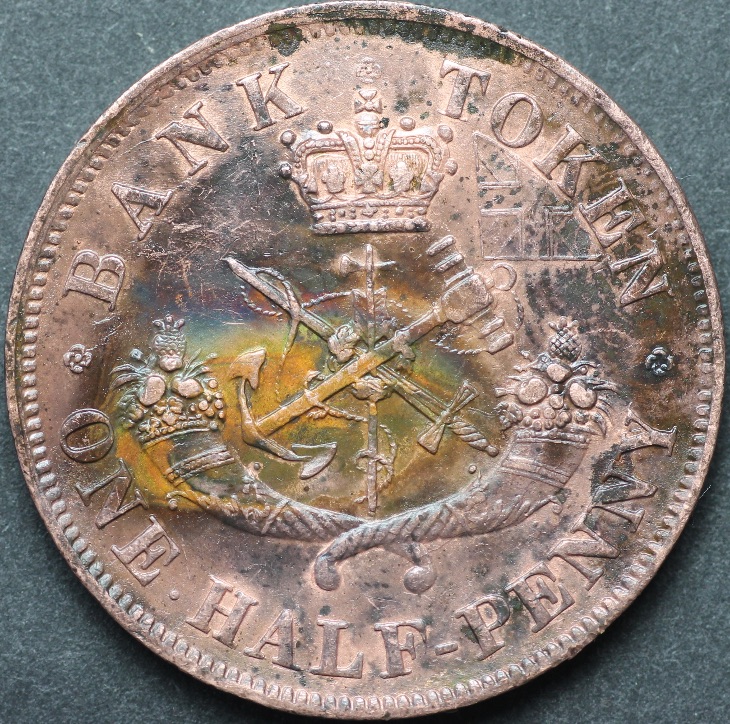 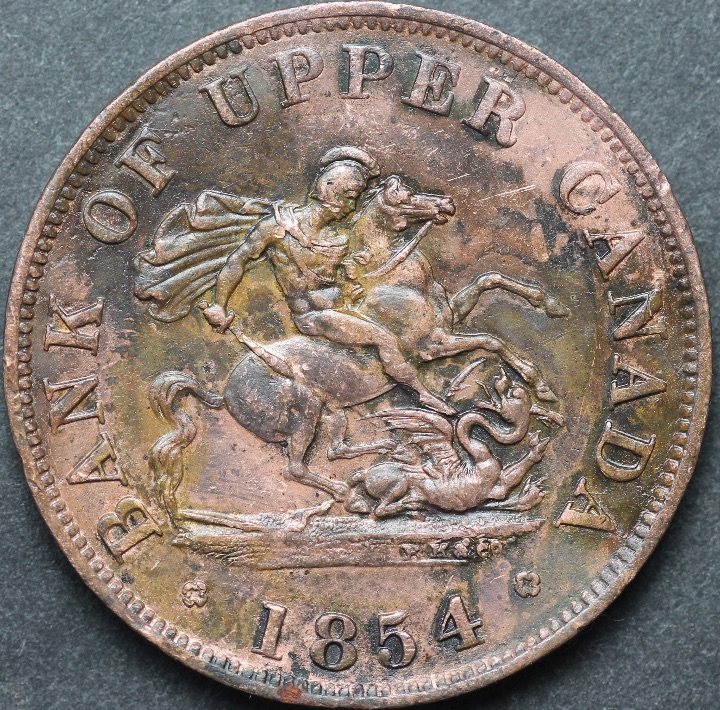 Cheers Don
Vickies cents and GB Farthings nut.
"Old" is a figure of speech and nothing more
|
|
|
|
Pillar of the Community
United States
840 Posts |
Technical grade AU-55, off colour. Net grade AU-50.
Will attribute variety when I have more time.
Kindly confirm if there is a die-Crack to the 3rd A in CANADA.
Looks like it, but from the photo I can not be positive.
doug
|
|
Pillar of the Community
 New Zealand
1679 Posts |
don't think so 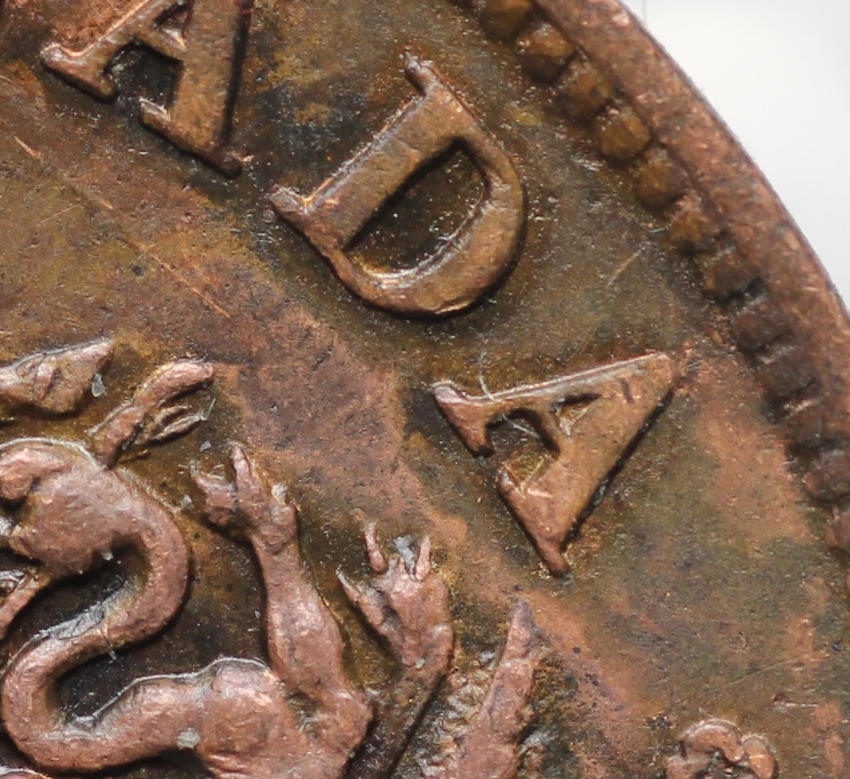 Cheers Don
Vickies cents and GB Farthings nut.
"Old" is a figure of speech and nothing more
|
|
Rest in Peace
United States
17900 Posts |
To be honest, a grade is of no importance for this piece. It is so messed up with an attempt to harshly clean it and remove stains that still exist, that any numismatic value has been destroyed.
|
|
Pillar of the Community
United States
840 Posts |
From Dr. Courteau's narrative, I find this one of the most difficult to properly ascertain. e.g., concerning the date, Dr. Courteau oftentimes states "Fig 4 away from 5," and describes another as "the figure 4 is a trifle farther from 5, etal." Absent a confirmed variety for reference, one is at a loss.
Of this grouping, Dr. Courteau separates these into two primary groupings dependent upon whether or not the right Rosette on the reverse contains an inner Dot. Varieties 111-132 inclusive (group I) only shew a Dot within the left Rosette. Varieties 133-158 (group II) exhibit an inner Dot within both the right and left Rosette. Your token is of the group I varieties.
Dr. Courteau is concerned with the placement of the numeral 4, the completeness of the Union Jack, the stands of the T and N in TOKEN, among a host of other specifics. In order to expidiate this presentation, I will concern myself with the specific of this ensample.
The stand of the T and N of TOKEN of your token are weakly struck:
Weakly struck Stands of the T and N are found on varieties 122, 123, 124, 125, 126, 127, 130, 130-1, 131, and 132.
Of these, varieties 124, 125, 126, and 127 have a characteristic small Dot betwixt the K in Bank and the upper Rosette. Yours is one of these 4.
Of these 4, Dr. Courteau further mentions whether or not "A small defect occurs below the Anchor Ring to the right." I had great difficulty endeavouring to ferret out what Doctor Courteau meant by this statement. I studied ensample after ensample searching about the field for any uniform resemblance of a mark or minuscule Dot of some sort, all to no avail.
Then one day.... A large buttress like extension about the shoulder of the right-side Arm of the Anchor was noticed. This buttress wraps around the right shoulder of the top of the Anchor, extending nearly to the 'eye' atop the Anchor. Much less confusing would have been ----
A large buttress-like mass is at the shoulder of the right-side Arm of the Anchor.
This large buttress-like mass is found on varieties 126 and 127. The buttress is not found on varieties 124 or 125.
Varieties 126 and 127 can be distinguished by the placement of the numeral 4 in relationship to the 3rd Denticle to the immediate right of the numeral 5.
On variety 126, the left-end of the Stand of the numeral 4 is on-line with the left-side of the Denticle. Whereas on variety 127, the left-end of the Stand of the numeral 4 is on-line betwixt the 2nd and 3rd Denticles to the immediate right of the numeral 5.
Again, this is somewhat subjective. I studied this in depth and developed another confirmation tool. The use of imaginary lines along the right-side of the upright of the numeral 4 and along the top of the diagonal of the same numeral. Compare where the imaginary line crosses the abbreviation below the ground.
On variety 126, an imaginary line along the right-side of the Upright of the numeral 4 extends to the mid-section of the Stand of the right Upright of the initial H, below the ground. An imaginary line along the upper-side of the diagonal of the numeral 4 extends to the vertex of the Base and Leg of the Ampersand, below the ground.
On variety 127, an imaginary line along the right-side of the Upright of the numeral 4 extends betwixt the initial H and the Ampersand, below the ground. An imaginary line along the upper-side of the diagonal of the numeral 4 extends to the terminal end of the Leg of the Ampersand, below the ground.
Variety 126 has a rarity factor of 1.
variety 127 has a rarity factor of 7.
I believe you can take it from here.
enjoy...
doug
Edited by colonialtokens
12/18/2017 9:57 pm
|
|
Bedrock of the Community
United States
94367 Posts |
It's a mess. No way to grade this in a meaningful way.
|
|
Pillar of the Community
Canada
2786 Posts |
technically high AU, but with obvious extreme environmental damage and extreme cleaning.
in this condition I would find it hard to put any net grade on it (I couldn't give it a net 50 myself).
|
|
Pillar of the Community
United States
840 Posts |
True, the colour is highly undesirable, but even on such coins / tokens the rarity of the piece commands numismatic value. How much damage can be done to a 1948 silver dollar to reduce the value to silver bullion. Unfortunately though, this token is not a rare variety. But on others... I have a high-grade NF-3A1 (Charlton number) that is holed and bent. ICCS noted "holed and bent" on the insert and still opted a grade of F-15. I am thankful for having this piece, but someday I desire to upgrade. The rarer the piece, the more forgiving the damage.
doug
Edited by colonialtokens
12/18/2017 10:13 pm
|
|
Pillar of the Community
United States
840 Posts |
All things considered, perhaps, net AU-50 was generous and XF 40 would be more in line.
doug.
|
|
Pillar of the Community
Canada
2495 Posts |
It's been dipped to death.
No signs of abrasive cleaning.
Also, I have no idea of variety.
|
|
Pillar of the Community
New Zealand
1679 Posts |
I received it as is-- well not quite I have dish washed it and wd it thats it for $3 who cares I am more interested in the variety and thank you Doug once again for all your information which is mind blowing . 2 more to come  Cheers Don
Vickies cents and GB Farthings nut.
"Old" is a figure of speech and nothing more
|
|
Pillar of the Community
Canada
514 Posts |
$3!
I'd buy that for three bucks in a heartbeat!
I don't really collect these, but this appears to have the best detail of any one I have seen.
|
|
Bedrock of the Community
Canada
10743 Posts |
Whatever Doug said, take it as gospel and, yes.. for $3 bucks, great deal.  |
|
Pillar of the Community
United States
1101 Posts |
I found this 1854 B.U.C. token recently. The reverse of this one has die cracks like the one fourmack posted, but the obverse also has some big die cracks. 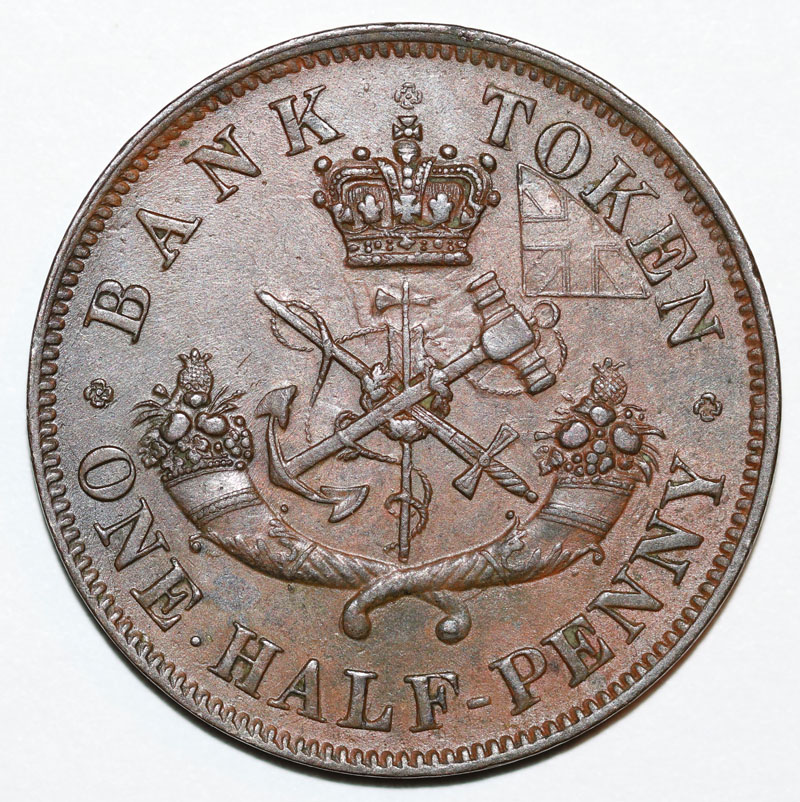 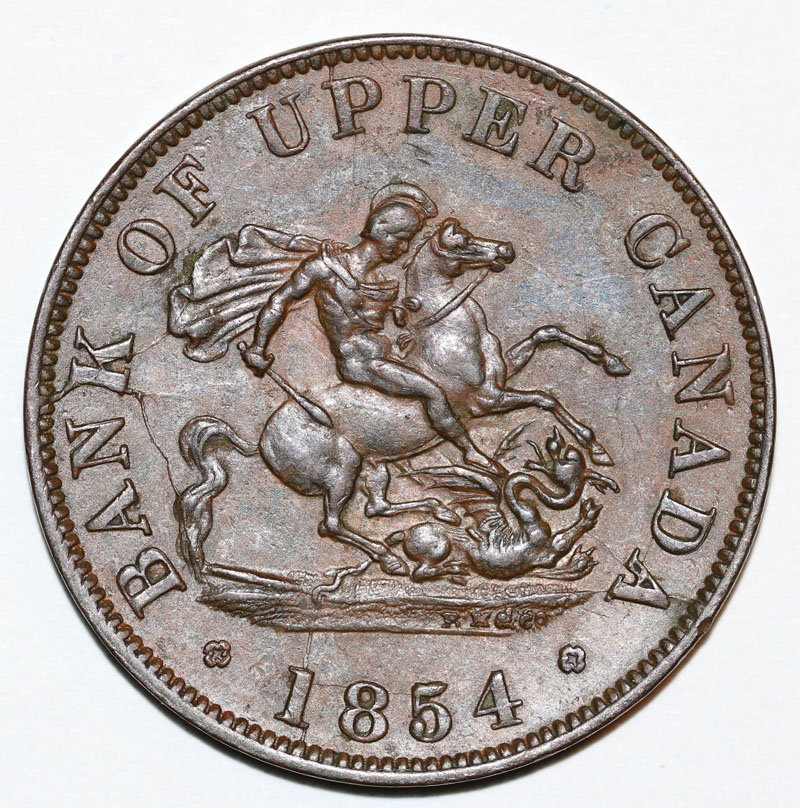 |
|
Bedrock of the Community
United States
94367 Posts |
A remarkable specimen. |
|
Pillar of the Community
United States
840 Posts |
Phil
Great token. Solid AU-55. Nice fields.
p.s. next time, kindly initiate a new independent thread.
My cut and paste:
This is Courteau variety 127.
127 R-7 The author finds this variety considerably rarer than the rarity factor indicates.
Obverse characteristics:
The left end of the Stand of the numeral 4 in the date is on-line betwixt the 3rd and 4th Denticles to the immediate right of the numeral 5.
The 4 is distant from the 5.
The top of the 5 is re-cut.
The right-side of the Stand of the numeral 4 is nearer the Denticles.
Note - This is akin to varieties 124 and 125.
An imaginary line along the right-side of the Upright of the numeral 4 extends betwixt the initial H and the Ampersand, below the ground.
An imaginary line along the upper-side of the diagonal of the numeral 4 extends to the terminal end of the Leg of the Ampersand, below the ground.
The Man's left Foot is Perfect.
The upper outline of the left Wing of the Dragon shews well.
Two horizontal lines are below the left Wing of the Dragon.
A faint wide fork of equal branches is below the Man's right Arm.
The right Bridle Rein tapers to a point. The left Bridle Rein does not shew.
The outline of the Belly of the Horse is double-cut.
The Knob to the Dagger-hilt is nearly round.
The upper side of the Thigh of the Man's right Leg is double-cut.
The left Leg of the Dragon is weakly attached to the Body of the Dragon.
Terminal die-states exhibit Clash marks.
Two parallel lines extend diagonally upwards from the Mans' lower Back and Hip area. These are mimics of the lower section of the Anchor Shaft.
Another clash is from the juncture of the Man's right foot and the Belly of the Horse, extending to the upper section of the left Wing of the Dragon. This clash mimics the section of the lower Anchor Rope Dots above the upper Hand Guard of the Sword.
From broken dies.
A Die-Crack is to the K in BANK.
This diagonal Die-Crack is from betwixt the Denticles between the N and K in BANK, extending to the upper left-side of the Upright of the same K. Latter die states have the Die-Crack much heavier, and engulfing the entire area betwixt the Serif and the original Die-Crack.
The Die-Crack exits the left section of the Stand of the same Upright, on-line with the left-side of the same Upright, and enters into the field and forks. The upper branch continues to the Man's right Hand. The lower branch extends through the 2nd outer curve of the Tail of the Horse.
Terminal die-states shew another branch is from the left-section of the Stand of the Leg of the same letter, extending through the lower section of the 4th Mantle Fold, and continuing through much of the Mantle.
A Die-Crack is to the 1st P in UPPER.
This Die-Crack is from the left section of the Denticle above the Upright of the 1st P in UPPER, extending to the top of the same letter, on-line with the left-side of the same Upright, and exiting the Stand of the same letter, on-line with the right-side of the same Upright and exiting to the Shoulder Straps of the Mantle.
A Die-Crack is to the 3rd A in CANADA.
This Die-Crack is from the right section of the Denticle above the left Leg of the 3rd A in CANADA, extending to the upper left section of the same Leg.
Latter die states have the Die-Crack much heavier and exiting the underside of the cross-bar of the same letter, extending through the right-side of the Stand of the same Leg, and continuing through the Wrist of the right Foreleg of the Dragon, and exiting to the lower curve of the Neck of the Dragon.
A Die-Crack is to the numeral 1 in the date.
This Die-Crack is from the centre of the Denticle below the right-side of the Stand of the numeral 1, extending through the right-side of the same Stand, and exiting the centre of the top of the same numeral, and continuing through the ground to the tip of the Tail of the Dragon.
Note - This Die-Crack was not mentioned by Doctor Courteau.
Reverse characteristics: According to Doctor Courteau, the same as variety 126, but from the broken die.
The Stand of the T in TOKEN is weak.
The Stand of the N in TOKEN is weak.
The right-side of the Stand of the Upright of the K in BANK is weakly struck.
The right-side of the Stand of the Leg of the K in BANK is weakly struck.
The right-side of the Stand of the Leg if the K in TOKEN is weakly struck.
The right-side of the Serif of the right Arm of the Y in PENNY is not fully struck.
The outline of the Union Jack below the K and E in TOKEN is very weak / missing.
#9758; According to Doctor Courteau the reverse of variety 126 is the same as that of variety 124, which is the same as variety 122, of which the outline of the Union Jack is ends in a small fork.
The author finds insufficient evidence to support this claim. The section of the outline of the Union Jack from the Leg of the K in TOKEN to the base of the Shield is so weakly struck that one could easily say, is missing. Even when using considerable imagination on mint grade specimens, no remnant of a small fork is evident. On lower grade specimens no outline shews.
The St. Andrew's Cross frame below the E in TOKEN is widely broken in the middle.
The hole in the Battle Axe appears as a large impression.
The left inner ornamental Balls is disconnected from the Cornucopia.
Two small central Dots comprise the Anchor Rope Dots betwixt the Feather and Anchor Shaft. Remnants of the 1st and 4th Dots are barely detectable. The Dots are extremely weakly struck, irregular, and tiny.
The Anchor Rope ends with one Dot and a thin line. A small Dot is attached to the underside of the line.
The Anchor Ring is complete.
The 2nd and 3rd quadrants are much heavier than the 1st and 3rd. The 1st and 3rd quadrants are extremely weakly struck.
A small Dot betwixt the K in BANK and the upper Rosette.
This is a faint Dot in the field on-line with the upper corner of the left Lobe of the upper Rosette. The Dot is a trifle closer to the Rosette than to the K. This Dot is situated on-line betwixt the 2nd and 3rd Denticles to the immediate left of the upper Rosette.
Note - This Dot may not be readily discernable on lower grade specimens.
Some specimens exhibit the small defect occurring below the Anchor Ring.
Note - Doctor Courteau references variety 127 as the same as variety 126, without addressing the issue of the 'defect.' Variety 127 must be a transitional initiatory variety, as early die states shew a perfect Anchor, without the defect.
On latter die states, the 'defect' is present. This confirms that variety 127 preceded variety 126.
This is a large buttress like extension of the inner band of the right-side Arm of the Anchor was noticed. This buttress wraps around the right shoulder of the top of the Anchor, extending nearly to the 'eye' atop the Anchor.
Much less confusing would have been ---- A large buttress-like mass is about the shoulder of the right-side Arm of the Anchor.
Die-Clash marks are to the left of the Blade of the Battle-Axe head.
Being struck from 'upset dies' or a coinage die-axis, the mimicked image is shewn in reverse. Vertical markings are to the right of the Battle Axe Head. Other markings are evident betwixt the upper right Anchor Arm and the Hilt of the Sword.
Note - This appears to be the same Die-Clash as found on variety 126.
From broken dies.
A Die-Crack is through the right Cornucopia and the end of the left Cornucopia.
This long faint Die-Crack is from the lower right-side of the right Upright of the N in CANADA, extending through the Grass Blades and Leaves of the right-side of the right Cornucopia, continuing along the inside of the same Cornucopia, and exiting at the juncture the Die-Crack to be discussed next, and continuing through the Handle of the left Cornucopia, and terminating at the Handle Knob of the right Cornucopia.
Note - Doctor Courteau references this variety as the same as the broken version of variety 126. However, at present, the author is not privy to
variety 127 specimens having the other characteristic reverse Die-Cracks of variety 126, thus variety 127 must have been struck from an early variety 126 die state.
Thus:
127 A Die-Crack is to the K in BANK (obverse).
Die-Crack as above, plus a Die-Crack is to the 3rd A in CANADA.
Die-Cracks as above, plus a Die-Crack is to the Cornucopiae.
127A Die-Cracks as above, plus a Die-Crack is to the numeral 1 in the date.
127B Die-Cracks as above, plus a Die-Crack is to the 1st P in UPPER.
This is the Die-Crack progression.
That covers just about everything...
Enjoy and God Bless.
doug
Edited by colonialtokens
12/22/2017 6:52 pm
|
| |
Replies: 38 / Views: 10,431 |




 Posted 12/18/2017 12:58 am





