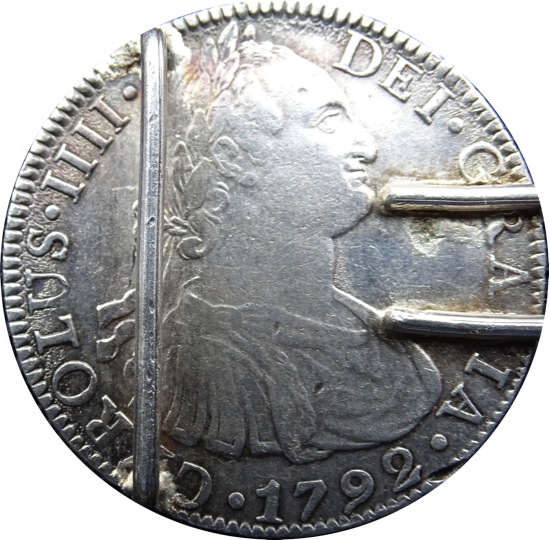
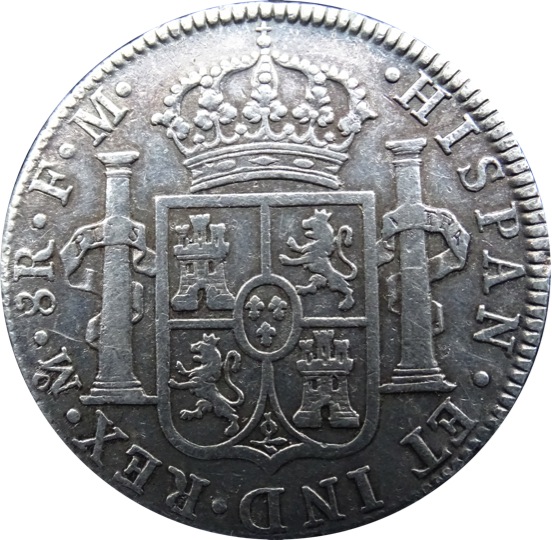
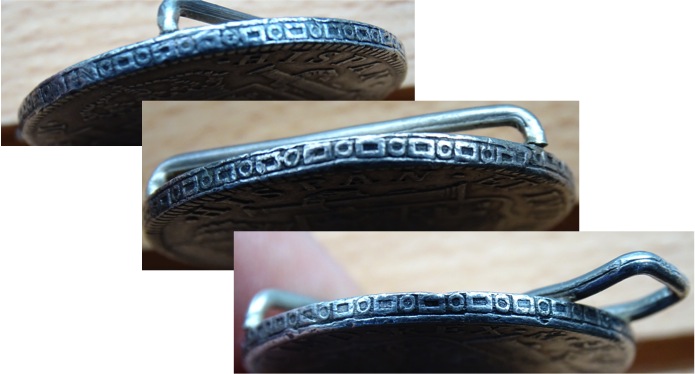
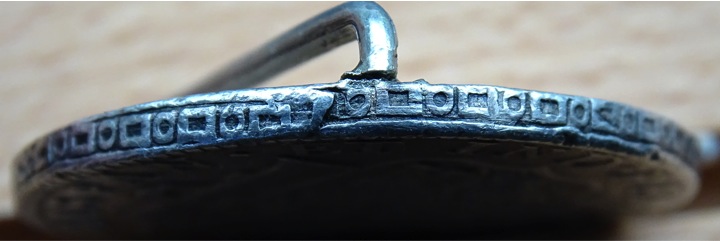
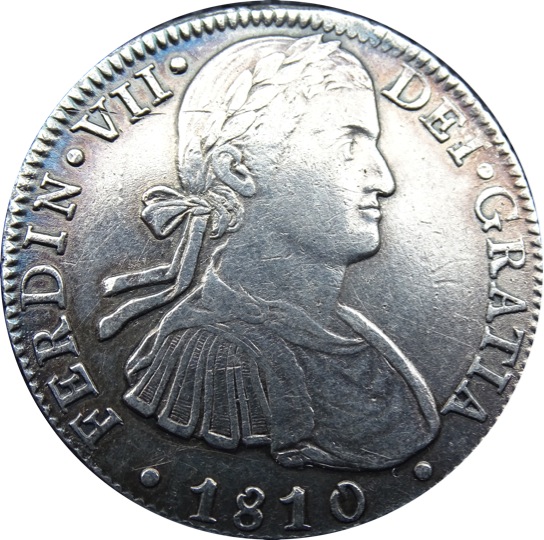
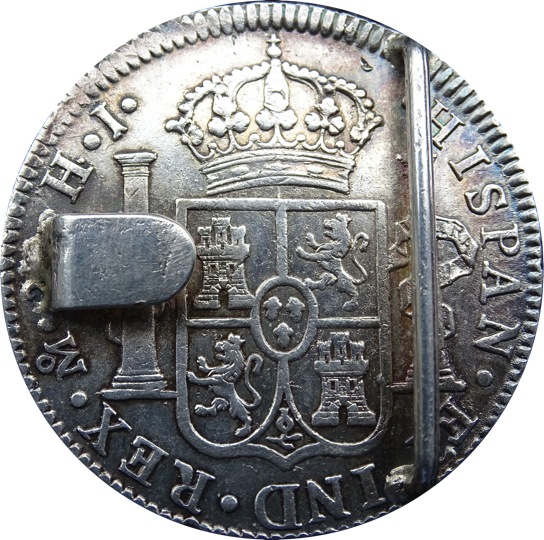
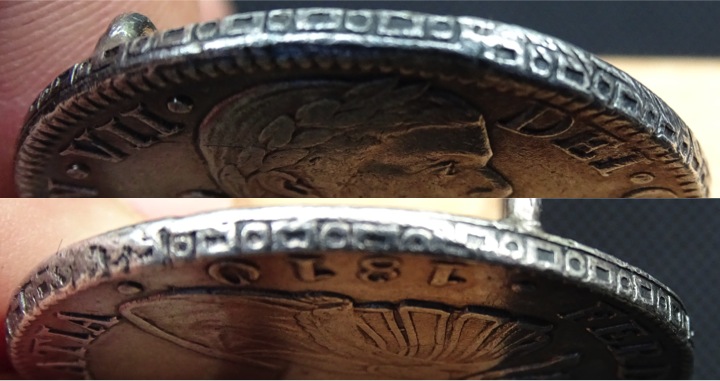
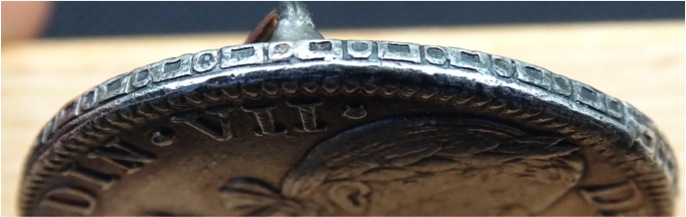
1c5d7n5m The pictures came out nice. I believe both coin will fall into the general category of probable Class 2 silver counterfeits. These are trade restrikes made several places (including the Netherlands and UK) for trade in China.
The manufacture of counterfeit 8Rs to meet Chinese demand started in roughly 1789 in China where the local officials commissioned Silver artisans to make replica 8Rs to feed the demand for them in the inland markets where they were trusted more than other dollar sized coins. The premium then was about 5% over silver content. The Chinese versions were said to be crude and they were withdrawn when the makers started using debased silver. There is no known method of absolutely identifying these counterfeits because no examples were documented at the time with identifying characteristics. I own several super crude Charles III counterfeits that I would love to prove are this early Chinese type.
In until about 1820 the existing supply of 8Rs made before the adoption of the Ferdinand VII coin design (with the thin face and thin ribbons) were adequate to meet demand. By 1800 the word market traded at a 4% premium for so called Carolus dollars and money dealers bought up high grade Mexican 8Rs.
After 1820 and certainly before 1830, the UK began making their own copies. These used an alloy of between 850 and 900 fine silver because 850 was the limit to pass a specific gravity test (standard test for
The Royal Mint). This about the level of detection available today with most common scales. (Typical accuracy is in the range of 0.2% of the weight being measured and this gives about a 50 point +/- range vs 903 fine.
In 1835 the British at Canton detected sub 850 fine restrikes in circulation. They suspected the Chinese but had no real proof of origin. Other suspects were the traders from the Netherlands and Spain. (The US was not yet involved). The British did not mind trading with their own 850+ coins but were concerned they might take lower value restrikes accidentally. So they introduced Specific Gravity testing to the Chinese Schroffs (money testers) so that the debased coins under 850 could be eliminated from circulation. At the time the premium on Charles 8Rs was 16-20% over silver value. This made importing counterfeits profitable even if they contained the correct weight of silver.
As the balance of payments with the UK shifted in favor of the Chinese (growing to millions of dollars per year) the demand for the more valuable Mexican 8Rs increased. The fact was the Chinese did NOT accept gold in payment only silver. There was an abortive effort in the 1830s to substitute the Republic of Mexico Cap and Ray 8R but it failed to get inland support. In particular the branch mint coins were found to have poor tolerances and traded below face value. The Portrait 8R premium rose to 25% while the C&R premium sat near 4% for those made at Mexico City. The 4% paid shipping costs. England increased output of 8Rs until they reached a financial breaking point in 1839. The solution seemed to be importing opium to China (a trade banned by China) to reduce the $30,000,000 per year deficit. Two wars resulted - the Opium Wars - and England forced China to accept the opium trade. The deficit plummeted and England got out of the 8R making business in large part after 1850. Other countries did not stop however.
In 1873 large silver discoveries in the western US led to a silver glut on world markets. The US made silver coinage a token coinage in 1873 (under full value silver). Germany abandoned silver as a monetary metal and went to a gold standard. Silver became a commodity not money. In the US the glut was particularly bad. There was no market to sell the silver from US mines and the
Trade dollar coin made for China was a failure. So the US faced a significant deficit of payments by the late 1860s. In 1869 the US Congress tried to make an agreement with Mexico to produce the old 8Rs. The deal failed only when Mexico demanded a 15% commission. There still was a Chinese premium that averaged 25% but often fluctuated higher. The US turned to private industry and began minting the old Carolus dollars to ship to China secretly. By 1890 the demand was so acute that Massachusetts silver makers were enlisted (there had been a depression and the work was welcome). So the coins were made in Massachusetts from bullion shipped east, traveled by rail to California (San Francisco) and went by clipper ship to China. The cost was under 5 cents a coin over silver leaving a 20% pure profit for the makers.
This business continued for decades in my own hometown. Several of my relatives worked at the plant and made 8Rs. My uncle introduced me to one of the remaining makers in the 1960s. The old man lived until about 1970 and had made Carolus dollars in the 1920s and 1930s. After the China demand dropped off after 1930 some of the operation he ran started making US
Morgan dollars. This was illegal but it was the depression. The man saw no problem with making the coins because they used the correct amount of silver in the copies - "so who was harmed?" He did tell me (sometime between 1965-69) that they had only made a few die errors on Morgans that he knew of. He warned me not to buy any "rare" Morgan error coins because they might be from New Bedford or Providence, RI. One particular error he told me about was using too small an O for the New Orleans mint mark. I didn't collect Morgans at the time so I didn't think too much about that, other than mint mark sizes were all the rage then. The micro s 1945 dime was very popular that year. I looked in the 20-30
Morgan dollars I had but no small O's. Then I kind of forgot about it.
The 8R coins (the old man still had a small box of them) were all dated to the reign of Charles IIII and many were dated 1805. He gave me one (1805) he said he had made it in the 1930s near the end of production. I took that coin to every coin dealer I knew and they all said it was a genuine 8R. Worth a few dollars. Weight was perfect and specific gravity was 10.30 to 10.31 virtually perfect every time I tested it.
So for years (1960-1995) I didn't know if the story was true or not. I studied the coin in great detail and did notice some minor issues - odd looking small lumps on the die surfaces - crazing of the surface from poor annealing - an odd rather bad looking edge with diagonal cut marks on half the edge. I began studying other 8 reales and found many of the features to be rather common.
About 1990 I was first exposed to laboratory level XRF testing at a Nuclear power station laboratory. I brought that dollar in along with many counterfeit and genuine 8Rs. Tests showed the 1805 coin was the correct alloy of silver and copper. The tests on my other Mexican coins, particularly the early Go and Zs coins showed what I thought were odd results - there was gold in them. I had one 1838 Go coin that contained almost 3% gold. So I started researching silver contaminants to see if gold should be there.
In the later 1990s I began hearing stories of a rare
Morgan dollar with a small o mint mark that might be a forgery. Later an article in
Coin World (referred to above) mentioned the failed contract of 1869 between the US and Mexico to make 8Rs for the China trade. Both stories resonated with me and caused me to dig out my old data.
To make a long story longer, by 1998 the micro-O dollars were being denounced as forgeries made in US in the 1930s. Also by that time museum forensic tests were being done which based authentication of rare South and Central American silver articles on trace contaminant levels of elements including arsenic and gold. Crandall published a book that indicated flatly that all old Mexican silver was contaminated with gold. I also discovered that in 1805 the vast majority of the silver used in Mexico City to make 8Rs came from La Valenciana mine in Guanajuato. That was a mine noted for HIGH gold content. This led to the obvious question how did the Mexicans get the gold out of the silver? I read that silver and gold are mutually soluble in each other. That is actually an uncommon trait. Parting gold and silver economically requires advanced methods that (while understood in 1800) were not cost effective especially in Mexico. Mexico lacked fuel for repeated cupellation and they also lacked raw materials needed to create acids to part the metals. So purity of silver in 1805 in Mexico could include up to 1-2% gold. It was not worth removing smaller amounts.
Eurika - test my 1805 for gold.
All tests using XRF before 2011 resulted in NO GOLD being discovered in my coin. XRF of test borings done on the grounds of La Valenciana (done by the current owners in the early 2000's show that all silver ore in the vein contains more than 1/2 of one percent gold and most show gold in the 3-8% region. Some but not all could be extracted economically.
For absolute full disclosure in 2013 I had my 1805 coin tested in RTI Labs in Durham, NC using their newest state of the art testing apparatus. (This coin has now been x-rayed more than most people.) The RTI instrument can detect levels as low as 1 PPM of all elements from Carbon to Uranium. The new results show a gold trace at 120 ppm (0.012%). That is simply too low a concentration of gold for the coin to have been made in Mexico in 1805. In fact it is too low for coins made in the US where adequate fuel and acid were available. Gold could not be purified to 0.9999 fine at any time on an industrially economical scale before 1850 and silver did not reach that same purity level until the twentieth century. So my 1805 8R was made sometime after 1900 when 0.999+ fine silver was possible.
I prefer to think it was made in 1930 in New Bedford, Mass (my home town) just as my old friend said he did.
This story was related because I believe that based on visual clues similar to the 8R I own and other similar coins confirmed to contain NO gold (about 100 coins) that both of your 8Rs also fall into this very common category. They have visual features that are often seen on coins that ultimately test as products of the last half of the nineteenth century or later. In my book written in 2011 to 2013, I listed about 20 visual clues that often point to the possibility of a coin being a Class 2 Silver Trade Counterfeit. These clues are not infallible when isolated but the more examples your coin possesses the more I believe it is at least a candidate for XRF testing.
Do you have to spend $500 (the cost of the 1 ppm test unless you happen to know a lab tech) to prove it? NO. You do not need that level of accuracy at all. I did it so that I would remove all doubt about my 1805 coin. A cheap hand held XRF tester used in any advanced coin shop, jewelry store or even junk yard can detect gold contamination at 1000 ppm (0.001 or 0.1%). Museum tests now use between 0.3% and 0.4% as lower limits to authenticate a period antique. That is well within the range of the typical handheld XRF. Tests using them cost $10 or less. The results you get for silver and copper from these tests are relatively worthless but the gold reading is not. Gold being a much denser metal returns a detectable signal from about 100 microns far deep enough to penetrate the deepest tarnish and fire scale layers on an uncleaned coin.
So if you get an XRF reading of 0.5% you MAY have a genuine coin from Mexico made before 1850. Remember this test only provides certainty that a coin with NO or LOW gold was made after 1850. You could still have a fake made last week using old silver reclaimed from melted Mexican culls. The test spots Class 2 Counterfeits.
There is also an upper limit to the gold content as well.
no mint (unless operating under stress) will make a coin containing economically recoverable gold. That upper limit is not yet published because it varies by period and mint but suffice it to say that a level of say 5% gold would make me sure it was a fake and likely made with silver where gold was added intentionally. The silver used could also come from reclaimed telecom or computer scrap. The key to those coins is testing for superconducting elements that are difficult to take out of recovered silver.
The wire connectors in the pictures show clearly a lengthwise line running on the wires. Old wire ca 1800 was made at times by pulling slit stock through a progressively smaller die. The line in that case is a seam where the metal folds back onto itself as it is pulled through an ever decreasing sized die. I have read that in old wires made using this method the seam line should twist in one direction. I could not locate a picture of the feature but a straight line like I see here looks more like an extruded wire made in a more modern factory.







 First Page


 Posted 01/28/2018 4:51 pm