| Author |
 Replies: 20 / Views: 5,185 Replies: 20 / Views: 5,185 |
|
Pillar of the Community
Belgium
1185 Posts |
We think of coins as means to trade, material to put weight to the purse of a peasant or money chest of a merchant. But coins were used for decorative means too. One example is shown in the illustrations below: the use of large silver coins as items of display in costumes of fishermen and farmers. Such "trouser pieces" could be ornamented silver disks or real coins and were fashionable in different provinces of the Dutch Republic (17th and 18th century) an later in the kingdom of the Netherlands (19th century). The two coins were connected to a hook and loop closure device to secure like a buckle the male trousers. Well known examples of such "trouser pieces" used 17th and 18th centuries silver ducatoons (photo of a 1785 piece on display in the Nederlands Openluchtmuseum) or 3 guilder pieces. The Leyden professor Johannes le Francq van Berkhey (1729-1812) describes such use of Dutch Republic money as "trouser pieces" in his book "Natuurlyke historie van Holland" (1773). Interestingly, he also mentions that Dutch fishermen who sailed to the coasts of England also used for the same display pieces of 8 reales ("Spaanschen matten"). Maybe an original pair of pieces of 8R still exists today (see two photo's, sorry for the low resolution). The left coin displays the portrait side of Ferdinant VII, Mexico 1810, HJ), the right side the pillar side of a Charles IIII, coin, Mexico1792 FM. Having read some of the interesting discussions on this forum about restrikes and counterfeits it may be of interest that (i) the circle/rectangle series are regular; (ii) both coins seem to have two areas of overlap of the same size on one coin, and at the expected opposing places. However, the overlap is much longer on the 1810 coin than on the 1792 coin. The total weight of the pair is 57 grams (including the attachments for clothing), the sound of the coins is silver-like and the magnetic test is OK. One may think what a pity for such nice coins "destroyed" by a hook and loop closure. On the other side, this odd pair of portraits connects present day remains to old times when this type of widely circulating money was found attractive. The admiration of a Chinese trader or a Dutch fisherman for the portrait 8R may have had something in common, so it seems. Are other examples of such "trouser pieces" known to this coin community? Or perhaps you know varieties on this theme in other countries? 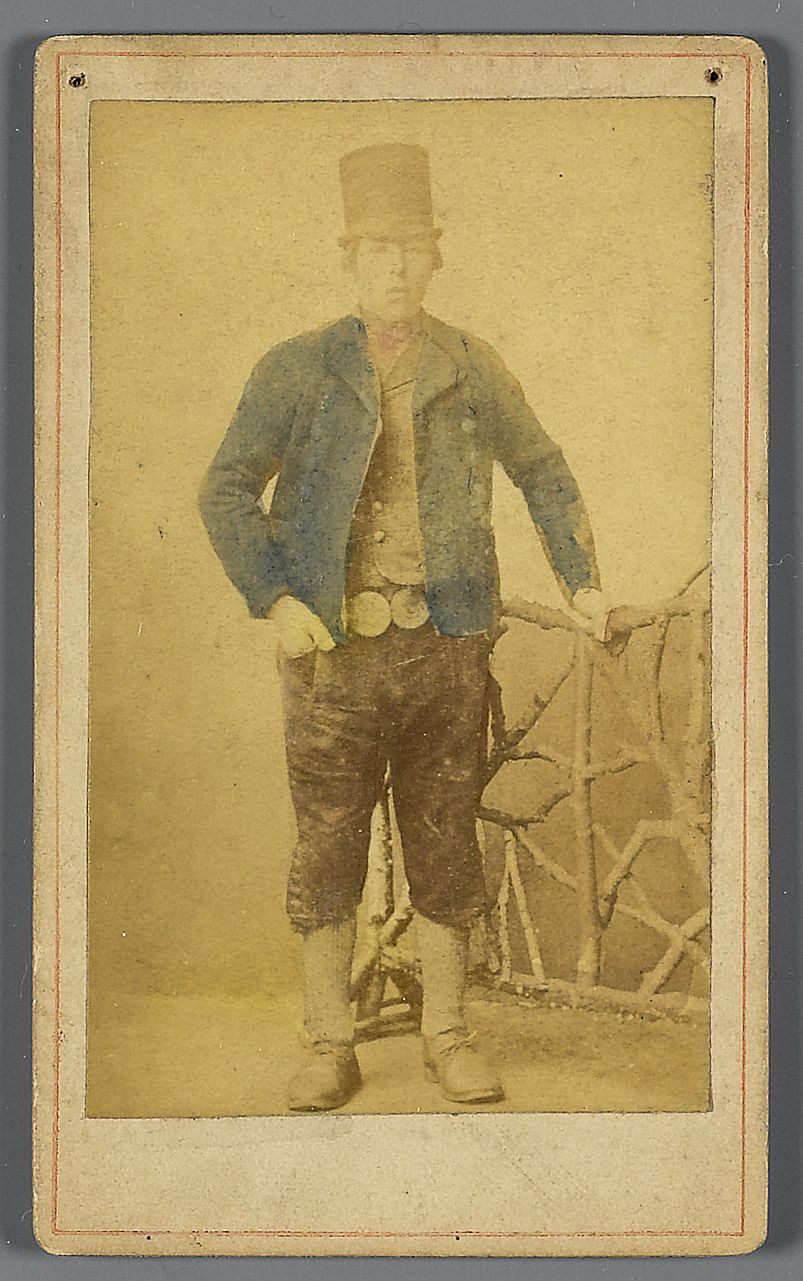 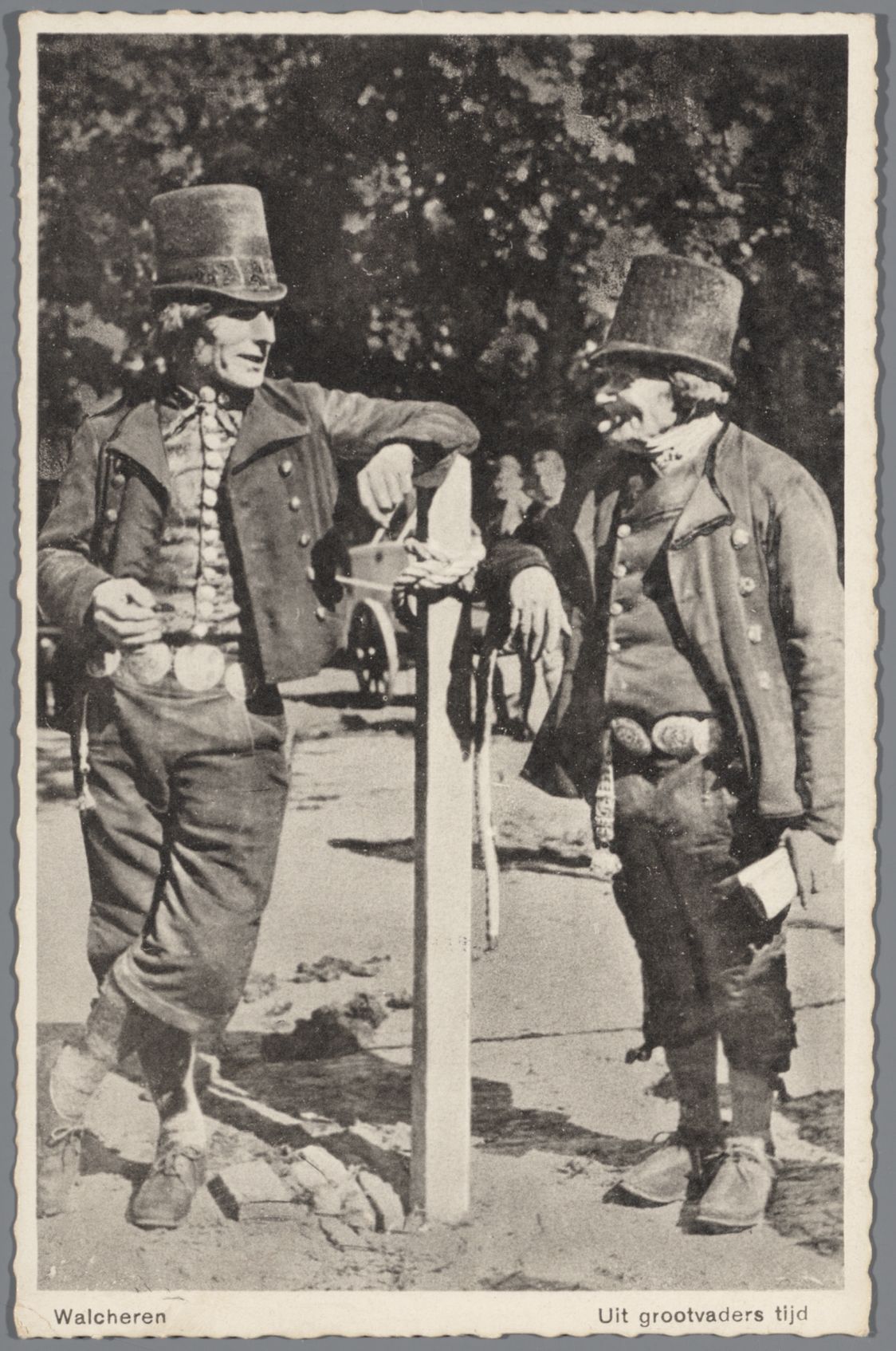 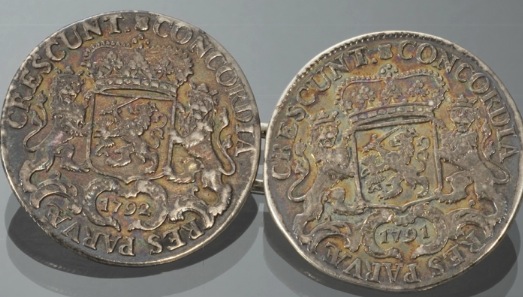 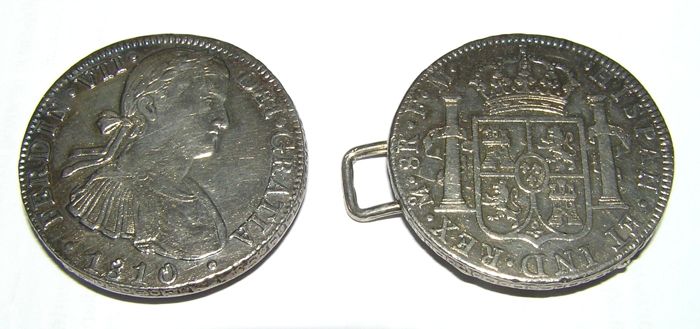 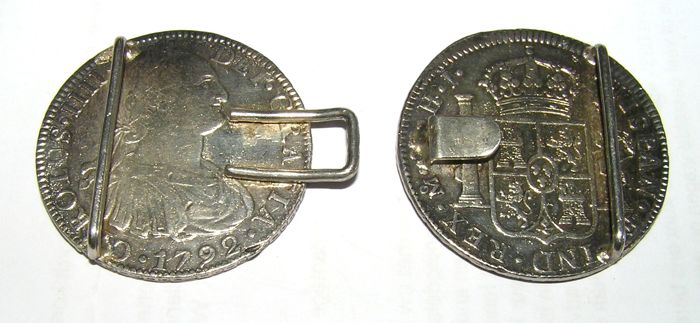 |
|
|
|
Moderator
 United States
34564 Posts |
Interesting thread. Quote:
Or perhaps you know varieties on this theme in other countries? How about so-called "belly dancer" tokens? http://goccf.com/t/298406"If you climb a good tree, you get a push."
-----Ghanaian proverb
"The danger we all now face is distinguishing between what is authentic and what is performed."
-----King Adz
|
|
Pillar of the Community
 Belgium
1185 Posts |
Hello Spence your example led me to Google the theme "tokens and clothing" in fact even today in the US old coins (real money lmost 3 centuries ago) are used for the apparel sector a company called "Tokens and Icons" convert "VOC duiten" (a common copper half penny in the Dutch Republic) into a pair of cufflinks https://www.amazon.com/Tokens-Icons...123011&psd=1 |
|
Pillar of the Community
Belgium
1185 Posts |
Of much greater numismatic value are the pendants made from coins from historic events that should never be forgotten. One example: the siege coins, made out of necessity in the 16th century when walled towns and cities were sieged, sometimes for a year or longer. The local authorities minted special coins (mostly silver, sometimes copper, tin, lead in Leyden even paper) to pay the garrison that protected the city against the enemy. Table silver was a common source for this emergency money. These were times of hardship. Leyden successfully defended until the city was relieved in October 3 1574 and kept the best siege coins as memory from difficult times. Quite a few were mounted in pendants and that is why they still survive until today. The picture below is from a 18th century drawing of a 1574 Leyden 28 stuiver (taler) ( Rijksmuseum Amsterdam) for more information about the Leyden siege see: : http://www.coinsweekly.com/en/Archi...id=80&type=a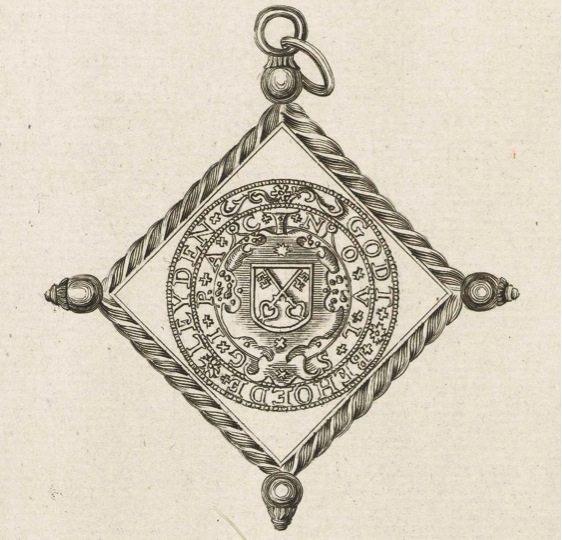 Edited by 1c5d7n5m
01/02/2018 06:28 am
|
|
Pillar of the Community
United States
5362 Posts |
The use of Mexican 8Rs as conchos was a well known practice which used real or sometimes counterfeit 8Rs to make them concave on the cap side. The eagle bulged outward and the coins were at times made into belts or used to decorate saddles. In these pictures the coin has to be very large or the men very small. Here is an example of a US half dollar concho. 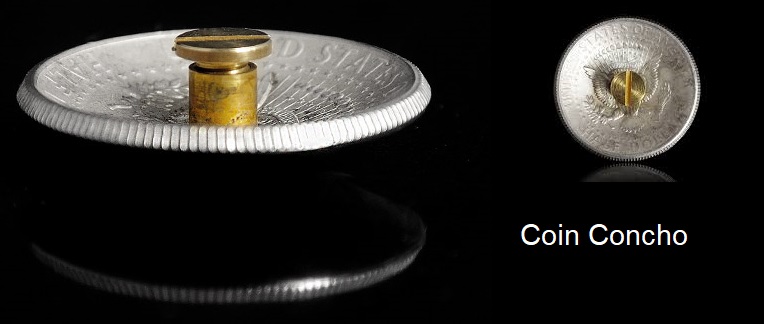 |
|
Pillar of the Community
Belgium
1185 Posts |
@swamperbob thanks for adding an interesting new example. The American use of coin concho seems indeed similar to the fashion of the Dutch fishermen of the 17th-19th centuries. Using big (and small) coins for belts can still be found on internet shops, also in Japan. It is known since when coin conchos have been used in the US? Your observation of the mismatch between the decribed thaler-like Dutch or Spanish coins and the size of the adults on the pictures is correct. Although there is a clear secular trend of human height ( https://www.ncbi.nlm.nih.gov/pubmed/16757103) the Dutch concho's on the pictures above are clearly bigger than a ducaton or portrait 8R. In fact, as this fashion evolved, "the bigger, the better" was part of a signal of wealth and social status. So after the middle of the 19th century, the a cheap pair was a set of two Wiliiam III Rijksdaalders, but the more valuable Dutch "broekstukken" were produced by silver smiths from bigger silver plates, often concave like the US conchos. Below are two examples that can be found among others in the "Dutch Open Air Museum" http://data.collectienederland.nl/s...broekstukkenActually, this odd pair of 8R brought me to the CCF where I read your interesting comments about counterfeits and numismatic frauds. In fact, I am not sure this is a pair of original Mexican strikes. The previous owner bought this set on a Dutch auction of antiques & small silver in 1993, so it is at least 25 years old. Die characteristics seem not suspicious, but I am an amateur not an expert. There are numerous small elevations on the surface of the Charles IV coin between the letters CAROLUS, maybe caused by the attachment of the clips. Two overlaps are present on the edge of each coin. Total weight is 57 gram, but with the clips attached exact measurements of weight and SG make no sense. Axel, 1842 diam 6,9 cm; weight 117.3 gram Nederlands Openluchtmuseum 0180-HM.4605 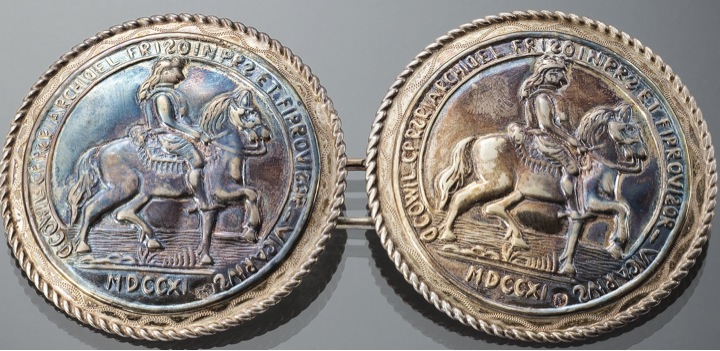 Zuid-Beveland, 1860-1887 diameter 9.2 cm weight 140.4 gram Nederlands Openluchtmuseum 0180-HM.2286 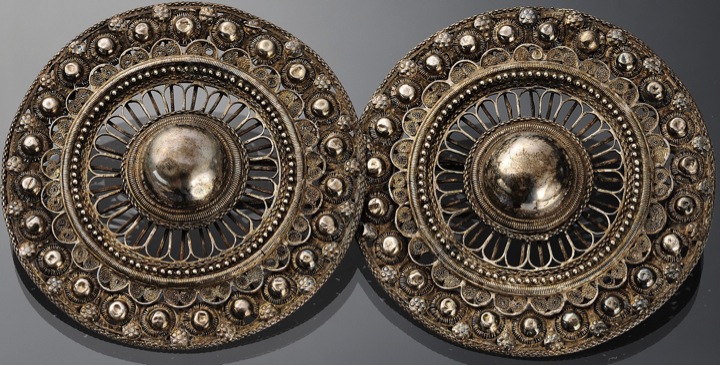 Edited by 1c5d7n5m
01/20/2018 10:09 am
|
|
Pillar of the Community
United States
5362 Posts |
1c5d7n5m The use of conchos in the SW US is associated loosely with the post Civil war period say 1870-1900. There are of course many modern made examples trying to take advantage of the value of the genuine historic pieces. I would view the genuine examples as rather rare.
The example you show from the auction is dated to 1842 in the auction. I wonder why? The item itself appears to be very modern. The date on the "coin" MDCCX equates to 1710. I would estimate it could have been made last week or 25 years ago, but not in 1842.
Regarding the 1809 and 1792 8 reales. The wire that forms the belt connection loop and the connector for the clasp looks like modern drawn steel wire. This looks far too modern to date before WWII. In addition the soldered connectors look modern with no patina at all.
The host coins may be genuine but the item is very unlikely to be from the nineteenth century.
|
|
Pillar of the Community
Belgium
1185 Posts |
swamperbobThe source from the two examples of large silver "broekstukken" shown above is not an auction or private seller but the Digital Collection Nederland, supported by the Rijksdienst voor het Cultureel Erfgoed (the Dutch official agency for cultural history). I understand your concern for the date 1842, given the Roman date MDCCXI on the two plates. The webpage gives description of the origin of this piece that can be translated as follows Silver pair of trouserpieces made in 1842. These trouserpieces were worn by a boy or man in Axel until WWI. Unless they made a big error of judgment, we can assume that these pieces were not made after WWII. On the other hand, 1842 is too precise given the fact that the silversmith is unknown in this case, whereas for other items in the collection the maker is known. Given these doubts I have asked Digital Collection Nederland the about the evidence that made them decide to date this piece at 1842. One tends to believe that the information provided about pieces in public collections is correct. http://data.collectienederland.nl/p...0180-Z.10-78For the pair of 8R: your hypothesis may be right; I will search a bit more in this strange niche of the numismatic world and pay attention to clips on items from the 19th century. If the clips are modern, one could wonder: Would someone be so stupid to ruin a pair of original 8R in the 20th century? If the pair of 8R is a modern numismatic fraud, all details would fit, including the point I wasted some money on a worthless item.
Edited by 1c5d7n5m
01/21/2018 05:06 am
|
|
Pillar of the Community
Belgium
1185 Posts |
some extra information The website allows connection of the piece discussed above to related pieces, which indeed look quite similar. The dating occurs via the silversmith mark, punched in the silverware which indeed are visible. It is clear that for the three pieces below the oldest is most worn and the newest looks like that. In this respect the fourth item of 1845 which looks the most modern is a bit suspect. IF the four dates are correct, the conclusion is that this design was traditional in the area it was used for almost one century. Again we are not discussing coins, but ornamented silver plates that evolved from pairs of thaler sized coins along the familiar motto "the bigger the better". 0180-HM.4605 http://igem.adlibsoft.com/wwwopacx/.../HM.4605.jpgthis piece is dated 1912 and was produced by M. de Pleyt in Schoonhoven (a town in Zuid-Holland famous for its silver industry, in particular the production of silver ornaments) 0180-Z.74-48 http://igem.adlibsoft.com/wwwopacx/.../Z.74-48.jpgthis piece is dated 1902 - silver smith unknown 0180-HM.1237 http://igem.adlibsoft.com/wwwopacx/.../HM.1237.jpgpiece is dated 1858 - silver smith possibly G.F. V. Geelen from Schoonhoven who was active between 1853-1880 for comparison the 1845 piece again http://data.collectienederland.nl/p...0180-Z.10-78Edited by 1c5d7n5m
01/21/2018 05:39 am
|
|
Pillar of the Community
United States
5362 Posts |
I agree the piece does look like some form of traditional design. Most of these traditional jewelry designs tend to degrade over time. A comparison of the object buckle is clearly very degraded compared to the 1912 dated item. 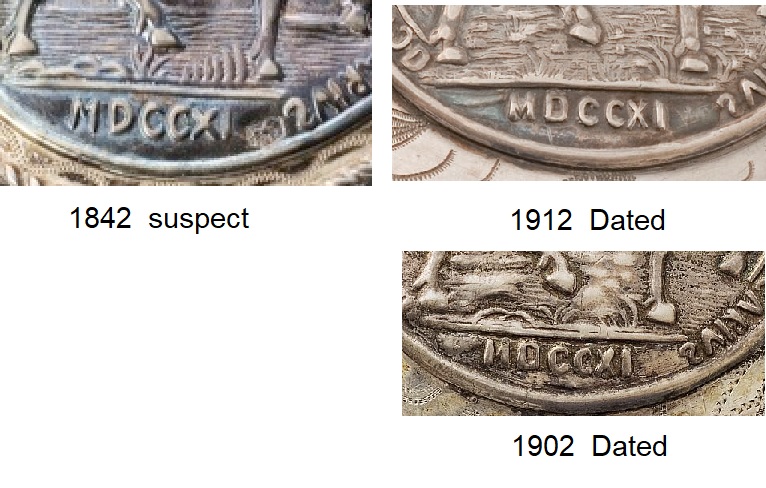 I think this demonstrates that the designs of the turn of the century had degraded by the time the piece in question was produced. The comparison of the Rider's body is even more extreme. 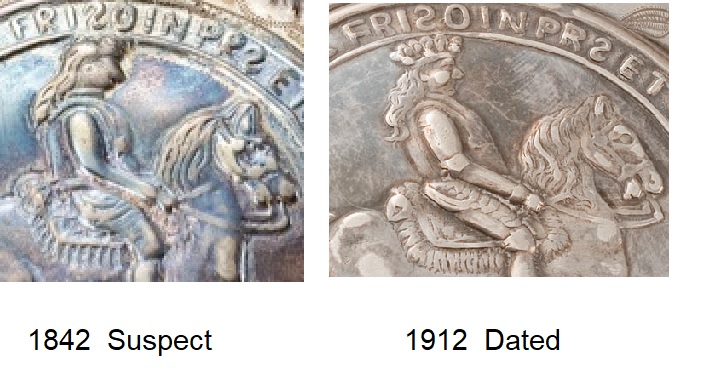 I suspect a really recent forgery with forged jewelers marks. |
|
Pillar of the Community
Belgium
1185 Posts |
hello swamperbob, your point is well taken it seems we meet some of same tricks in the (what should be fun) world of folklore the fraud could here indeed be the silversmith mark (1842) that was stamped on a modern object I am working on a conversation with the Dutch Openluchtmuseum Related to the above, but now concerning "real" coins, is another object from the public collection of the Dutch Openluchtmuseum: 0180-Z.29-65 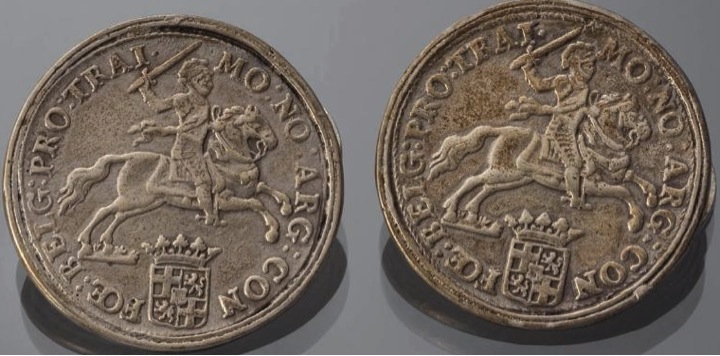 a pair of " Klepstukken" used in the well known fishermen town of Volendam, North of Amsterdam. The Klepstukken are pairs of one large and one small silver coin and are used (for trousers) in a cufflink way. In this example, the large two coins are described by the museum as genuine end of 17th century " (silver riders" of 1793 which are ducatons, about 31 grams, the "fathers of the 8R"  , the small coins are described as a pair of half guilders from king William 3, 1863, 1866). The two ducatons are looking weird, everything seems wrong: - degenerated details of what normally should be a very nice and careful design - the planchet is too large, so that there are rings outside the normal area of the coin - do I see copper color on the surface of the coins? although the pictures are not very good, the half guilders on the other side of the pairs seem "coppery" too: http://data.collectienederland.nl/p...0180-Z.14-69to support my point of a counterfeited 19th century pair of ducatons, see a genuine ducaton from the same Province and year 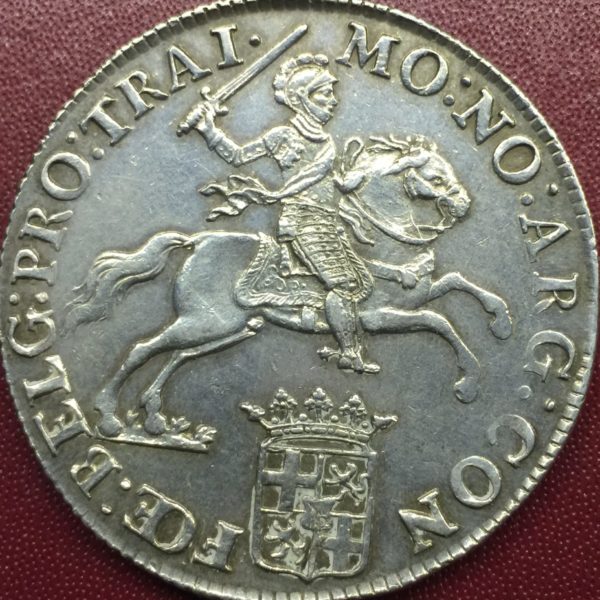 |
|
Pillar of the Community
United States
5362 Posts |
It is obvious from the picture of the pair of coins last posted that they are casts of an already slightly degraded type. They lack the clarity of a struck coin and the minor details are starting to merge. In addition, as you point out, the outer rings are out of place on screw press struck coins.
I see no copper on the surfaces. I believe you are wondering if they may be silver plated copper. You need to be aware that casts are not normally layered as if plated. Casts can be silver/mercury "gilded" but in those cases, a meniscus is usually present at horizontal to vertical transitions. Any form of silver wash is unlikely as well for the same reason. Both tend to wear off of high points easily.
Silver plated over copper using electricity could not date before the 1840s. The procedure was not industrialized until that time. A few experimental pieces of copper plate on silver were made accidentally prior to 1840 but the reverse seems not to have been possible.
Silver plate of the Sheffield type is older than electroplate. In that case the surface silver can be alloyed to match the percentage of silver in genuine coins. Sheffield plate is created by hot welding silver layers over an ingot of copper. After bonded the three layer ingot can be rolled to thin it to a small fraction of the original size. The silver and copper work as if they were a unit and the silver layer can be thinned to a few thousandths. The process dates to 1770 as a single sided plating and a few years later for two sided plate. The edge needed treatment to cover it separately. The first use of a silver ribbon to cover the edge occurred in 1785. After that point the method was widely used.
A cold bonding of silver foil to a copper core was known from antiquity and can be achieved during the strike of a coin. It was rarely used until the late 1770s because the foils was easily destroyed and poorly bonded.
Using the dates of the various forms of silver plating is helpful to determine if the rest of the item makes sense.
|
|
Pillar of the Community
Belgium
1185 Posts |
thanks for helpful explanation, understanding the technology and the time fram it was used is helpful at another section of the nederlandsopenluchtmuseum collection, one can inspect the piece at high resolution: http://www.collectiegelderland.nl/o...werp-z.29-65unfortunately this webpage does not show the other side which could be interesting too, because the half guilders (dated around 1860) may perhaps be silver plated copper counterfeits? low resolution photo of one of the pair below; the color of the half guilder is strange 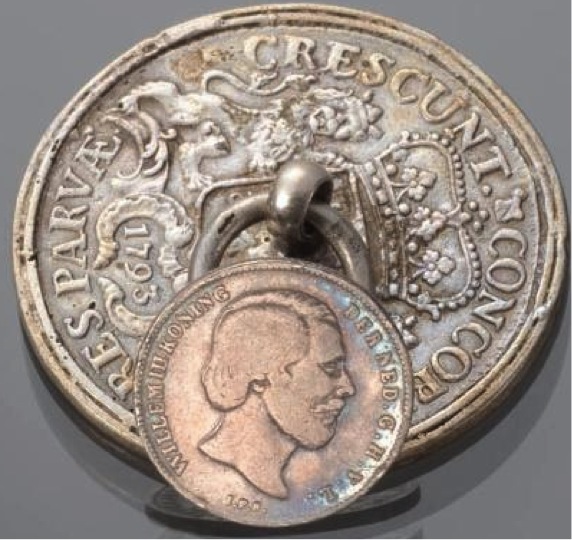 |
|
Pillar of the Community
Belgium
1185 Posts |
Object Z.14_69 in the same collection looks like another pair of counterfeited ducatons (dated 1765, 1790). Impression from the photo's is that an inner plate was attached by the counterfeiters to two outer plates that have the "degenerated" ducaton silver rider; details are poor as in the other pair 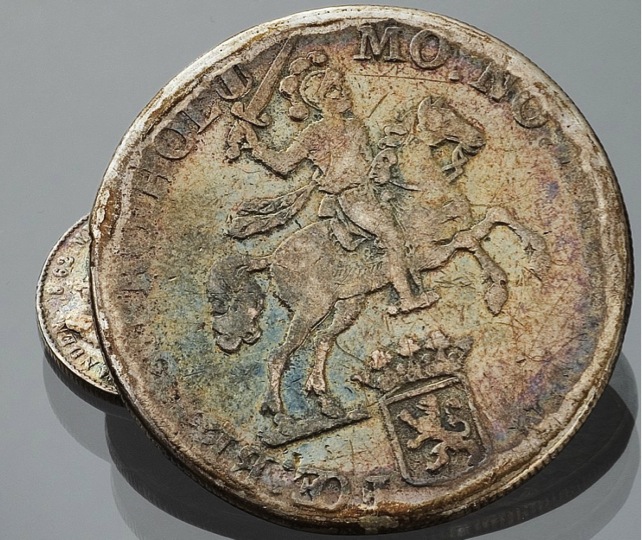 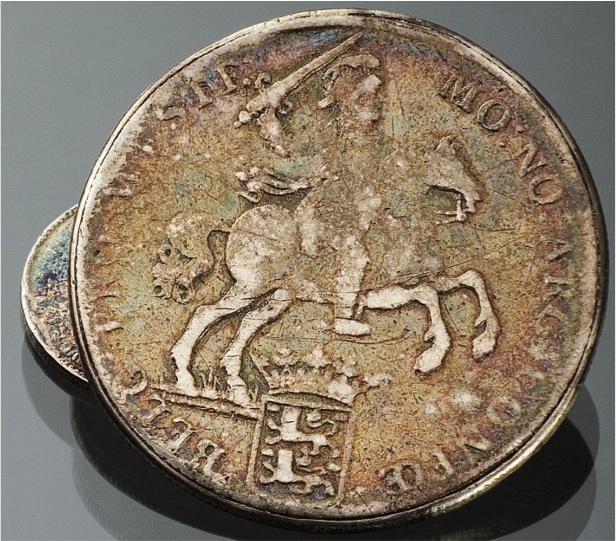 higher resolution images online: http://www.collectiegelderland.nl/o...werp-Z.14-69 |
|
Pillar of the Community
United States
5362 Posts |
I would agree the last pair are clearly cast copies. They are made for jewelry which means they were not originally made as counterfeits meant to pass into circulation. I place all of these 'replicas' jewelry, buttons etc. in their own class. There are many items made using coin motifs which are collectable in their own groups.
However, the technology used and the history of the changes in technology can be used to date counterfeit coins in the same way as buttons. No coin can be made before the technology was invented. It is an axiom that is too often neglected.
|
|
Pillar of the Community
Belgium
1185 Posts |
swamperbob I agree with your idea that also the second pair of ducatons are casts. As far as I can see, the objects 0180-Z.29-65 and Z.14_69 match well as they are the only pieces in this collection based on cast counterfeited provincial 18th century ducatons. There are other pieces with coins that look genuine, but these were made in the 17th century, using different techniques in different regions (Bunschoten and Groningen) than the Volendam area. See example on photo below and photo of other example in the beginning of this thread. The short synthesis is that the rich man jewelry of this kind in the second half of the 19th century was based on big silver plates, that have nothing to do with real coins. The two pairs of cast counterfeit ducatons made after 1850 in Volendam do not match with this evolution and may be the alternative for someone less wealthy. Therefore, there are two possibilities A) these pieces were made by the local silversmith as kind of jewelry and have nothing to do with coins B) these pieces were counterfeits that could not be exchanged for new money when the old monetary system was replaced. It seems of interest to consider B, and I consider A less likely. Indeed, after the French occupation (Napoleontic period), the Netherlands became a kingdom with one centralized mint and silver pieces solely based on a decimal system and the guilder. This means that provincial large silver pieces (ducatons, florins, daalders minted by the seven different provinces) were gradually removed from the circulation to be replaced by new coins. According to the literature (ref 1-3), the final phase of this replacement took place between 1842 and 1849, i.e. not long before the two pairs of "Klepstukken" above were made. It seems conceivable that the authorities organized the exchange on basis of visual inspection, so that old silver coins that looked OK could be exchanged into new types. This must have been a filtering system for obvious counterfeits. So if you were from Volendam where "Klepstukken" were part of clothing tradition and you were in possession of these false ducatons that could not be exchanged, the logic would be to convert them to "Klepstukken". Perhaps pieces from a larger area in the Netherlands found their way to this traditional industry. In this sense, the two counterfeit pairs of the Digital Collection Nederland, (Openluchtmuseum.nl) seem quite interesting. References 1. Dr. H Enno Van Gelder "De Nederlandse Munten" (1970) p171-172 2. A. Vrolik, Verslag van het verrigte tot herstel van het Nederlandsche muntwezen van 1842—1851, 1855; 3. J. Schulman, Handboek van de Nederlandsche munten van 1795—1945, 1946. a pair of Broekstukken (Groningen, after 1785) using genuine ducatons 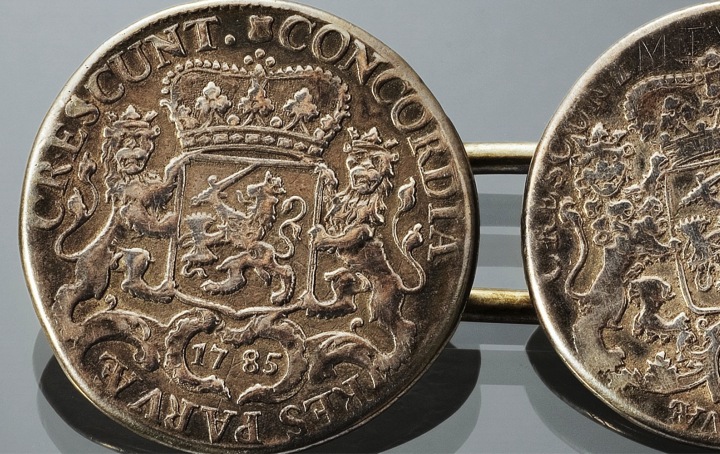 Edited by 1c5d7n5m
01/26/2018 4:20 pm
|
| |
Replies: 20 / Views: 5,185 |










 Posted 01/01/2018 05:02 am


