Wade
A cut-and-paste of my introductionary over-view concerning the ONE PENNY series.
Doctor Courteau identified twenty-four different major die varieties of The St. George Bank of Upper Canada 1852 ONE PENNY tokens and identified them as numbers 234-257 inclusive. Of this number, Doctor Courteau also identifies noted Die-Cracks. The Die-Cracks noted by Doctor Courteau, were not provided an independent designator. Doctor Courteau oftentimes uses the phrase perf. and book. dies (perfect and broken dies). On some tokens the identified Die-Crack is germane to the entire specific variety.
Concerning the 1852 ONE PENNY:
Doctor Courteau's major areas of focus were the size, shape, and positioning of the 2, the size and shapes of the reverse Grass Blades, and whether the Die-Axis was coinage or medal. Doctor Courteau identifies whether the Anchor Ring is perfect or broken. Doctor Courteau identifies defective lettering. Doctor Courteau identifies stray specks, dots, and lines. Doctor Courteau identifies various Die-Cracks.
Doctor Courteau provided no information concerning:
The pattern of lines below the Man's right Arm as all varieties have the same line pattern.
The completeness of the Mantle to the left of the Man's Arm as all varieties have incomplete Mantles.
The Knobs on the Dagger Hilt, as all varieties have two Knobs.
The Reins to the Bridle, as all varieties have full Reins.
The left Leg of the Dragon as all varieties have the left Leg disconnected from the right.
Whether the F in OF is re-cut to the left, as all varieties have the re-cut F.
The number of Anchor Rope Dots betwixt the Sword and Feather as all varieties have the same Anchor Rope Dot pattern.
The number of Oak Leaves betwixt the Sword and Anchor Shaft as all varieties have three Oak Leaves.
Whereas, concerning the 1850 ONE PENNY:
Doctor Courteau's major area of focus was whether the obverse legend had perfect or defective lettering.
Normally, Doctor Courteau identifies whether the Anchor Ring is perfect or broken.
Doctor Courteau also identifies stray specks, dots, and lines. Doctor Courteau identifies various Die-Cracks.
Doctor Courteau provided no information concerning:
The pattern of lines below the Man's right Arm as all varieties have the same line pattern.
The completeness of the Mantle to the left of the Man's Arm as all varieties have incomplete Mantles.
The Knobs on the Dagger Hilt, as all varieties have two Knobs.
The Reins to the Bridle, as all varieties have full Reins.
The left Leg of the Dragon as all varieties have the Dragon's left Leg disconnected from the right.
Whether the F in OF is re-cut, as all varieties have the re-cut F.
The number of Anchor Rope Dots betwixt the Sword and Feather as all varieties have the same Anchor Rope Dot pattern.
The number of Oak Leaves betwixt the Sword and Anchor Shaft.
The completeness of the Grass Blades.
Whereas, concerning the 1854 ONE PENNY:
Doctor Courteau's major area of focus was the positioning of the 4. Doctor Courteau identifies the completeness of the Mantle to the left of the Man's Arm.
Doctor Courteau identifies the various patterns of lines below the Man's right Arm. Doctor Courteau identifies the number of Reins to the Bridle. Doctor Courteau identifies the completeness of the left Leg of the Dragon.
Doctor Courteau identifies the Anchor Rope Dot pattern betwixt the Sword and Feather.
Doctor Courteau identifies whether the Anchor Ring is perfect or broken.
Doctor Courteau also identifies defective lettering.
Doctor Courteau also identifies stray specks, dots, and lines.
Doctor Courteau identifies various Die-Cracks.
Doctor Courteau provided no information concerning:
The Knobs on the Dagger Hilt.
Whether the F in OF is re-cut to the left.
The number of Oak Leaves betwixt the Sword and Anchor Shaft.
Whereas, concerning the 1857 ONE PENNY:
Doctor Courteau's major areas of focus were the Anchor Rope Dot patterns and the size of the Dots within the obverse Rosettes. Doctor Courteau identifies the positioning of the 7.
Doctor Courteau identifies the number, size, and shapes of the Knobs on the Dagger Hilt.
Doctor Courteau identifies the completeness of the Mantle to the left of the Man's Arm.
Doctor Courteau identifies the various pattern of lines below the Man's right Arm.
Doctor Courteau identifies the number of Reins to the Bridle.
Doctor Courteau identifies the completeness of the Dragon's left Leg.
Doctor Courteau identified whether the F in OF is re-cut to the left.
Doctor Courteau identifies the number of Oak Leaves betwixt the Sword and Anchor Shaft.
Doctor Courteau identifies the completeness of the Grass Blades. Doctor Courteau identifies whether the Anchor Ring is perfect or broken.
Doctor Courteau identifies defective lettering.
Doctor Courteau identifies stray specks, dots, and lines.
Doctor Courteau identifies various Die-Cracks.
Doctor Courteau first separates the St. George 1852 ONE PENNY series into four major groupings according to the size and shape of the numeral 2. Group I has a Small 2; Group II has a Narrow 2; Group III has a Large 2; and Group IV has a Wide 2.
Doctor Courteau makes note of whether the 2 points to the left-side, right-side, centre, or betwixt denticles.
Doctor Courteau also describes the shape and positioning of the Grass Blades, and whether or not the Anchor Ring is perfect or broken.
Doctor Courteau also references whether the token has a Medal or Coinage die axis.
Doctor Courteau makes mention of whether the Anchor Ring is perfect (complete) or broken.
Concerning the St. George 1852 ONE PENNY series, Doctor Courteau does not make mention of the number of Oak Leaves in the left quadrant of the Oak Leaf Wreath at the junction of the Sword, Feather, and Anchor. Doctor Courteau used this characteristic diagnostic extensively when discussing
the St. George 1857 ONE PENNY series. The author suppled this data on the St. George 1854 ONE PENNY series, and opted to do likewise of this series.
Doctor Courteau does not indicate:
The number of Reins to the Bridle, as all varieties shew full reins.
The completeness of the Mantle, as all varieties are incomplete.
The lines below the Man's right Arm, as all varieties have a massing of four lines.
Whether the left Leg of the Dragon is complete or incomplete, as all varieties have the Leg complete.
Whether the F in OF is re-cut, as all varieties shew the F re-cut.
The strike of the Man's left Foot, as all varieties shew a complete Foot.
The number of Knobs to the Dagger Hilt, as all varieties shew 2 Knobs.
Whether the Belly of the Horse is perfect or re-cut, as all varieties shew the Belly re-cut.
All varieties have the Oak Leaf Wreath consisting of either two or three small Oak Leaves in the left quadrant (betwixt the Anchor Shaft and the Sword). Of the three leaf varieties, two are upper leaves and one is a lower left-side Leaf. The two upper Leaves are near the Sword while the lower left-side
Leaf is close to the Anchor Shaft. Some varieties do not have the lower left-side Leaf. Care must be taken as not to confuse the central Stem of the Oak Wreath for the lower Oak Leaf. The lower Oak Leaf is not the stem itself, but is affixed to the Stem.
For the sake of uniformity and clarity, seeing Doctor Courteau opted not to identify each and every Characteristic attribute of each and every variety discussed, the author included all relevant data omitted by Doctor Courteau in Section One below Doctor Courteau's narrative discussion of each
variety. The attributes and information presented by the author are normally indicated by italics.
On many tokens the primary characteristic diagnostics may not be readily apparent. The characteristics may be weakly struck, damaged, or worn beyond positive attribution. Some tokens struck from latter states of a die, having extensive Die-Cracks, may not have enough remaining medal mass to fully shew
all the design details. In such cases the investigator must resort to secondary or tertiary markers in order to endeavour to ascertain a specific variety. Normally, by a preponderance of all the evidence, an accurate assessment can be determined. Unfortunately though, the tedious process of elimination is sometimes painstakingly time-consuming. The author never used to have grey hair. Perhaps positive attribution is the culprit.
In any event, your token is Courteau variety 241, having a rarity factor of 1.
My cut-and-paste of Courteau 241...
Dr. Courteau variety 241 R-1 Coinage Die Axis. Narrow 2.
Obverse Characteristics:
Four lines are below the Man's right Arm.
The Mantle is incomplete.
The Man's left Foot is Perfect.
Two Knobs are to the Dagger Hilt.
Two Reins are to the Bridle.
The Belly of the Horse is re-cut.
The left Arm of the Dragon is connected.
The F in OF is re-cut.
The numeral 2 is narrow.
The numeral 2 is slightly further from the numeral 5 than variety 240.
The left-end of the numeral 2 is on-line with centre of the 2nd Denticle to the immediate right of the numeral 5.
Note - Doctor Courteau mentioned the 2 points to the centre of a Denticle. The 2 actually points to the area betwixt the right-side and the centre of the Denticle.
The left end of the numeral 2 is nearer the Denticles.
An imaginary line from the right-side extremities of the numeral 2 (the upper right corner of the vertical of the base, and the apogee), extends slightly to the left of the Knuckle of the lower Toe of the right Foot of the Dragon.
Note - This is a significant characteristic diagnostic differentiating varieties 238 and 241, as variety 238 is nearer the large Knuckle Joint.
The 6th and 7th Mantle Folds are close together.
From perfect and broken dies.
A Die-Crack is to the 3rd A in CANADA.
This straight Die-Crack is from near the Denticle above the left Leg of the 3rd A in CANADA, extending to the top of the same letter.
Reverse Characteristics:
Two Grass Blades shew well.
The lower Grass Blade is longer than the upper Grass Blade, and situated slightly diagonally. Both ends of the lower Grass Blade are cloven.
The upper Grass Blade vaguely resembles that of variety 238. The base of the lower Grass Blade is horizontal and very close to the lower Grass Blade. The upper section of the upper Grass Blade emanates from the right-end of the base of the upper Grass Blade and extends diagonally inward and upward at a 30° angle. The upper section terminates on-line with the mid-section of the base of the upper Grass Blade. The terminal of the upper section is distant from the base of the upper Grass Blade.
Note - The upper section of the upper Grass Blade on variety 238 runs parallel to, and close to the base of the Grass Blade. Both limbs are of equal length. Whereas variety 240 has the upper limb shorter and distant and angling away from the base.
The Anchor Ring is Perfect.
6 ½ well spaced, diamond shaped Dots comprise the section of the Anchor Rope betwixt the underside of the right-side of the Anchor Arm and the underside of the Anchor Shaft.
The Dots are smaller than normal and are in descending order of size. The ½ Dot is attached to the Anchor Shaft.
Die-Clash Marks are to the Anchor and to the left of the Pineapple of the right Cornucopia.
The characteristic mimic of the Man's Back is through the lower right Anchor Arm. A section of the right Leg of the Horse is evident betwixt the end of the upper right Anchor Arm and the right Cornucopia.
From perfect and broken dies.
A Die-Crack is to the T in TOKEN.
This straight Die-Crack is from along the right-side of the Denticle to the immediate right of the Serif of the right Arm of the T in TOKEN, running along
the right-side of the vertical of the same Serif, and exiting to the Shield, slightly to the right of the upper corner of the Shield.
Note - Latter state specimens may shew small lines emanating from the Stands and Serifs. This is probably caused by 'die-chatter,' as the result of the die not being properly secured.
Thus:
241 Perfect - no Die-Crack.
241A A Die-Crack is to the T in TOKEN.
241B Die-Crack as above, plus a Die-Crack is to the 3rd A in CANADA.
This is the Die-Crack progression.
Wade,
Great high-grade token. An astute observation of being a weak / soft strike of a high grade ensample. The soft strike prevents this from being MS-63, but I would not squabble with a MS-62.
doug
Edited by colonialtokens
01/30/2018 6:59 pm







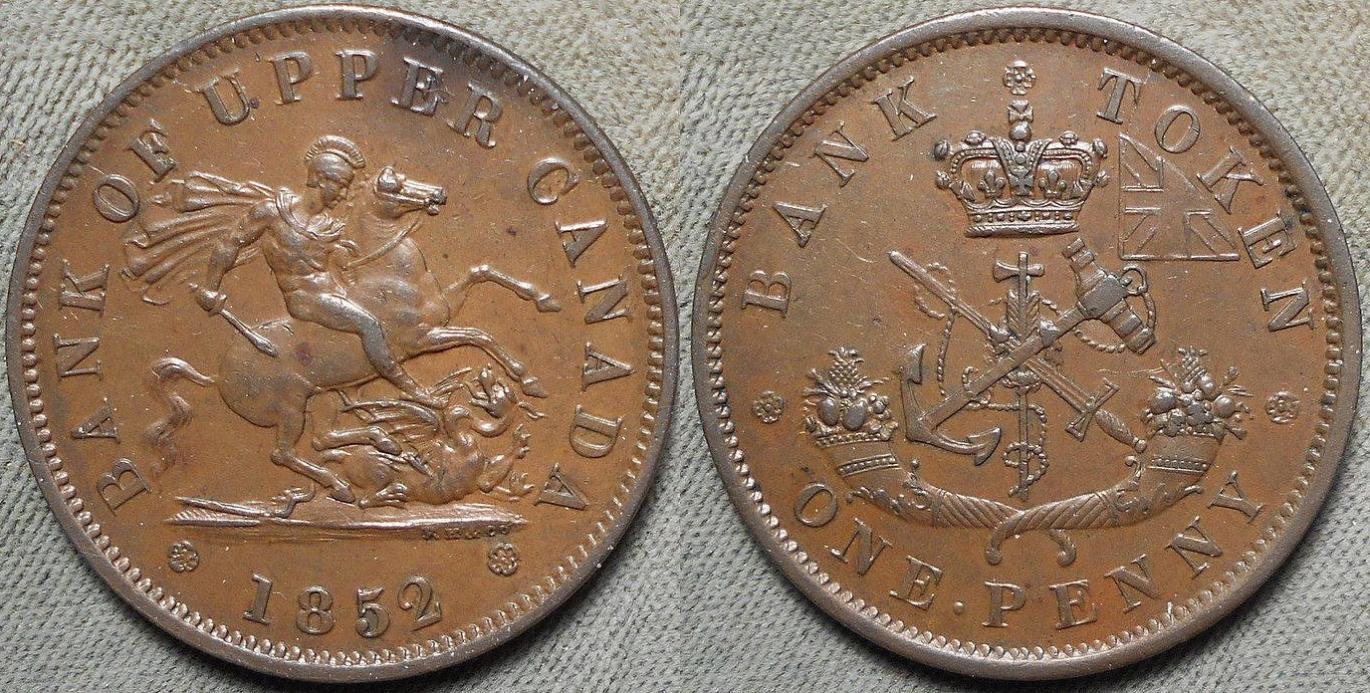


 Posted 01/30/2018 12:21 pm


 I don't know much about token's but it looks uncirculated nice coin



