| Author |
 Replies: 50 / Views: 8,735 Replies: 50 / Views: 8,735 |
|
Valued Member
269 Posts |
This 302406106431 is a current auction for a 1923 threepence. It isn't cheap but I'm thinking of clicking it. 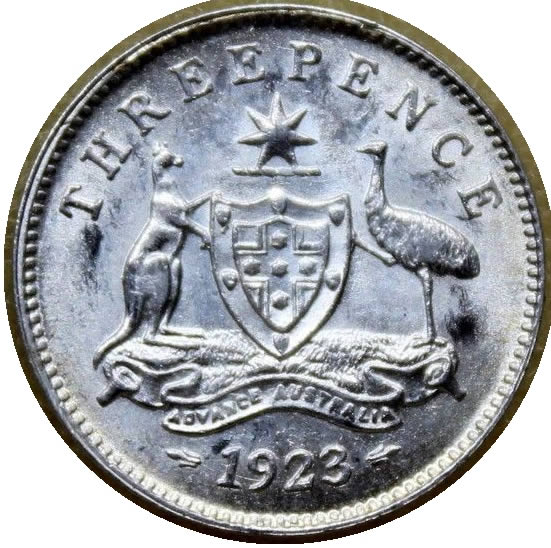 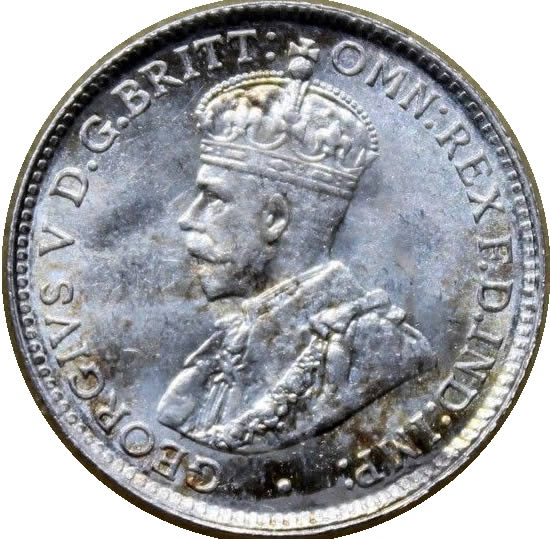 The target grade is MS62 up - and this is a buy. If it's AU**, it's a pass. 1923 Threepences are rare and valuable in elite grades. The center pearls and blunt star don't matter here. For a comparison, below is an MS64 that sold a while back for $4,600 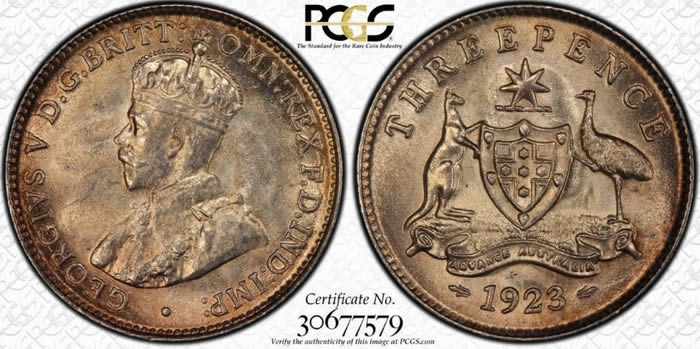 Do we have any threepenny bit experts? Edited by CoinOS
02/25/2018 04:05 am
|
|
|
|
Pillar of the Community
Australia
908 Posts |
I would grade it at MS63 being held back from a higher grade by the weak strike and before
anyone says its not unc they should look at the fields which are virtually mark free so it
obviously has never been circulated
|
|
Pillar of the Community
Australia
607 Posts |
Its a FAKE and the other threepences this seller has are also fake.
DON'T BUY IT
Watch your top knot
Edited by echidna
02/25/2018 05:22 am
|
|
Bedrock of the Community
Australia
21794 Posts |
Nice luster, but only 6 diamonds in the headband of the crown.
Not much definition in the beard or King's mustache. (obv.)
Not much definition in the faces of the kangaroo or emu.
No definition at all in the center of the star above the shield.(rev.)
I wouldn't be happy with it.
|
|
Valued Member
 269 Posts |
Quote:
Its a FAKE and the other threepences this seller has are also fake. 10-4 copy that. Any particular reason? |
|
Pillar of the Community
Australia
1372 Posts |
Quote:
Its a FAKE and the other threepences this seller has are also fake.
DON'T BUY IT I'm relatively new to this hobby and it concerns me when I read such differing views from people who appear to be knowledgeable in this field. Another thing that surprises me is the number of desirable Australian predecimal coins that are only available overseas? |
|
Pillar of the Community
Australia
607 Posts |
Very high quality fakes are coming on to the market.
They look very genuine and often have some "toning" and "chatter".
The key to identification is the rims.
Look for the extra high rim on the very outside.
Most noticeable on the 1917 threepence this seller has for sale.
Look at all of them together and they all have the same issue.
Watch your top knot
Edited by echidna
02/25/2018 07:45 am
|
|
Pillar of the Community
Australia
1372 Posts |
Quote:
Very high quality fakes are coming on to the market.
They look very genuine and often have some "toning" and "chatter".
The key to identification is the rims.
Look for the extra high rim on the very outside.
Most noticeable on the 1917 threepence this seller has for sale.
Look at all of them together and they all have the same issue. I see what you mean but it doesn't seem to make any sense ... if someone goes to all the trouble of faking a coin you would think that 'fixing' this minor rim problem wouldn't be a concern. My other worry is how is it possible for so many uncirculated, or close to, predecimal coins are still available to buy when it comes to silver as compared with bronze coins of the same era? |
|
Valued Member
269 Posts |
Quote:
Look for the extra high rim on the very outside. 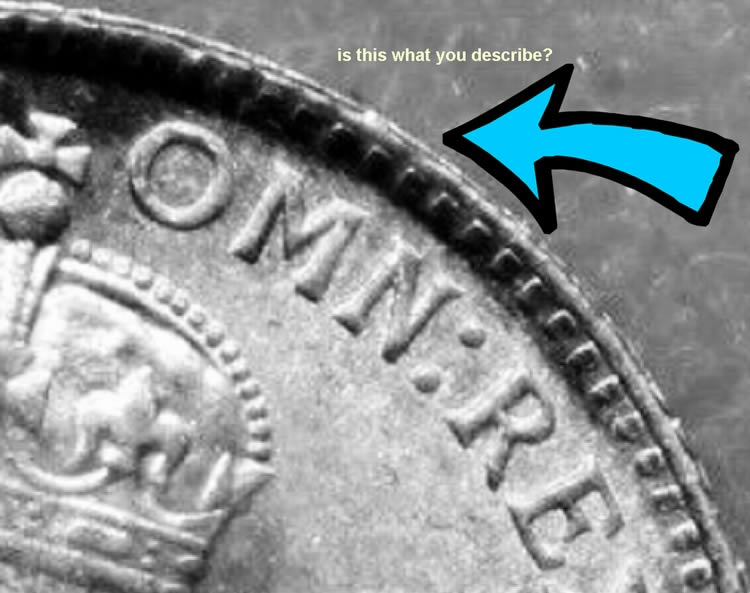 Here is his threepence. I assume that what my arrow points to is the area of concern, and has you questioning the coins authenticity. Here [below] is a verified threepence. 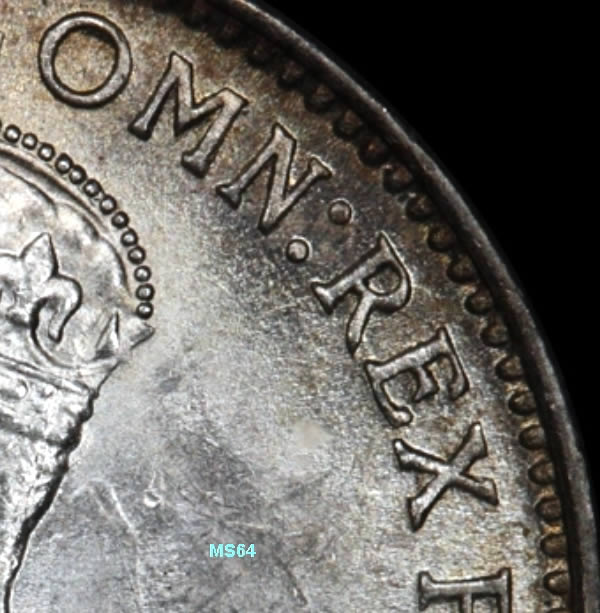 There is something worth a discussion there, but calling him out is premature. You are not yet certain. When photographing coins most sellers use vertical aerial photography which is sometimes insufficient. I have asked the seller to provide further photos taken at about 45 degrees. He may or may not oblige me, we shall see. To be continued.. |
|
Pillar of the Community
Australia
607 Posts |
I'm certain they are fakes.
Re the diagram - yes that is what I'm referring to.
You need to look at the 1917 threepence though.
The extra rim is more obvious on that one.
Also check out the 1911 shilling - I reckon its fake also.
Same issue with the rims but more subtle.
Watch your top knot
Edited by echidna
02/25/2018 10:46 am
|
|
Pillar of the Community
United States
4883 Posts |
There's a basic principle in play here that hasn't been remarked upon.
If you're selling a rarity (either conditional or absolute) why wouldn't you have it certified? The cost involved is easily made up in the ultimate sale price, and the piece's saleability skyrockets in any case. The obvious explanation is that the seller suspects (or worse, knows for certain) it won't pass muster.
There's a reason why Stack's Bowers, Heritage, Goldberg, et al only deal in reliably certified coins. If they wouldn't consider offering such as this to their customers, why should you buy it?
Colligo ergo sum
|
|
Valued Member
269 Posts |
Quote:
You need to look at the 1917 threepence though.
The extra rim is more obvious on that one. I have looked at the 1917. Symptoms presenting: Apparent gyratory interstice or radial cracking intermittently occurring at rim/edge junction. Presumption of counterfeiting via empirical evidence-based imaging as supplied by seller. Diagnosis: No conclusive diagnostic decision is currently possible. Awaiting further linear-scaled angular imaging of subject. Prognosis: Don't shoot Skippy 'til we know for sure. Pro Tip for beginning variety/error/fake collectors: Go here >> http://www.error-ref.comQuote:
If you're selling a rarity (either conditional or absolute) why wouldn't you have it certified? Money. Quote:
I'm certain they are fakes.  I'm not. # |
|
Pillar of the Community
Australia
1372 Posts |
Quote:
Symptoms presenting:
Apparent gyratory interstice or radial cracking intermittently occurring at rim/edge junction.
Presumption of counterfeiting via empirical evidence-based imaging as supplied by seller.
Diagnosis:
No conclusive diagnostic decision is currently possible.
Awaiting further linear-scaled angular imaging of subject.
Prognosis:
Don't shoot Skippy 'til we know for sure. Lost me at 'apparent'!  |
|
Valued Member
269 Posts |
Quote:
My other worry is how is it possible for so many uncirculated, or close to, predecimal coins are still available to buy when it comes to silver as compared with bronze coins of the same era? Hi. Silver is less susceptible to oxidation and corrosion. At the time it was more likely to be hoarded. Interestingly, Australian pennies and halfpennies are the same bronze alloy as our decimal 1c and 2c coins. Quote:
Lost me at 'apparent'! I got lost long before that. Quote:
The key to identification is the rims. I don't even know what I'm seeing in that image I posted with the blue arrow. This is going to remain a cold case, unsolved unless: 1. Some expert here sorts it out. 2. I buy the coin and send it to NGC. Edited by CoinOS
02/26/2018 11:30 am
|
|
Pillar of the Community
United States
5825 Posts |
For that price I'd want it at least authenticated.
|
|
Pillar of the Community
United States
992 Posts |
The coin is a fake, no doubt about it. Just look at the comparison photos that you yourself provided. Complete lack of detail, and spacing and shape of rim dentition is obviously different from the genuine coin. You can clearly see two rims on the fake coin, the rim that appears genuine, and outward, a thin 'rim' or sprue that surrounds the other. That is the second rim, and identifies most fakes as being pressure cast. This results from the metal being poured into the mold before pressing. This is much worse than a 'weak strike', but you can talk yourself into accepting it as genuine if you want, such things are very easy to do. Prudence alone would dictate a pass on this coin until it's certified and graded. There is a reason why expensive rarities are offered on ebay without certification, and this is it. Edited by paxbrit
02/26/2018 12:08 pm
|
| |
Replies: 50 / Views: 8,735 |




 Posted 02/25/2018 04:37 am





