| Author |
 Replies: 10 / Views: 1,737 Replies: 10 / Views: 1,737 |
|
|
Pillar of the Community
Canada
955 Posts |
|
|
|
|
Valued Member
Canada
291 Posts |
Very nice. Large 2 variety.
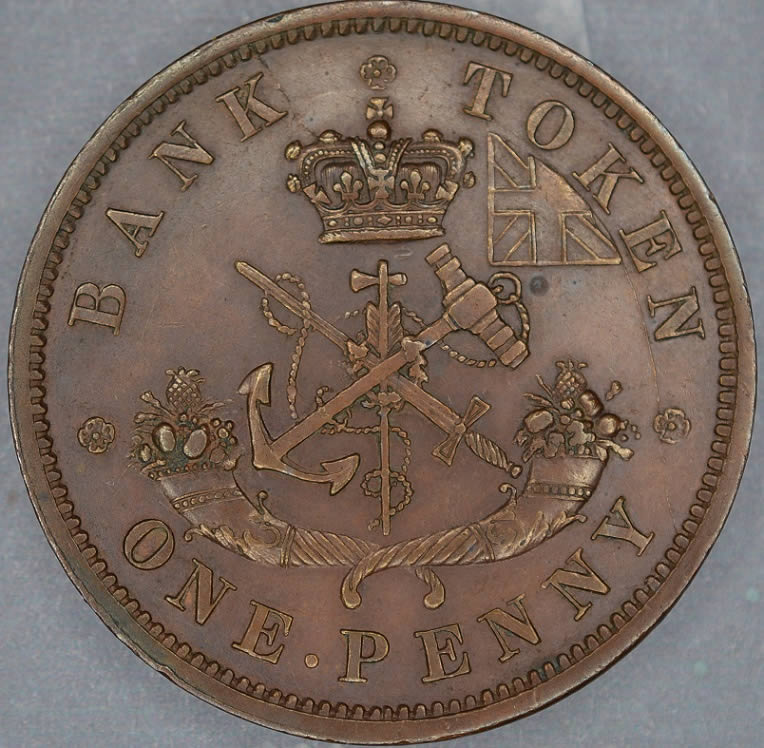
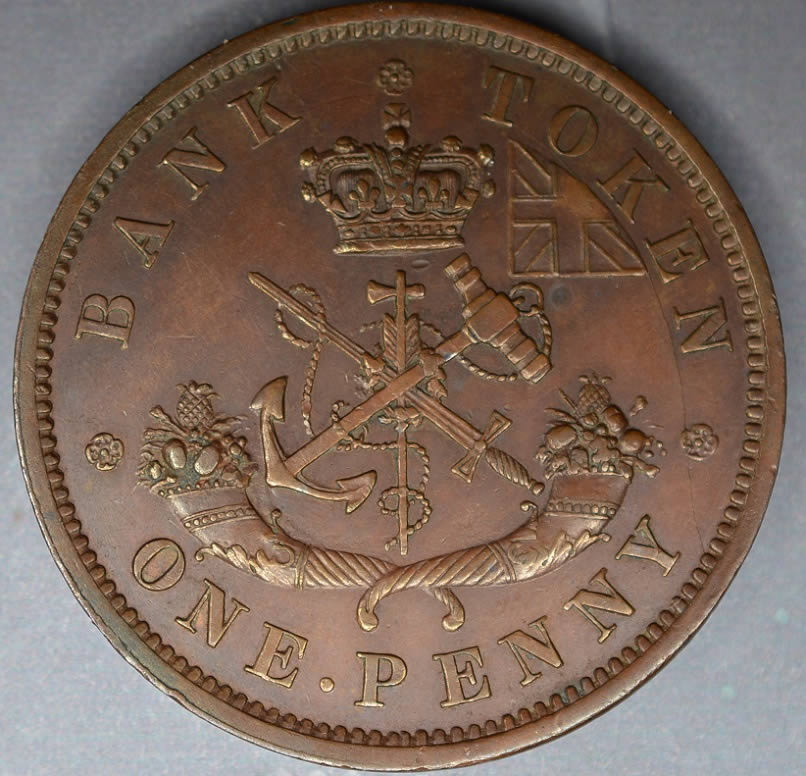
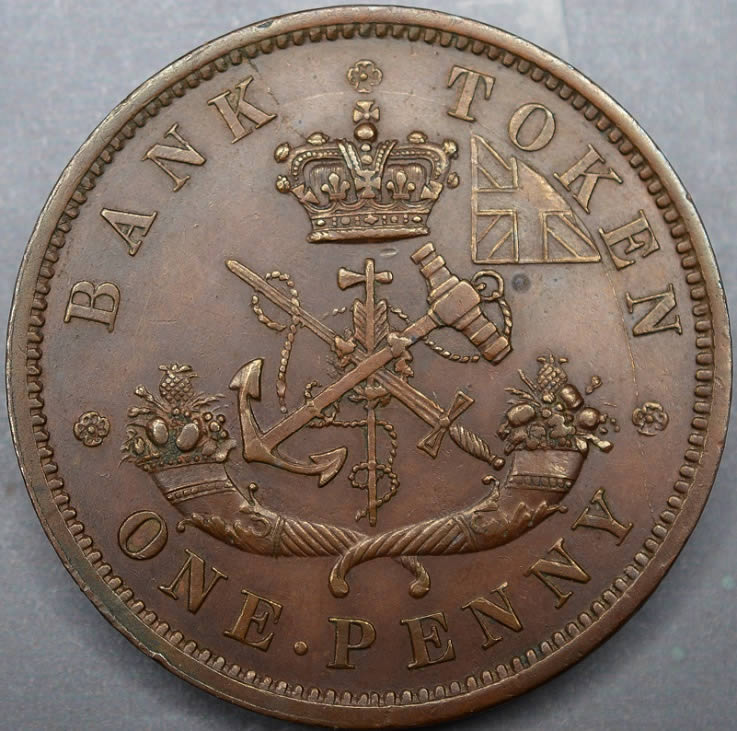
There is some wear on the chest strap and leg on the reverse and on the cornucopia and highest cross on the crown on the obverse. I'd think it's EF, maybe AU
|
|
Pillar of the Community
Canada
2784 Posts |
most definitely the AU range, 55, possible 58 if not accounting for the cleaning it had a long time ago.
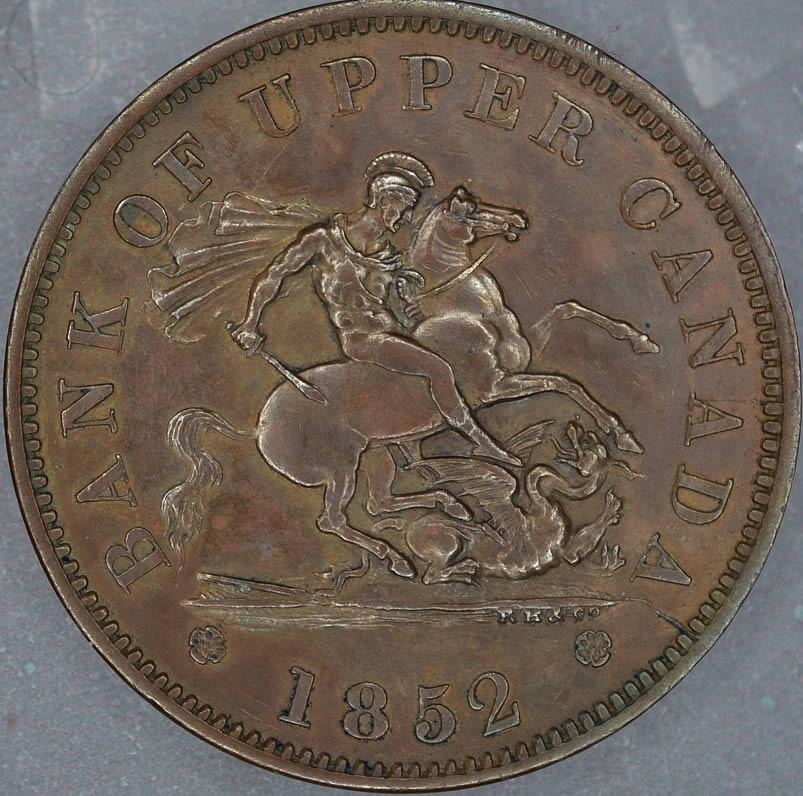
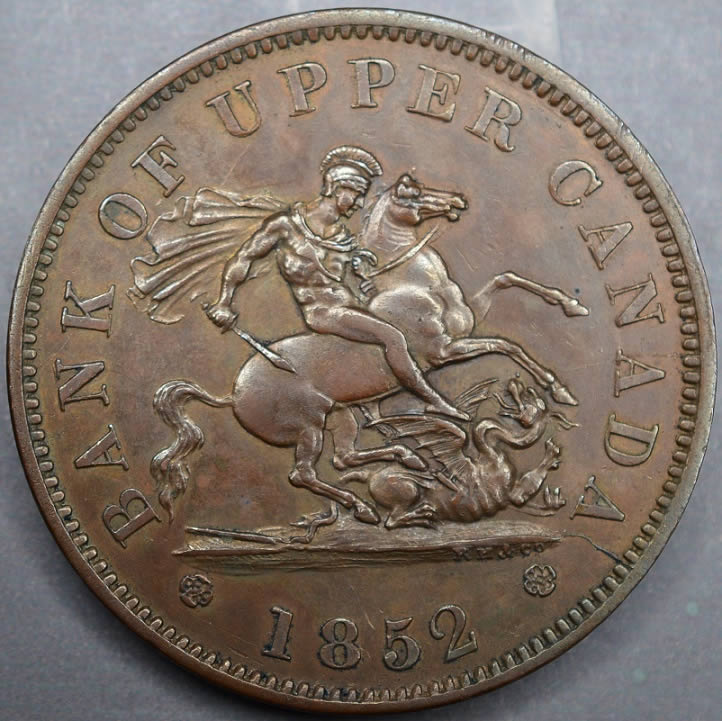
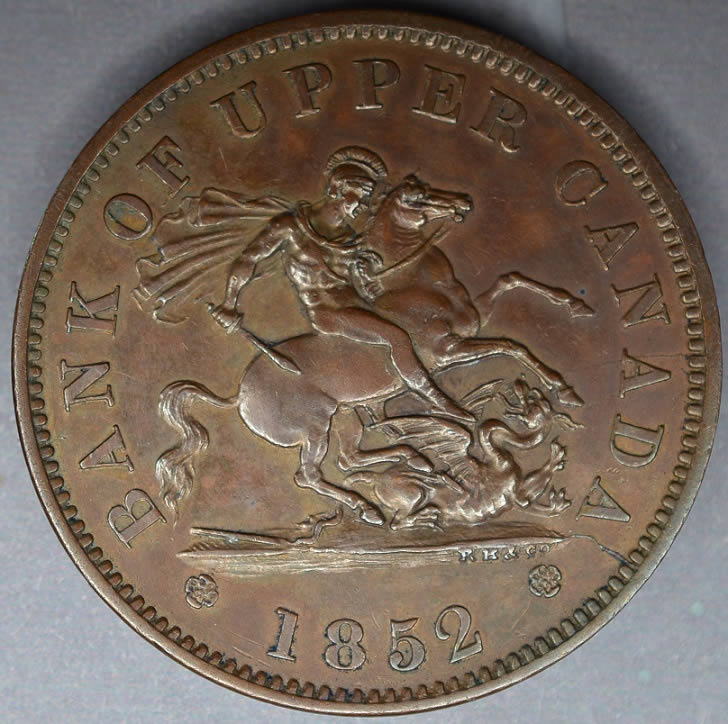
OBV very well struck,
REV shows a tad bit of wear on the crown's center & flanking Fleur-dis-lis.
The rope that crosses the anchor still has some definition, which saves it from sliding to XF.
Some verdigris present in the cornucopia (easily attended to), but I suspect it shows better in hand.
If this were a 1/2 P it would easily be mint state, but as a 1P we expect a little more :)
Some nice die cracks forming on the REV between 11 - 4 o'clock. I don't think this die lasted much longer before shattering that section completely.
|
|
Pillar of the Community
 Canada
5607 Posts |
Also a huge D/C at 4:30 on the Obv and a small one at 3:00
|
|
Pillar of the Community
United States
1101 Posts |
Nice AU token. Quote:
Not really a collector of these You might be after Doug tells you all about this one  |
|
Pillar of the Community
United States
7214 Posts |
|
|
Bedrock of the Community
Australia
21789 Posts |
I must admit: if it came my way, I wouldn't be able to walk away from it, either.
Despite this,
it surprises me how many of this type turn up in AU or better condition. Maybe some of our Canadian friends can tell us 'why is it so'? **
There is a flat spot halfway down the right cornucopia, but none like this to be seen anywhere else; maybe a slightly filled die at this point. (Other tiny flat spots on high points exist.)*
Interesting radial die crack to be seen on the reverse.
Small but obvious carbon spot to be seen.
The lack of small nicks and scratches in the fields is pushing me to think in terms of MS grades, especially with the variation in lighting angles.
Because the lighting angle fail to show up any noticeable nicks and scratches, I think
MS64. (Nevertheless. I understand why an AU58 opinion is offered.)*
** Quote from Professor Julius Sumner Miller.
|
|
Pillar of the Community
United States
840 Posts |
Canacoins,
Nice token and great photos.
Wade posted an astute grading evaluation...well done Wade.
The following are cut-and-paste extracts of my work on this series.
"The St. George Bank of Upper Canada series are typically full weight and professionally minted. Minor axis
rotation is rather common and affords virtually no premium. Likewise, hub doubling or shift entry doubling is also
commonly encountered and affords scant premiums. Minor axis rotation and hub doubling are the result of the
manufacturing process and do not constitute independent die varieties. For the most part, the St. George Bank of
Upper Canada ONE PENNY series are of excellent workmanship.
It should further be noted that the St. George series was the 'work-horse' of the commerce of the time (especially
the 1850, 1852, 1854 issues). The primary reason many of the 1857 issue have survived in comparably higher
grades is that Canadian decimal coinage commenced one year later (1858) which rendered the tokens basically
obsolete. Many of the recently issued 1857's saw scant use compared to the other dates of the series which
experienced extensive circulation.
Of all the Canadian Colonial tokens, the St. George Bank of Upper Canada ONE PENNY series far surpasses all
others by their overall beauty, extensive detail, and superb degree of craftsmanship. This anomaly proves the
culprit of considerable disappointment amongst typical collectors of Canadian Colonial tokens. The St. George
Bank of Upper Canada tokens cannot be graded according to the traditional Standards of most typical Canadian
Colonial tokens. Many collectors, overawed by the extensive detailing of this series tend to over-grade by several
grading levels. The authors' have seen far too many nice St. George Bank of Upper Canada tokens (except those
graded by ICCS, CCCS, PGCS, NCG., or equivalent Third Party Grading firm), being promoted as in Mint-State
condition, when in actuality they are really no better than Extra Fine.
237 R-1 Coinage Die Axis. Narrow 2.
Obverse Characteristics:
Four lines are below the Man's right Arm.
The Mantle is incomplete.
The Man's left Foot is Perfect.
Two Knobs are to the Dagger Hilt.
Two Reins are to the Bridle.
The Belly of the Horse is re-cut.
The left Arm of the Dragon is connected.
The F in OF is re-cut.
The numeral 2 is narrow.
The numeral 2 is distant from the numeral 5.
The left-end of the numeral 2 is on-line with the centre of the 2nd Denticle to the immediate right of the numeral 5.
An imaginary line from the right-side extremities of the numeral 2 (the upper right corner of the vertical of the base, and the apogee), extends to the left-end of the Knuckle of the lower Toe of the right Foot of the Dragon.
The Serif of the right Upright of the N in BANK is re-cut.
Oftentimes having Rust Spots to the left of the right Rosette.
Note - Rust Spots are blemishes caused by being struck by dies pitted with rust spots.
Note - This feature may not be readily discernable on lower grade ensamples.
The 6th and 7th Mantle Folds are close together.
From perfect and broken dies.
A Die-Crack to the right point of the ground.
This serpentine Die-Crack is from betwixt the 2nd and 3rd Denticles to the immediate right of the 3rd A in CANADA, extending to the tip of the right ground.
A Die-Crack is to the numeral 1.
This Die-Crack is from the left section of the Denticle below the right-side of the Stand of the numeral 1, extending to the lower right corner of the same Stand.
Terminal die-states have the Die-Crack exiting the upper section of the right-side of the Upright of the same numeral, and extending diagonally into the field, and bending upward, extending through the ground, exiting to the lower section of the Tail of the Dragon.
Note - This Die-Crack was not mentioned by Doctor Courteau.
A Die-Crack is to the N in BANK.
This Die-Crack is from the left-side of the Denticle above the right Upright of the N in BANK, extending to the Serif of the same Upright, on-line with the left-side of the same Upright, and exiting the left corner of the base of the same
Upright, and exiting to the upper left section of the upper curve of the Tail of the Horse.
Note - This Die-Crack was not mentioned by Doctor Courteau.
A Die-Crack is to the K in BANK.
This Die-Crack is from the left-side of the Denticle above the right Upright of the N in BANK. This Die-Crack is from the same point of origin as the previous. The Die-Crack extends diagonally through the K in BANK, exiting the right-side of the Stand of the Leg of the same Letter, and extending through the upper corner of the 5th Mantle Fold, exiting the upper section of the 2nd Mantle Fold, and passing close to the lower right section of the you in UPPER, extending to the mid- section of the left-side of the Upright of the 1st P in UPPER, exiting the top of the same letter and exiting to the right corner of the Denticle above the right-side of the same letter.
Note - This Die-Crack was not mentioned by Doctor Courteau.
A Die-Crack is to the 2nd A in CANADA.
This relatively straight Die-Crack is from along the right-side of the Denticle above the left Leg of the 2nd A in CANADA, extending through the lower section of the same Leg, exiting the Stand of the same Leg, and exiting to the Ankle of the right Foreleg of the Horse.
Some ensamples have the Die-Crack forking mid-way betwixt the A and the Hoof. The branches run parallel.
Note - This Die-Crack was not mentioned by Doctor Courteau.
A Die-Crack is to the DA in CANADA.
This Die-Crack is from the centre of the Denticle above the right-side of the Stand of the right Leg of the 2nd A in CANADA, extending across the tops of the DA in the same word.
Reverse Characteristics:
Two Grass Blades.
The Upper Grass Blade is short and weakly struck.
The lower Grass Blade is much longer and normally struck.
The Serif of the right Arm of the 2nd N in PENNY is slightly re-cut to the right.
The Anchor Ring is Perfect.
6 ½ bold, widely spaced, mostly diamond shaped Dots comprise the section of the Anchor Rope betwixt the underside of the right-side of the Anchor Arm and the underside of the Anchor Shaft. The Dots are situated in descending order of size, and the last full Dot is nearly round. The ½ Dot is attached to the Anchor Shaft. The 'relief' betwixt the Dots is poorly executed.
From perfect and broken dies.
A Die-Crack is from the Shield through the right Rosette.
This long Die-Crack is from the lower right corner of the Shield, extending below the E and N in TOKEN, and continuing through the left Lobe of the right Rosette.
Terminal die-states have the Die-Crack emanating from the Die-Crack near the Stand of the Leg of the K in BANK (next to be discussed), and curving through the lower Lobe of the upper Rosette, and the lower section of the Upright of the T in TOKEN, passing betwixt O in the same word and the Shield, and entering the Shield, on-line with the Upright of the K in the same word.
The Terminal die-states have the Die-Crack continuing to the right-section of the Denticle below the Serif of the right Arm of the Y in PENNY.
A Die-Crack is to the Crown.
This Die-Crack is from along the right-side of the Denticle immediately to the right of the K in BANK, extending to the left-side of the left-side inner upper Crown Jewel. The Die-Crack intersects the previously discussed Die-Crack.
Note - This Die-Crack was not mentioned by Doctor Courteau.
Thus:
237 Perfect - no Die-Crack.
237A A Die-Crack is from the Shield to the right Rosette.
Die-Crack as above, plus a Die-Crack is to the right point of the ground.
237B Die Cracks as above, plus a Die-Crack is to the 2nd A in CANADA.
237C Die-Cracks as above, plus a Die-Crack is to the N in BANK (obverse).
237D Die-Cracks as above, plus a Die-Crack is to the Crown.
Die-Cracks as above, plus a Die-Crack to the K in BANK (obverse).
327E Die-Cracks as above, plus a Die-Crack is to the DA in CANADA.
Die-Cracks as above, plus a Die-Crack is to the numeral 1.
Note - Many Die-Cracks were not mentioned by Doctor Courteau.
This is the Die-Crack progression."
Your ensample appears to be from the fifth state of the die. Their is a known sixth state.
Enjoy
doug
Edited by colonialtokens
03/22/2018 10:54 am
|
|
Bedrock of the Community
Canada
10743 Posts |
Easily, MS-60 BN. beautiful.  |
|
Bedrock of the Community
Australia
21789 Posts |
colonial tokens: Thanks for the shcolarly depth of information on these.  |
|
Pillar of the Community
 Canada
955 Posts |
Quote:
colonial tokens:
Thanks for the scholarly depth of information on these. And I re-iterate that statement . Thank you colonialtokens and I will "enjoy" for hours most likely. And the token does show quite evident ( not in these pictures) hub doubling . Thanks again |
| |
Replies: 10 / Views: 1,737 |
|










 Posted 03/22/2018 12:37 am


