| Author |
 Replies: 14 / Views: 983 Replies: 14 / Views: 983 |
|
|
Valued Member
United States
142 Posts |
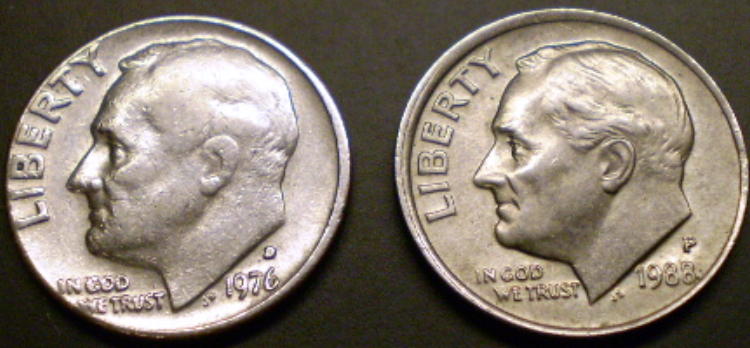
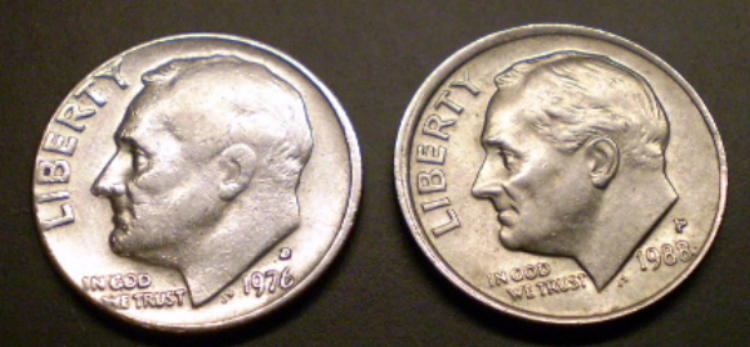
The one on the right is a misaligned die error, but what is the one on the left? Is it also a misaligned die? I thought it was a clipped planchet but the edge is reeded all the way around. Also, the Roosevelt bust on the left looks bigger than in the right coin. Anybody know why? Image:  P6230005.jpg P6230005.jpg61.98 KB Image: P6230004.jpg56.03 KB |
|
|
|
Rest in Peace
United States
1943 Posts |
The one on the right is a normal coin. It is off centered a little but well within tolerance. The one on the left is a slightly misaligned die if the reverse is centered. To command a premium it should be off enough that part of the letters are missing. This one isn't off enough to go into the letters yet.
|
|
Pillar of the Community
United States
3507 Posts |
Hi,
By looking at only one side of a coin it is impossible to say on coins like this if they are misaligned die strikes or very slight off-center strikes.
If the obverse is off centered a little and the reverse is centered, then these coins are misaligned die strikes.
If the obverses and reverses are off centered equally on either or both coins then they are slightly struck off center.
Also if the reeding is complete, the collar was involved in the strike.
Off center strikes are struck without a collar so the reeding would be disrupted or missing.
I'm leaning toward misaligned dies but I need to see the reverses of both coins to be sure.
The sizes of the heads is due to the master hubs being redone somewhere between 1976 and 1988. Nothing unusual about the sizes of the heads.
Thanks,
Bill
Edited by foundinrolls
06/22/2008 12:45 am
|
|
Bedrock of the Community
United States
62064 Posts |
When comparing size of devices on coins, always best to compare from the same year. The only exception to that rule would be the large/small dates. Also the Wide/close AM would also be an exception. But changes happen to some coins yearly, others in several years.
|
|
Pillar of the Community
United States
3640 Posts |
Interesting. I was reading Found in Rolls thread and that seems to make sense. But then, I have a Roosevelt dime that is both a misaligned die strike (off only on the obverse) along with an off center strike (no reeding/no collar) H'mmm... I call it a broadstrike. Not a real wide one but ? Is that the correct term then for a broadstruck coin ? |
|
Member
United States
3242 Posts |
Bill  |
|
Rest in Peace
United States
1943 Posts |
I'll take a stab at this and then see if Bill agrees. The difference between an off center and a broadstrike is the centering of the strike. If the strike is perfectly centered then it is a centered broadstrike. If the strike is off center but the whole design is still visible then it is an off centered broadstrike. If the strike is off center and any part of the design is missing then it is an off centered strike. All of the above are strikes without a collar.
|
|
Valued Member
United States
405 Posts |
So an off-center strike can't occur unless the collar was missing during the strike?
Edited by seattleMD
06/23/2008 11:45 am
|
|
Rest in Peace
United States
1943 Posts |
I don't see how it could be there. If I understand the mechanics right, the collar is a ring shaped die that fits around the lower die. The feeder finger positions a planchet over the lower die then moves back out of position. The collar then comes up from around the lower die surrounding the planchet while the upper die comes down applying the strike. The force of the strike causes the planchet to spread outward until it is captured in the collar producing the square edge or reeding depending on the coin. If the planchet is off center the force of the upper die coming down pushes the collar back down during the strike keeping it from affecting the finished strike. As I said, this is my interpretation of the striking process. Let' see what the experts have to say.
|
|
Pillar of the Community
United States
3507 Posts |
Coop said: "When comparing size of devices on coins, always best to compare from the same year. The only exception to that rule would be the large/small dates. Also the Wide/close AM would also be an exception. But changes happen to some coins yearly, others in several years." I am going to add that I am working on a circulation strike dime now that has different reverse designs:-) They are minted in the same year. I don't want to divulge the date yet until I do some further study on the two coins. I am not sure yet if this is a mid-year design change or a proof die that got used for circulation strikes. In any case, the reverses are vastly different. A couple of points would be that coop is 1000% correct when he says to check coins of the same year to determine if there might be a design change that would constitute a sub-type or variety. Coins of different dates can be like comparing apples to pomegranates:-) They can both be round and red but everything else is different:-) The next point would be, to be open to any possibility especially with Roosevelt dimes. There needs to be more work done on the series of Roosevelt dimes. I'm betting there could be more interesting stuff to be found. Thanks, Bill |
|
Bedrock of the Community
United States
62064 Posts |
|
|
Pillar of the Community
United States
3507 Posts |
Hi, Some might disagree with the terminology being used. This is my understanding: A centered-broadstrike would be a coin that is struck centered, with no collar that becomes oversized with respect to it's diameter due to the metal filling the void created by the missing collar during a malfunction involving the collar. Off-centered broadstrike is a term that is not used. (At least it shouldn't be) The coin is struck without the collar engaged but is in the coining chamber so the planchet is really not off centered during the strike. An off-center struck coin is simply that, struck without a collar with the entire planchet not contained within the coining chamber. There are different types of collars used. Some are complete rings that are down inside the coining chamber. ( I am not sure of the collar's position relative to the anvil die) They are 5/1000ths of an inch larger than the die. The planchet is fed (there are two types of feeder mechanisms depending upon the presses used) (one uses feeder fingers others use a ring type of feeder)into the coining chamber. Anyway, the planchet is struck and is ejected from the coining chamber by a movement of the anvil die, controlled by a cam the newly struck coin is pushed up past the collar and released. The reeding, if a part of the collar is imparted to a coin during the strike. Another type of collar , like the ones used on Proof Presidential dollars is in segments and actually surrounds the edge of the coin during the strike and that imparts the details from the collar to the coin. If I left something unanswered, just narrow it down to another question:-) Thanks, Bill Edited by foundinrolls
06/23/2008 2:20 pm
|
|
Pillar of the Community
United States
3507 Posts |
Indian 1, your coin sounds like a broadstrike.
Without seeing it though, I can't be sure.
Thanks,
Bill
|
|
Valued Member
United States
405 Posts |
Cool video Coop - thanks for sharing. I wish it showed more detail on the striking though. I'd specifically like to see how the collar comes into play.
|
|
Rest in Peace
United States
1943 Posts |
Thanks Bill. I was hoping someone would come on and help me out. I guess I picked up the off centered broadstrike term from some of the auctions. If you go to the Heritage archives under errors and search for broadstrike you will find uncentered broadstrikes. But this doesn't mean the term is correct. But I had to check Heritage out right away because I was worried that I might have picked the term up from ebay and then I would really have to hang my head in shame. |
| |
Replies: 14 / Views: 983 |
|










 P6230005.jpg
 P6230004.jpg


 Posted 06/22/2008 12:42 am


