Another find from an "unknown ancient coin" listing.
This is an AE Ant of Numerian (Carus' son) -- the reverse legend translates roughly to "conquering/victorious everywhere" or "conquerors/victors all around/on all sides" depending on if you take VICTORES as an adjective or a noun -- perhaps an intentional bit of wordplay.
Unfortunately, it was somewhat of an exaggeration...
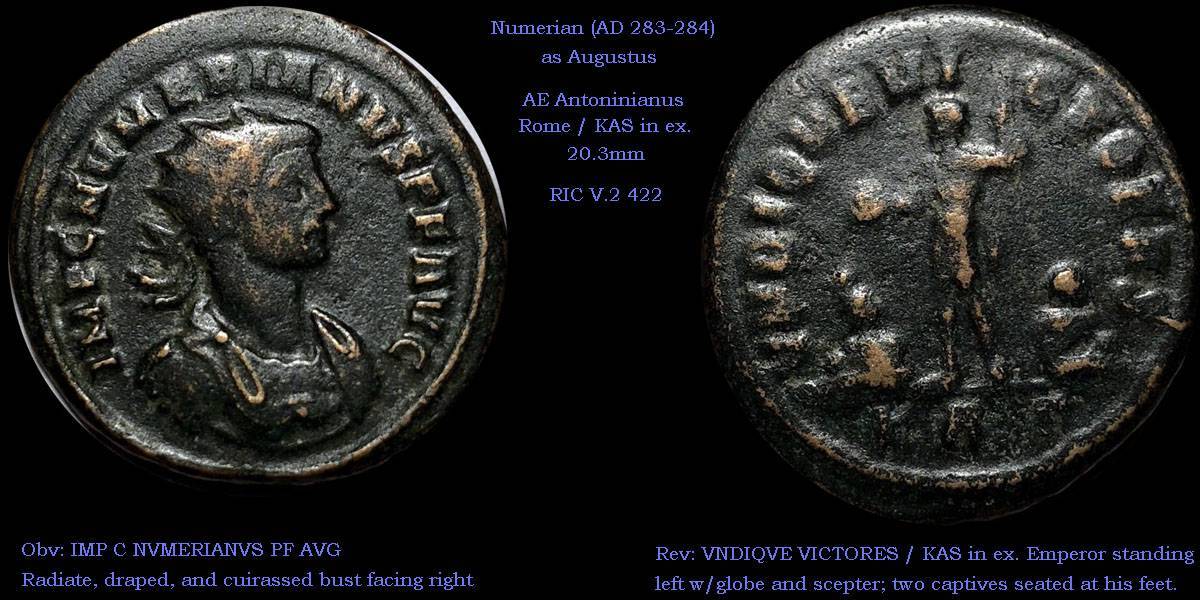 Numerian
reigned as Caesar from 282-283 and Augustus from 283-284. He was the son of Carus and the brother of Carinus. As a future Emperor, he headed off with his father to wage war in the East while his brother stayed in Rome.
Numerian, moving with Carus, fought a successful (and easy) campaign against the Sarmatians and Sasanians, moving down the Danube, through Thrace, and then Mesopotamia, down the Tigris to Sassanid Ctesiphon; at this final stop, they encountered little resistance from the Sasanians.
Following Carus' bizarre and ominous death while encamped there (it was rumored that lightning came from nowhere and set fire to his tent) Numerian, apparently somewhat less of a warhawk than was his father, was pressured by the army into conducting an inexplicable retreat, allegedly due to prophesied ill augurs and misfortunes which were certain to befall any unlucky soul who dared remain beyond the Tigris; Numerian didn't garrison any forces in the area nor put up any fortifications.
This gave the Sasanians at Ctesiphon a bit of hope that they wouldn't have to fight a war and deal with an internal power struggle at the same time -- Galerius would correct that "oversight" at Ctesiphon 6-7 years later, but it wasn't until the mid 7th c. that the Sassanid Empire would finally fall to the Byzantines.
Numerian hung around for a bit with his army before they marched back to Rome; he never made it, dying either of a continuing and worsening illness or by being assassinated along the way. His prefect L. Flavius Aper -- who also had been his father's prefect -- announced his death to the troops in Bithynia.
The assembled armies soon proclaimed Carus' commander of the Imperial household guards, Diocles, to be the Emperor based on a story that Numerian had been slain by his prefect Aper; Diocles' earnest promise to avenge Numerian by executing the traitorous assassin responsible for Numerian's death (i.e. Aper, who just happened to be Diocles' only real opponent for the claim to Emperor) was carried out, and Diocles was on his way to becoming the Emperor Diocletian.







 Posted 06/03/2018 1:31 pm





 Awesome coin


