Coin Community Family of Web Sites Join Thousands of Coin, Bullion, & Money Collectors
Join Thousands of Coin, Bullion, & Money Collectors Vancouvers #1 Coin and Paper Money Dealer 300,000 items to help build your collection! Specializing in Modern Numismatics Royal Canadian Mint products, Canadian, Polish, American, and world coins and banknotes. Royal Estate Auctions - $1 Coin AuctionsCoin, Banknote and Medal Collectors's Online Mall


Username:
Password:
Save Password
Forgot your Password?


This page may contain links that result in small commissions to keep this free site up and running.

Welcome Guest! Registering and/or logging in will remove the anchor (bottom) ads. It's Free!

What Was The First Coin Dated In Positional (Hindu-)arabic Numerals?

To participate in the forum you must log in or register.
Author Previous TopicReplies: 14 / Views: 3,861Next Topic  
Pillar of the Community

Russian Federation
5174 Posts
 Posted 08/07/2018  7:56 pm Show Profile   Bookmark this topic Add january1may to your friends list Get a Link to this Message Number of Subscribers
Just about everyone knows about the first AD dated coins (Roskilde 1234), and a lot of people know about the first coins dated in European "Arabic" numerals (St-Gallen 1424).

But of course the Muslims were dating coins in their own Arabic numerals well before 1424 AD; I have one example that (probably) dates from 723 AH = 1323 AD, and, IIRC, yet earlier dates are known.

Which leads to (what I thought was) the obvious question: what was the first coin dated in any variety of (Hindu-)Arabic numerals, anywhere?

(I should clarify that I mean positional numerals, the ones where the digits are the same for units, tens and hundreds. This means that the assorted Western Kshatrapa coins dated in non-positional Brahmi numerals don't count, any more than the Greek numeral dated coins of the Parthians and Seleukids would.)


Weirdly, this doesn't appear to be a question I've seen explicitly answered, or even researched, anywhere.

Or, rather, there's a bare quote that shows up every so often, apparently directly copied, and without any supporting evidence:
Quote:
The first dated coin using positional numerals is a relatively common small silver coin of northern India, 418 A.H. (1027 A.D.), using the Hindu-Arabic style of numerals.
I was so far unable to identify this "relatively common small silver coin of northern India" (there are some likely candidates, but they don't appear to have numeric dates).


The oldest example that I could find, as it happens, came from a completely unexpected place: Norman Sicily.
A fairly common(-ish) copper coin of Ruggero II, made at the Messina mint, gave the date as 533 AH in archaic Arabic numerals, corresponding to 1138/9 AD.

Now that I know about this type, it had joined my long-term wishlist... not that I could realistically afford one anytime soon (examples appear to sell on auctions regularly, but tend to cost around $200).


...Any further comments on the question? Is the Sicilian coin of 533 AH truly the oldest dated in positional numerals?
(Come to think of it, were any coins ever dated in positional numeral systems other than Hindu-Arabic?)

An old VCoins page on an example of the Sicilian coin describes it as "the first coin of Europe using positional (modern) numerals in the date" - implying that there are perhaps earlier such coins from Asia - and suggesting to look in "Dated Coins of Antiquity, p. 12, for a brief discussion".
If so, I have no idea how to check this; I could hardly afford a copy of this catalog any more than I could afford an example of the coin, and it doesn't appear to be freely available online (or, if it is, I was unable to access it).


...Oh, and just in case - is this a weird question, and was this subforum the right one to ask it?

I was just randomly wondering about it one time, and was surprised that there didn't seem to be a detailed discussion of it anywhere the way there are lots of regarding, for example, early dated AD coins.

Again, sorry for the distraction
Moderator
Learn More...
Spence's Avatar
United States
34418 Posts
 Posted 08/07/2018  8:26 pm  Show Profile   Bookmark this reply Add Spence to your friends list Get a Link to this Reply

Quote:
is this a weird question, and was this subforum the right one to ask it?


Yes and Yes! I just wish I had some answers for you.

In the meanwhile, I think that I'll look to see what is the earliest example in my own collection. I know I have a dated coni from 1422 AD, but maybe I've got something even older.


Added:
Ok @J1M, here are the earliest dated coins that I have in my colelction from various empires:

Europe: 1419 AD
Arab: AH 99 (718 AD)
Western Satraps: 289 AD

I'm sure others here can beat at least some of these with coins from their collections. Other dated coins I have are all in relation to the ascension/regnal date of a particular ruler and therefore not in scope for this particular exercise, right?
"If you climb a good tree, you get a push."
-----Ghanaian proverb

"The danger we all now face is distinguishing between what is authentic and what is performed."
-----King Adz
Edited by Spence
08/07/2018 9:17 pm
Moderator
Learn More...
echizento's Avatar
United States
23731 Posts
 Posted 08/07/2018  10:36 pm  Show Profile   Bookmark this reply Add echizento to your friends list Get a Link to this Reply
Interesting question and one I don't have an answer for either. Though I think you might have answered your question with the Indian example of 418 AH, I think that region would most likely area to search.
Pillar of the Community
United States
1554 Posts
 Posted 08/07/2018  11:47 pm  Show Profile   Bookmark this reply Add Kushanshah to your friends list Get a Link to this Reply
The 418h reference is apparently to the Ghaznavid bilingual dirhams of Mahmud. According to Album in the Checklist, they are "dated in words in Arabic, but also dated 418 in Sanskrit numerals on the reverse". Coins with dates in purely Arabic ciphers rather than words don't become common until about 700h, but I don't know what issue is considered "first". Like you, I'm surprised this info isn't easier to find.
Edited by Kushanshah
08/08/2018 12:21 am
Pillar of the Community
jimbucks's Avatar
United States
4692 Posts
 Posted 08/08/2018  12:17 am  Show Profile   Bookmark this reply Add jimbucks to your friends list Get a Link to this Reply
I'm pretty sure the correct answer isn't 46 BC.
Pillar of the Community
Finn235's Avatar
United States
6130 Posts
 Posted 08/08/2018  02:03 am  Show Profile   Bookmark this reply Add Finn235 to your friends list Get a Link to this Reply
Positional numerals were not practical or mathematically sound until the work of Brahmagupta in 628 to establish the mathematical properties of zero.

Coming from the tradition of dated Sassanian coins, Islamic dirhems were dated right off the bat, but written out fully rather than utilizing numbers. I don't think I recall seeing any dated Islamic coins (in numerals) from before the 1300s.
Valued Member
76 Posts
 Posted 09/07/2018  6:10 pm  Show Profile   Bookmark this reply Add louie to your friends list Get a Link to this Reply
Please educate me. What do you mean
by "positional". Would coins with
Roman numerals count?
Pillar of the Community
United States
1554 Posts
 Posted 09/08/2018  12:20 am  Show Profile   Bookmark this reply Add Kushanshah to your friends list Get a Link to this Reply
@louie "Positional" means that the value of a numeral depends on it's sequential position, like the value of "3" in 321 and 123 respectively. Roman numerals in classical usage are position-independent and have the same meaning regardless of position, like tally marks. Subtractive (positional) notation such as IV for 4, IX for 9 and XC for 90 was rarely used in ancient Rome but became popular in the 13th century (according to Wikipedia).
Edited by Kushanshah
09/08/2018 12:45 am
Valued Member
76 Posts
 Posted 09/08/2018  02:33 am  Show Profile   Bookmark this reply Add louie to your friends list Get a Link to this Reply
@Kushanshah Thank you very much.
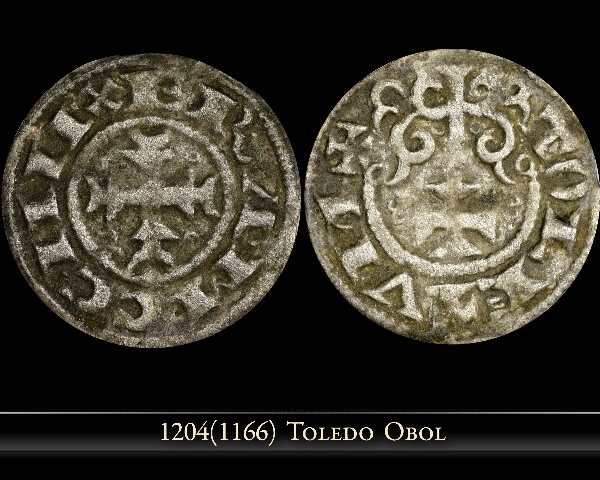
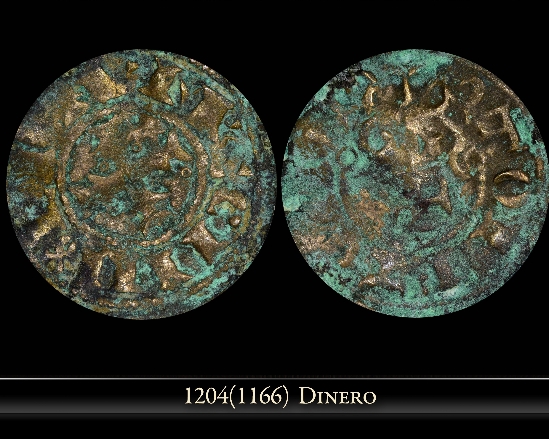
There are two different coins struck
by Alfonso VIII celebrating the re-taking
of Toledo (Toleto) Spain. One Obol the
other Denier. They bare the es-Safar calendar
date 1204. This translates to 1166 AD. The date
on the coin is ERA MCCIIII, ERA referring to the
es-Safar calendar. While the Roskild denier is the
first "positional" dated coin, the Toledo Obol and
Denier pre date the Roskild coin by 68 years
1166 AD=es Safar 1204.Pictures of these two coins
may be viewed at medievalcoinage.com
Valued Member
76 Posts
 Posted 09/08/2018  03:21 am  Show Profile   Bookmark this reply Add louie to your friends list Get a Link to this Reply
I stand corrected. The Roskild has Roman numerals
as do the two Spanish coins. They just use a different
calendar system. The 1424 St. Gallen plappart I believe
is the first positional dated coin. I apologize for
confusing the forum.
Pillar of the Community
Russian Federation
5174 Posts
 Posted 09/08/2018  09:59 am  Show Profile   Bookmark this reply Add january1may to your friends list Get a Link to this Reply

Quote:
I stand corrected. The Roskild has Roman numerals as do the two Spanish coins. They just use a different calendar system. The 1424 St. Gallen plappart I believe is the first positional dated coin. I apologize for confusing the forum.
The 1424 St. Gallen plappart is the first positional AD dated coin (in Arabic numerals); there were, of course, much earlier dated coins, e.g. of Golden Horde, that used the local variety of Arabic numerals to represent Hijri dates.

The earliest of those appears to be the Sicilian copper (forgot the exact denomination) of AH 533 (=1138/9 AD).
Which, incidentally, deserves a placement on MedievalCoinage.com at least as much as the Spanish denier of es-Safar 1204 I mean, neither of those coins is using the AD calendar, and both are, in principle, European.
Supposedly the Ghaznavid bilingual dirhams of AH 418 (=1027 AD) had the date 418 listed "in Sanskrit numerals" on the reverse; I don't know enough to tell whether the system described as "Sanskrit numerals" is positional or not.
(I was unable to pick up any of several styles of Sanskrit numerals that I could find on images of that coin type, but maybe I just wasn't looking in the right place.)

Incidentally, @louie, do you happen to have a coin from the year 1480 AD?
If so, the How Far Back Can We Go (Fourth Edition) thread is waiting for your pics!
Valued Member
76 Posts
 Posted 12/12/2018  02:24 am  Show Profile   Bookmark this reply Add louie to your friends list Get a Link to this Reply

What-Was-The-First-Coin-Dated-In-Positional-Hindu-arabic-Numerals?


Obv. ERA MCCIIII
Rev. TOLETUM

What-Was-The-First-Coin-Dated-In-Positional-Hindu-arabic-Numerals?

Obv. ERA MCCIIII
Rev. TOLETUM

The E Safar calendar was implemented by Augustus Caesar
38 BC. While the date on the coin reads 1204, by the new
calendar (todays) it is 1166.
Pillar of the Community
Russian Federation
5174 Posts
 Posted 12/17/2018  4:49 pm  Show Profile   Bookmark this reply Add january1may to your friends list Get a Link to this Reply

Quote:
Obv. ERA MCCIIII
Rev. TOLETUM

The E Safar calendar was implemented by Augustus Caesar
38 BC. While the date on the coin reads 1204, by the new
calendar (todays) it is 1166.
Nice coins!

Unfortunately, since the date is in Roman numerals, they are ineligible for this thread; there are plenty of older coins dated in Roman numerals (in non-AD calendars, obviously, but those two aren't AD either).

The oldest coin dated in positional Hindu-Arabic numerals still appears to be the Sicilian follaro of AH 533 (1138/9 AD), pending a clarification of what's going on with the Ghaznavid dirham of AH 418 (1027 AD).


...Someone really should make a generic thread for dated ancient coins.

How about "Twenty Weeks of Dated Ancient and Medieval Coins" (or something along those lines, not sure how to phrase it best)?

First week (or whatever unit we end up using) for anything before 300 BC (not sure if anyone on CCF has any, admittedly), and then one week (or whatever) per century until we get to 1600 AD.
Valued Member
76 Posts
 Posted 12/19/2018  04:22 am  Show Profile   Bookmark this reply Add louie to your friends list Get a Link to this Reply
I realize that the coins I posted have Roman numerals
and do not have a date with positional numbers. I posted
them since I mentioned them earlier in the thread. Should
I remove the pics?
Edited by louie
12/19/2018 04:25 am
Moderator
Learn More...
Sap's Avatar
Australia
16834 Posts
 Posted 12/19/2018  11:11 pm  Show Profile   Bookmark this reply Add Sap to your friends list Get a Link to this Reply
The Ghaznavid coins mentioned by the OP are in Sanskrit, written in the Devanagari alphabet. They have the dates written in Aryabhata numerals. While some literature describes this numeral system as "positional", it is perhaps best described as "semi-positional".

Just as Devanagari "letters" are composed of a vowel-consonant combination, so Aryabhata numerals are composed of a "consonant" component, representing a number between 1 and 100, and a "vowel" component representing the power-of-ten applied to the number. Thus, the letter "G" by itself (with the implied consonant "a", giving the combined letter "Ga") was the number "3", Gi would be 300, Gu would be 30000, Gr would be 3000000 and so forth; 30, 3000, 300000 etc would be written using the letter "N" (Na, Ni, Nu, Nr, and so on).

The primary difference between this and a "true positional" numbering system devised some centuries later is the lack of a concept of or symbol for "zero", requiring the use of the vowel-consonant combination to fully denote the position in a large or complicated number. Nor had they invented the concept of assigning unique characters to the numerals, instead adopting and adapting directly from the Devanagari alphabet.

The system allowed them to easily write the really humongous numbers present in Hindu cosmology, but it fell out of favour as many of the resulting number-words are really, really difficult to pronounce. Take the example given on the Wikipedia page linked to above: the number "299,792,458" would be written (and pronounced) "JaLaGHiNiJHuSuJHrSrKHl" - which is as tongue-twistingly nonsensical in Sanskrit as it is in English. Which did mean that people tended to swap the order of numerals around to try to make them more pronounceable, thus defeating the whole purpose of positionality (to make mathematics easier).
Don't say "infinitely" when you mean "very"; otherwise, you'll have no word left when you want to talk about something really infinite. - C. S. Lewis
  Previous TopicReplies: 14 / Views: 3,861Next Topic  

To participate in the forum you must log in or register.


Disclaimer: While a tremendous amount of effort goes into ensuring the accuracy of the information contained in this site, Coin Community assumes no liability for errors. Copyright 2005 - 2026 Coin Community Family- all rights reserved worldwide. Use of any images or content on this website without prior written permission of Coin Community or the original lender is strictly prohibited.
Contact Us  |  Advertise Here  |  Privacy Policy / Terms of Use

Coin Community Forum © 2005 - 2026 Coin Community Forums
It took 0.46 seconds to rattle this change. Forums