| Author |
 Replies: 39 / Views: 10,478 Replies: 39 / Views: 10,478 |
|
Valued Member
United States
84 Posts |
I am only 17, so I have a long time to go. I have been trying to find how to recreate the conditions that give coins beautiful toning. I have heard that real leather can tone copper (not sure how true that is). I know that sulfur compounds are converted to hydrogen sulfide by bacteria, and that hydrogen sulfide reacts with silver and will tone it. But knowing that doesn't help much, because I don't know what I would store it in that I know contains sulur. I also know that humidity also helps tone the coin, so I thought that I could put a small thing of water in the same container that the coins and toning material. Any one know what exactly I should put my coins in, or next to, that will cause natural toning of several years?
|
|
|
|
Rest in Peace
10197 Posts |
You do know that it is called "artificial" toning, and is a killer of the value of a coin...it is considered DAMAGED and if silver, of melt value only afterwards? That said, make yer own brew. Take a couple capfulls of ammonia, maybe 3, cutoff the tops of a pack of paper matches and crush them add to the ammonia in a closed top glass jar. Place a coin tub cap flat side down in solution, make sure that the top edges are out of the liquid. Place coin on lip of coin tube cap, cover and leave for day, weeks, months, turning coin over periodically. Make sure you open the container outside, the sulfur gas will smell like rotten eggs. On copper coins, rub with lemon juice to darken. 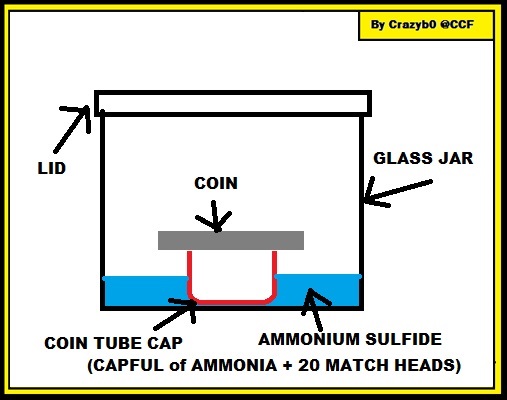 Now I'm not quite sure just how volatile this may be, but ammonium nitrate does come to mind...  Edited by Crazyb0
09/02/2018 8:36 pm
|
|
Pillar of the Community
7234 Posts |
Quote:
I am only 17 Well son, sit back and read - the best I've ever seen is "books before coins" |
|
Valued Member
 United States
84 Posts |
No, it is not artificially toning it. There are certain conditions that a coin has to be in to have naturally toned over 50 years. In the 50s and 60s, if you left your collection of silver coins in a box or envelope and 50 years later you go through your old coin collection, you would find that your coins have now been toned. With all the new synthetic and non-reactive materials, and cheaper production processes we've developed (and regulations), if you were to leave your silver coins in a box or envelope, they would look the same in 50 years from now. Because the materials were designed to not react with and damage what was in it. I want to find out what made the old materials react with and tone the coins. I want to be able to leave my coins in a box and have them in the conditions necessary, so that when I go through those coins 50 years from now, they will be toned the exact same as if I did this back in the 50s.
|
|
Bedrock of the Community
13014 Posts |
Quote:
You do know that it is called "artificial" toning, and is a killer of the value of a coin...it is considered DAMAGED and if silver, of melt value only afterwards? Doesn't sound like it in this case. Sounds like he wants to try and set up an environment to tone it, that's natural. AT is things like baking it in the oven, applying chemical toners, blow torch ect. Simply putting coins in an album or on a window ledge is perfectly fine. Silver doesn't automatically go to melt because of AT, just depends what it is. |
|
Pillar of the Community
5464 Posts |
I always wondered how they mass-produce these things. 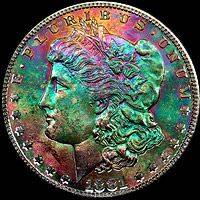 |
|
Rest in Peace
10197 Posts |
PP, what you are proposing is really random chance. There may be some "helpful assistance" one may do to help the "environment" surrounding a specific coin but youhave NUMEROUS factors that can contribute to and as=lso take away from the possibility of "natural toning. First of, you need to learn about metals. Their composition, their properties, rate of absorption (you go ...huh?), specific alloy content and purities PER AGE/PER SERIES. Older coins are made slightly different, materials vary, the refining techniques differ. Newer materials and processes applied within the last quarter century are vastly different, therefore logically there will be different results on say a 2016 ASE and a 1963 proof Franklin half. You see I just used an extreme apples and oranges comparison...size, weight , alloy composition, purities of metal content. A silver coin containing a .90 fineness as compared to a .999 fineness! Those other alloys react differently than a purer item, was the .90 stock actually tempered and refined correctly? What may have been the variances and tolerances of the 1950's as compared to the regulated means of computer assisted monitoring of the refining process of the 2000's? A lot of questionable variables I'm tossing out for consideration. Now, take older coins. Even those in sealed mint sets, say from 1958-1964. I've been seeing and handling a few hr=ere recently. Let me give you a couple observations. Thes sets are still in mint cello, in envelopes even. some are still "sealed" as original (They licked the tip of the flap to hold shut), others have been opened to inspect contents from previous owners. Most all show very little "toning" other than a slight dulling look. It matters little to the climate apparently, these are all over the US, most have languished in old brick and mortar shops. The envelopes may show some wear, dirty/smokey, even water stained, but the contents are unaffected. the only one that was a disaster, was a 64 proof set that the sealing edge had run over the half and quarter, they turned a copper orange color of corrosion because apparently there were pinholes in the seal..BTW, this was a sealed envelope, never been inspected. Which leads me to a final point. You do know what "toning" actually indicates I hope. It is the degradation process of corrosive effect upon metal. This is a process, ending in rust, dust, infected Bronze disease, and blackened tarnishing the end stage. So enjoy your Rainbow toning of today, for in 50 years unless correctly retarded will become darker and sometimes uglier. Also, BTW, please ignore the posting about toning you coins by the jar process, you may indeed harm yourself or others and there is no guarantee it would do any good effect other than stink up the house and have your folks kick your behind out! |
|
Valued Member
United States
333 Posts |
I'm not an expert on toned coins -- it's simply too far down my to-do list -- but perhaps you can simply buy empty mint set envelopes from the 50s and 60s and let some coins sit in those. There are plenty on ebay for $2 free shipping. I think there were traces of sulfur in the paper at the time. I also think that's true of tissues today. I once left a brand new bullion dollar on only a tissue for years(?) and it has since developed some pale blue toning on the side that was in contact with the tissue. Thus you might want to consider that as well, but it'd probably work with high purity/untoned silver. |
|
Valued Member
United States
84 Posts |
Thank you Crazyb0, I am actually really into chemistry and metallurgy. I also love to research verious topics, from comic books, to medical conditions, to science. So my point is, I do my research. Also I will be doing this to 95% copper pennies, and some junk silver (and a MS 60 1955 quarter from the YN auction). Although I have found a couple of some decent toning on 1990's pennies and even some 2000's pennies.
|
|
Moderator
 United States
195203 Posts |
Describing toning as artificial or natural are should be discouraged. The real question should always be whether the toning is market acceptable or not.
|
|
Pillar of the Community
United States
2958 Posts |
crazyb0, you again took the words out of my mouth. I would never pay a penny over the regular worth of a coin which has toning.
CRH Nickeloholic. 1,600,000 nickels searched in eight years! Have found FOUR complete Jefferson sets!
|
|
Valued Member
United States
441 Posts |
Quote:
Describing toning as artificial or natural are should be discouraged. The real question should always be whether the toning is market acceptable or not. Maybe... A market can choose to abandon what is good and right, so acceptability sometimes cannot be trusted. Perhaps a less volatile characteristic could be the foundation for evaluating toning, something that is based on scientific approach toward conservation. I mean, that would likely also enforce a stable standard for market acceptability, instead of market acceptability enforcing conservation etiquette. @PennyPride my children and I have decided to document a series of experiments designed to address your exact questions. I imagine that it the well-planned experiment will yield the most valid results. Perhaps we could collaborate with you to plan an experiment, maybe split it up and create a thread where we all post our progress. |
|
Bedrock of the Community
United States
12477 Posts |
Quote:
Describing toning as artificial or natural are should be discouraged. The real question should always be whether the toning is market acceptable or not. Whether something is "market acceptable" is inextricably linked to profit, so I have to say that this topic does not address that, and has not requested any input on it. Rather than using "artificial" or "natural", I suggest "intentional" and "unintentional". OP suggests creating an atmosphere similar to those in which many a silver coin was toned without purpose (unintentional). We now can attempt to recreate the environment that those lovely toned coins were in for decades. I don't think trying that makes them AT. The process is the same. Intentional? Maybe not...  In Memory of Crazyb0 12-26-1951 to 7-27-2020
In Memory of Tootallious 3-31-1964 to 4-15-2020
In Memory of T-BOP 10-12-1949 to 1-19-2024
|
|
Bedrock of the Community
United States
20753 Posts |
There are numerous methods to tone coins. Mostly all it takes is to know what reacts with what. Just look up chemical reactions with metals in any chemistry book. The speed of such reactions can be calculated by the amount of things you use to do the toning. People have used many household items such as Lemon Juice, Orange Juice, baking soda, steaks, eggs, etc. You would still have to check on the coins as time goes by so no over toning happens. Just remember that as a general rule, you'll probably ruin most coins doing this. Very few people like what becomes an Artificially Toned Coin.
|
|
Valued Member
United States
441 Posts |
Quote:
Rather than using "artificial" or "natural", I suggest "intentional" and "unintentional". You've got it! Based on the OP's suggestions, however, it is impossible to determine one from the other with certainty. However, I feel that the taboos surrounding even the idea of "Artificial Toning" stem from two distinct factors: 1.) Was the toning created intentionally? 2.) Has the coin been compromised? Is it now at risk to rot away with time? I relate to the purists and the rationalists equally. In the long run, I've come to the following conclusions (regarding toning): #1: Coin conservation is the first priority. #2: If priority #1 fits, the next priority is personal preference/opinion in regard to intentional vs. unintentional toning. My preference is unintentional toning, regardless of whether it was "natural" or even whether it fits within the "market acceptable" version of natural. The strict goal here, however, is still conservation. That must never be forgotten. If one must experiment, throw away those coins when your experiments are complete. |
|
Pillar of the Community
Canada
1267 Posts |
Quote:
Which leads me to a final point. You do know what "toning" actually indicates I hope. It is the degradation process of corrosive effect upon metal. This is a process, ending in rust, dust, infected Bronze disease, and blackened tarnishing the end stage. So enjoy your Rainbow toning of today, for in 50 years unless correctly retarded will become darker and sometimes uglier.
What I am about to write pertains to silver issues (as that has been my focus over the years). Unless you keep your coins in a vacuum, from the moment they are minted they will begin the natural process of oxidation and form a thin layer of silver oxide on the coins surface. That is a fact. This silver oxide layer is what we refer to as 'thick skinned', or in other cases where we start to see color, toning. This same silver oxide layer also forms a natural barrier that protects the original surfaces underneath. Removal of this layer (dipping) also removes a small portion of the coins surface. Without the silver oxide barrier, the coin is now exposed to further degradation and can no longer be considered original. Witness the lack of luster on over dipped pieces. I have personally seen coins with dramatic rainbow toning that have remained completely unchanged for close to 40 years. Andrew Kimmel has a few, as does Bryan Sonnier. My own avatar has not changed one iota since Phil Flanagan owned it close to 20 years ago, and the PCGS slabs are not airtight. Will they change over time? Yes, although it may take centuries. Can someone, anyone show me a naturally toned example that has turned in a modern holder? There will be no response to this except the sound of crickets. Although I am a strong proponent of originality, I have come to accept that in certain situations (to save a coin) conservation through dipping is better than losing the coin. Market acceptable. Now there is a term I dislike. What is considered market acceptable at this point in time may not be so in the future. Remember, not that long ago cleaning was market acceptable. Today, we consider dipping to be market acceptable because it makes the coin all shiny and white again (well perhaps not so shiny as the flow lines are compromised thus diminishing luster). There are already more than enough dipped coins to go around- that is not the case for original coins. Witness the premiums collectors are paying for originality, especially on older issues such as seated liberty's. I much prefer the terms natural toning and questionable toning. If I'm not convinced that it's natural, then it becomes questionable. Makes life easy. As collectors and people who should know better, perhaps we should reflect on how future generations are going to look back on this time. I hope it is not with distain. |
| |
Replies: 39 / Views: 10,478 |







 Posted 09/02/2018 9:22 pm





