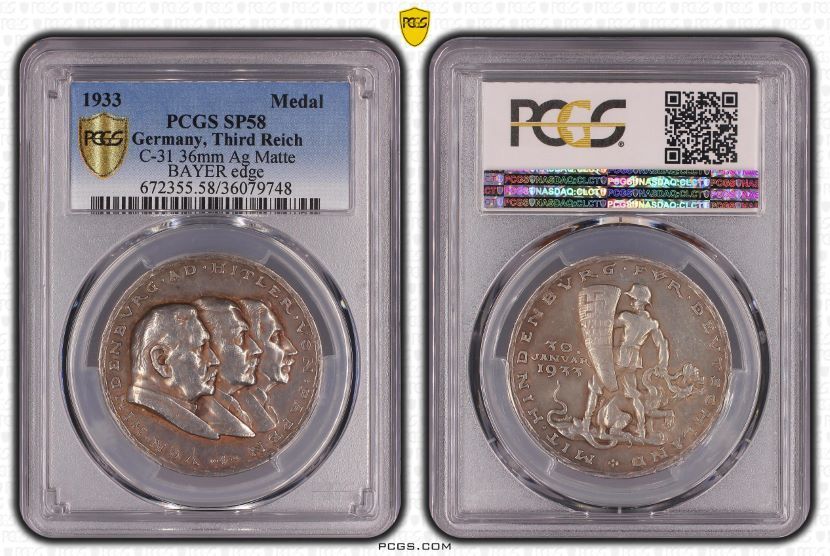
KIENAST-484 (AD INSCRIPTED)coin Illustrated is from the Eric P. Newman CollectionThere is a very rare Karl Goetz medal that was commissioned by the NSDAP to be designed and struck by Karl Goetz. The medal caused quite the controversy, and quite nearly some jail time for Mr. Goetz.
Karl Goetz' own explanation of the medal (As published in the November 02, 1966 Edition of
CoinWorld):
There came the day of the take-over of power on the 30th of January, 1933. My publisher, Hans Nantz of Berlin-Nikolassee of Bock and Com-pany, called me the very same day and asked whether I had already made an Adolf Hitler medal. My answer was negative, and I also mentioned that I did not intend to engage in such a medal. He asked me whether I was of a different political view. I let him know subtly, although it was on the telephone, how I thought about it and declined categorically to make such a medal. The next day came another phone call. I evaded the issue by stating that I had no picture to work from. Further, I stated, I had never yet seen the new Chancellor face to face. "If you do not want to make the Hitler medal, there are many others who are anxious to do this work," was his prompt reply. But it did not stop at this. The very next day I received a special delivery letter with pictures of Hitler, and the friendly request to submit to the signs of the times and make the medal, since the collecting world in Germany wanted a medal of Hitler made only by me.
Because of my pleasant relationship of many years with Nantz, I let myself be persuaded to make the first Hitler medal. (opus 484) [Author' s note: Goetz apparently overlooked opus 483 when he wrote this. Opus 483 was made by him in March of 1933 with an image of Hitler on the obverse, not a very flattering picture of him at that].
For the reverse [of opus 484] I used the decree of Hindenburg of May 5th, 1933, after which both flags, the old as well as the new, were rightful emblems of the German Reich and existed side by side. It appealed to my sense of justice that the swastika should not triumph easily over the old honorable flag of the black, white and red colors. On the obverse I used the inscription: REICHSKANZLER AD. HITLER. This was a big blunder which I committed: [AD in German (properly shown as a.D.) is used against a military rank or official position if retired as ausser Diensten (out-of-service) - for example: Hauptmann a.D.means Captain (Ret)] The connotation was given that it could be inter-preted as Chancellor of the Reich, retired (a.D.) whereas the medal intended to show the abbreviation of the first name Adolf as AD. in capital letters.
The medal was already minted by the Government mint of Berlin when the adjutant of Hitler appeared and ordered the immediate stop of the striking.1
From the Brown House in Munich (the Nazi party headquarters for all of Germany - Das Braune Haus - ,) I received a most insulting telephone call. At the beginning of the conversation the caller had asked me whether I was a party member. When I said no, I was showered with insults of various degrees. Should I dare to put this medal on the market, they would take care of me. The facial expression of Hitler, I was in-formed, also was much too pugnacious. The fate of this piece, and the following one, was determined by this call.
The metal refinery of J. Baumgartner and Company in Munich, Damenstiftstrasse, commissioned me with the production of another medal. They wanted this medal to be adorned with heads of Hindenburg, von Papen and Hitler. This I liked much better, as Hindenburg's nomination of von Papen as Vice Chancellor indicated the restriction of the absolute power of Hitler. This medal, (opus 484), was presented by the publishers to the "Brown House" for approval. After long months of waiting, the approval for manufacture was refused, mainly for the reason that the reverse did not show the swastika, but rather the colors black-white-red, and also because the artist who designed it was not a party member. Further, the party had already started negotiations for the creation of an official medal with the sculptor, Gloeckler, in Berlin, who held a high rank in the stormtrooper's organization as a Sturmbannführer.
Behind this commission stood Witzig and Company, who had the best of relations with the party; hence our efforts were without results. There even came a strict ban from the government. After this fiasco, which can be explained by my distance from the Nazi party, I did not move a finger in the creation of a commemorative medal. Who can blame me?







 Posted 11/26/2018 7:15 pm





