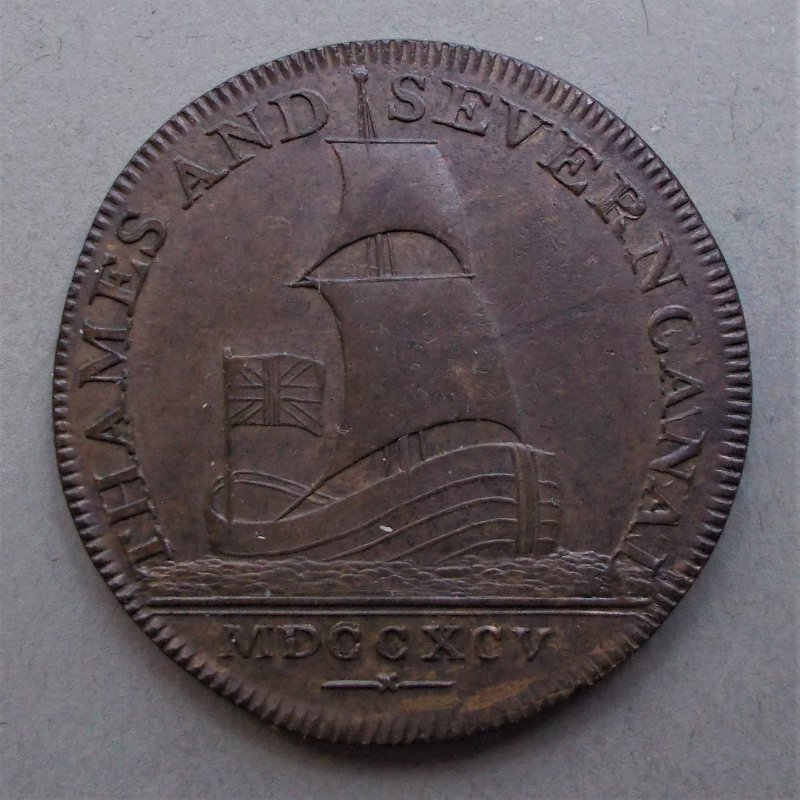
RC Bell lists the diesinker and manufacturer of this token as "Hancock". Hancock was British, but played an interesting part in US coin history too, as described below.
John Gregory HANCOCK senior (1775 to 1805), described in an article in the British Numismatic Journal as an "artist and die sinker", initially worked for the brothers John and Obadiah Westwood. Some references give his year of death as 1815, but there is an obituary for him for 1805 in the Birmingham Gazette.
Hancock appears in a Birmingham trade directory of 1785 described as a "modeller, die sinker and chaser", with an address of Bartholomew Road. In 1787 he appears described as an "artist", of 45 Edmund street, and in 1803 is listed as being at Hospital Street. Matthew Boulton ( he of the great Soho manufactory), mentions Hancock in a letter of 1787 as a "dye graver". Later that year Boulton wrote of a business rival Williams, having "already hired the two best die engravers in England", referring to Hancock and Hancock's business associate Obadiah Westwood. Clearly Hancock was a man of some talent, which can be seen in the beautiful detail of the token above.
Hancock worked for the brothers John and Obadiah Westwood. John died in March 1792 in some considerable debt, and Obadiah was declared bankrupt in 1789. Obadiah was described by Boulton as "an ingenious shabby fellow, associated with counterfeiters of coin", and "not fit to run a mint". At that time the production of bogus conder tokens was rampant. Obadiah is known to have produced tokens above and beyond those ordered by genuine clients, for circulating for his own profit. The concept of evasion halfpennies was already well established, and more than one conder token manufacturer produced equivalent "evasion" tokens, where minor details were changed from genuine tokens.
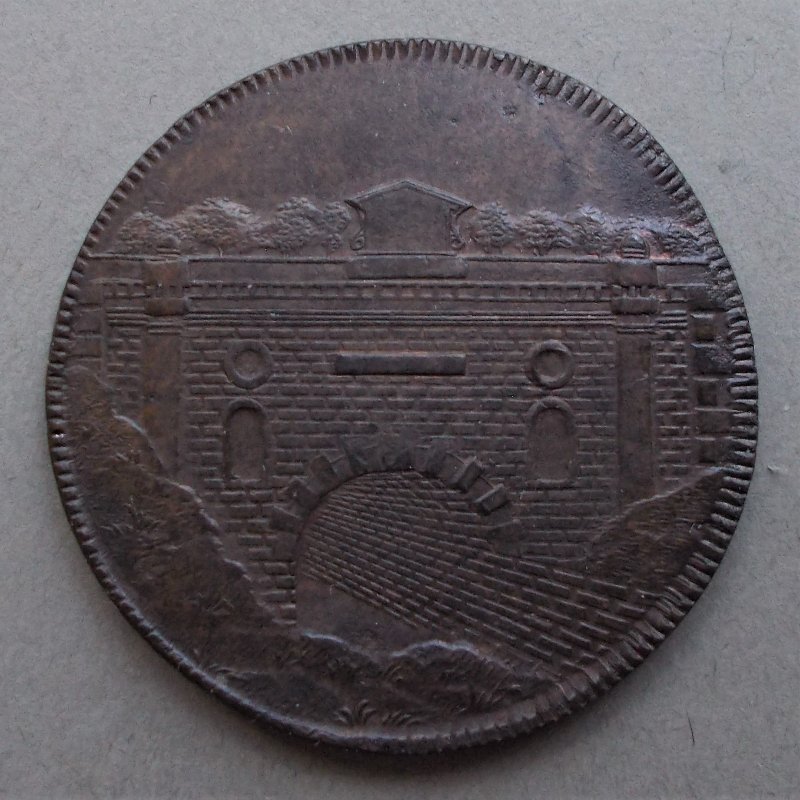
Hancock became the front man for Obadiah Westwood, to put a respectable face on business dealings. Hancock also produced his own tokens, but does not appear as a token manufacturer in "A dictionary of Makers of British metallic tickets. 1788 - 1910" by RNP Hawkins, published 1989. Production of the Thames and Severn canal token above is mentioned in a letter by Obadiah's son John some years later. They were the second from last series of tokens produced by Hancock.
In 1793 Hancock produced some trial American cents, with a portrait of Washington.

Image from the British Numismatic Journal.
In 1793 Hancock is mentioned in a letter by Thomas Digges to Thomas Jefferson regarding the proposed production of these cents. Digges described Hancock as "tho with the character of a dissipated man". The trial cents were not accepted. In revenge, Hancock produced a satirical coin referred to as the "Roman head" cent, showing Washington as a "degenerate and effeminate" Roman emperor.

Image from coinweek.
About twenty of these coins were produced. Their existence was kept separate for forty years, in fear of causing an international incident.









 Posted 05/21/2019 7:44 pm


