I have actually had this set done for quite some time, but have just never gotten around to posting it before now.
Back when I first started dabbling in world coins, I became fascinated by Japanese coins that showed up in lots,
due to my high school years spent as an unrepentant weeaboo although I'm not sure why. It took almost a year and more money that I'm willing to let my wife find out about, but here is my (almost) complete Japanese type set! So pop in some FLCL, put some ramen on the stove, and let's get weird!
The scope:
- One coin of every type in silver or base metal issued since the introduction of modern coinage in 1870, up until the explosion of commemoratives in ~2008
- A healthy assortment of pre-Meiji coins from the Tokugawa era (1638-1869)
Not in scope:
- Excessively rare, expensive, and/or heavily counterfeited coins (e.g.
Trade dollars, patterns, e-sen)
- Paper money (although I hope to eventually expand there)
- Gold except for the easily affordable, debased late Tokugawa issues
- The exhaustively expansive and expensive 500 and 1,000 yen 47 prefectures series
- Really any commemoratives made after about 2005, save for "Anniversary of rule" issues and similar.
I'm a history buff, so that will be the primary leaning of this write-up. Feel free to skim ahead to the coins!
Before coins: Historical backgroundSettled since the paleolithic period, Japan was a very late adopter of minted coins. Her economy was fueled entirely by the commodities trade until the mid-7th century AD, focusing on measures of rice, weights of silk and linen, and later gold powder or small nuggets. Japan and China traded since ancient times, and although both Wu Zhu and Ban Liang coins have been found in Japanese archaeological sites, there is no evidence of any sort of monetized economy prior to 680 AD.
Fuhon-sen: An experiment?Over on the mainland, China changed hands from the Sui to the Tang dynasty, giving rise to the famous Kai Yuan Tong Bao cash coins in 621 AD. No doubt these coins came to the attention of Japanese officials. While it was thought the first Japanese coins were not produced until 708 AD, in 1998 a small cache of a previously unknown type of coin was discovered in Asuka. 33 coins (6 intact, the rest fragmented) were found, along with casting trees which seemed to indicate that they were produced at the site and never circulated. The site was dated to roughly 680 AD. The coins bear two characters, "Fu-Hon" meaning "wealth-basis" and dots arranged in two flower patterns. The extreme rarity of these coins seems to indicate that they were little more than an engineering test to demonstrate Japan's ability to provide native coins to fuel her economy. These coins are all owned by the Japanese government and not obtainable for collectors. You can see some pictures of the coins here:
https://www.zeno.ru/showgallery.php?cat=1470The 12 Antique Coins: 708-958In 708, Empress Genmei issued the order to begin minting Japan's first official cash coins, bearing the inscription "Wado Kaichin" roughly meaning "Japanese Copper Money". Over the next 250 years, a total of 12 different types of coin were produced, primarily in bronze (but also in gold and silver) with a fixed value of 1:10:100 in gold:silver:bronze. Fiscal mismanagement led to debasement and rampant counterfeiting, which ultimately led to the collapse of Japan's monetary economy in 958. Most of the coins in circulation were scrapped when they lost their legal tender status. Of those recovered, most are owned by the Japanese government, although a few are in private hands; when they go up for auction (once every few years or decades), prices typically range from several hundred to several thousand dollars. Not surprisingly, these attract skilled counterfeiters who have churned out extremely convincing fakes. These really can't be said to be collectible. You can see some examples here:
https://www.zeno.ru/showgallery.php?cat=1471Officially cashless; Imports and imitations 958-1608When the monetary system collapsed in 958, Japan officially reverted to a barter economy, with rice being the principal object of value. On an unofficial scale, coins were imported via trade with China and formed an ad-hoc (technically illegal) economy. When Chinese coins were not available, local imitations were often made. Nearly all of these were based on Song dynasty coins, which were by far the most available in post-Tang Eastern Asia. These illicit castings could either use an original Chinese coin as a mother coin to create the casting dies (which would usually result in a shallow-relief, inferior coin) or by freehanding a casting die, often by a poorly literate local smith. Imitations of a demonstrated Japanese origin are known as "Bita sen" or "bad copper" while coins of uncertain origin (i.e. unknown whether they are Japanese, or Korean/Vietnamese imitations that were imported into Japan) are known as "Shima sen" or "Unknown copper (coin)". Local coin production was technically prohibited, but the power of the Imperial Court waned toward the end of the 13th century and gave rise to the Shoguns, or local warlords, and the country plummeted into on-and-off civil warfare that stretched until the end of the 16th century. During these great civil and governmental upheavals, private minting went largely unchecked. On several occasions, bita sen were cast in a semi-official capacity on orders of a Shogun.
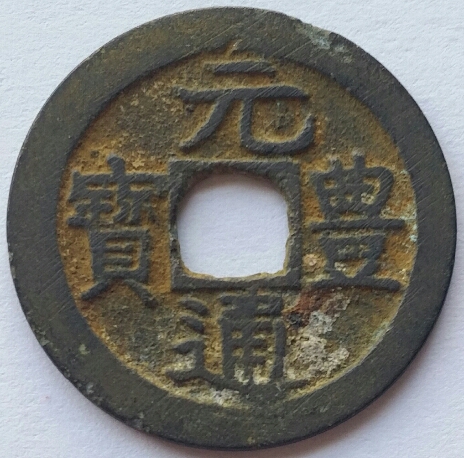
Bita-sen are quite scarce and can sometimes be difficult to properly attribute, due to their unofficial nature. Of my coins, I believe only this one is a true bita-sen:
Gen Ho Tsu Ho, (Imitating or directly copied from Chinese Yuan Feng Tong Bao)

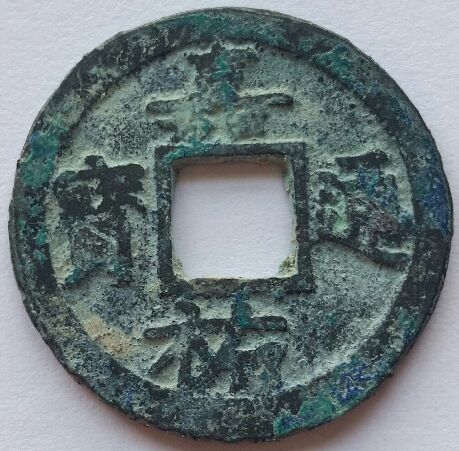
A special class of unofficial cash are the Kajiki Sen, minted on the southern island of Kyushu under the authority of the Satsuma clan from about 1573 - 1688. Like the Bita Sen, these were all copied from Song Dynasty coins.
Gen Yu Tsu Ho
(Imitating Yuanyou Tongbao)
Minted by the merchant Hacrapsune Takehiko, 1616 - 1646 until he was executed for his illegal castings
Ref: Hartill 3.71

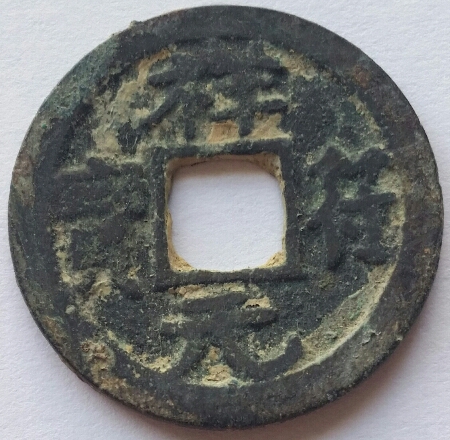
Gen Tsu Tsu Ho
Minted 1580 - 1620
Ref: Hartill 3.132

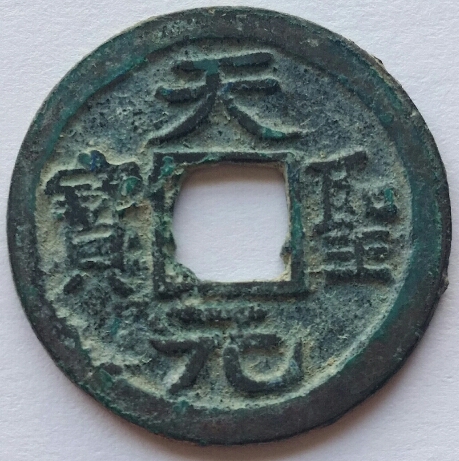
Ki Nei Gen Ho
Minted 1580 - 1620
Ref: Hartill 3.156












 Posted 06/10/2019 6:23 pm


