| Author |
 Replies: 36 / Views: 8,293 Replies: 36 / Views: 8,293 |
|
Press Manager
 United States
1420 Posts |
Professional Coin Grading Service (PCGS) is excited to announce its partnership with HID Global to begin embedding high-security Near Field Communication (NFC) chip technology in PCGS coin slabs. PCGS slabs embedded with NFC technology allow any collector or dealer with a modern smartphone to easily verify that the coin encapsulated within was indeed certified, graded, and slabbed by PCGS. The new NFC-enabled slabs will premiere in early 2020 and will be identified as such on their labels. PCGS will make this technology available for all domestic Gold Shield products at no additional charge. While this incredible anti-counterfeiting technology is already employed in a variety of industries, including those involving luxury goods, it's new to numismatics. 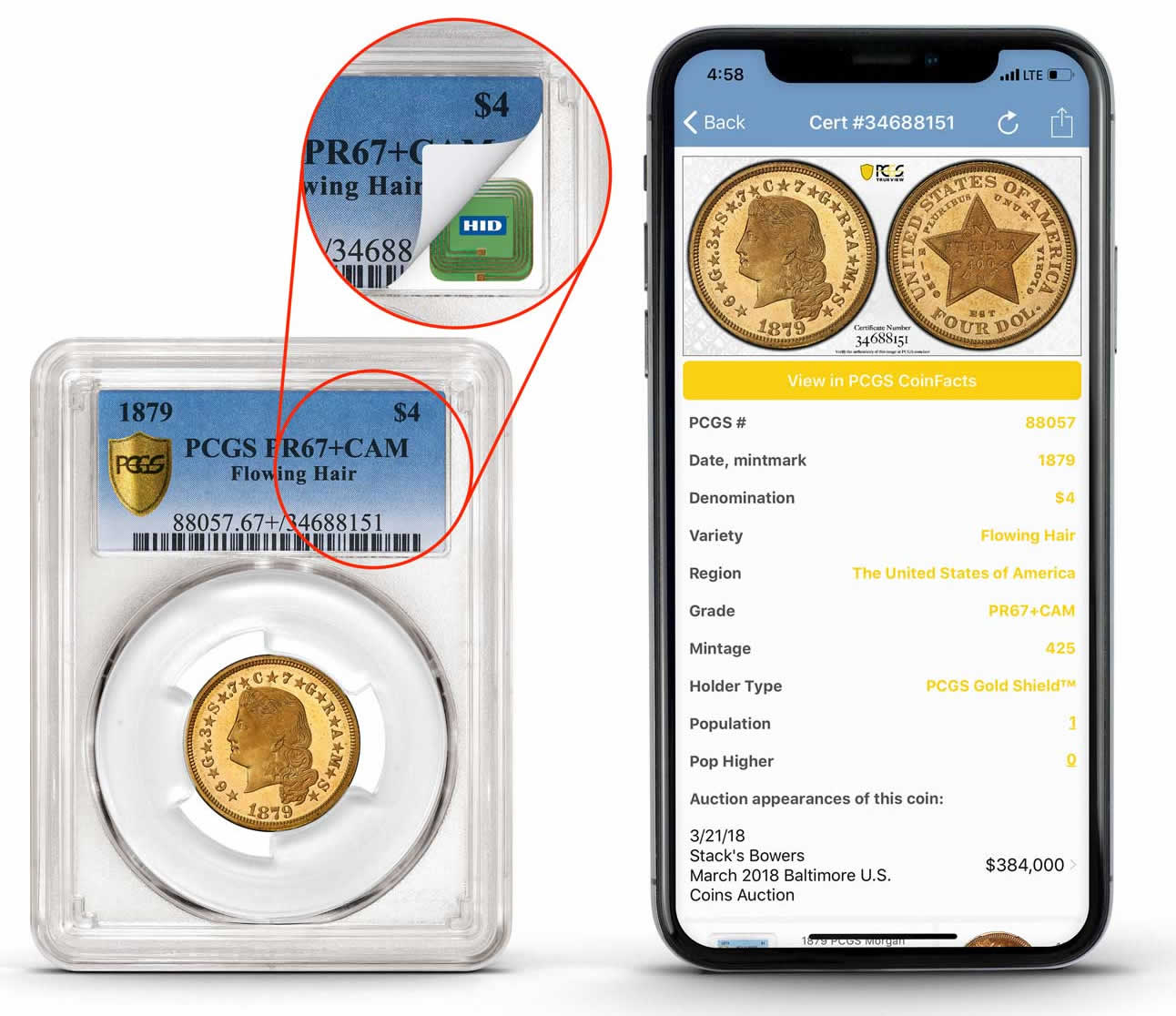 "We will be the first in the numismatic industry and among the first in any of the collectibles fields to utilize this type of technology at scale," said PCGS Chief Information Officer John Nelson. "This will allow collectors to tap their coins with their phones and the certificate verification will pop right up. On some of the most modern smart phones this data will appear on the screen without even having to download an app." These state-of-the-art NFC chips, which individually serve as one part of a wireless connection, incorporate encrypted technology to securely exchange data between it and another NFC-enabled device, such as a smart phone. NFC inserts are intuitive and very easy to use. Those who have Android and iPhone XS (or newer) phones need to simply put those devices close to the chip, and this action will automatically launch the PCGS Cert Verification app if the user has it installed or open a web browser to display the information about the slab and the coin within. Meanwhile, those who use older iPhones will need to launch an NFC chip-reading app before putting their device near the chip and enjoying the same experience. Mark Robinton, Vice President of IoT Services, Identification Technologies with HID Global, explains, "The NFC chip contains a uniform resource locator (URL) that generates a unique, cryptographic one-time password (OTP) that changes every time the chip is tapped. This password is validated by the HID Trusted Tag® Cloud Authentication service to prove that it is the exact same tag that was issued with the slab." This technology, representing many years of development, marks an exciting new era for PCGS at a time when sophisticated counterfeit slabs are appearing with ever greater prevalence in the marketplace. "PCGS' use of this technology is ideal for adding trusted identities to the collectibles that have gone through the PCGS vetting process; it is exactly in line with the vision of HID Trusted Tag Services, and we are excited to work with PCGS on this deployment," Robinton remarks. "The addition of trusted NFC inserts to the slabs will allow a very simple and secure validation of the authenticity of the coin." |
|
|
|
Pillar of the Community
United States
5825 Posts |
Interesting announcement and certainly a step forward in Counterfeit Detection. But I have a few problems with it. 1. The title, "PCGS Announces Security Chip-embedded Slabs To Protect Against Counterfeiting", caused me to do a "Oooo, great!" response. But in a few seconds the full meaning hit me (PCGS slabs only) and I dropped to an "Okay" response. It's still an improvement. 2. "PCGS slabs embedded with NFC technology allow any collector or dealer with a modern smartphone to easily verify that the coin encapsulated within was indeed certified, graded, and slabbed by PCGS." This part stopped me in my tracks. What if you don't have "a modern smartphone"? I don't. So now I'm down to a "so what" response. 3. "PCGS will make this technology available for all domestic Gold Shield products at no additional charge." I have a LOT of PCGS-slabbed coins but I don't recall having even one Gold Shield product. Maybe some of my coins would qualify for that but I got them before that was done ... or maybe you had to select that as an option (for a price). At this point I've thrown the towel in as far as the announcement is concerned. Bottom line: Anything that protects against counterfeiting is a plus. This is a step forward, but only a VERY small one. I'd be interested in hearing how many people in here will benefit. I've got to believe it will be limited to the top-end collectors/dealers. |
|
Pillar of the Community
 United States
4622 Posts |
1. CoinWorld also announced something similar, although theirs would be an external NFC chip while PCGS' is inside the holder. 2. You need NFC (Near Field Communications) capability - Samsung S5 or later, iPhone 6 or later. You can probably buy a $60 phone from sprawlmart and never activate it - just use it on WiFi. 3. GoldShield is a $5 add on to the lowest tiers. -----Burton 50+ year / Life / Emeritus ANA member (joined 12/1/1973) Life member: Numismatics International, CONECA Member: TNA, FtWCC, NETCC, EveryCountry (online) coin club Owned by three cats and a wife of 40+ years (joined 1983) Author: 3rd Edition of the Sample Slabs book, https://www.sampleslabs.info/ |
|
Bedrock of the Community
13014 Posts |
Quote:1. CoinWorld also announced something similar, although theirs would be an external NFC chip while PCGS' is inside the holder. My understanding of the CoinWorld one is that it is more of a tracking system showing where everything has been etc. I don't see the CoinWorld one being popular in a hobby that values privacy. This one sounds appears to just be verification based with no tracking aspect |
|
Rest in Peace
United States
18456 Posts |
While I am not a slabbed coin collector this I just the beginning of modern technology for fighting counterfeit slabs . Like electronic devices I believe this chip & tech will keep getting more sophisticated in the near future . And you know NGC and others will be on the bandwagon with this or other devices of their own to deter counterfeiting their slabs .  |
|
Pillar of the Community
Canada
3733 Posts |
if they can fake, the slabs, the coins, then chips will be right behind. Most likely the technology is coming from overseas..
I believe it is a feel better move..
|
|
Bedrock of the Community
13014 Posts |
Quote:
if they can fake, the slabs, the coins, then chips will be right behind. Most people really don't get the effort it would take to fake the chips. They aren't a visual cue they have unique features that will have to match in the system Anyone good enough to switch things in the system undetected would be wasting their time on coins, the fake would still have to pass muster which they don't. Far to much the sky is falling in this hobby |
|
Pillar of the Community
Australia
852 Posts |
Excuse Me? How on earth can you say the fakes don't pass muster? Lots of fake coins in PCGS slabs (I own a few) and lots of fake everything comes from overseas (cough China cough). Was in China 2 months ago and was offered lots of fakes coins etc. In Shanghai I visited what was described as the largest market in China and found fake US coins in under 2 minutes . Shenzen (China) is the worlds number 1 electronics hotspot and they will probably have spoofed these chips before the typical PCGS customer even gets a real slab (the technology isn't that high tech, you can spoof most NFC/RFID devices in under 2 minutes with fairly basic know-how). |
|
Pillar of the Community
United States
4622 Posts |
You're pretty much all missing the point. Its not the chip itself that's the magic - it's the back end Link to the PCGS database.
The chip itself can store 144 bytes of information. That's more than enough to store the 18 characters of the PCGS barcode, a random number called the nonce and a GUID/UUID.
After the coin is encapsulated PCGS writes the information to the tag (one time write) and then reads it, hash has the value and stores the hash as an index into their database.
So in order to fake a specific coin you have to have a clean read of the tag. That allows you to fake a slab with just that one coin.
-----Burton 50+ year / Life / Emeritus ANA member (joined 12/1/1973) Life member: Numismatics International, CONECA Member: TNA, FtWCC, NETCC, EveryCountry (online) coin club Owned by three cats and a wife of 40+ years (joined 1983) Author: 3rd Edition of the Sample Slabs book, https://www.sampleslabs.info/Edited by BStrauss3
12/29/2019 10:58 am
|
|
Pillar of the Community
United States
4622 Posts |
-----Burton 50+ year / Life / Emeritus ANA member (joined 12/1/1973) Life member: Numismatics International, CONECA Member: TNA, FtWCC, NETCC, EveryCountry (online) coin club Owned by three cats and a wife of 40+ years (joined 1983) Author: 3rd Edition of the Sample Slabs book, https://www.sampleslabs.info/ |
|
Pillar of the Community
United States
8946 Posts |
Hate to ask the question, but someone has to.
How much will this raise the cost for a submission?
|
|
Pillar of the Community
United States
581 Posts |
The following is obtuse on purpose as I am not going to abet the abhorrent.
#1 Do not forget about the hacking of a website.
#2 This $#^ could be dealt with right now simply and cheaply by implementing brand new methods that utilize recent technological advancements and scientifically proven products that are now (finally) commercially available.
The real issue is about money.
#1 The implementation of the above would eliminate lucrative revenue streams from TPGs, and other entities, balance sheets.
#2 What I describe above can not be patented. Well... they maybe could but not affectively anyway.
Edited by yellow88
12/30/2019 07:37 am
|
|
Bedrock of the Community
13014 Posts |
Quote:
How much will this raise the cost for a submission? Basically none, it's part of Gold Shield submissions for the initial implementation. Costs may or may not increase from the new year anyways |
|
Moderator
United States
196100 Posts |
Very interesting. The tech nerd in me is impressed.
|
|
Bedrock of the Community
United States
17884 Posts |
Quote:
The chip itself can store 144 bytes of information. That's more than enough to store the 18 characters of the PCGS barcode, a random number called the nonce and a GUID/UUID.
After the coin is encapsulated PCGS writes the information to the tag (one time write) and then reads it, hash has the value and stores the hash as an index into their database. With only 144 bytes of date, how is this chip going to generate a new and unique passcode every time it is read? And if it is read a few times without connecting to the PCGS database, the next time it does will it be generating a passcode that is NOT the one the database is expecting and get a non-recognition response? If it only generates one unique passcode, recorded at the time of slabbing and replies with that each time, then all I have to do is record that and program chips to respond with that code and I can make fakes of that slab. Edited by Conder101
12/31/2019 12:16 am
|
|
Pillar of the Community
United States
4622 Posts |
(you are also confusing the EEPROM of 144 bytes with the capacity of the chip's RAM if it had any - NFC/RFID typically don't because there isn't enough parasitic power to drive a real computation).
The code being read is static - it's EEPROM (Electronically Erasable Programmable Read-Only Memory) or WORM (Write Once Read Many). The programming station that PCGS uses will supply enough power to the chip and for long enough for the programming session - this is a lot more power than the typical read session.
Agreed you can fake that ONE slab. The point of using a UUID/GUID is that you don't have enough information to fake any OTHER slab.
You need to do things like this in situations where the threat surface exposes the entire system except your back end.
-----Burton 50+ year / Life / Emeritus ANA member (joined 12/1/1973) Life member: Numismatics International, CONECA Member: TNA, FtWCC, NETCC, EveryCountry (online) coin club Owned by three cats and a wife of 40+ years (joined 1983) Author: 3rd Edition of the Sample Slabs book, https://www.sampleslabs.info/Edited by BStrauss3
12/31/2019 10:39 am
|
| |
Replies: 36 / Views: 8,293 |










 Posted 12/27/2019 5:50 pm


