| Author |
 Replies: 5,919 / Views: 201,182 Replies: 5,919 / Views: 201,182 |
|
|
|
CCF Master Historian of Commemorative Coins
 United States
12515 Posts |
Quote:Of these, the Eagle dollar is my favorite.  @jbuck: Good choice. The design does have a certain timeless nobility about it. Collecting history one coin or medal at a time! (c) commems. All rights reserved.
Edited by commems
12/19/2021 06:44 am
|
|
CCF Master Historian of Commemorative Coins
United States
12515 Posts |
The 2011 commemorative coin program for the Founding of the US Army consisted of a CuNi Clad Half dollar, a Silver Dollar and a Gold Half Eagle. The coins were issued "in recognition and celebration of the establishment of the United States Army in 1775, to honor the American soldier of both today and yesterday, in wartime and in peace, and to commemorate the traditions, history, and heritage of the United States Army and its role in American society, from the Colonial period to today. " (Public Law 110-450) In response to Britain's passage of the Intolerable Acts and the subsequent armed conflict at Lexington and Concord, the Second Continental Congress established the Army on June 14, 1775 via the adoption of the following resolution: Resolved, That six companies of expert rifflemen, be immediately raised in Pensylvania, two in Maryland, and two in Virginia; that each company consist of a captain, three lieutenants, four serjeants, four corporals, a drummer or trumpeter, and sixty-eight privates.
That each company, as soon as compleated, shall march and join the army near Boston, to be there employed as light infantry, under the command of the chief Officer in that army.
That the pay of the Officers and privates be as follows, viz. a captain @ 20 dollars per month; a lieutenant @ 13 1/3 dollars; a serjeant @ 8 dollars; a corporal @ 7 1/3 dollars; drummer or [trumpeter] @71/3 doll.; privates @ 6 2/3 dollars.(Note: The misspelled words in the above are as written in the original; no updates to current usage have been made.) And thus, the Continental Army of the 13 colonies, the forerunner of today's US Army, was born. I find it interesting that the drummer or trumpeter was given a higher pay amount than the privates - I guess privates have always been the bottom rung on the ladder! The obverse of the CuNi Clad Half Dollar presents the US Army's peacetime activities/contributions. It depicts (from left to right) a soldier using a theodolite while surveying, a pair of soldiers helping to build a wall to hold back flood waters with sand-filled bags and a Redstone rocket - an Army ballistic missile used in the late 1950s through mid-1960s; versions of the missile were developed for use in launching US satellites and the first two manned Mercury flights into space. The design was created by US Mint Artistic Infusion Program artist Donna Weaver; the design was sculpted by US Mint Sculptor-Engraver Charles L. Vickers. The coin's reverse design looks at the US Army as a military fighting entity. It presents an armed colonial-era soldier along with the inscription "FIRST IN SERVICE TO THE NATION" - a nod to its 1775 roots. Above the soldier is presented an arc of 13 stars, symbolic of the 13 original colonies (not States). Artistic Infusion Program Master Designer Thomas Cleveland was responsible for the reverse design; it was modeled by then US Mint Medallic Artist Joseph Menna (Menna was promoted to Chief Engraver in February 2019). 2011 US Army CuNi Clad Half Dollar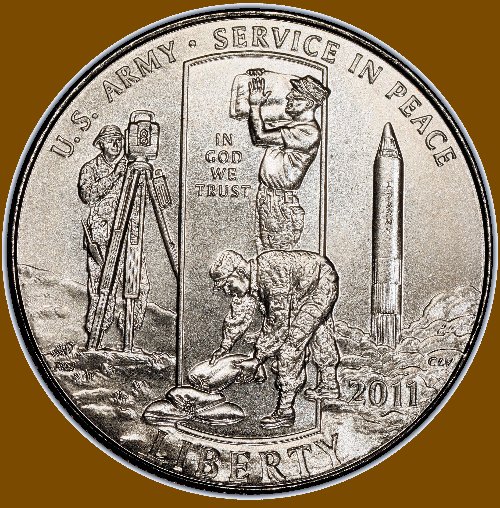 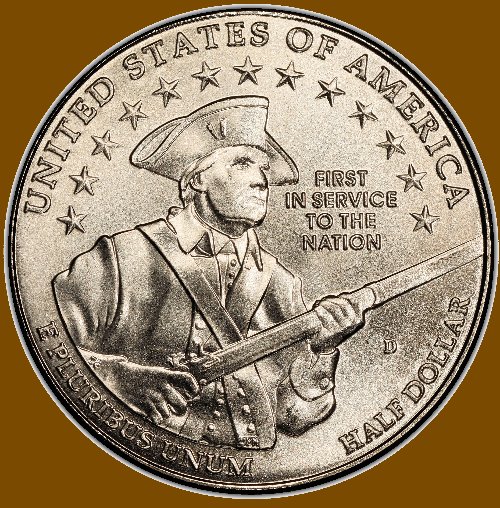 Collecting history one coin or medal at a time! (c) commems. All rights reserved.
Edited by commems
12/19/2021 06:46 am
|
|
CCF Master Historian of Commemorative Coins
United States
12515 Posts |
The Silver Dollar of the 2011 Founding of the US Army commemorative coin program includes stars on its reverse design. The surcharges collected on sales of all three coins in the 2011 program were directed to the Army Historical Foundation for use in helping to finance the National Museum of the United States Army. The Museum seeks "to tell the Army's story and honor the accomplishments, sacrifices and commitment of American Soldiers." (Web site of the National Museum of the US Army, https://www.thenmusa.org/about/amer...rmy-museum/)For the coin's obverse, Artistic Infusion Program Artist Richard Masters, depicted individual male and female soldiers, back to back, with a globe seen in the background. The overall design is meant to represent the modern US Army's responsibility of worldwide deployment to areas of need. US Mint Medallic Artist Michael Guadioso created the sculpt of the design. The reverse design was the work of freelance artist Susan Gamble (Ms. Gamble was a Master Designer within the Mint's Artistic Infusion Program (AIP)). The design presents the seven core values of the US Army in a ring that encircles the Great Seal of the United States. The values - Honor, Loyalty, Duty, Respect, Selfless Service, Personal Courage and Integrity - are separated by five-pointed stars. Thirteen stars, one for each of the original 13 States, are seen in the constellation above the head of the Great Seal's eagle. US Mint Sculptor-Engraver Don Everhart modeled/sculpted the design. 2011 Founding of the US Army Silver Dollar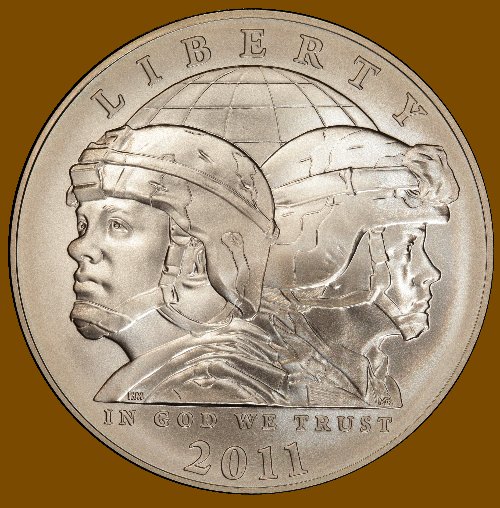 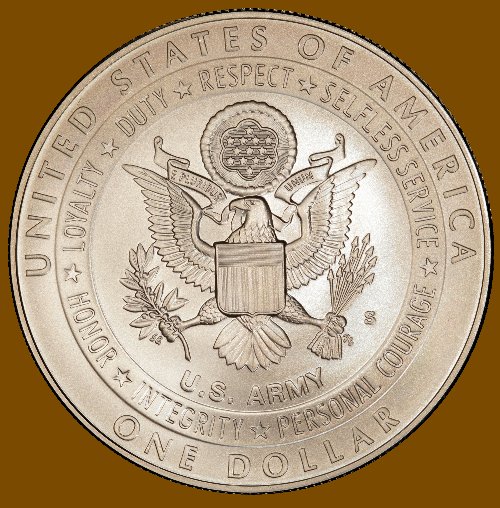 Collecting history one coin or medal at a time! (c) commems. All rights reserved.
|
|
CCF Master Historian of Commemorative Coins
United States
12515 Posts |
The third coin of the three-piece 2011 Founding of the US Army commemorative coin program is its Gold Half Eagle. As with the CuNi Clad Half Dollar and Silver Dollar of the program, the coin features stars within its reverse design. The obverse of the coin depicts five soldiers that represent important eras in the history of the US Army. On the left are seen a Revolutionary War soldier (at rear) and a Civil War soldier. At right are depicted soldiers from World War I (rear) and World War II. At the front, is a modern-day US soldier (circa 2011). The design is meant to symbolize the continuity of strength and readiness of the US Army throughout its history. The design was created by independent artist and US Mint's Artistic Infusion Program (AIP) member Joel Iskowitz; the design was sculpted by US Mint Sculptor-Engraver Phebe Hemphill. US Department of the Army Seal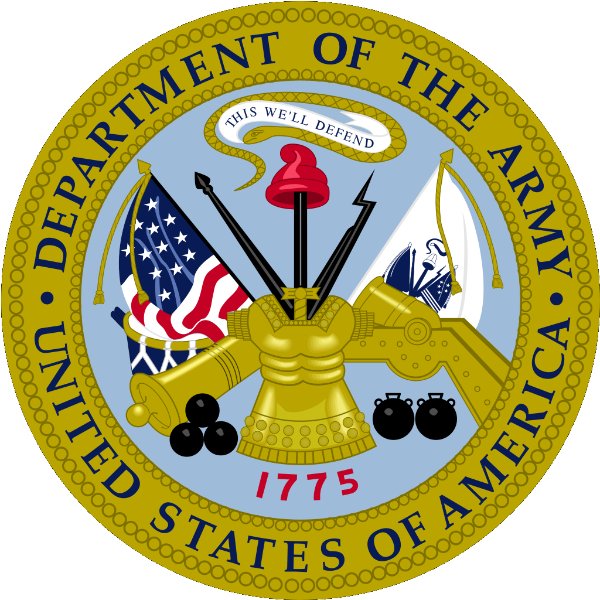 (Image Credit: Institute of Heraldry. Fair use.) (Image Credit: Institute of Heraldry. Fair use.)The coin's reverse design is dominated by an adapted rendering of the US Army Seal. Per the web site of the Institute of Heraldry - https://tioh.army.mil/default.aspx - the symbolism of each of the Seal's elements are as follows:  The central element, the Roman cuirass, is a symbol of strength and defense. (Note: A cuirass is a piece of armor with a breastplate and backplate joined together.) The sword, esponton (a type of half-pike formerly used by subordinate officers), musket, bayonet, cannon, cannon balls, mortar, and mortar bombs are representative of Army implements. The drum and drumsticks are symbols of public notification of the Army's purpose and intent to serve the Nation and its people. The Phrygian cap (often called the Cap of Liberty) supported on the point of an unsheathed sword. The motto "This We'll Defend" on a scroll held by the rattlesnake is a symbol depicted on some American colonial flags and signifies the Army's constant readiness to defend and preserve the United States. In the background, at left, is a US Flag; at right is a US Army Flag. Each flag includes stars. The number of stars shown on the US Flag do not appear to be strictly defined as I've seen versions of the Seal/Emblem with 8, 10 and 12 (as here) stars. US Mint Medallic Artist Joseph Menna was responsible for adapting the Army Seal and developing the coin's overall design; Menna also created the sculpt. 2011 Founding of the US Army Gold Half Eagle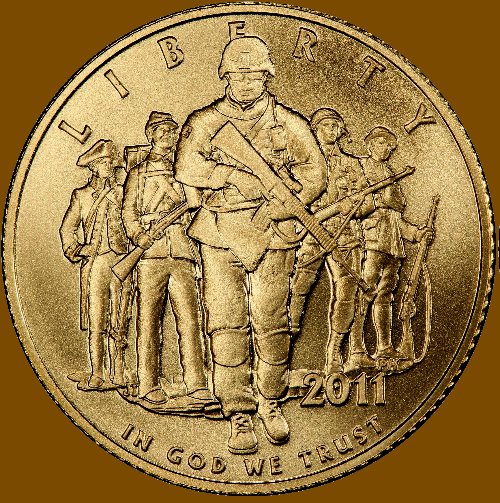 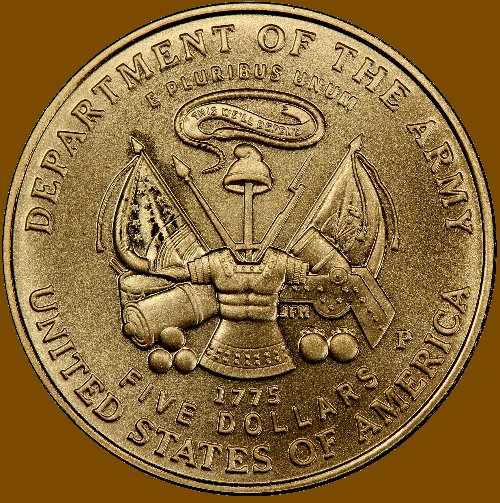 Collecting history one coin or medal at a time! (c) commems. All rights reserved.
Edited by commems
12/19/2021 11:11 am
|
|
CCF Master Historian of Commemorative Coins
United States
12515 Posts |
In 2011, the US Mint struck silver and gold coins to commemorate the 150th anniversary of the creation of the US Medal of Honor. In the Act authorizing the coins, a brief history of the Medal of Honor was included; it was presented in the legislation's "Findings" section: (1) The Medal of Honor, first authorized by the Congress in 1861 as the United States Navy's highest personal decoration, the Army Medal of Honor was authorized by the Congress in 1862, and the Air Force Medal of Honor was authorized by Congress in 1956.
(2) The Medal of Honor is presented by the President of the United States in the name of the Congress, to a person
who, while a member of the United States Armed Forces, distinguishes himself or herself conspicuously by gallantry and intrepidity at the risk of his or her life above and beyond the call of duty while engaged in action against an enemy of the United States; while engaged in military operations involving conflict with an opposing foreign force; or while serving with friendly foreign forces engaged in an armed conflict against an opposing armed force in which the United States is not a belligerent party.
(3) The deed performed must have been one of personal bravery or self-sacrifice so conspicuous as to clearly distinguish the individual above his or her comrades and must have involved risk of life.
(4) Incontestable proof of the performance of the service will be exacted and each recommendation for the award of
this decoration will be considered on the standard of extraordinary merit.
(5) Fewer than 3,500 Medals of Honor have been awarded to members of the United States Armed Forces."Note: As of December 20, 2021, there have been 3,511 recipients of the Medal of Honor across all service branches. The focus of this post is the program's Silver Dollar. The stars on this issue are found on the coin's obverse, being incorporated into the design via the Medals of Honor depicted. The dollar's obverse design presents (l to r) the current Army, Navy and Air Force Medals of Honor (MoH); eligible members of the Marine Corps and Coast Guard receive the Navy version of the MoH. The coin's obverse design was created and sculpted by US Mint Sculptor-Engraver Jim Licaretz. The medal of each service branch uses a five-pointed star as its design foundation, and presents a field of 13 stars in the ribbon segment to which the hanging medal is attached; the MoH is the only US military decoration that is worn via ribbon around the neck. A bust portrait of Minerva, the Roman goddess of Wisdom and War, is seen at the center of the Army version of the MoH. The Navy MoH presents a standing Minerva defending against a man clutching snakes in his hand; the man is meant to represent a hostile enemy. The center of the Air Force MoH features the head of the Statue of Liberty. More about the Medal of Honor and its designs can be found here: Congressional Medal of Honor Society. The coin's reverse design depicts an infantry soldier carrying a wounded soldier over his shoulder; he is carrying the soldier to safety while under enemy fire. The scene illustrates the courage and self-sacrifice required to be considered for a Medal of Honor (see Finding #2 above). The coin's depiction of a combat scene also is per MoH criteria (also, Finding #2 above). The reverse design was created by Richard Masters, a member of the Mint's Artistic Infusion Program (AIP); the design's sculpt was developed by US Mint Medallic Artist Phebe Hemphill. The MoH Silver Dollar I received from the Mint is a very satiny/frosty example vs. a brilliant coin. 2011 Medal of Honor 150th Anniversary Silver Dollar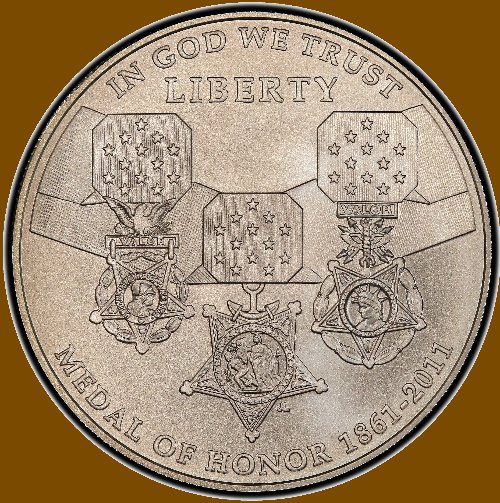 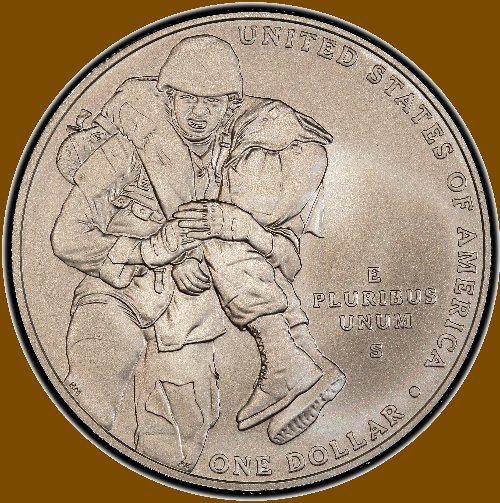 Collecting history one coin or medal at a time! (c) commems. All rights reserved.
|
|
Moderator
United States
195024 Posts |
Very nice examples and excellent accompanying written material!  Again here, Army dollar is my winning design. Although the half dollar reverse appeals to me, impressive given how I generally dislike people on coins.  I also like the obverse on the Medal of Honor Silver Dollar. |
|
CCF Master Historian of Commemorative Coins
United States
12515 Posts |
Quote:
Again here, Army dollar is my winning design. Hard to find fault - it's a solid design on both sides. Collecting history one coin or medal at a time! (c) commems. All rights reserved.
|
|
CCF Master Historian of Commemorative Coins
United States
12515 Posts |
The last modern US commemorative coin of the program's third decade (2002 to 2011) to include stars in its design is the 2011 Medal of Honor Gold Half Eagle. The obverse design of the coin depicts the first Medal of Honor. It was created as a Navy award for seamen and marines who "distinguish themselves by gallantry in action and other seamanlike qualities." (Act of December 21, 1861, signed into Law by US President Abraham Lincoln). The bill calling for the award was introduced in the Senate by James Grimes (R-IA). on behalf of Secretary of the Navy Gideon Welles. The Act creating the Army MoH followed soon after, being signed into law on July 12, 1862 (its bill was introduced in February 1862 by Senator Henry Wilson (R-MA)). Jacob Parrott, a Union soldier in the Civil War, was the first recipient of the Medal of Honor, being awarded the distinction on March 25, 1863; five other Union soldiers were honored on the same day, however: Sgt. Elihu H. Mason, Cpl. William Pittinger, Cpl. William H. H. Reddick, Pvt. William Bensinger and Pvt. Robert Buffum. The solders were among (James J.) Andrews' Raiders, the group of Union Army volunteers who went behind enemy lines and stole a Confederate train - The General - from Big Shanty, GA and attempted to take it north to Tennessee. While escaping, the Union soldiers cut telegraph wires and did as much damage as they could to the rail tracks they rode over; the damage was limited, however, due to a lack of men, proper tools and rain. Ultimately, the raid failed and members of Andrews' Raiders were either executed or imprisoned by the Confederates; while prisoners some soldiers successfully escaped and made it back to the North. Private Parrott was one of the men who was taken prisoner; he was recognized with a MoH for the physical abuse he endured while a prisoner. The obverse design was created and sculpted by US Mint Medallic Artist, Joseph Menna. (See the 2011 Medal of Honor Silver Dollar post above for a description of the medal's design.) The coin's reverse design presents a Civil War era theme. It depicts a forward-striding Minervaat the center with a Union Flag (on a pole) held in her left, outstretched hand and a Shield representing the Army and Navy in her right. Behind Minerva, at her feet, are presented a mortar (with rounds), a cannon (with cannon balls) and a pair of swords. The field artillery are definitely from the Civil War. US Mint Artistic Infusion Program (AIP) Master Designer Joel Iskowitz created the design; US Mint Medallic Artist Michael Gaudioso developed the sculpt. More about the Medal of Honor and its designs can be found here: Congressional Medal of Honor Society. 2011 Medal of Honor Gold Half Eagle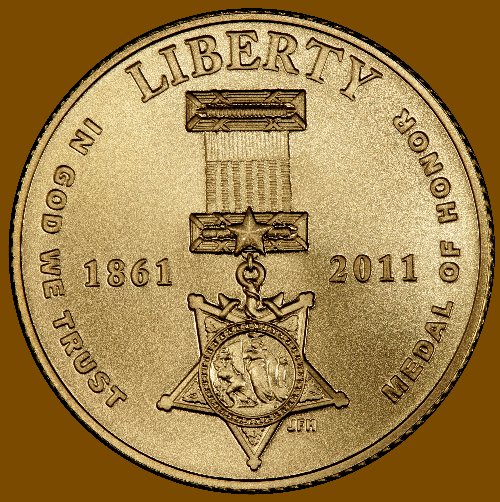 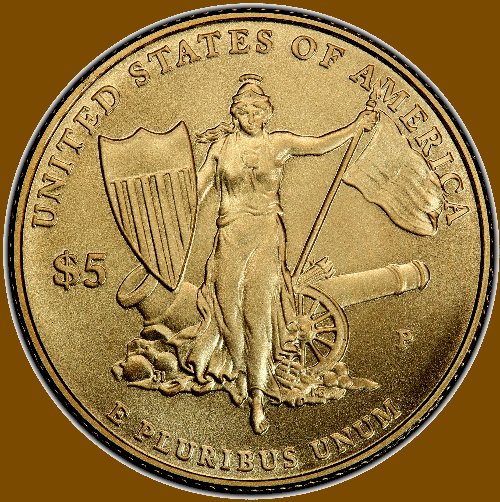 Collecting history one coin or medal at a time! (c) commems. All rights reserved.
Edited by commems
12/21/2021 06:48 am
|
|
Moderator
United States
195024 Posts |
Quote:
The coin's reverse design presents a Civil Ware era theme... This reverse with the Dollar's obverse would have been an excellent, dare I say perfect combination, one I would likely have been more inclined to purchase. That being said, I do like the combination here; however, gold is not really in my budget. I can imagine a what if... where this was actually a silver medal and it was paired with the dollar coin (as it is)... Of course, that assumes I was already a fan of the silver dollar and medal sets.  |
|
CCF Master Historian of Commemorative Coins
United States
12515 Posts |
Stars are found on both sides of the 2012 Star-Spangled Banner (SSB) Bicentennial Silver Dollar, courtesy of the US Flag that is presented on each side in some form. A Gold Half Eagle was also issued as part of the SSB program. The SSB coins were struck in commemoration of the 200th anniversary of the writing of the poem that became the US National Anthem; Francis Scott Key was the author. A great presentation of the SSB's story/history is presented by the Smithsonian Institution here: The Star-Spangled Banner. Highly recommended! Key was inspired to write the famed poem / lyrics after he observed a large, 15-star US flag that remained flying over Fort McHenry in Baltimore harbor after the fort had been bombarded by the British for 25 hours on September 13-14, 1814. The flag was the Fort's large Garrison Flag which had been raised in place of the battered flag that survived the bombardment. The poem was originally titled "The Defense of Fort McHenry" and soon was being sung to the tune of "To Anacreon in Heaven" - a popular British song that was familiar to many in the recently-independent US as well. The poem/song was eventually renamed the "Star-Spangled Banner" and was officially made the US national anthem in 1931 when President Herbert Hoover signed a Congressional resolution into law. The obverse of the Silver Dollar features a standing Lady Liberty waving a 15-star, 15-stripe Star-Spangled Banner flag (current in 1814 when the US had 15 States); Fort McHenry is depicted in the background. The design was created by US Mint Artistic Infusion Program (AIP) Master Designer Joel Iskowitz and sculpted/engraved by US Mint Sculptor-Engraver Phebe Hemphill. The coin's reverse presents a close-up view of a waving 50-star modern US Flag focused on its field of stars; 20 whole or partial stars are visible. Outside artist William C. Burgard II created the design; US Mint Sculptor-Engraver Don Everhart was responsible for the sculpt. The paring of the circa 1814 US Flag (15 stars, 15 stripes) with a modern, circa 2012 US Flag *13 stripes, 50 stars) creates an effective now-and-then design theme for the coin. 2012 Star-Spangled Banner Bicentennial Silver Dollar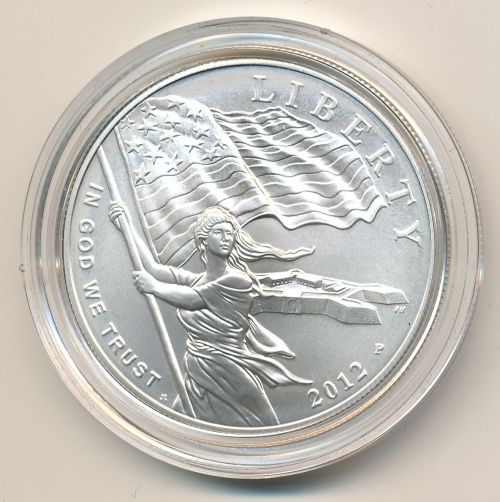 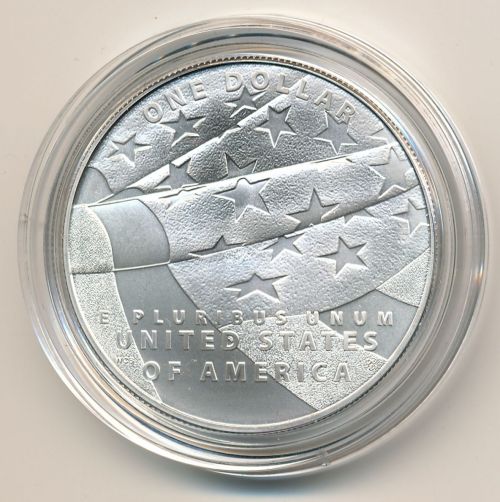 Here are a few previous posts I've made about the SSB Bicentennial coins: - 200th Anniversary of Star-Spangled Banner- 200th Anniversary of Star-Spangled Banner Set PicturesCollecting history one coin or medal at a time! (c) commems. All rights reserved.
Edited by commems
12/21/2021 08:18 am
|
|
Moderator
United States
195024 Posts |
That is the most fantastic example of a coin with stars!  |
|
CCF Master Historian of Commemorative Coins
United States
12515 Posts |
The Gold Half Eagle of the US Mint's 2012 Star-Spangled Banner Bicentennial coin program includes stars on its reverse. Per its authorizing legislation, the coin's design needed to "be emblematic of the War of 1812 and particularly the Battle for Baltimore that formed the basis for the Star Spangled Banner." To meet this criteria on the Half Eagle, (the same specification applied to the Silver Dollar), the coin's obverse design presents an American sailing ship (foreground) with a damaged British Ship leaving the battle scene (background). The Mint describes the British ship as "fleeing," though, IMO, such is difficult to see considering the direction the British ship appears to be sailing and the direction of the wind that is billowing the ship's sails (i.e., I get the sense the British ship is moving toward the American ship, not away from it). There is clear "exiting" movement of the American ship shown, however. I see the design as one that depicts an American ship departing the scene after defeating its British adversary. The design was created by US Mint Artistic Infusion Program (AIP) Artist Donna Weaver and sculpted by US Mint Sculptor-Engraver Joseph Menna. The reverse design is a stylized rendition of the US Flag as seen in 1815 (i.e., 15 stars, 15 stripes). Rather than a standard flag, its design features are presented as a long, striped ribbon with an arc of stars between the one and eight positions on a clock. The opening line of the Star-Spangled Banner - "O say can you see" - written in Francis Scott Key's handwriting is presented as the foreground element in front of the ribbon. The coin's reverse was designed by Richard Masters of the Mint's Artistic Infusion Program (AIP); it was modeled by US Mint Medallic Artist (and future Chief Engraver) Joseph Menna. 2012 Star-Spangled Banner Gold Half Eagle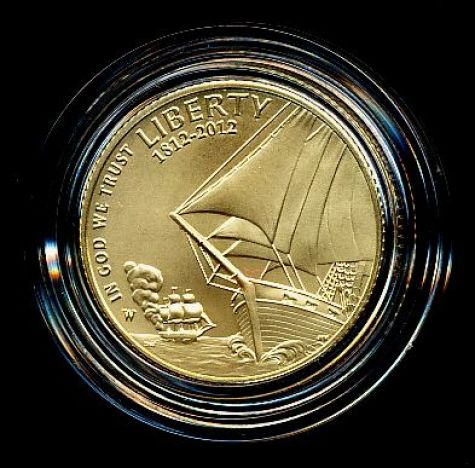 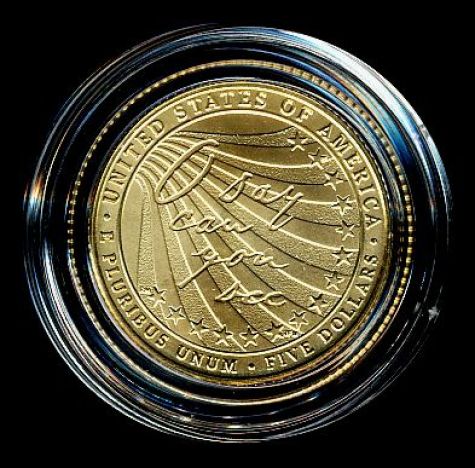 Here's a previous post I've made about the SSB Bicentennial coins that includes the Gold Half Eagle: - 200th Anniversary of Star-Spangled BannerCollecting history one coin or medal at a time! (c) commems. All rights reserved.
|
|
Moderator
United States
195024 Posts |
Very nice! |
|
CCF Master Historian of Commemorative Coins
United States
12515 Posts |
The three-coin US Five Star General commemorative coin program struck by the US Mint in 2013 was issued to recognize "five United States Army 5-Star Generals, George Marshall, Douglas MacArthur, Dwight Eisenhower, Henry "Hap" Arnold, and Omar Bradley, alumni of the United States Army Command and General Staff College, Fort Leavenworth, Kansas, to coincide with the celebration of the 132nd Anniversary of the founding of the United States Army Command and General Staff College." (Public Law 111-262) The program includes a CuNi Clad Half Dollar, a Silver Dollar and a Gold Half Eagle. The authorizing legislation included extensive "Findings," including a brief biography on each General honored by the coin program and a discussion of the school it also recognized. Per the Findings, the United States Army Command and General Staff College was founded in 1881; it was in 2013 - and remains today - the US' oldest active military staff college and has trained officers in war and peace throughout its long history. (William Tecumseh Sherman founded the school as the School of Application for Infantry and Cavalry; it dedicated to the training of Infantry and Calvary officers.) During its 140 years of operation, the college has trained thousands of field grade officers - its specialty. Today, the College is within the US Army's Combined Arms Center in Fort Leavenworth, KS. (Note: Though "College" is part of its name, it is not a general academic school such as Harvard or Johns Hopkins or University of North Carolina, etc. It is exclusively for the training of the Army's officers.) Generals Henry "Hap" Arnold and Omar N. Bradley, both graduates of the College, are the focus of the CuNi Clad Half Dollar of the program. Per the Coin Act: Henry H. Arnold, General of the Army (A) General "Hap" Arnold is the only officer in the history of our country [US} to earn the ranks of General of the Army and General of the Air Force.
(B) General Arnold, a graduate of West Point in 1907, received his pilot training in 1911 from the Wright brothers in Dayton, Ohio.
(C) He became one of our Nation's strongest advocates for air power, and personally held numerous records and trophies for flying achievements, to include the first delivery of United States mail by air.
(D) Accomplishments in and from the air in the World Wars, particularly in World War II, were heavily influenced by his genius.
(E) As a result of General Arnold's contributions, massed air power gave a third dimension to battles of World War II, swept the skies of the enemy, and denied him mobility on the ground.
(F) One of General Arnold's citations reads in part: ``From conception to execution, General Arnold's leadership guided the mightiest air force in history''.
(G) General Arnold's service at Ft. Leavenworth was as a student at the Command and General Staff College, 1928-1929.Omar N. Bradley, General of the Army (A) Throughout his distinguished military career, General Omar N. Bradley was recognized as an exceptional leader, tactician, and educator.
(B) As Commandant of the Infantry School, he developed the officer candidate program through which more than 45,000 combat leaders of World War II were commissioned.
(C) During the war, he successfully commanded a division, corps, army, and army group. While commanding II Corps, he was instrumental in defeating German forces in North Africa and Sicily.
(D) His successful career as a field commander reached a peak when, as commander of the 12th Army Group, he greatly assisted in the liberation of Europe.
(E) This group contained the largest number of American to ever serve under one commander. He became the Army Chief of Staff in 1948 and the first Chairman of the Joint Chiefs of Staff in 1949.
(F) General Bradley's service at Ft. Leavenworth was as a student at the Command and General Staff College, 1928-1929.The obverse of the Half Dollar presents front-facing portraits of Generals Arnold (left) and Bradley; between the Generals is seen the 5-Star rank insignia. The coin's reverse design depicts the heraldic crest of Fort Leavenworth, home to the United States Army Command and General Staff College. The coin's obverse and reverse designs were created and sculpted by US Mint Sculptor-Engraver Phebe Hemphill. 2013 5 Star Generals - Clad Half Dollar 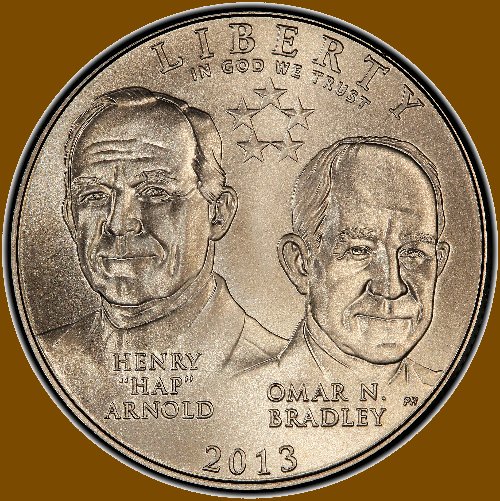 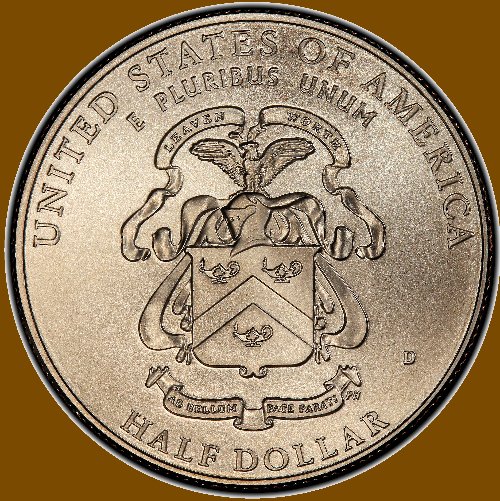 Collecting history one coin or medal at a time! (c) commems. All rights reserved.
|
|
CCF Master Historian of Commemorative Coins
United States
12515 Posts |
Taking a closer look at the crest... Heraldic Crest of Fort Leavenworth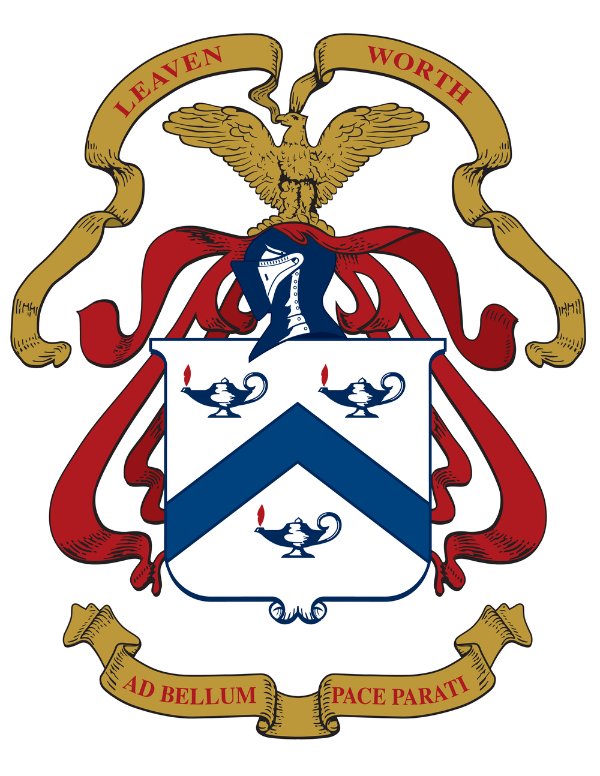 (Image Credit: Creative Commons CC0 1.0 Universal License. Public Domain.) (Image Credit: Creative Commons CC0 1.0 Universal License. Public Domain.) At the center of the Crest is presented a shield with three Leavenworth Lamps, two above and one below the chevron. The lamps are rooted in the allegorical "Lamp of Knowledge" and the blue chevron recalls the US Army Infantry. Above the shield is seen the Athena Helmet. "Athena, a fully armed mythological goddess, is associated with the arts of war, and her helmet signifies wisdom and learning." (United States Military Academy Fact Sheet). The helmet is surmounted by an American Bald Eagle with a ribbon in its beak inscribed in two segments "LEAVEN WORTH". The eagle's head faces to its right which, as per the Great Seal of the United States, traditionally faces toward the talon holding the olive branch symbolic of "Peace." (The olive branch and arrows often seen in the heraldic eagle's talons are not included in the Leavenworth Crest.) On a ribbon below the shield is inscribed "AD BELLUM PACE PARATI" which translates to English as "READY FOR PEACE". Collecting history one coin or medal at a time! (c) commems. All rights reserved.
|
| |
Replies: 5,919 / Views: 201,182 |
To participate in the forum you must log in or register.
Disclaimer: While a tremendous amount of effort goes into ensuring the accuracy of the information contained in this site, Coin Community assumes no liability for errors. Copyright 2005 - 2026 Coin Community Family- all rights reserved worldwide. Use of any images or content on this website without prior written permission of Coin Community or the original lender is strictly prohibited.
Contact Us | Advertise Here | Privacy Policy / Terms of Use
|
| Coin Community Forum |
© 2005 - 2026 Coin Community Forums |
| It took 0.9 seconds to rattle this change. |
 |
|








 First Page
 Previous Page


 Posted 12/19/2021 06:39 am


