| Author |
 Replies: 9 / Views: 996 Replies: 9 / Views: 996 |
|
|
Valued Member
United States
405 Posts |
|
|
|
|
Pillar of the Community
United States
3507 Posts |
It's not really a raised area. It is a portion of the design that did not strike up fully.
There are several possibilities. Grease in the die being one, a slight thinness of the planchet being another. Damage to the reverse die caused by a die clash could be another.
I've seen many cents from the early 1970s that look like this.
Thanks,
Bill
|
|
Valued Member
 United States
405 Posts |
While I agree the Grease Filled Die or weak strike (due to thin planchet) would explain the raised smooth area I see, there is a well defined raised area that is out of place for the reverse design and I don't think can be explained with grease alone. I've highlighted it in the image below: 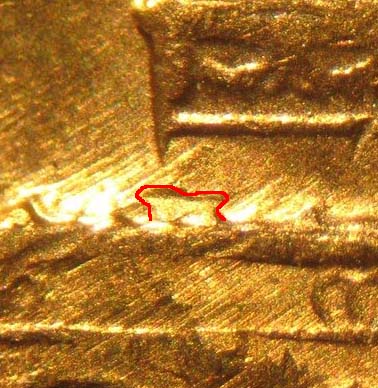 It may not be 100% clear in the image I provided, but it is sharply raised above the field of the coin and has a distinct shape. It is similar in shape to the serif like feature at the top of the memorial columns. Edited by seattleMD
09/16/2008 9:03 pm
|
|
Bedrock of the Community
United States
17884 Posts |
The coin shows die polishing in that area where they have been polishing away clashmarks. (some of the marks still show in the areas between the pillars) and I think what you are seeing is just remnants of the upper part of the building that have not been polished away.
|
|
Valued Member
United States
405 Posts |
My initial guess was a polished damaged die as well, but I couldn't figure out what the clash was and where that raised area (highlighted above) came from or how it somehow missed being polished when everything around it seems to have been polished.
|
|
Pillar of the Community
United States
3507 Posts |
I agree with Conder101, there is the effect of the clash (the blank looking area) and then there are the parts that were not polished away remaining on the die that show up on the struck coin.
|
|
Pillar of the Community
United States
7629 Posts |
Yup, a polished die clash, and these are very common.
|
|
Valued Member
United States
405 Posts |
Okiedokie - thanks everyone!
|
|
Pillar of the Community
United States
1450 Posts |
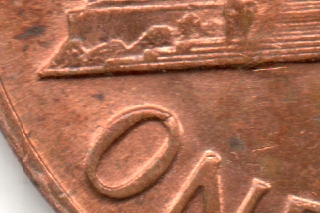
Hey guys, this is cool. I have a 73 d I pulled 3 days ago with the same thing as this coin. Must have been produced from the same die. I checked Seattle md's photo and it also has the little notch on the "o" in one like the photo below. What caused the notch, actually it looks like an extra level on the "o". Image:  img008.jpg img008.jpg72.43 KB |
|
Pillar of the Community
United States
3507 Posts |
Thousands of dies, hundreds of clashed dies, the likelihood is that they are not from the same die pair.
In the "old" days when they may have used ten pairs of dies to produce a coin of a particular type, you could determine the dies used.
Folks that study and collect VAMs have created a body of material that allows us to confirm die pairs by using clash marks as identifying marks.
On modern Lincoln cents, It is not a way to narrow down what dies struck what coins. There are too many dies and too many clashed die scenarios.
Thanks,
Bill
|
| |
Replies: 9 / Views: 996 |
|










 Posted 09/16/2008 9:02 pm


 img008.jpg


