| Author |
 Replies: 17 / Views: 2,722 Replies: 17 / Views: 2,722 |
|
New Member
United States
4 Posts |
|
|
|
|
Bedrock of the Community
Canada
24885 Posts |
 To the Forum. |
|
Rest in Peace
United States
17900 Posts |
Not a goal I've ever considered, but very interesting. You might wish to define an age range as that might make the comparisons seem of lesser value just because of huge inflation and sharp drops in value because of those value waterfalls. |
|
Pillar of the Community
Canada
5287 Posts |
Any coin from Argentina or Brazil from the 1920s would need quite a few zeros after the decimal place to list its value.
|
|
New Member
 United States
4 Posts |
You are missing the point. These coins are buying bread or butter today. They are in circulation. They have not been demonetized.
|
|
Bedrock of the Community
United Kingdom
18602 Posts |
There are probably quite a few very low value coins that are theoretically still legal tender because they've never actually been officially demonetised. However, Turkey re-valued the Lira in 2005 and no coins from before then are in circulation. On my only visit to Turkey, in 1995, the smallest coin I encountered in circulation was 500 Lire.
|
|
Pillar of the Community
Canada
5287 Posts |
I would find it difficult to believe that a 1 tyin from Uzbekistan would buy anything in any store there.
So, can I rephrase the OP request as follows?
What is the least valuable coin in the world still in circulation today?
|
|
Bedrock of the Community
United States
20753 Posts |
According to many people right here on this forum our one Cent coin appears to fit that description.   |
|
Moderator
 Australia
16964 Posts |
Quote:
What is the least valuable coin in the world still in circulation today? The question is not as simple as that; coins can "be in circulation" yet be officially discontinued or even demonetized by the government that issued them. "Circulation" can also have a varied meaning. For example: in Thailand the 1, 5 and 10 satang coins are quite low in face value (1 satang = 0.0328697 US cents); they are still being produced but you never see them in everyday trade; they are still being made, for collector sets and a few for "circulation". apparently, banks in Thailand are given them but they do not issue them to the public, even if you ask for them; they only use them for settling accounts between banks. In Turkey, pre-2009 coins from the "old lira" (like the 1965 coin mentioned by the OP) are no longer in circulation. When I was in Turkey five years ago, all prices were usually rounded to the nearest lira, so although coins below 1 lira still exist, you very rarely are asked to use them or are given them in change. The lira's value is deteriorating rapidly (and their recent invasion of northern Syria is not going to help, at all). 1 kurus (1/100th of a lira) coins still nominally "circulate", though I never saw one even in 2014; the face value today for 1 kurus is 0.171126 US cents, and falling rapidly. I strongly suspect it will be "the least valuable coin" by the end of the year. Countries in turmoil are always good for finding "worthless coins". The Iranian rial has collapsed in terms of international value in the wake of the rogue state's isolationist policies. The smallest coin in use in Iran right now is the 250 rials (rarely seen), equal to 0.593826 US cents; this too is likely to continue to fall unless there is significant improvement in foreign relations. Syria is of course in economic ruin; the smallest Syrian government coin, face value 5 pounds, is theoretically worth nearly 1 US cent, though finding people who would actually accept it at that rate in that war-torn country would be the hard part. Moldova has a series of low-value coins. The Moldovan leu is worth just over 5 US cents, and coins down to 1 ban (1/100th of a leu) are still in use in everyday trade; some friends who visited there a couple of year ago brought me back some with minimal difficulty. 1 ban = 0.05653 US cents. In Uzbekistan, the 1 tiyin coin is still legal tender (until next year), though no longer produced or used (which is a good thing, since you would need a wheelbarrow-load of tiyin to buy a loaf of bread). The smallest coin currently being produced and theoretically still in use in Uzbekistan is the 50 s'om, equal to 5000 tiyin and currently worth 0.53035 US cents. Don't say "infinitely" when you mean "very"; otherwise, you'll have no word left when you want to talk about something really infinite. - C. S. Lewis
|
|
Moderator
United States
194816 Posts |
Quote: According to many people right here on this forum our one Cent coin appears to fit that description.  Quote:
The question is not as simple as that; coins can "be in circulation" yet be officially discontinued or even demonetized by the government that issued them... Excellent insight, Sap.  |
|
Pillar of the Community
 United States
8038 Posts |
I think @Sap's post points out the gray areas in trying to come up with valid answers to the original question.
From personal experience, I can say the Italian aluminum 5 lire coin was the least valuable coin at the time, which I personally ever encountered. I travelled to Italy regularly between 1984 and 2000. In late 1984 to early 1985, the lira was at 1900 to 2000 to the $US. 5 and 10 lira coins were in circulation, so the 5 lira coin was worth about $0.0025. The 2 lira coin had not yet been demonetized as best I can tell, but I never saw one in circulation.
For the record, there were also 500 lira banknotes in circulation worth 25 cents.
Edited by tdziemia
10/11/2019 1:18 pm
|
|
New Member
United States
4 Posts |
Just got a 2000 rial note from a coin friend and looked up the value. Less than 5 cents
|
|
Pillar of the Community
United States
6130 Posts |
When this was asked a few years ago, I remember a response from a member who had lived in China and mentioned that the various Fen coins (1 fen = 1/100 yuan) were regularly being given out in change, and the common reaction was to drop them in the garbage on the way out the door because they weren't even worthwhile to save up in large change jars. It looks like they are still legal tender (and were produced as recently as the late 2000s), and 1 fen is equal to 0.14 of a US cent. https://en.numista.com/catalogue/pieces1005.html |
|
Pillar of the Community
United States
7387 Posts |
In Portugal before the Euro the escudo was trading at .005508229 to the Dollar. You needed about 200 escudos to get a dollar.  And while this is an old version, you could still find a 1 Escudo coin or worth .5508229 cents.  The escudo was further broken out to 100 centavos, this is a 20 centavo coin or worth .0011146 dollars. 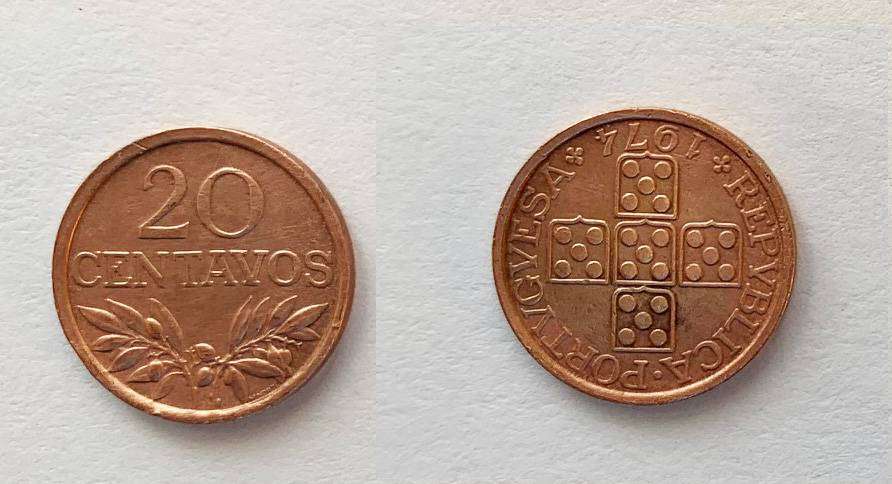 And the smallest currency I was able to pull from circulation, 5 centavos, worth about .000275411 dollars.  |
|
Pillar of the Community
United States
8038 Posts |
Quote:
the common reaction was to drop them in the garbage on the way out the door because they weren't even worthwhile to save up in large change jars That may explain why high grade examples of those aluminum 5 fen sell for pretty decent amounts. There is a recent thread here somewhere on that (I could not quickly find it in a search). |
|
Pillar of the Community
United States
8038 Posts |
@hfj, I agree that Portuguese escudo is another good example. I first visited Portugal in 1980, and I know that coins as low as 20 centavos were still in circulation then (I still have some of the pocket change from that trip in my collection). As the 5 centavo had not been minted in over 50 years at that point (and 70 yrs at the time of the euro conversion), it's not a surprise that I did not see them on a short trip.
Edited by tdziemia
10/12/2019 2:04 pm
|
| |
Replies: 17 / Views: 2,722 |










 Posted 10/10/2019 12:35 pm


