| Author |
 Replies: 28 / Views: 10,894 Replies: 28 / Views: 10,894 |
|
|
|
Pillar of the Community
United States
5887 Posts |
I was also thinking I would see a bigger weight reduction....
-CH27
Collector of U.S. Coins, Varieties, and Colonial Coinage
|
|
Pillar of the Community
United States
7344 Posts |
 if the clad layer was missing , how could it be over-weight  I'm on team Yokozuna |
|
Pillar of the Community
United States
2567 Posts |
If you want to be 100%. You can polish a small area and see if it changes colors
|
|
Pillar of the Community
 United States
5895 Posts |
Quote:
If you want to be 100%. You can polish a small area and see if it changes colors Not a good option because that would be considered damage and if it's legit, Uh oh!! Do an NDT (Non-Destructive Test) first like Yokozuna suggested. It is an XRF tester (LINK- https://www.thermofisher.com/us/en/...hnology.html ) . Scrap Yards, jewelers and pawn shops are a possibility for having a tester. Words of encouragement are one of the major food groups.
We need to consume them regularly to thrive and grow.
|
|
New Member
 United States
35 Posts |
Okay so would a numismatic shop be better then just a "silver and gold" shop. There are many of both in my area, CT/NY
|
|
Bedrock of the Community
United States
62064 Posts |
It is the real deal, why mess with it. Any alteration could drastically drop the price. When you see a small bit of the rim of the cladding, you know it is real. Keep it safe in a 2X2.
|
|
Pillar of the Community
United States
7174 Posts |
Sorry Coop your wrong. This would have to start out over 3.5 before both layers were missing. That would be 50% overweight, never seen it.
|
|
New Member
United States
35 Posts |
would better pictures of the rim help clarify anything?
|
|
Bedrock of the Community
United States
62064 Posts |
Clad dimes are 2.27 grams. This one shows a 2.3 grams for weight. The design is not showing weakness despite it having both clad are missing. I would like to see the height compared with a clad dime. I thinking the height will be the same as normal. Note on the reeds, there is no clad metal on the edge of the coin. When the blanks are cut, you can see the clad on the edge wrapping around the top to bottom on the edge. When you look at the edges, the cupro-nickel clad on the edge of the coin will show which direction the blank was cut. But on this coin not a hint of cladding on the edge. So it looks like the cladding was mostly missing off this coin. The obverse shows a tiny speck of cladding on the rim at 2:00. Usually when you see a missing cladding on one edge of the coin you see weakness of the strike. On this coin, no weakness. So the weight is within allowance for a dime. So unless the weight that is posted is wrong, where am I incorrect?
|
|
Moderator
United States
56855 Posts |
Might be worth the effort and money to send off to ANACS? John1  |
|
Pillar of the Community
United States
5895 Posts |
The XRF test would determine the percentage of metals in the coin without damaging the coin.
This could help exclude the possibility someone copper plated a regular dime.
(Debris may have caused any plating to fall off at the "silvery" area of the rim.)
Words of encouragement are one of the major food groups.
We need to consume them regularly to thrive and grow.
|
|
Pillar of the Community
United States
2752 Posts |
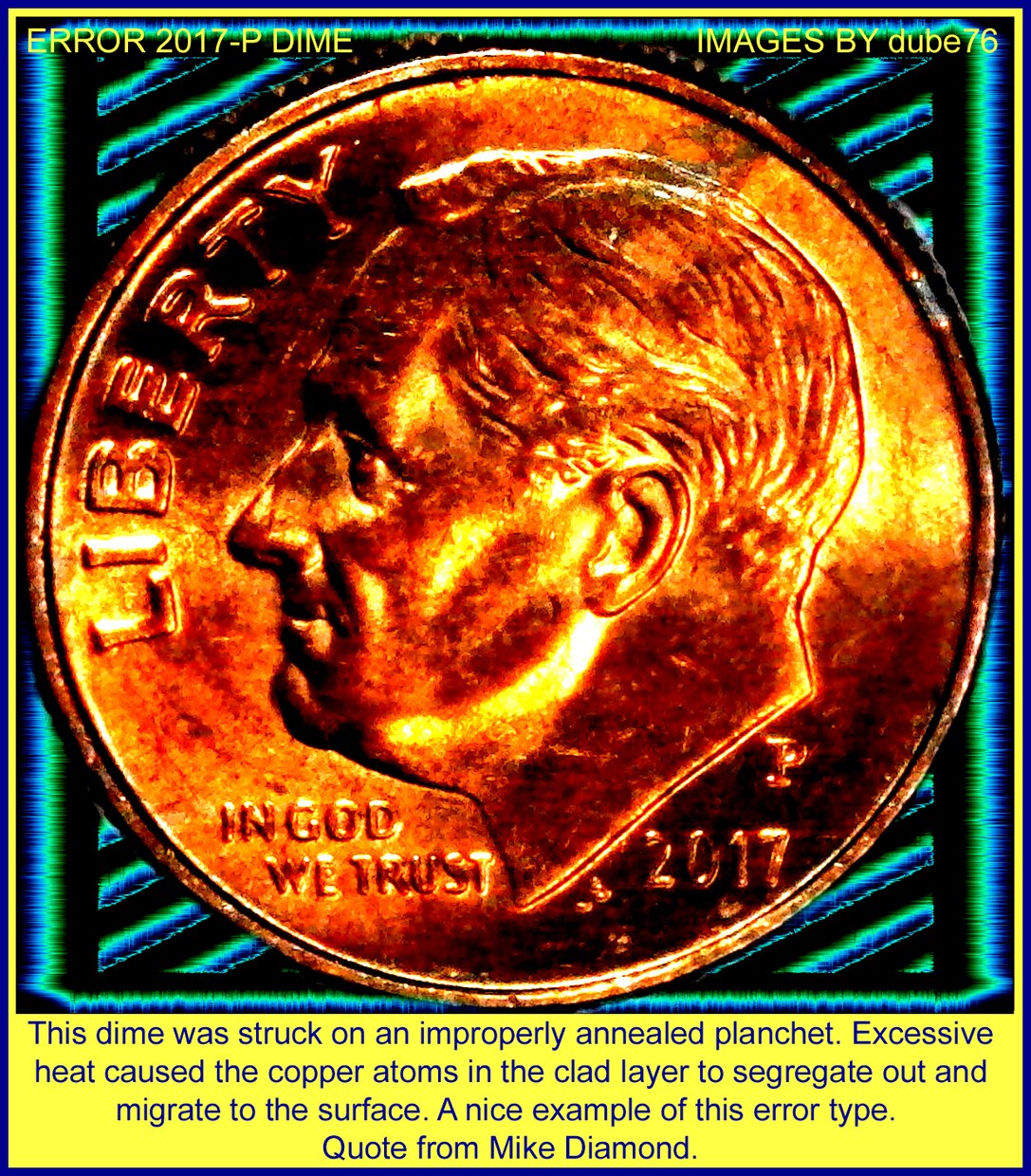
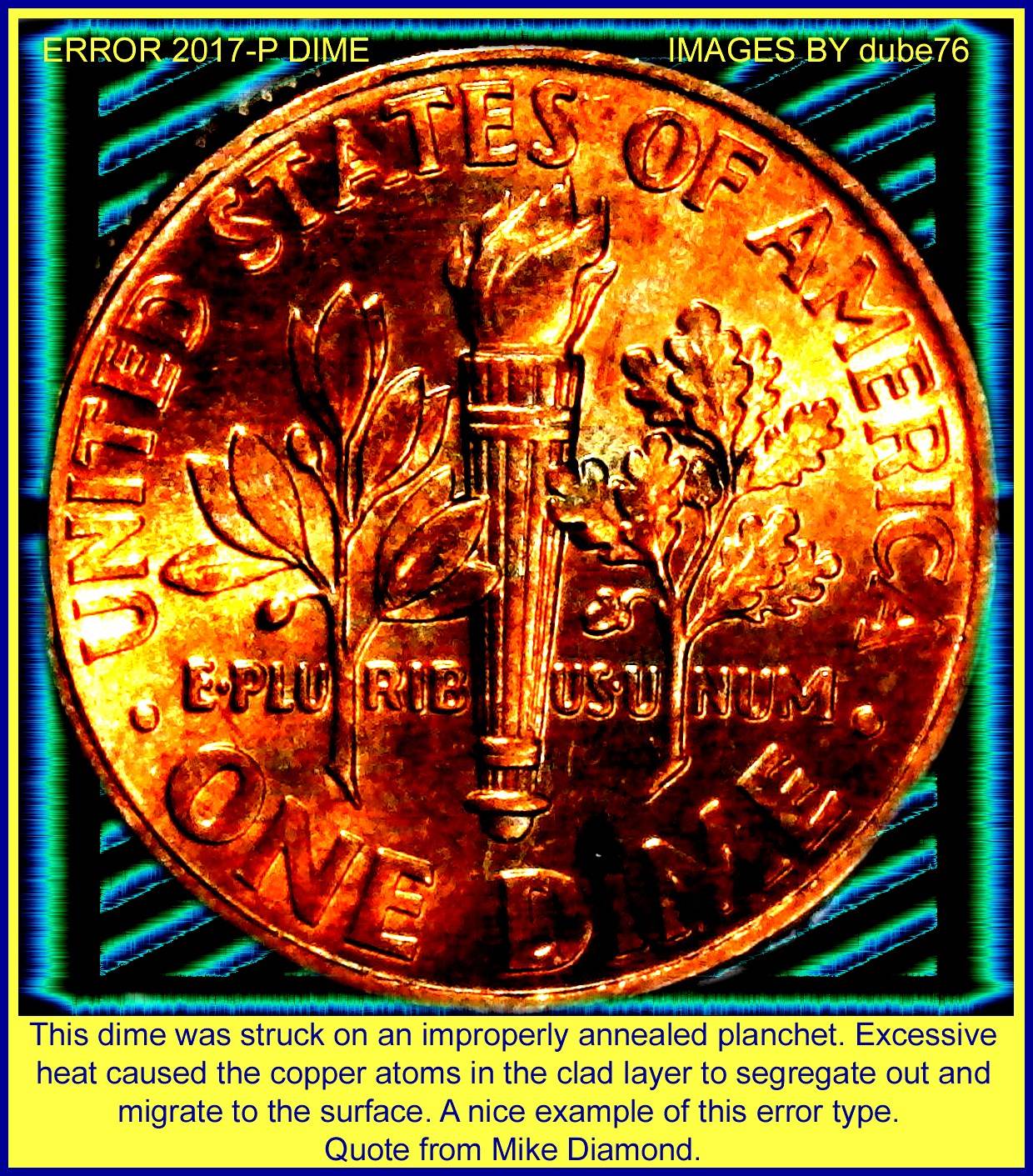
This dime was struck on an improperly annealed planchet. Excessive heat caused the copper atoms in the clad layer to segregate out and migrate to the surface. A nice example of this error type.
Error coin writer and researcher.
|
|
Bedrock of the Community
United States
62064 Posts |
|
| |
Replies: 28 / Views: 10,894 |







 First Page


 Posted 10/30/2019 02:06 am