Part of the process of determining what an odd mark on a coin is would be in understanding the minting process. One part of the process, die making, is in transferring designs in their entirety from one tool to another. At no time during the die making process are the obverse and reverse designs mixed in any way. There is also no 'hand punching' of design elements into the dies. Given neither of these happening, it's quite impossible to end up with a raised numeral digit on the reverse of a
Lincoln Cent.
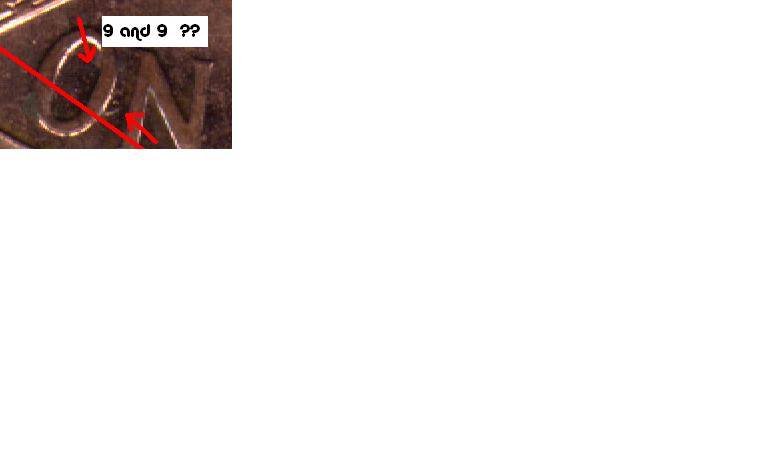
There are two possibilities to having an incuse (sunken in) number digit on the reverse of a cent, both of which are very plausible. First would be a die clash - the obverse and reverse dies mint into each other without a planchet between them and transfer their designs onto one another. This would effectively raise the obverse design (like the date) into the reverse die, which would transfer onto the coin as a sunken digit. Second possibility is the 9 cavity in the obverse die becomes filled with grime, then falls out onto the reverse die keeping its shape, a lot like a bucket of sand turned over at the beach makes a tower for a sand castle. The next coin through the process receives its strike and the piece that looks like a 9 gets struck into the coin, leaving a sunken in digit on the finished coin. This is called 'struck through dropped filling" and can be of value, especially if it's dramatic and obvious. These, however, are the only realistic possibilities of ending up with a well shaped 9 on the reverse of a
Lincoln Cent.
Of course there are other far more rare circumstances, such as failure of the ejection process leaving a struck coin behind in the chamber, then striking another coin on top of it. This would leave an out of round coin with a rather normal obverse, but an incuse and backward obverse design on the reverse of the coin with no reverse details at all. Quite scarce, quite valuable, and they show up VERY infrequently.









 Posted 09/30/2008 10:26 pm





