Apologies for skipping way, way ahead of myself on this one, but I feel the need to get them out there!
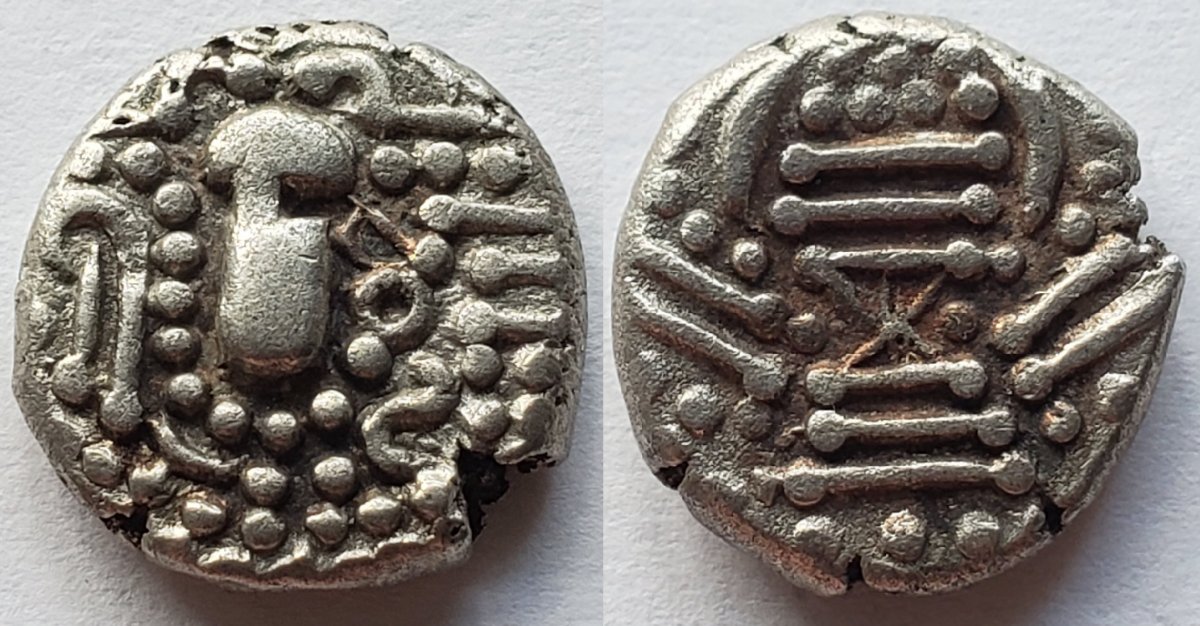
In late 2016, I purchased an individual coin from Dr. Lanz, being sold as "Chaulukya Gadhaiya Paisa" It stuck out to me as unusual because rather than having two crescent-shaped lips as normal, there was a small circle in front of the bust and under the nose. I bid high and won it, then began my search for answers. As I got copies of the relevant reference works (A big thanks to everyone who helped with that!) I came to realize that my coin was not a published type in Mitchiner, Deyell, or Maheshwari! As they say, "One coin does not a variety make" so I slapped it at the end of my Chaulukya series the first time around. When Paul posted another odd coin with some striking similarities to mine, I began searching and ultimately found the source - one
ebay seller who was slowly feeding out a small hoard of late type Gadhaiya. Over the span of about six months, I managed to get five coins in addition to my first, and earlier this summer finally(!) convinced Paul to trade me his

. My current seven coins comprise, by my calculation, somewhere between 1/3 and 1/2 of all known specimens.
So here it is -
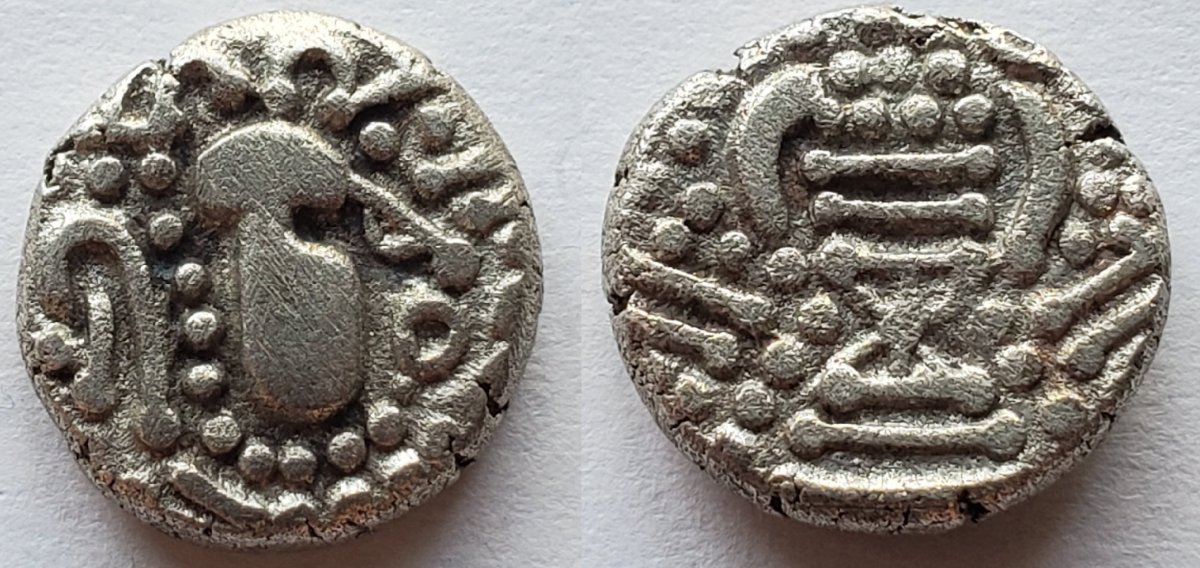
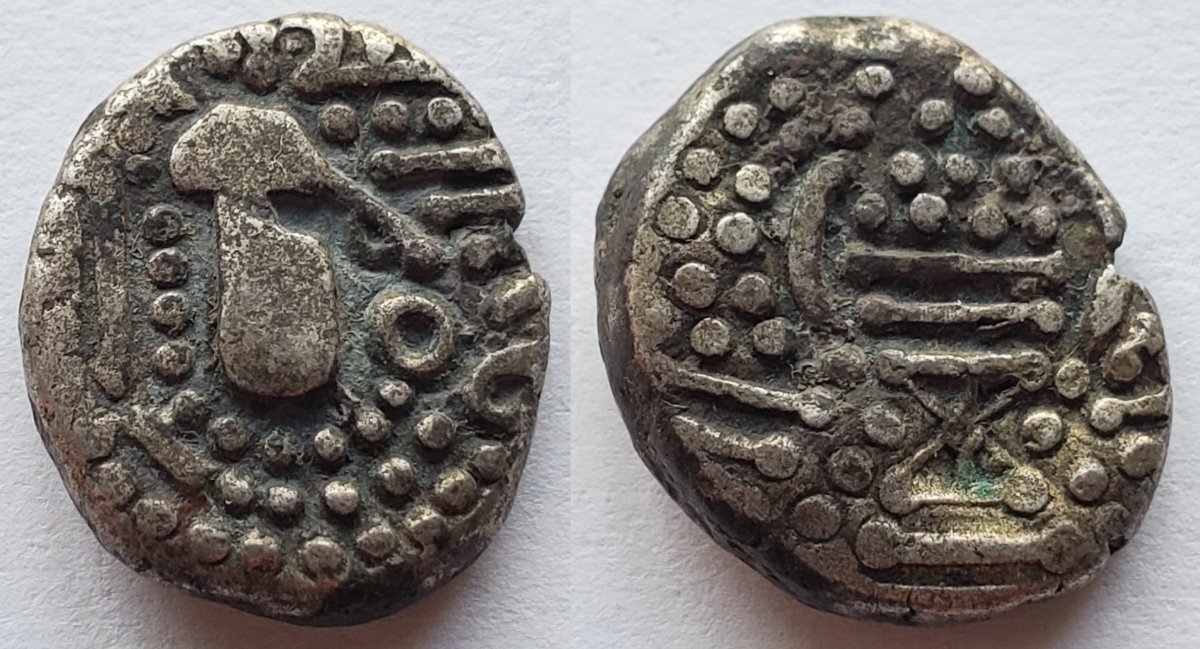
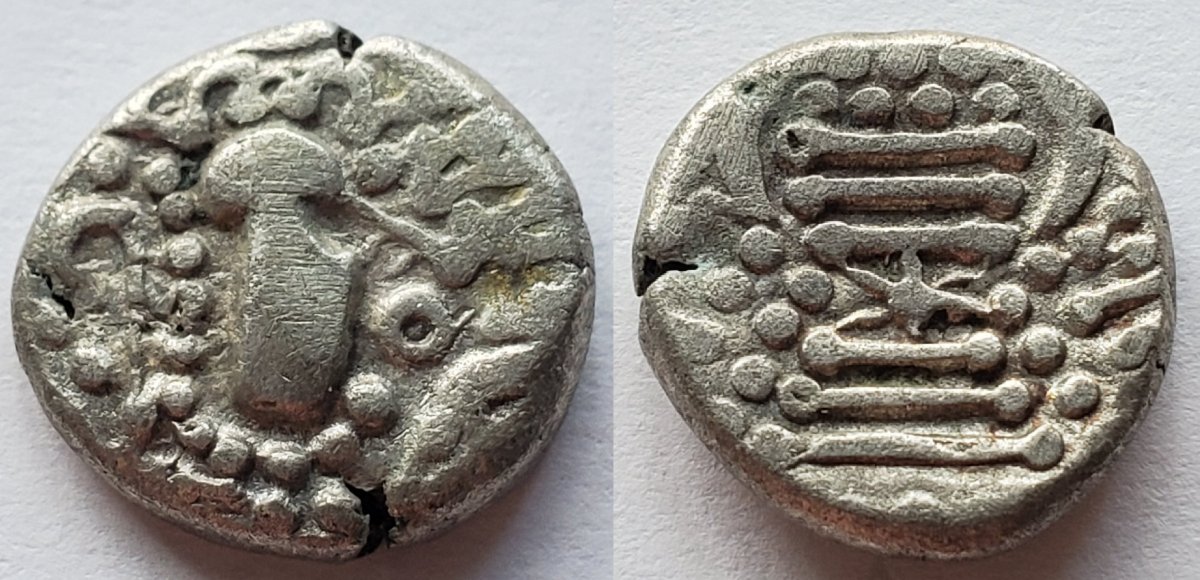
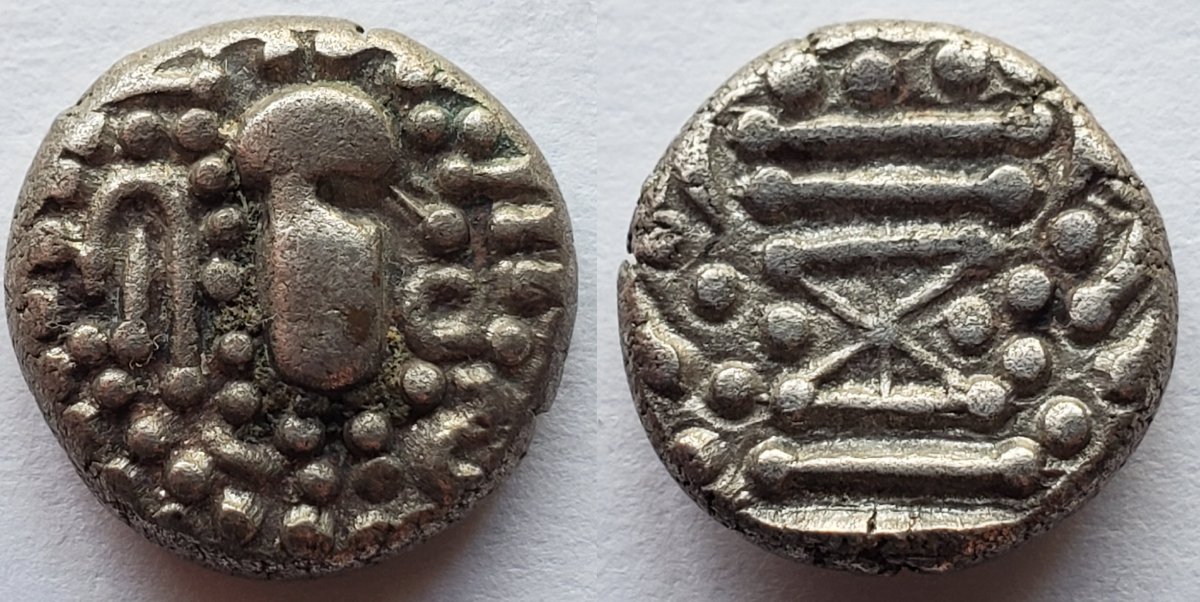
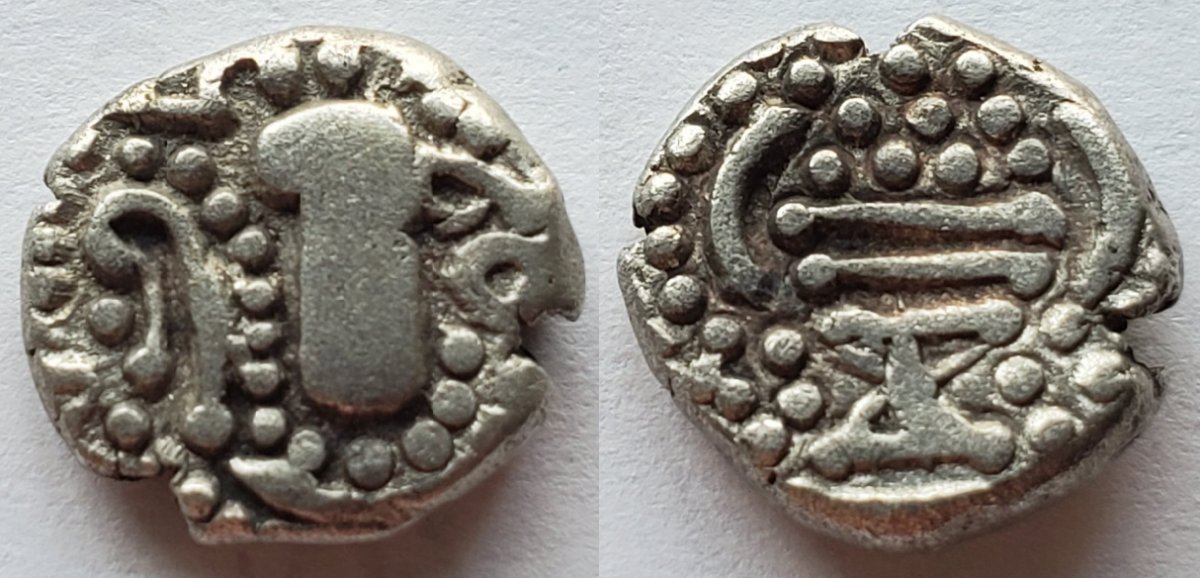
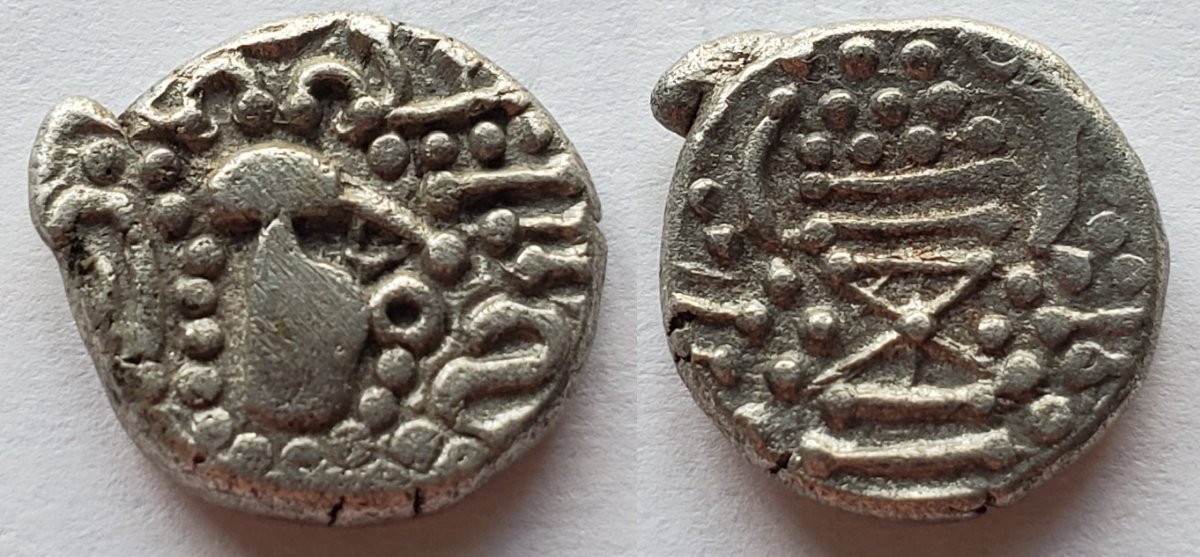
Series 1.11 - "Circle Lips" type Gadhaiya ImitativeThis coin is, and likely will remain, an enigma. They are clearly copies of intermediate type Gadhaiya, made by a moderately experienced engraver who was not trained in the significance of the iconography of what he copied. These coins start as excellent copies and quickly degrade to a sloppy mess.
The unifying feature of all of these coins is, of course, the circle in front of the bust. Its significance, however, is not easy to sort out. If the Malwa type coins' "elephant trunk" noses were intended to replace the Sankh shell, the circle could perhaps be the sun. It is not, however, the standard Gadhaiya style sun - which is a total of seven dots comprised of a central dot surrounded by a rough hexagon of six dots. There are two other coins within the Indo Sassanian series that use a hollow ring - the Horseman series and the Omkara series, which despite being struck on a completely different fabric, appear to use nearly the same punch used on the dies of this series. The Horseman series is itself associated with the Chauhan king Jaitra Simha (fl. 1275 AD) who, in addition to his usual lion type, also struck horseman coins. The hollow-ring sun does appear on his lion type, which is also a completely different fabric. The Omkara series also utilize the hollow-ring as a variant for the "eye" of the portrait, and were likely made around the 13th/14th centuries.
Another possibility are the silver drachms of the Chahamana king Ajayadeva II (1110-1135), featuring a seated Lakshmi with a similar circle for her navel. Ajayadeva's wife, Somalladevi, famously produced crude-fabric Gadhaiya imitations which are not unlike these coins.
The problem with both, unfortunately, is that these coins are struck to an extraordinarily tight weight standard - All of mine fall between 3.88 and 3.99 grams - probably an even 4.00 if fully uncirculated. This is problematic for any of the "officially minted" theories, as the main line of Gadhaiya had shifted upward to a standard of 4.20-4.25 grams, reflected in both the Ajayadeva, Somalladevi, and Jaitra Simha drachms.
Some other consideration points for the series:
Overall:
- I cannot test the silver fineness, but by appearance, I would estimate it at between 30-50%
- Overall fabric is nearly identical to late Gadhaiya coins - Coins are engraved in high relief, and the flans are always smaller than the dies used.
- Weight standard is tightly maintained at 3.88-3.99g
- Diameter is also tightly controlled, between 14-16mm
Obverse:
- The head shape is the standard late Gadhaiya shape
- Few of the coins have an eye; most of the ones that do only have a tiny pinpoint.
- The nostril is similar to the late Gadhaiya, however it is thinner, larger, and almost always engraved as a half-circle attached to the nose on both sides; by comparison, all late Gadhaiya noses are crescents and detached from the nose.
- The lips, of course, have been replaced with the enigmatic circle.
- All of the Gadhaiya-type headgear (vestigial hat, wings, korymbos) is retained
- The ribbons are present and generally correctly engraved - However, one particular variety has the lower ribbon detach from the upper and slide down the portrait
Reverse:
- The fire altar is present, and overall fairly well engraved, compared to the coins which these copy
- The shaft is correctly engraved as a six pointed star with a central dot (compare to "unusual nose" coins which simplify it to an X)
- The arms of the attendants are present, but on some coins they are horizontal, not angled.
- The attendants have degraded to a meaningless field of dots
- Only two of my coins shows the moon is still present; it is likely present on all of these coins, but off flan.
- I cannot discern how the sun is portrayed, if at all.
Within this series, I have my coins grouped into the following varieties:
1.11.1 - Early Type With Eye
1.11.2 - Intermediate Type Without eye
1.11.3 - Intermediate Type, Atypical Ribbon
1.11.4 - Late/Degenerate









 Posted 12/29/2019 02:23 am