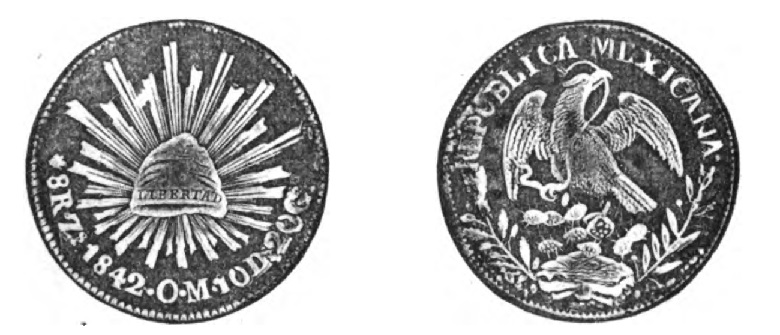
Augustus49 The coin you picture is without a doubt an example struck from the same dies that made the Riddell # 274.
The Riddell # 274 is an extremely common counterfeit type, so there is a good opportunity to examine many specimens. I have over 50 examples of that type family in my collection. I identify 3 major die versions and at least two mules of die pairs (there are likely more). There is also a version mated with an 1836 Zs OM cap die which uses ONLY one of the three reverse die types. (I am looking for others.) In addition to the major die varieties, I note several sub-varieties based on the dies being recut while in service.
The dies were used for an extended period of time until they were entirely worn out. During that time period several different alloys were employed. The earliest examples are the debased silver versions made of a solid low grade silver alloy. The Riddell coin is this type. There are also Sheffield plate varieties using the silver over German silver core alloy. That is a later date Sheffield plate developed in the late 1830s. I have located one example struck in a copper alloy that lacks any silver plate at all. That points to either a silver amalgam wash - an early technology dating to well before 1800 or possibly the survival of the dies until electroplating arrived on the scene in the late 1840's. I also own a cast version using the same design which could mean the dies were used to prepare a mold after they were no longer serviceable for use as dies for striking.
I know in my case, that I did not notice that my collection contained 2 entirely different die types until one day when I was sorting my coins at the bank and I noticed that the eagle's claw on some appeared to have two toes grasping the snake while there were three toes on others. After I completed my point by point comparison I had over a dozen variations in details which I had not noticed.
These particular dies were far from hubbed, the eagle itself was not even created from a single punch. So recognizing that can help when looking for die variations.
So my point here is that caution must be maintained when looking at counterfeits to compare the coins point by point - covering different die punch areas before pronouncing the dies to be a match or not.
Here is a blow-up of an 1836 version of the two toe die.

Notice the numerous small hand cut details that are visible just in this tiny area. I see that as evidence usable to identify not only the die variety (two toe) but the die state itself when comparing coins.









 Posted 01/21/2020 09:01 am





