| Author |
 Replies: 12 / Views: 1,864 Replies: 12 / Views: 1,864 |
|
|
Pillar of the Community
 United States
4618 Posts |
The amount of detail on this broad struck error seems almost astounding! The reverse shows all 3 sets of full(?) steps, windows, doors and railings around the roof are struck very sharp and strong. The bust of Jefferson is also sharp in detail at the eye, mouth and most of the hair. Now, I have a question. Could it be that the retaining collar is keeping the dies from leaving a full impression on normally struck coins? Why would the detail be so strong on a coin struck outside of the collar? I've seen this on many Jefferson error nickels, centered and off center strikes. While full step coins for this issue aren't rare, they do command about a 75% premium over partial step coins. Just an observation on my part, but I'd really like to hear what you think. Click the picture for a larger image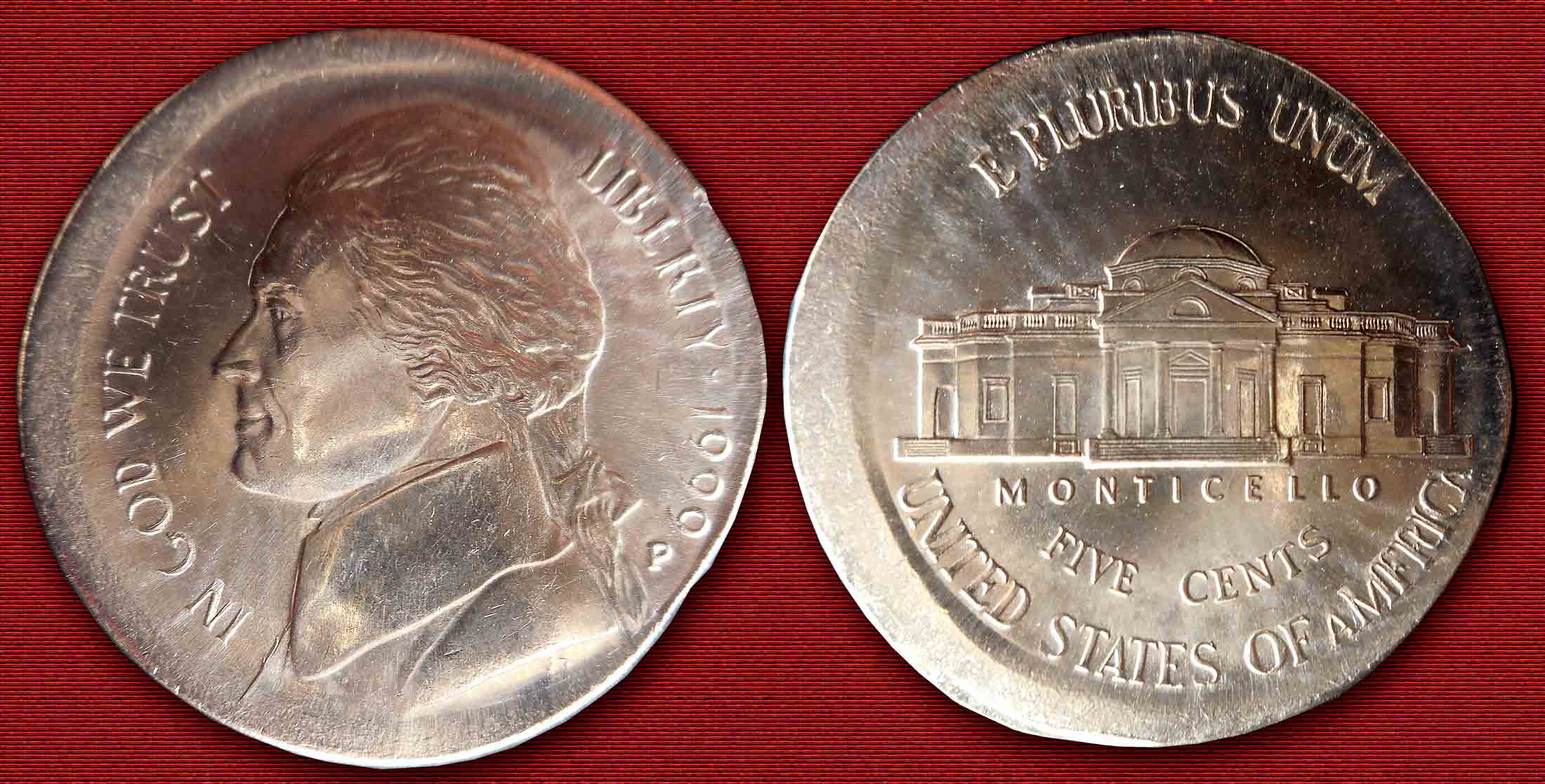 ANA ID: 3203813 - CONECA ID: N-5637 Clean a coin that may be worth collecting? Please DON'T! When in doubt, leave it dirty!! 
|
|
|
|
Pillar of the Community
United States
3281 Posts |
What a spectacular coin! Gorgeous and full of extreme detail!
I however cannot answer your question, broadstrikes are not my speciality. Nevertheless, an amazing coin.
|
|
Pillar of the Community
United States
4846 Posts |
It's possible they did something like that to prevent early die fatigue, which is exceedingly common on nickels, but I would imagine they would lower the striking pressure instead of stopping it physically like that.
|
|
Moderator
United States
56855 Posts |
Isn't the striking pressure (tonnage) higher on nickels in the first place, because of the harder nickel metal? Also,isn't the shape of the die kinda cone shaped,where the center is higher than the edge? John1  Edited by John1
09/10/2020 04:14 am
|
|
Bedrock of the Community
United States
10284 Posts |
Most broadstruck coins have exceptional detail (from the dies) since there is no resistance of pressure in striking from the absent collar.
Edited by TNG
09/10/2020 11:33 am
|
|
Pillar of the Community
United States
2567 Posts |
TNG you nailed it! Nice coin!
|
|
Moderator
United States
34553 Posts |
Quote:
Most broadstruck coins have exceptional detail (from the dies) since there is no resistance of pressure in striking from the absent collar. Well I learned something today. Thx! "If you climb a good tree, you get a push."
-----Ghanaian proverb
"The danger we all now face is distinguishing between what is authentic and what is performed."
-----King Adz
|
|
Pillar of the Community
United States
7333 Posts |
 good to know...thanks TNG |
|
Bedrock of the Community
United States
10635 Posts |
While I don't know how this nickel was formed, I do know it's a great error coin! Spectacular!  |
|
Pillar of the Community
 United States
4618 Posts |
@TNG Thanks! That confirms my hypothesis that the collar may be limiting the depth of the strike on normally struck coins.
ANA ID: 3203813 - CONECA ID: N-5637 Clean a coin that may be worth collecting? Please DON'T! When in doubt, leave it dirty!!
|
|
Bedrock of the Community
United States
10284 Posts |
I am not completely sure but I believe the collar is considered the "third" die in a minting process.
I assume that it surrounds the bottom die and is arranged to rise from the die just before the planchet is stuck and the striking or hammer (I'll call it that) die comes down to make a coin.
Either that or the collar is stationary and the anvil (I'll call it that) die, the one that has a design of the reverse usually, is lower than the collar and rises after the strike to effectively eject the finished coin.
Either way, if one die fails to rise (or lower), there is nothing to hold the planchet in place.
If the potential broadstruck planchet doesn't slide out of position, it would be considered a "Centered Broadstrike" which are usually the most desirable.
This is what I think happens but I could be wrong.
Edited by TNG
09/11/2020 1:27 pm
|
|
Bedrock of the Community
United States
17884 Posts |
Quote:
Either that or the collar is stationary and the anvil (I'll call it that) die, the one that has a design of the reverse usually, is lower than the collar and rises after the strike to effectively eject the finished coin. BINGO, in the case of the old vertical striking presses the collar is stationary and the anvil die rises post strike to eject the coin. In the case of a broadstrike the anvil die has not retracted and so is much closer to the hammer die when the coin is struck. Since the hammer die still tries to effect is full downward stroke the result is a much higher striking pressure than normal. The collar is not completely stationary. It is not intended to move, but it is mounted on springs so that if the hammer die is out of place and hits it it can move some to lessen the blow and help protect the press from damage. Since it can move up and down some on the springs sometimes after the anvil ejects a coin the collar jams against itas the die retracts pulling the collar down with it. In this case a broadstrike will be struck with normal pressure and will not expand in diameter to the extent the OP coin has. Edited by Conder101
09/11/2020 5:19 pm
|
|
Pillar of the Community
United States
2752 Posts |
A planchet that is confined by the collar is pretty much incompressible, apart from the plastic flow that forces coin metal into the die's recesses. The resistance provided by that incompressible disc interrupts the descent of the hammer die, often before coin metal has fully occupied the dies' recesses. When a planchet is struck out of collar, resistance is far lower, allowing the hammer die to sink more deeply into the planchet which, in turn, allows the coin metal to fully occupy the dies' recesses. That's why full steps is no big deal in a coin struck out-of-collar.
Error coin writer and researcher.
|
| |
Replies: 12 / Views: 1,864 |
|










 Posted 09/10/2020 03:09 am


