| Author |
 Replies: 28 / Views: 4,050 Replies: 28 / Views: 4,050 |
|
|
|
Valued Member
 Canada
235 Posts |
Rothery: I think I see the Bar of the 3, the small tooled shaft of it down to the top of, but not connecting to, the remnant of the bowl.... I'm trying to find a match to the ear and general carving style (at least two tools were used), but I'm coming up empty
Edited by whatdowehavehere
12/08/2020 8:27 pm
|
|
Pillar of the Community
United States
3745 Posts |
It's a 1916-S or 1917-S, most likely 1917-S. It has a Type 1 San Fran mint mark, with the die chip inside the upper curl of the "S." That restricts the dates to 1913-14-15-16-17. It can't be ODV-001, because it has the strengthened LIBERTY. That eliminates 1913-14-15 as dates. The remnant of the left ribbon also matches ODV-002, because it is straighter, thicker, and closer to the last digit than the ODV-001 ribbon. 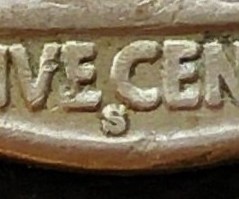 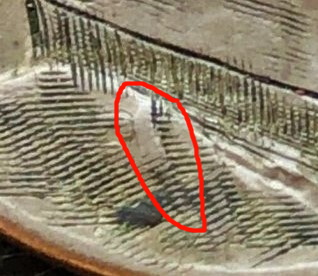 |
|
Pillar of the Community
2145 Posts |
Quote:
I think I see the Bar of the 3, the small tooled shaft of it down to the top of, but not connecting to, the remnant of the bowl.. Ahhhh, that explains it well. Thanks |
|
Bedrock of the Community
United States
94367 Posts |
Oh c'mon, one of you hobo collectors can surely explain, here in real time, what an original hobo nickel is!  |
|
Pillar of the Community
1110 Posts |
An original hobo nickel is an artistically altered buffalo, or Indian head nickel. The nickel first minted in 1913 with the large profile of a Native American was a natural attraction for those carving their artwork onto a coin. ... Many of those coins were used as identification tokens. Some original hobo nickels sell in the 100-300-dollar range, but others have brought as much as $24,000. Modern knock-offs are out there, too, as are high-quality pieces from contemporary artists. But even the "new" originals are seldom worth as much the vintage coins. I found the above on-line using my friend Mr. Google.  |
|
Pillar of the Community
United States
746 Posts |
I say it's a 16-S
Tim Hughes
|
|
Pillar of the Community
United States
2244 Posts |
I'm fairly certain it's a 1916-S. I can see the upper curve of a "6".
|
|
Pillar of the Community
United States
931 Posts |
I believe it is a 1916-S also. It is the only date with a curve on the 6 like on this coin. The 1926 and 1936 dates have the 6 over the top of the left tassle or whatever it is called.
|
|
Pillar of the Community
United States
4680 Posts |
Well I stand corrected, looking at it side by side after FC's breakdown it's apparent it falls into that date range. I'm joining in on Coinfrogs curiosity. I think the question is, how does one determine a "original " vs. "modern knockoff" ? Besides the carving toning over with time, how else can you determine it was done almost a century ago and not some more recent alteration? Edited by Ty2020b
12/08/2020 10:39 pm
|
|
Bedrock of the Community
United States
94367 Posts |
How do you distinguish between an original and a "new" hobo nickel? Can ANYONE on this thread provide useful references? Is the OP's example an "original", and if so why?
|
|
Valued Member
Canada
235 Posts |
I'm no maven, but I look for 'em. Toolwork, mostly, is what I use for a determination. Modern carvers have finer tools with which to work. Yuh, anyone can hack job an example and tone it down, but many early Carvers are well-known for their styles. I think Del Romines published a book on them, and there is a Hobo Nickel club that has on its website all of their past auctions-with pictures of the lots. Great stuff. And a BIG "Thank You!!" to fortcollins for your information. The LIBERTY on the nickel just wants to jump out at you... never would have known that otherwise, and up to now I thought I knew everything  |
|
Valued Member
United States
459 Posts |
|
|
Pillar of the Community
United States
4680 Posts |
Thanks for the link @AES. Under old carvers, "the woodsmen" is quite the conversation starter
|
| |
Replies: 28 / Views: 4,050 |








 First Page


 Posted 12/08/2020 9:00 pm


