|
Pillar of the Community
United States
1427 Posts |
I know this has been delayed, but I have not had the time to do this until now...
Welcome to part 2 of Coin Corner! Coin Corner is a place for both new and old collectors a chance to learn a thing or two. Feel free to ask questions in the comments.
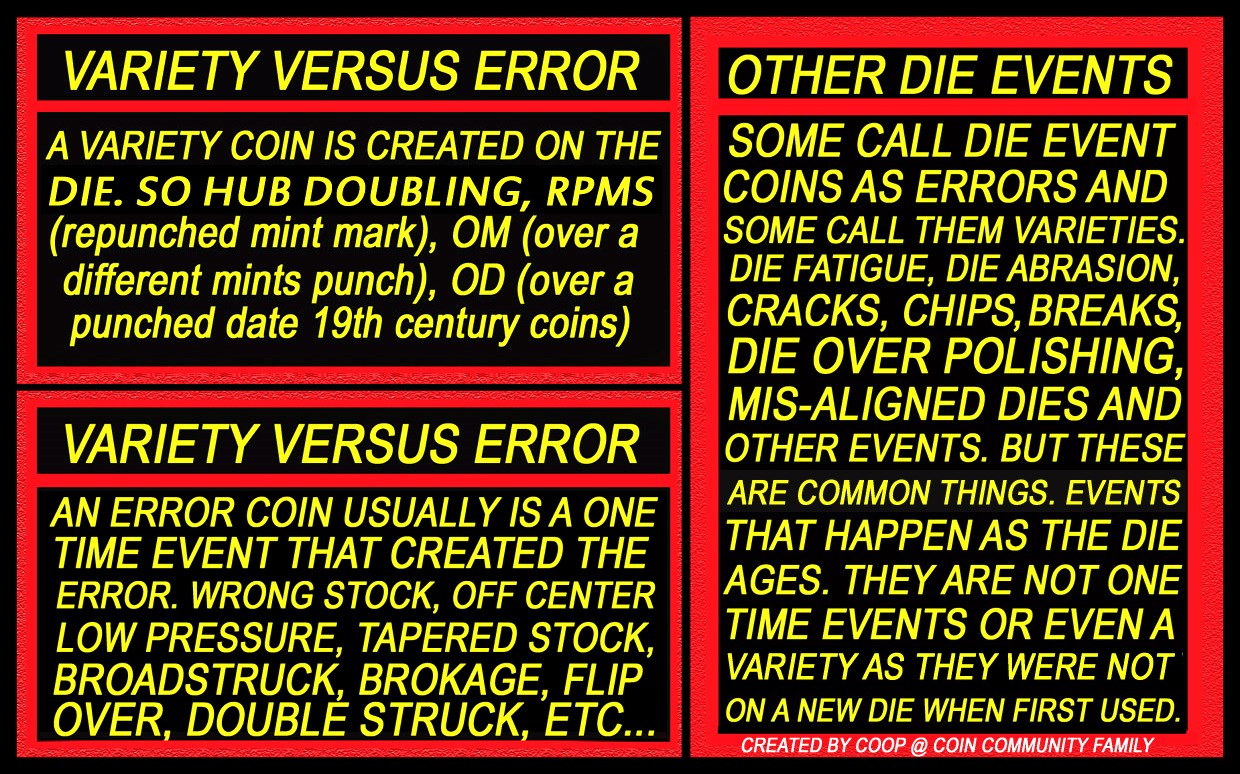
Today we are discussing die varieties. Die varieties occur at some point between the dies creation and it's first use.
The 4 main types of varieties are listed here.
1: by far the most popular, Die doubling. Die doubling occurs during the hubbing of the dies, which is when the dies are squeezed against a hub (which has a positive image) and creates the negative imprint which will be used on a planchet to create a coin. During the hubbing phase, the hub can bounce or move, or in cases when the multiple squeeze method is used, the hub can imprint at a different position than another, all of which cause a doubled or distorted image on the die. If the mint employees don't notice the doubling on the die, it will be used to create coins with the variety. Doubled Dies are divided into 8 or 9 classes, depending on who you ask. **Most classes are no longer seen on modern coins due to a change in our hubbing method**
Class I, Rotated Hub Doubling: A rotated second image is hubbed on the first.
Class II, Distorted Hub Doubling: A second, dilated image is hubbed on the first.
Class III, Design Hub Doubling: 2 different designs are hubbed on a single die (Small date over large date, some overdates)
Class IV, Offset Hub Doubling: A shifted second image is hubbed on the first.
Class V, Pivoted Hub Doubling: A second, pivoted image is hubbed on the first.
Class VI, Distended Hub Doubling: How this occurs is still unknown, but the images on the die appear to be distorted.
Class VII, Modified Hub Doubling: A modified hub is squeezed after an unmodified one.
Class VIII, Tilted Hub Doubling: Squeezed with a tilted hub.
Class IX, Shifted Hub Doubling: This is not agreed on by all as a form of die doubling, but occurs when the hub moves during the squeeze hence the debate on it being 'doubled'.
2: Re-Punched Mintmarks. These occurred until 1990 when the mint employee would hand-punch the mintmark into the die after hubbing and notice it was placed improperly, the employee would then re-punch it to prevent the coins created becoming collected. If the repunch is done improperly, the variety becomes visible. The mintmarks can be rotated, offset or the wrong mintmark.
3: Re-Punched design features. This only occurs on classic coinage, as design features were no longer hand punched in the early 1900s. This occurs when the hand punched element is not satisfactory for use and warrants a re-punch. These include Re-punched dates, early overdates, Re-punched lettering, etc.
4: Missing or different design elements, these also are seen on classic coinage, when dies were created by hand, these include 1796 pole vs no pole, stem vs no stem, etc.
Thank you for reading this all the way through. May this help you in the future.
If you have a question, leave it below and we will be sure to respond!
Presented By,
That Coin Dude
|







 Posted 02/02/2021 11:23 am