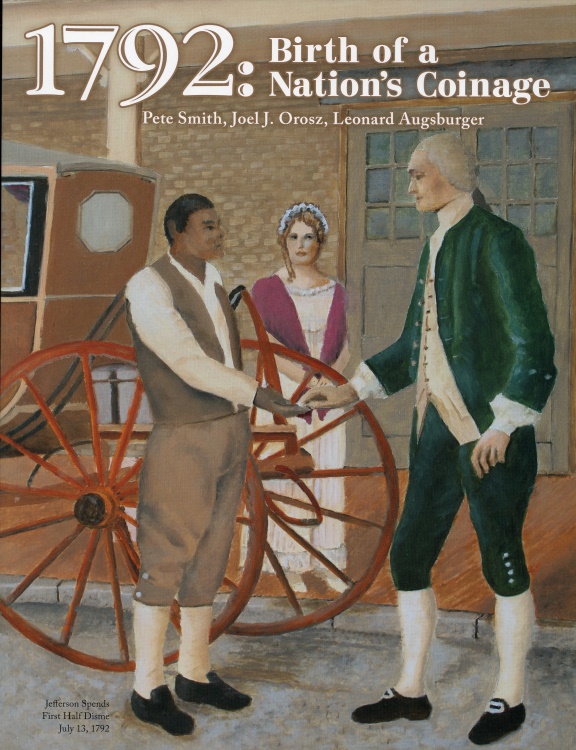
Collectors who are privy to the early silver coinage of the United States are often flummoxed upon seeing two similar-looking words that seem to refer to the same coin but yet are spelled quite differently. These two words are "
Half Dime" and "half disme," both of which refer to a United States silver coin with a face value of five cents and moving the scales at just one half of what their contemporary silver dime counterparts weigh. The two names surely seem to be related and they both relate back to the small, silver five-cent coins of early United States Mint vintage. But why are there spelling variances like this, and how does one even pronounce "disme" anyway?
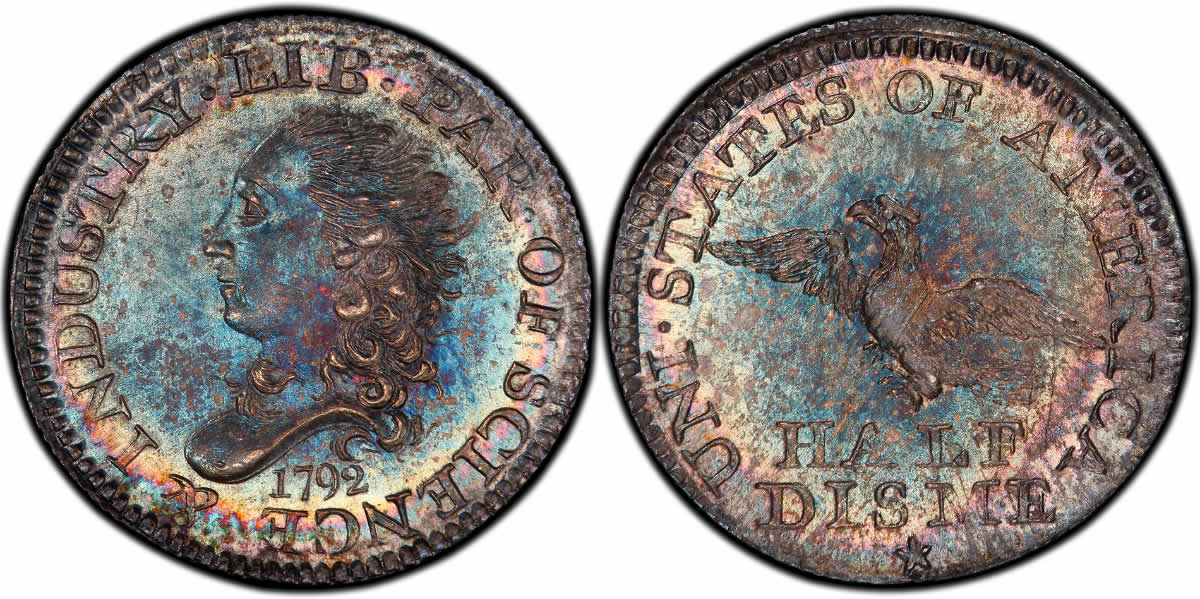 Bust Half Dime, 1792 H10C, PCGS MS68
The origin of both names dates back to the early 1790s, when the
United States coinage system was still in its infancy. The Coinage Act of 1792, which established the United States Mint in Philadelphia - then the capital city for the young United States, called for a variety of coins based on a decimal system and including a five-cent coin, denominated at half the rate of the 10-cent coin to be called the disme, terms and spellings taken straight from said act:
"Dismes - each to be of the value of one tenth of a dollar or unit, and to contain thirty seven grains and two sixteenth parts of a grain of pure, or forty one grains and three fifth parts of a grain of standard silver.
Half Dismes - each to be of the value of one twentieth of a dollar, and to contain eighteen grains and nine sixteenth parts of a grain of pure, or twenty grains and four fifth parts of a grain of standard silver."
As then-Secretary of State Thomas Jefferson described, "the most easy ratio of multiplication and division is that of ten." And "10" is a critical numerical component of the decimal system as proposed in the 1585 book La Disme by French mathematician Simon Stevin of Bruges. More than 200 years later, the early
United States coins known as the
Half Disme were produced under the watchful eye of first Director of the United States Mint David Rittenhouse. Some 1,500
Half Dismes dated 1792 were made from silver (often cited to have been bullion donated by Founding Parents George and Martha Washington) in the Philadelphia basement of John Harper, whose building resided just feet away from the first United States Mint then under construction.
The 1792
Half Dismes were presented to President George Washington and other leading statespersons of the day, including the aforementioned Jefferson and Secretary of the Treasury Alexander Hamilton. Many of these early silver coins - generally deemed pattern coins by many numismatists - circulated in commerce, a point proudly noted by Washington, who said in a 1792 public address that, "There has been a small beginning in the coinage of
Half Dimes, the want of small coins in circulation calling the first attention to them." The lucky few in the public who got to handle the new coins widely embraced them but had trouble in pronouncing the French-origin name of the new denomination, the
Half Disme, which carries a silent "s" and "e" and is phonetically read as "deem."
In short order, the revised name, "dime," was officially adopted for both the five-cent and ten-cent coins and by 1794, when the next run of
Half Dimes and first batch of dimes officially hit production at the United States Mint, the "disme" spelling had been dropped in favor of the Americanized "dime." To this day, the spelling "disme" almost exclusively refers to the 1792 United States silver coinage denominated to five cents, while "
Half Dime" and "dime" refer to the relevant coins minted in 1794 and thereafter.
 Check out Half Dimes and Half Dismes on ebay
.







 Posted 08/27/2021 3:58 pm