| Author |
 Replies: 15 / Views: 2,275 Replies: 15 / Views: 2,275 |
|
|
New Member
Turkey
6 Posts |
Does anyone know about this coin of Septimius Severus. how much is it worth. It's called Limes AE aureus. raided in remote areas in times of war. very rare coins. smaller in size.   Edited by hefankhan
06/08/2021 5:55 pm
|
|
|
|
Moderator
 United States
56855 Posts |
|
|
CCF Advertiser
United States
1318 Posts |
First, your photos are far from ones we can use to help you know if you have an ancient item or not so it could be something modern: But to help others I'll start the discussion with information: From Aeqvitas site: Septimius Severus --AE (Limes) Aureus. Struck circa 202 AD. Laureate, draped and cuirassed bust of Septimius Severus right / Facing draped bust of Julia Domna; Caracalla on left facing right, laureate and draped; Geta on right facing left, bare headed, draped and cuirassed. RIC IV 181c; BMCRE 380 note; RSC 6.  |
|
Moderator
United States
23731 Posts |
 to the community Better pictures would be helpful. IMO this is not a genuine coin. The overall appearance doesn't look right, the coin is too round also. |
|
Pillar of the Community
United States
1554 Posts |
There's a first for everything, I suppose. "Limes aureus" is a new one on me - and twice in one thread! RIC IV, 181 exists as both an aureus and a denarius (see snippet below). Though the photos are hopelessly out of focus, the op may be a fourree (plated) denarius of RIC IV 181(a) type. It looks like a corroded core may be erupting through silver plate at 10 o'clock on the reverse. It could also be a modern something or other. The 'Aequitas' coin appears to be a contemporary cast counterfeit (so-called "limes") denarius of RIC IV 181(c) type. I see no reason to think either was intended to imitate an aureus. 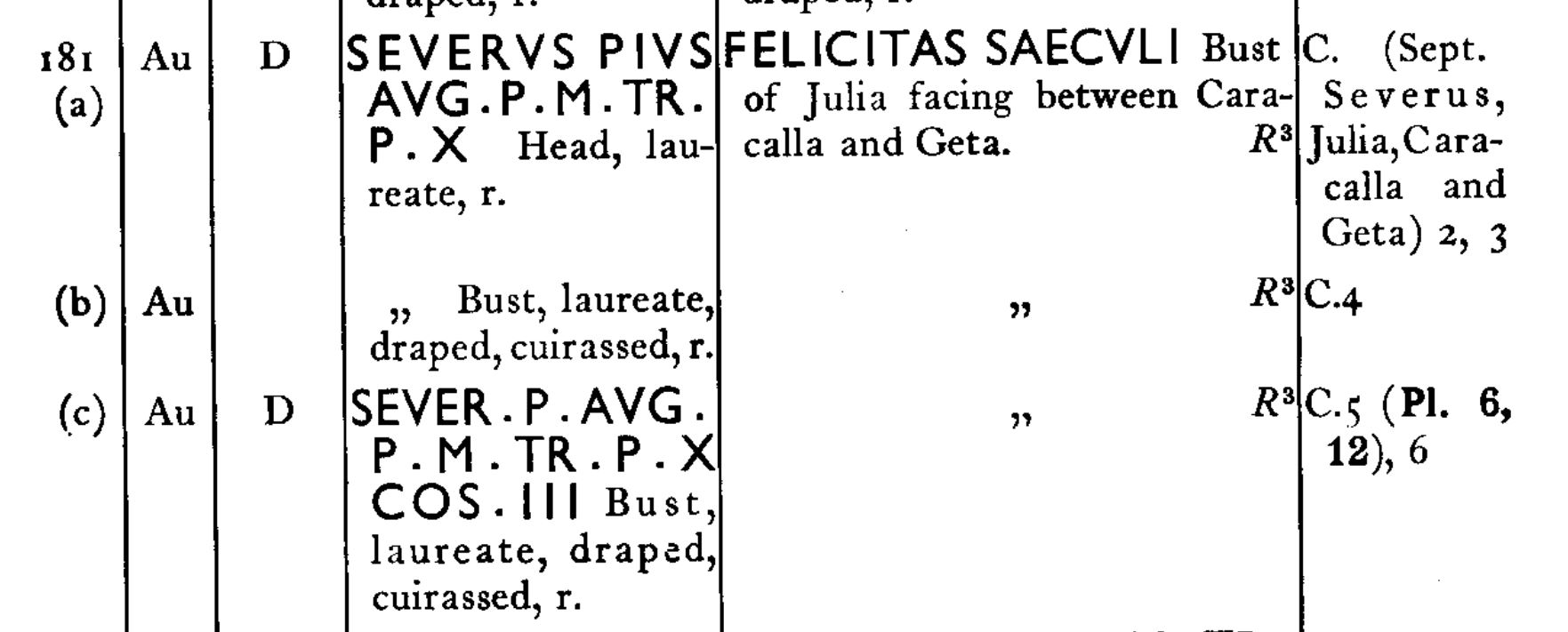 Edited by Kushanshah
06/09/2021 01:18 am
|
|
New Member
 Turkey
6 Posts |
I'm posting pictures before the money was cleared  new shot when cleared , According to the Acid Test, it has gold in it, but I don't know gold carat.  Edited by hefankhan
06/09/2021 07:08 am
|
|
CCF Advertiser
United States
1318 Posts |
|
|
Pillar of the Community
United States
1122 Posts |
From the new pics, the surface looks like there is evidence of casting bubbles. Therefore, I'm leaning towards this being a fake.
|
|
Moderator
United States
194400 Posts |
to the Community! |
|
Pillar of the Community
United States
1554 Posts |
Based on the new pics, I would say that it was intended imitate an aureus after all. The metal has the appearance of low-karat gold. I no longer see what appeared to be a base metal core in the op. Whether an ancient counterfeit or a modern fake, I'm not certain. I would take it to a local museum.
Edited by Kushanshah
06/09/2021 2:22 pm
|
|
New Member
Turkey
6 Posts |
As I know, limes coins are not in very good condition because they are made to meet the need for money in wartime. I am sharing the article I found about it.
These are thought to be coins minted either officially or pseudo-officially on the fringes of the empire out of necessity. Perhaps they were used to pay soldiers on the extreme frontiers of the Roman territories or maybe to bolster the economy of regions far from the normal means of monetary distribution. Whatever the reason, many of these coins exist.
According to Doug Smith 's postscript to The Vocabulary of Classical Numismatics, many Roman coins can be classified as "coins of necessity":
Of uncertain status are thousands (millions?) of surviving bronze coins of the Severan era that copy silver denarii. Some examples still bear traces of a very thin silver wash... Termed Limes (Lim-ace) or coins of the borders, these may be another example of coins of necessity. They may also be officially sanctioned issues for use in regions where political unrest made it hazardous to ship large amounts of silver. These low value issues could have served troops on the front and been redeemable for good coinage when they returned to the stable regions.
The name "Limes Denarius", although a misnomer, has been applied to these so often that it has stuck. Here again, although we know that these AE denarii are more or less faithful copies of silver prototypes, and we know that they were both struck and cast in various places - we even have numerous molds and forgers ' dies - we don 't understand the role, if any, they may have played in the official monetary system. Were they copies made by semi-Romanized folks just outside the reach of empire? - folks who had become accustomed to the use of coin but who did not have access to official supplies? Were they a form of military scrip meant to keep large quantities of precious metal from falling into enemy hands in the event of a defeat - and presumably redeemable in good coin at some future date? Were they out-and-out counterfeits? Were they particularly debased official issues? (well, the cast ones probably weren 't) Or did they fill some, as-yet unknown function? They might have done any or all of these at various times and places.
|
|
Pillar of the Community
United States
1554 Posts |
Some clarification. The term limesfalsa was originally coined to describe a specific class of cast imitations of early imperial aes, finds of which appeared to be concentrated near the Roman limes. The limesfalsa were never copies of silver or gold, only aes. It has since come to the attention of scholars that the so-called limesfalsa are more evenly distributed than first thought. The find spots are not concentrated along the limes after all. The preferred term today is "lightweights". What then are the "limes denarii"? This term seems to have originated on ebay in the late 1990s through a misunderstanding of limesfalsa. The term has since caught on with collectors and some dealers but not among academics, who by and large regard them as contemporary counterfeits. By the Severan era, the official silver coins had become debased enough that counterfeits wrapped in silver foil (fourrees) were no longer necessary. Copies cast in whitish high-tin bronze became the preferred method. I have never encountered the term "limes aureus" before this thead. In my opinion, the op - if ancient - should be regarded as a contemporary counterfeit. The profit on a single counterfeit aureus might have represented 6 months' to a year's wages for a common laborer. The possible penalty, on the other hand, was death. High risk, high reward. Edited by Kushanshah
06/09/2021 6:11 pm
|
|
New Member
Turkey
6 Posts |
According to my research, this coin appears as both gold and silver coins minted in the same mold due to the urgent need for money in the wartime Limes Arabicus ( https://en.wikipedia.org/wiki/Limes_Arabicus) region. This is the reason why Limes Coins have low mintage quality. There are rare coins that are hard to find because they are minted enough to meet the needs. Very high value coins. |
|
CCF Advertiser
United States
1318 Posts |
hefankhan; If you do feel that strongly about your coin then spend the $40 or so and send it to NGC (below) and if you have a genuine ancient coin it will be well worth the price to have the respected professionals give a seal of opinion so you can indeed have an item of high value. And if they state to you it is modern, even if they are incorrect and you don't accept their opinion that will also be valuable as if they don't accept it as ancient buyers won't ever either and the situation resolves. https://www.NGCcoin.com/specialty-s...grading.aspx |
|
Pillar of the Community
United States
3480 Posts |
Nothing about this coin looks right to me
Firstly it has been polished to smooth out the rough surfaces on the portraits both obverse and reverse while the fields remain very rough
As mentioned the flan is much too round and the edges appear rounded as well
Probably from being polished
The letters are much too modern looking and lastly the reverse legend is misspelled SALCVLI
It has every appearance of having been cast using dirty recycled alloy
Hence the miserable results
|
|
Pillar of the Community
United Kingdom
2120 Posts |
A few things to note here. The style of the coin is wrong when compared to a genuine type. This relates to everything from the busts to the lettering. I suspect that it is modern and more than that is a cast. The worthpoint item is not really helpful in reality as it is from the same dies and has the same problems except that it claims to be silvered (not silver).
There is nothing about this item that makes me believe it is ancient.
|
| |
Replies: 15 / Views: 2,275 |
|










 Posted 06/08/2021 7:11 pm


