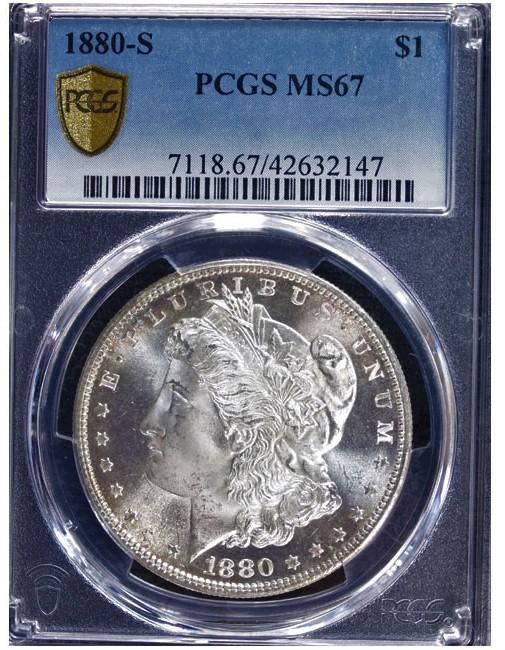
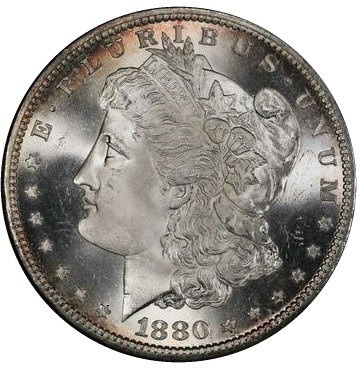
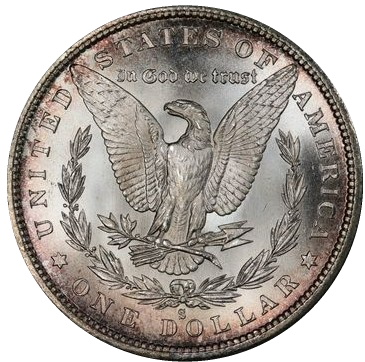
I posted this to prompt some discussion. I specifically picked an 1880-S because that date has one the widest grading ranges in the series (all the way to MS-69). I chose this coin because it is for sale online, and the dealer's pictures accurately depicted the surfaces.
Here's a re-upload of the dealer's obverse photo, with
some of the contact marks circled. Very few of these marks are visible in the PCGS TruView.
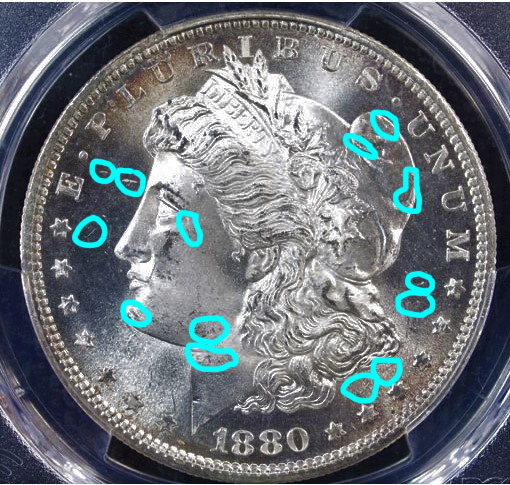
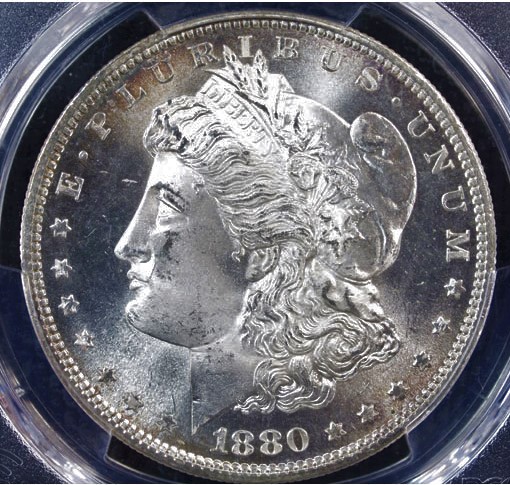
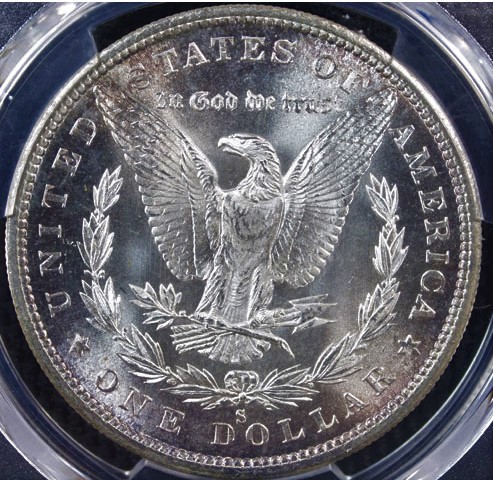
I had the obverse at MS-65/65+ and the reverse at MS-67, net MS-66. Old school, I had this as Gem SPL, falling short of Choice SPL.
There is a fairly large swing in price from 66 to 67, +$500. Is MS-67 an absurd grade for this coin? No. Is it pushing the envelope? Yes.
Here are some hot takes:

The members on this board who have engaged with this thread have at least 200 collective years of grading experience. TPGs do an excellent job with authentication and generally do a good job with grading. So do the members on here. The collective weight of member grading on this thread is MS-66. PCGS is at 67.
Hot take: With a $500 swing at stake, the members on here owe zero deference to the TPGs. We can stand eye-to-eye with them, and our disagreements have merit.The original goal of slabbing was to create a sight-unseen market. The internet eliminated that need.
Hot take: For higher grade (non-bulk purchase) classic coins and more expensive coins, a truly sight-unseen market will never exist. Too much is at stake.
The adage "buy the coin, not the slab" is an adage for a reason.
Hot take: This adage is the collector's biggest safety net.Photographs show what the eye cannot see. That is both good and bad. Take for example a nature photographer who shoots two pictures of the same waterfall. The first, at high shutter speed, captures thousands of droplets frozen in mid-air. The second, at slow shutter speed, shows milky water flowing over the rocks. Neither matches what the eye sees, but each reveals something of what exists. Coin photos can deceive, and grading from photos is difficult. One way to compensate is to use software (Paint.net, Photoshop, or countless others) to adjust the photos. By sliding lighting, contrast, color, and clarity up and down, the photo reveals more details than a single image can capture.
Hot take: Digital photo tinkering by buyers of higher price coins is a must to compensate for the static nature of pictures.Grading disagreements do not necessarily mean one party is right and the other is wrong. (An argument over VG versus MS might be an exception!) When the differences are comparatively small - a point or so - both sides can be correct. This is less science and more an art. What is key is recognizing that a sale does not occur unless there is both a willing buyer and a willing seller, and grading, eye appeal, and pricing are
all variables in that discussion.
Hot take: if you are not fully comfortable with the differences in these variables, walk. Don't be talked into something that your instincts nudge you away from.
When I mentioned at the start that this was in a Gold Shield, each of us had an impression of how PCGS would see this coin. Several specifically commented on how PCGS would see the grade. If this coin has been in an OGH, would we have seen this grading lower? Of course.
Hot take: grade inflation is real. It is also both creating a niche market and hurting the broader market.
Some questions for discussion. I have no thoughts to offer here.
Is it time to have the discussion about computer grading?
Is it time to replace the Sheldon scale with a multi-variable scale, including die state, strike, contact marks, circulation, alterations (cleaning, etc.), varieties, and toning? What factors matter? Can all of these be quantified?
Who should lead the discussions? the TPGs?
ANA? Dealers and associations (PNG, etc.)? Should the grading scales be proprietary and regulated (and by whom), or should the market be left open-sourced and unregulated?
In a world of pandemic, virtual technology, and economic uncertainty, how can these issues meet or create rapidly-changing markets? What comes next?
If this coin was a Gem SPL back in the day (or maybe even Choice SPL back then?), haven't we both gained and lost something with the current grading? The pinpoint grade (whether 66 or 67) can be seen as a positive. But at the same time, the old SPL designation has been lost, and many found it useful. Is newer better? Were the "good old days" really that? Or is there room for both?
Just some musing from the curmudgeon's corner. I'll shut up and go have my coffee now.











 Posted 08/18/2021 8:23 pm


 and it only took me like 10 seconds to determine this