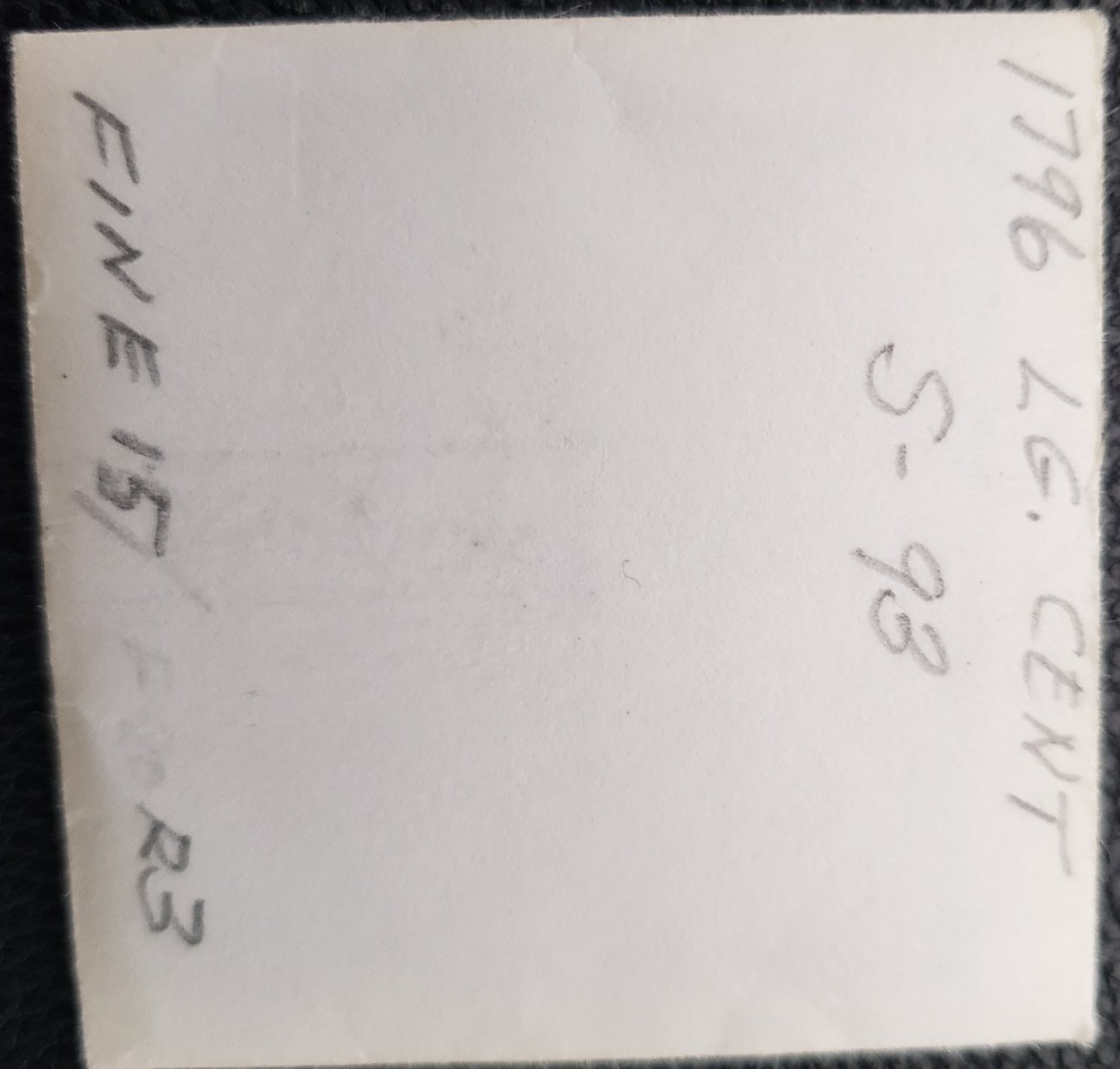
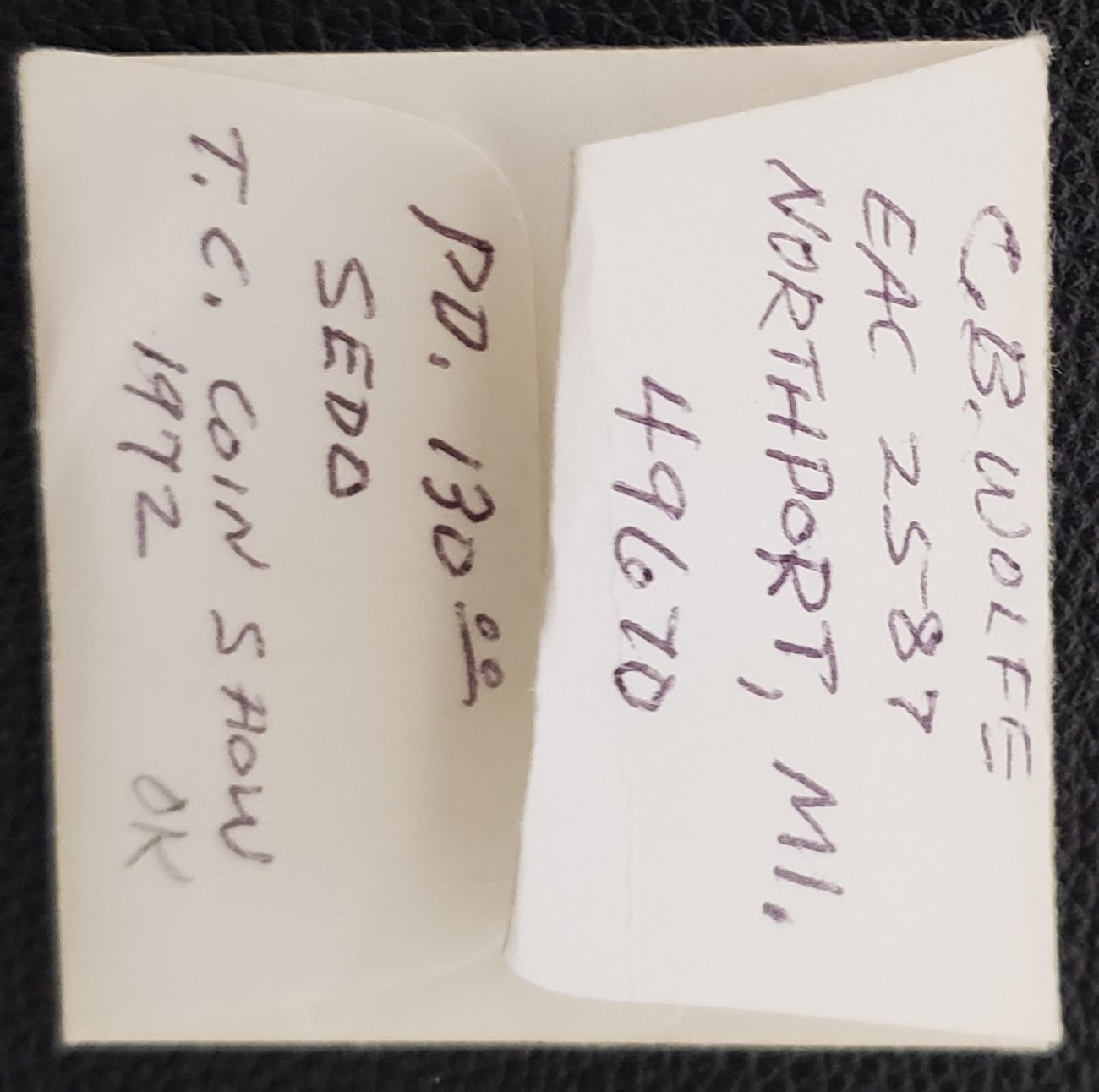
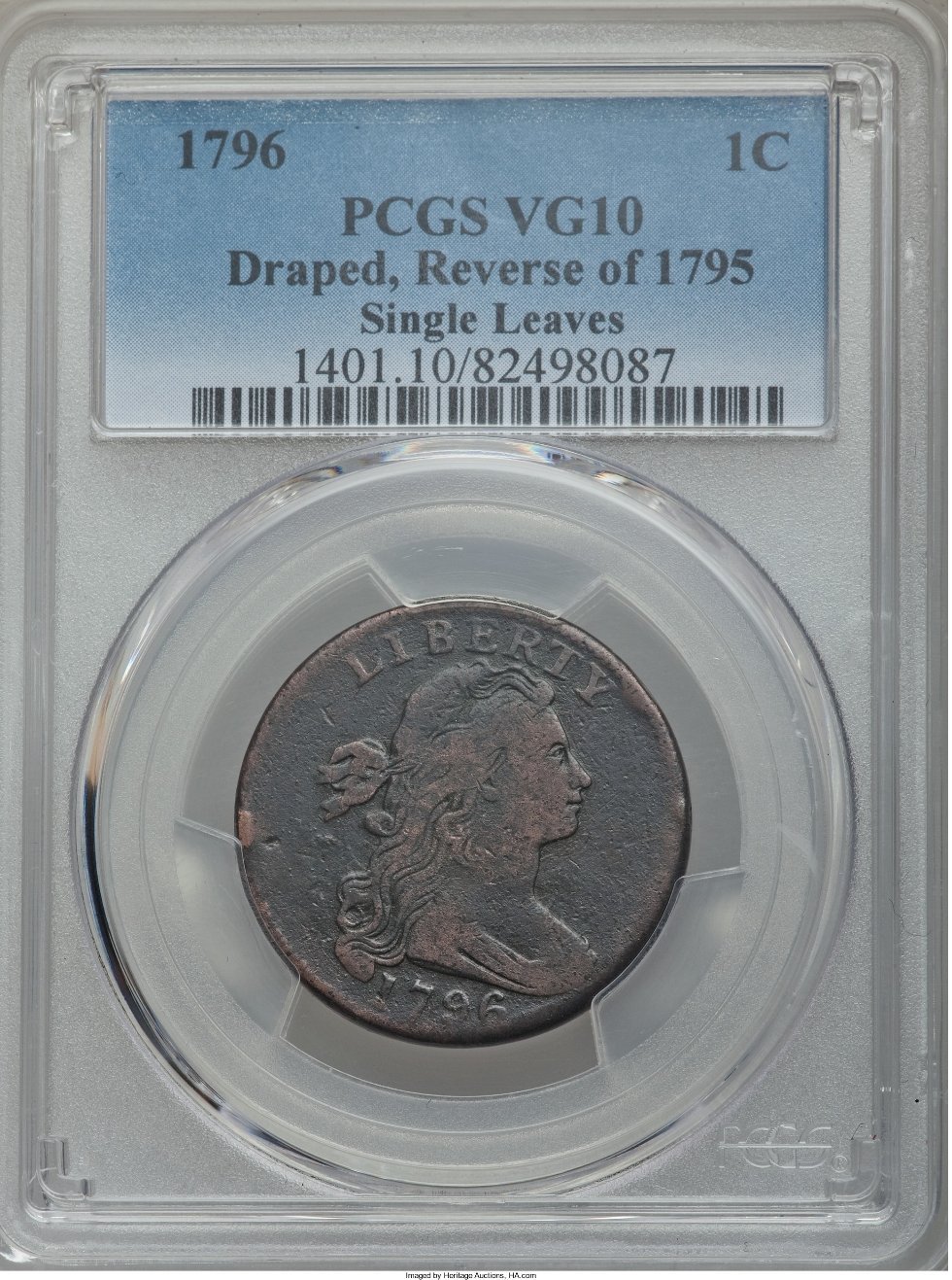
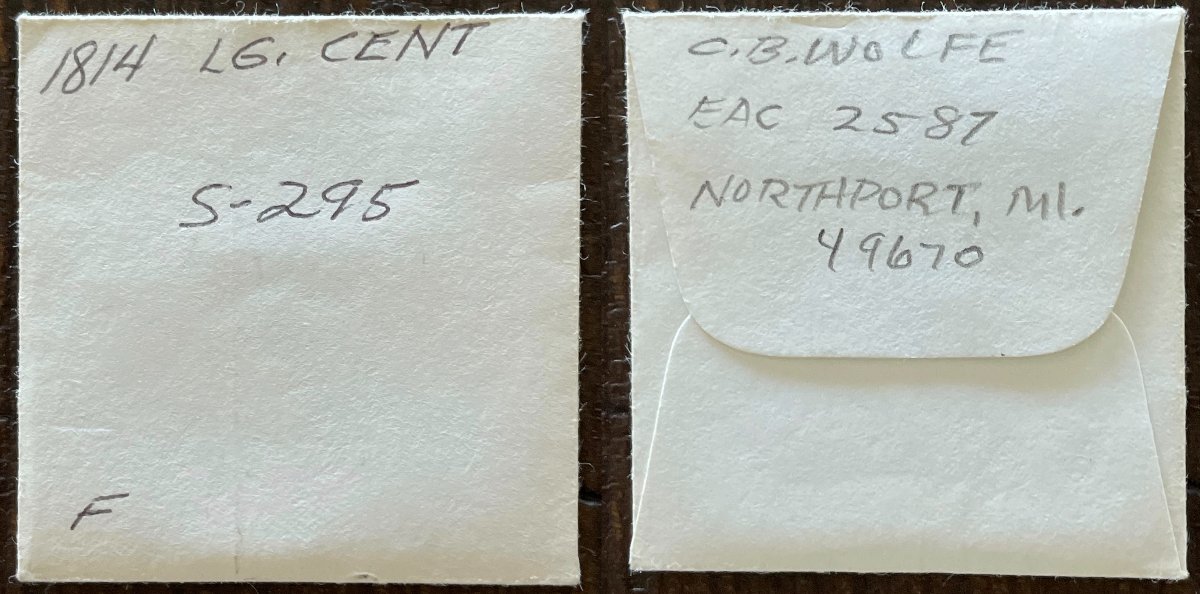
I bought this large cent in early 2017 at auction, and received with it the envelope the coin was stored in by the previous owner, C.B. Wolfe. I did a brief Google search, and while I couldn't find much I did find that he was a member of Early American Coppers, and thus the notation "EAC 2587" on the envelope.
Mr. Wolfe died at age 93 in January of 2011, and this coin was part of his collection sold in 2017. I did find an old topic in this forum from another member who had a coin with a similar envelope from the same gentleman. I keep the envelope in a flip with the coin, and will pass them on together if and when I ever sell it.
I thought it was a bit of an interesting piece of history; I have many coins with attribution on the TPG holders, but this is the only one where I have an old coin envelope like this.
By the way, while Mr. Wolfe had given it a grade of F, PCGS deemed it VF25.
Nice find. You have to wonder what collections that coin was a part of prior to Mr Wolfe acquiring it. It so cool seeing the envelope from the old school collecting method. Nice collector grade with a nice planchet. F12 is extremely conservative.
Always nice to be able to place your coin with a provenance to another collection in the past. This example is a superb coin for the era. No problems and great surfaces.
The Early American Coppers (EAC) group prides itself on the depth of research that its members do learning about coinage.
Ralph Rucker took that research to a new level in his book on the 2×2 envelopes that contained these coins.
He shares why his believes his research is important and what inspired him to begin this literary quest.
s40JXBT0MsM
I got my copy of Ralph's book for free when I joined the EAC in my welcome packet.
"Buy the Book Before You Buy the Coin" - Aaron R. Feldman - "And read it" - Me 2013! ANA Life Member #3288 in good standing since 1981, ANS, Early American Coppers Member (EAC), Colonial Coin Collectors Club member (C4), Conder Token Collector Club member (CTCC), Civil War Token Society (CWTS) member, Liberty Seated Collectors Club (LSCC) & Numismatic Bibliomania Society member (NBS), USMex, Member in good standing, 2¢ variety collector.
Thank you for the comments. I've always been fascinated imagining the paths the U.S. coins I own have taken to finally reach my hands (especially the 18th and 19th century ones), and it's nice to have a little something from the person who owned this one before me!
I agree that PCGS was generous with assigning a VF25 grade to this coin and took that into consideration on my bidding at the time, but I remember being attracted to it by the fairly decent strike and nice overall appearance. And I still am .
@westcoin, I'm somewhat familiar with EAC, but hadn't heard of that publication. Interesting!
Quote: @westcoin, I'm somewhat familiar with EAC, but hadn't heard of that publication. Interesting
!
I don't know if they still give them out with membership, I would bet they are out of them by now. They do pop up on ebay from time to time. Usually in a lot of other EAC literature bundled or so I've noticed.
"Buy the Book Before You Buy the Coin" - Aaron R. Feldman - "And read it" - Me 2013! ANA Life Member #3288 in good standing since 1981, ANS, Early American Coppers Member (EAC), Colonial Coin Collectors Club member (C4), Conder Token Collector Club member (CTCC), Civil War Token Society (CWTS) member, Liberty Seated Collectors Club (LSCC) & Numismatic Bibliomania Society member (NBS), USMex, Member in good standing, 2¢ variety collector.
Just on a guess, Wolfe's grade of "F" could be a grade based on EAC standards. As I understand it EAC grading starts with a technical grade, then adjusts that for specific irregularities. So the PCGS grade of VF-25 was probably the starting point (the technical grade).
Anyway, I like it and would gladly include it in my collection.
My friend Mark Borckardt, Senior Cataloger and numismatist with Heritage, is also the EAC historian and is probably a big part of why Heritage keeps the envelopes and passes them on to the buyers of EAC coins.
I'm glad others also see value in them as well, as it is a good way to help preserve the provenance of a certain coin, which allows us to track it over time as it moves through various collectors hands. Some known others not so much, but no matter the legacy will live on, and it's easier to keep if we know the caretakers of the coins through time and history.
"Buy the Book Before You Buy the Coin" - Aaron R. Feldman - "And read it" - Me 2013! ANA Life Member #3288 in good standing since 1981, ANS, Early American Coppers Member (EAC), Colonial Coin Collectors Club member (C4), Conder Token Collector Club member (CTCC), Civil War Token Society (CWTS) member, Liberty Seated Collectors Club (LSCC) & Numismatic Bibliomania Society member (NBS), USMex, Member in good standing, 2¢ variety collector.
Quote: Just on a guess, Wolfe's grade of "F" could be a grade based on EAC standards.
@kanga, that's what I was assuming. I've noticed over the years that Heritage Auctions often lists the EAC grade for early coppers, and it's almost always lower than the grade on the slabs.
Disclaimer: While a tremendous amount of effort goes into ensuring the accuracy of the information contained in this site, Coin Community assumes no liability for errors. Copyright 2005 - 2026 Coin Community Family- all rights reserved worldwide. Use of any images or content on this website without prior written permission of Coin Community or the original lender is strictly prohibited. Contact Us | Advertise Here | Privacy Policy / Terms of Use









 Posted 09/25/2021 8:47 pm


 .
.