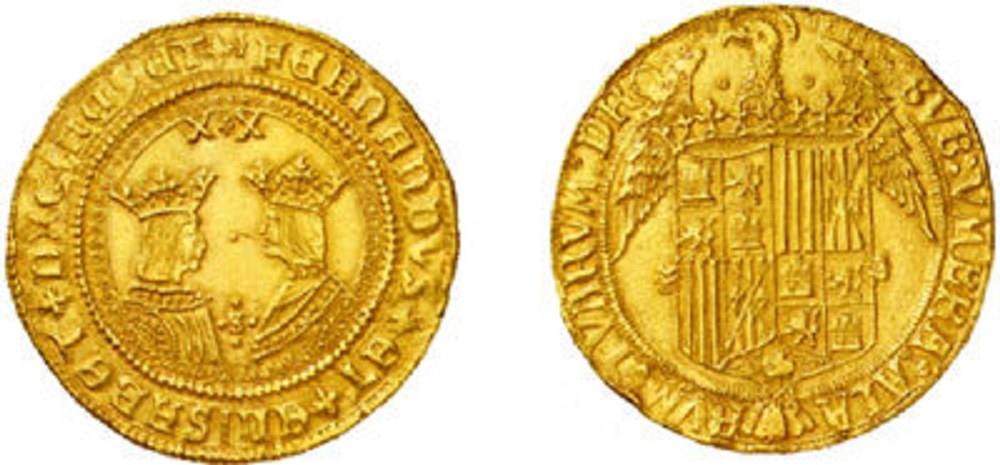
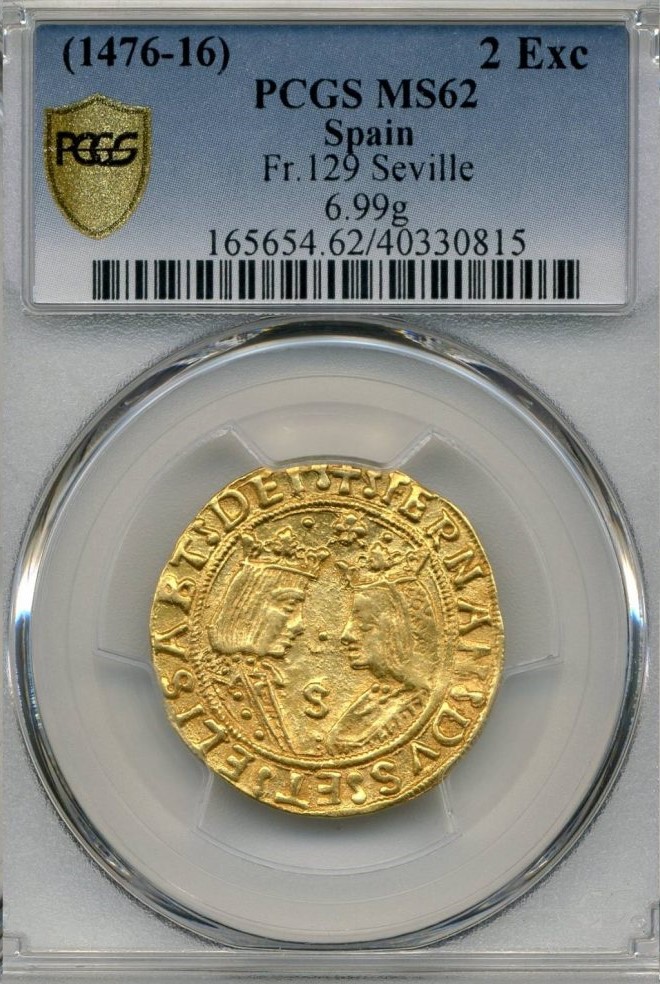
Is this the coin that made the New World and the United States possible the way we know it now?
Thoughts? Thanks!
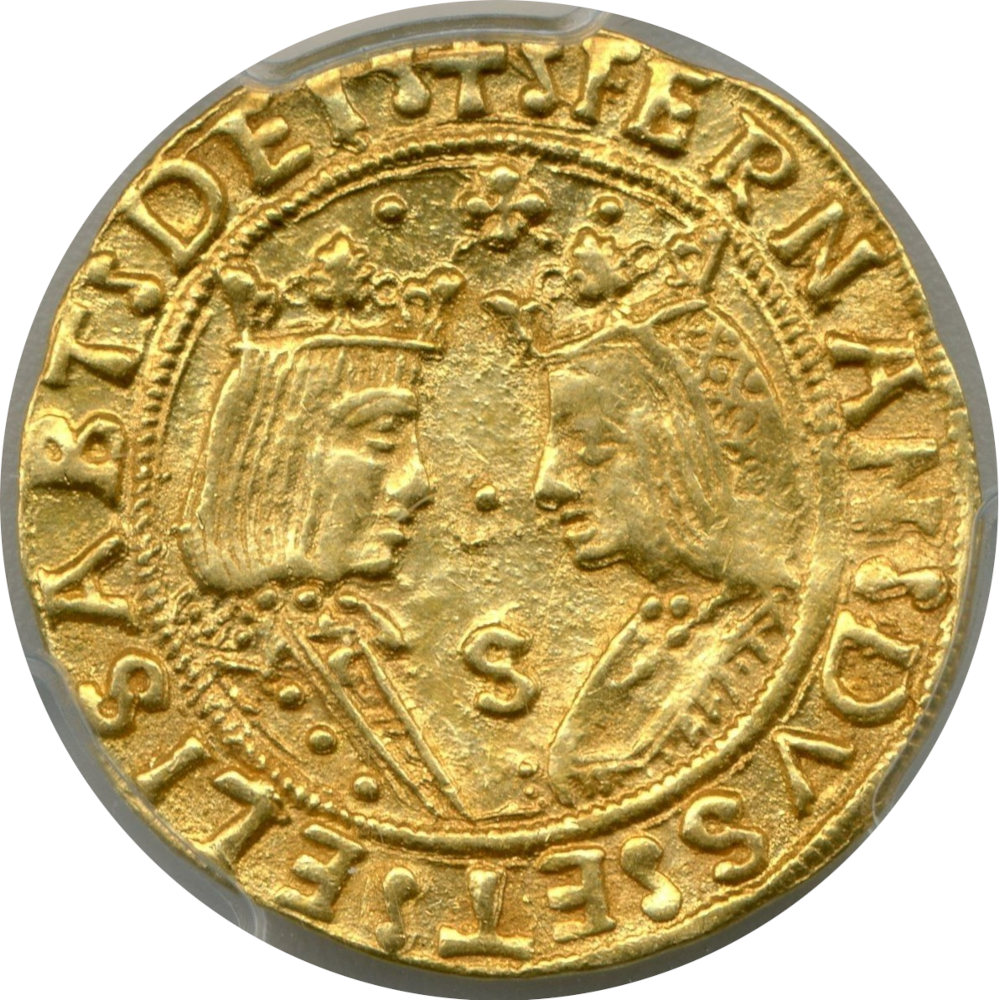
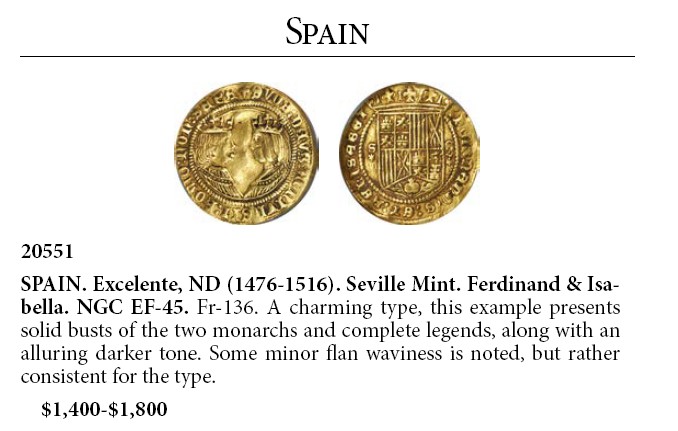
OBV: FERNANDVS ET ELISABT DEI - Royal Busts Facing One Another.
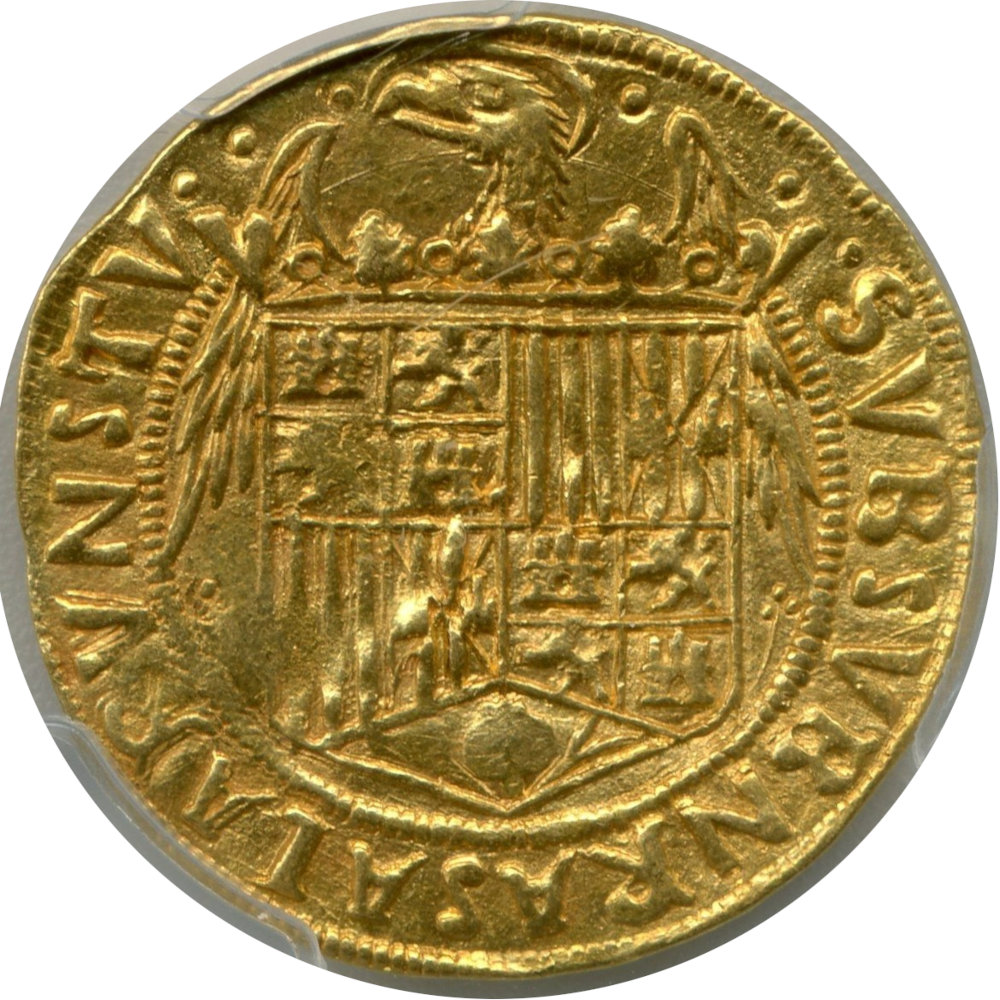
REV: SVB VBNRA ALARVN TV (perhaps the marks of the coin maker) - Shield Protected by the Eagle of San Juan
The coin pictured above, that I was fortunate to acquire, is historically important because it spans the Pre-Columbian era and the European colonization of the New World - or the Americas. This coin is undated and was minted between 1476 and 1516 in the Sevilla Mint in Spain. It weighs 6.99 grams which is the same weight as a U.S. $4 Stella gold coin.
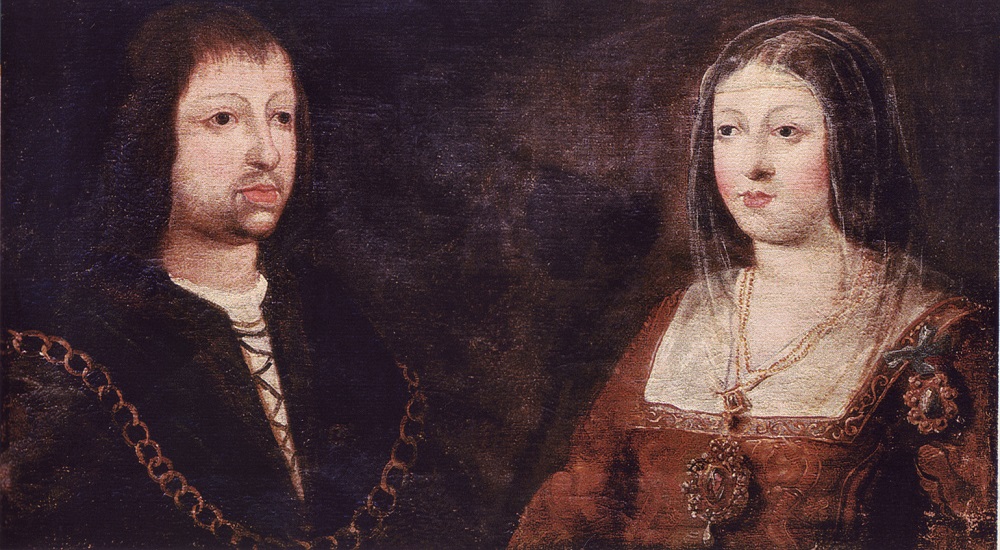
Fernando II of Aragon and Isabel I of Castilla married in 1469. Isabel ascended to the throne of the Kingdom of Castilla in 1474 and Fernando ascended to the throne of Aragon in 1479. Together they unified Spain and completed the Reconquista by expelling the Moors from Granada in January of 1492.
In 1484, Christopher Columbus (pictured below) showed up in an audience with King João II of Portugal to obtain funding for a voyage to the Far East. Columbus sought a new route to China and Japan, at the end of the Silk Road trade route that Marco Polo had written about, by sailing West from Portugal across the Atlantic. The Portuguese advisors noticed that Columbus miscalculated the distance to the Far East and turned him away.
In 1486, Columbus shows up in the Court of Fernando II and Isabel I of Spain and pitches them on the idea of the voyage. The Spanish Court advisors also find that Columbus miscalculated the voyage and rebuff him, but the Spanish monarchs did not want Columbus to be funded by other European sovereigns and gave him a small stipend to stick around and not go exploring for someone else.
In April of 1492, Columbus finally gets his funding from Fernando and Isabel to set sail in search of a new route to the Far East trade. He sets sail on August 3, 1492 in three ships, the Niña, Pinta and Santa María. On October 12, 1492 he lands in an island in the Bahamas that he named San Salvador and began the European Colonization of the New World.
The Double Excelentes are the coins that would have paid for three ships, crews, provisions and everything needed for this voyage that would change the course of the World.
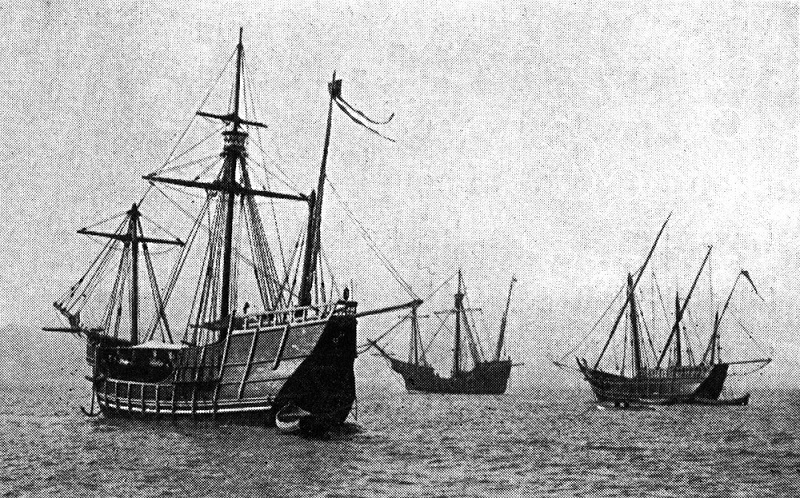
The ships pictured below are replicas of the Niña, Pinta and Santa María, the three ships that Columbus sailed in his first voyage to the New World. These replicas were built and set sail in 1893 at the Columbian Exposition in Chicago to celebrate the 400th anniversary of Columbus' voyage.
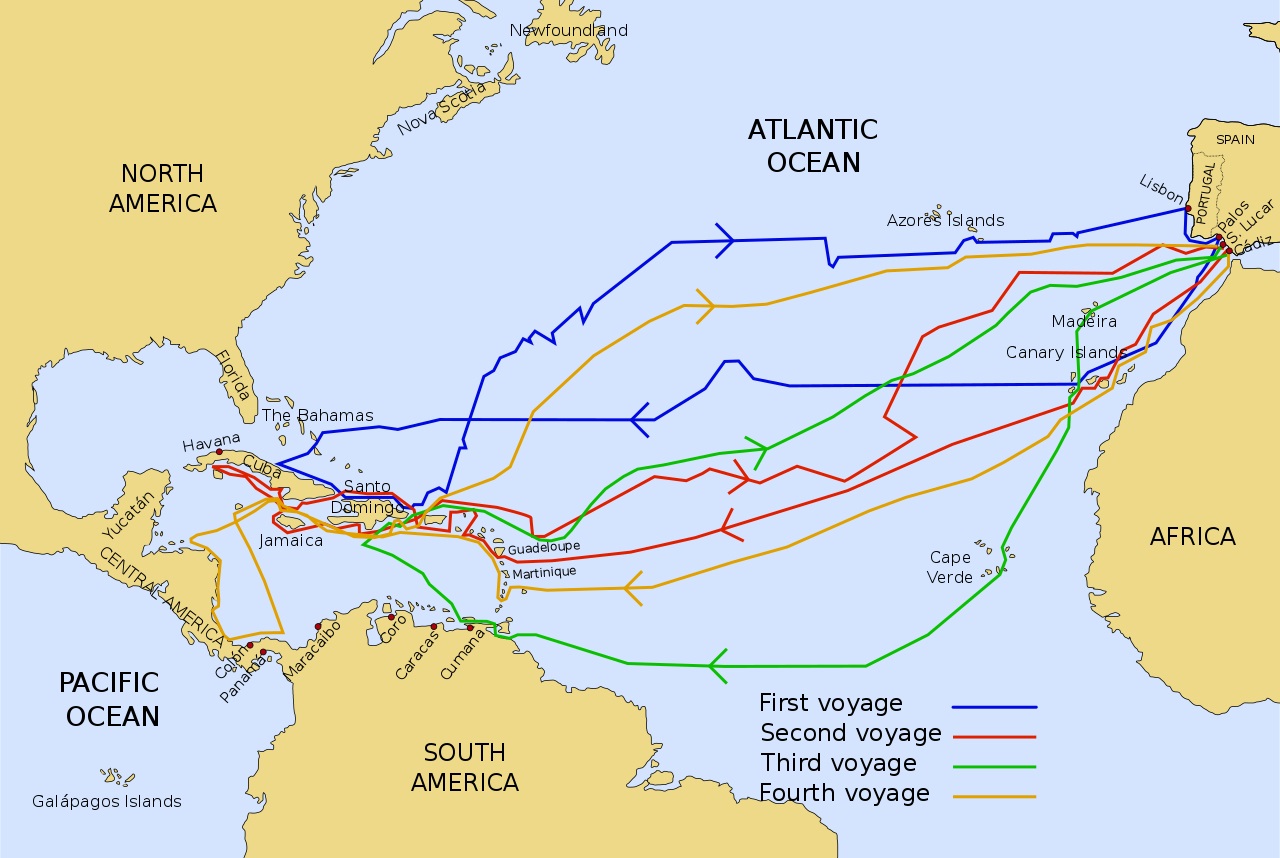
And the map below shows the four voyages that Columbus made to the New World where he developed a reputation for the ruthless treatment with which he dealt with indigenous Americans.
Without the coins financing his voyage, Columbus may not have made his discovery and history may have turned out in a different way.
That's a lot of "what if's" to consider, but all other things being equal, if that coin didn't exist, it would have been funded some other way. If Leif Erikson had gone further south and been more thirsty for gold, maybe we'd be worried about Scandinavians coming in from Central America. You can see how these "what if" things can go. Somebody from Europe during the colonization phase would have gotten here eventually, and the ones who got here 16000+ years ago would still be going "what took you so long?".
Many what if's I agree! The dates of the double exelente is pre anything considered early colonial by most standards, and I am not well read into that early era (yet). It's not covered in my books "Yankee Doodle's Pocket" by Will Nipper or "Colonial History in Your Hands" by Dr. Peter Jones.
I recommend both books as great reads into our early coinage history. I review Dr. Jones' book here: http://goccf.com/t/382003
You may also enjoy a video clip from a previous symposium done by John Kraljevich, Jr. for the Colonial Club C4:
BASv_LFkDcI
it's titled "The Immigrants Sources and Methods" a wonderful talk early Covid-19 from his basement covering what constitutes coinage that was used in early formation of America. While this talk doesn't get quite that far back it's still interesting and relates to the coinage that did circulate here in the early American colonies.
To go even farther back and still remain in the Americas I think it is a likely candidate for this type of coin that the Spaniards used to conquer Mexico and Central America, as well as to finance and build ships for exploration and their wars. An affordable type coin and tons of history there. A really neat looking piece NS! I saw one sell at last Stacks/Bowers sale in January 2020 NCG EF45 for an affordable single exelente only $1440.00
That one was in the January 16, 2020 Ancient & World coin Auction. Don't see the double excelente often at all.
These pieces are associated with Columbus because they were created by the rulers who financed Columbus at the time of his voyages, and because a version of this coin was struck specifically for use in Santo Domingo, the capital of the Dominican Republic, which was founded by Columbus' younger brother Bartholomew Columbus in 1496. Later Diego Colombus (Christopher's son) arrived in 1509, assuming the powers of Viceroy and admiral.
Many counterfeits exist so care is needed in purchasing them, this is probably a good type of coin to only buy certified these days. I've seen some of them clipped as well, this example shown is in a wonderful state of preservation and little to no circulation wear noted as well.
Thanks for sharing this beauty Numismatic Student! Another piece to be quiet proud of for sure.
"Buy the Book Before You Buy the Coin" - Aaron R. Feldman - "And read it" - Me 2013! ANA Life Member #3288 in good standing since 1981, ANS, Early American Coppers Member (EAC), Colonial Coin Collectors Club member (C4), Conder Token Collector Club member (CTCC), Civil War Token Society (CWTS) member, Liberty Seated Collectors Club (LSCC) & Numismatic Bibliomania Society member (NBS), USMex, Member in good standing, 2¢ variety collector.
This is the history of European colonization of North America. In U.S. schools, it generally starts with Jamestown, VA because that is when the British colonization of territories now considered within the U.S. began. U.S. education ignores all non-British colonization in the current U.S. Typical selective history is being taught here.
In bold are the entries of the history of European settlement in territory now considered to be in the U.S.
North America Before Columbus
986: Norsemen settle Greenland and Bjarni Herjólfsson sights coast of North America, but doesn't land (see also Norse colonization of the Americas). c.1000: Norse settle briefly in L'Anse aux Meadows in Newfoundland. c.1450: Norse colony in Greenland dies out. 1473: João Vaz Corte-Real perhaps reaches Newfoundland; writes about the "Land of Cod fish" in his journal. The claims of this discovery remain entirely speculative.
Late fifteenth century
1492: Columbus sets sail aboard the Niña, Pinta, and Santa Maria. 1492: Columbus reaches the Bahamas, Cuba and Hispaniola. 1492: La Navidad is established on the island of Hispaniola; it was destroyed by the following year. 1493: The colony of La Isabela is established on the island of Hispaniola. 1493: Columbus arrives in Puerto Rico 1494: Columbus arrives in Jamaica. 1496: Santo Domingo, the first European permanent settlement, is built. 1497: John Cabot reaches Newfoundland. 1498: In his third voyage, Columbus reaches Trinidad and Tobago. 1498: La Isabela is abandoned by the Spanish. 1499: João Fernandes Lavrador maps Labrador and Newfoundland
Sixteenth century
1501: Corte-Real brothers explore the coast of what is today the Canadian province of Newfoundland and Labrador 1502: Columbus sails along the mainland coast south of Yucatán, and reaches present-day Honduras, Nicaragua, Costa Rica and Panama 1503: Las Tortugas noted by Columbus in passage through the Western Caribbean present-day Cayman Islands 1508: Ponce de León founds Caparra on San Juan Bautista (now Puerto Rico) 1511: Conquest of Cuba begins 1513: Ponce de León in Florida 1515: Conquest of Cuba completed 1517: Francisco Hernández de Córdoba lands on the Yucatán Peninsula 1519: Founding of Villa Rica de la Vera Cruz (Veracruz) 1521: Hernán Cortes completes the conquest of Mexico. 1521: Juan Ponce de León tries and fails to settle in Florida. 1524: Pedro de Alvarado conquers present-day Guatemala and El Salvador. 1524: Giovanni da Verrazzano sails along most of the east coast. 1525: Estêvão Gomes enters Upper New York Bay 1526: Lucas Vázquez de Ayllón briefly establishes the failed settlement of San Miguel de Gualdape in South Carolina, the first site of enslavement of Africans in North America and of the first slave rebellion. 1527: Fishermen are using the harbor at St. John's, Newfoundland and other places on the coast. 1535: Jacques Cartier reaches Quebec. 1536: Cabeza de Vaca reaches Mexico City after wandering through North America. 1538: Failed Huguenot settlement on St. Kitts in the Caribbean (destroyed by the Spanish). 1539: Hernando de Soto explores the interior from Florida to Arkansas. 1540: Coronado travels from Mexico to eastern Kansas. 1540: The Spanish reach the Grand Canyon (the area is ignored for the next 200 years). 1541: Failed French settlement at Charlesbourg-Royal (Quebec City) by Cartier and Roberval. 1542: Juan Rodriguez Cabrillo reaches the California coast. 1559: Failed Spanish settlement at Pensacola, Florida. 1562: Failed Huguenot settlement in South Carolina (Charlesfort-Santa Elena site). 1564: French Huguenots at Jacksonville, Florida (Fort Caroline). 1565: Spanish slaughter French 'heretics' at Fort Caroline. 1565: Spanish found Saint Augustine, Florida. 1566-1587: Spanish in South Carolina (Charlesfort-Santa Elena site). 1568: Dutch revolt against Spain begins. The economic model developed in the Netherlands would define colonial policies in the next two centuries. 1570: Failed Spanish settlement on Chesapeake Bay (Ajacán Mission). 1576: Martin Frobisher reaches the coast of Labrador and Baffin Island. 1579: Sir Francis Drake claims New Albion. 1583: England formally claims Newfoundland (Humphrey Gilbert). 1585: Failed English settlement on Roanoke Island, North Carolina. 1587: Failed English settlement on Roanoke Island, North Carolina ([Lost Colony]). 1598: Failed French settlement on Sable Island off Nova Scotia. 1598: Spanish settlement in Northern New Mexico. 1600: By 1600 Spain and Portugal were still the only significant colonial powers. North of Mexico the only settlements were Saint Augustine and the isolated outpost in northern New Mexico. Exploration of the interior was largely abandoned after the 1540s. Around Newfoundland 500 or more boats annually were fishing for cod and some fishermen were trading for furs, especially at Tadoussac on the Saint Lawrence.
Seventeenth century 1604 - Acadia - French 1605 - Port Royal - French 1607 - Jamestown - English
Thanks westcoin. There is also a rare 20 Excelentes version of this coin that was sold by Áureo & Calicó in 2009 for €566,400 with tax applicable to buyers who are citizens of members of the EU that raised the price to €600,000 ($693,786). And people complain of high taxes here. The coin weighs well over 2 troy ounces and is 55 mm in diameter. A Morgan dollar is only 38.1mm.
Reyes Católicos 1475-1516. Sevilla. 20 excelentes. (Cal. 4, mismo ejemplar) (C.C. 1607). Ø 55 mm. 70,39 gr. Anv.: Bustos afrontados de los reyes, encima, en el campo X + X, entre los bustos • y S flanqueada por cuatro puntos. Leyenda: *S FERNANDVS * ET * ELISABET * DXG * RES ET. Rev.: Escudo coronado con las armas de Castilla y León, Aragón, Sicilia y Granada, cobijado por el águila de San Juan, nimbada, cuya cabeza está entre dos º º; leyenda: ºººº SVB : VMBRA : ALA RVM : TVARVM : PRO ºººº. La cabeza, las alas y la cola del águila interrumpen la leyenda. Golpes en canto, habituales en monedas de gran módulo. De este tipo, conocemos los siguientes ejemplares: Carles Tolrá, 1126; VQR. 6481, sin foto, aunque por la descripción, creemos que pertenece a este tipo y colección particular. Suave pátina. Muy atractiva. Extraordinariamente rara. EBC-. Est. 300.000 €. Precio de martillo 480.000 € + 18 % = 566.400 €. Para miembros de la Unión Europea 480.000€ + 25% = 600.000 €. (Nº 3 de nuestro «Top ten»).
Este ejemplar pertenece a la Colección «Caballero de las Yndias» núm. 1607. Subastado por Áureo & Calicó, el 21 de octubre de 2009, lote 1735.
A real beautiful piece of history there Numismatic Student! You have one heck of an early American type collection now.
"Buy the Book Before You Buy the Coin" - Aaron R. Feldman - "And read it" - Me 2013! ANA Life Member #3288 in good standing since 1981, ANS, Early American Coppers Member (EAC), Colonial Coin Collectors Club member (C4), Conder Token Collector Club member (CTCC), Civil War Token Society (CWTS) member, Liberty Seated Collectors Club (LSCC) & Numismatic Bibliomania Society member (NBS), USMex, Member in good standing, 2¢ variety collector.
Did a little more digging and found this page on the dos excelantes coin, this shows an incredible finest known in NGC MS65 and the price record holder at auction (2009) where it brought $10,637.50 wow! I actually like a lightly circulated coin as it has more history attached to it in my mind. Such as did the King or Queen actually hold these? Perhaps Columbus did?
Oh and Numismatic Student I can confirm that coin facts is indeed your coin. The URL is the same serial number as your slabbed coin. The large image is amazing.
"Buy the Book Before You Buy the Coin" - Aaron R. Feldman - "And read it" - Me 2013! ANA Life Member #3288 in good standing since 1981, ANS, Early American Coppers Member (EAC), Colonial Coin Collectors Club member (C4), Conder Token Collector Club member (CTCC), Civil War Token Society (CWTS) member, Liberty Seated Collectors Club (LSCC) & Numismatic Bibliomania Society member (NBS), USMex, Member in good standing, 2¢ variety collector.
Disclaimer: While a tremendous amount of effort goes into ensuring the accuracy of the information contained in this site, Coin Community assumes no liability for errors. Copyright 2005 - 2026 Coin Community Family- all rights reserved worldwide. Use of any images or content on this website without prior written permission of Coin Community or the original lender is strictly prohibited. Contact Us | Advertise Here | Privacy Policy / Terms of Use













 Posted 10/31/2021 07:05 am




 The coin weighs well over 2 troy ounces and is 55 mm in diameter. A