| Author |
 Replies: 14 / Views: 1,874 Replies: 14 / Views: 1,874 |
|
|
Valued Member
Spain
68 Posts |
The origin of the dollar symbol.  The spanish Piece of Eight was the first silver dollar offical in the USA  The colums of Hercules is part of the Spaniard Seal. .svg/225px-Escudo_de_Espa%C3%B1a_(mazonado).svg.png) El lema "Plus Ultra", en origen era "Non plus ultra", que significaba que no había nada más allá de las columnas de Hercules que estaban situadas al final del mar Mediterráneo. Cuando Cristobal Colón descubrió America, se descubrió que sí había un mundo más allá de las columnas y se le quitó el "Non", al lema. |
|
|
|
Valued Member
 Spain
68 Posts |
It´s the most common theory.
|
|
Valued Member
Spain
68 Posts |
"Pillars of Hercules" is better translation. In spanish is "Columnas de Hercules".
|
|
Valued Member
Spain
68 Posts |
El lema "Plus Ultra", en origen era "Non plus ultra", que significaba que no había nada más allá de las columnas de Hercules que estaban situadas al final del mar Mediterráneo. Cuando Cristobal Colón descubrió America, se descubrió que sí había un mundo más allá de las columnas y se le quitó el "Non", al lema.
Translated:
The motto "Plus Ultra" was originally "Non plus ultra", which meant that there was nothing beyond the Pillars of Hercules at the end of the Mediterranean Sea. When Christopher Columbus discovered America, it was discovered that there was a world beyond the columns and the "Non" was removed from the motto.
|
|
Pillar of the Community
 United States
6514 Posts |
Cool origination story. Whooda Thunk? Thanks for sharing.
Check out my counterstamped Lincoln Cent collection: http://goccf.com/t/303507 |
|
Rest in Peace
United States
10625 Posts |
Makes cents... errr dollars.. Thanks for sharing...  |
|
Pillar of the Community
United States
9811 Posts |
Eric P. Newman wrote an article on the Origin of the dollar sign, a most respected and noted numismatic author, and presented it at the Coinage of Americas Conference at the American Numsmatic Society, New York, October 30, 1993, it is titled; "The Dollar $ign: Its Written and Printed Origin" in America's Silver Dollars (Published by the ANS in 1995 a chapter of the COAC Book). I have the the entire book or just that chapter in a PDF format which I will provide to anyone that would like to read it, just drop me a PM and let me know which you prefer. Eric Newman's notes on his $ symbol article can be found at the NNP here: https://nnp.wustl.edu/library/book/605947The first time the dollar symbol used in print was in this book - Auction lot from Heritage Newman Sale part X1 Lot #13329 (it sold for $660.00 USD): 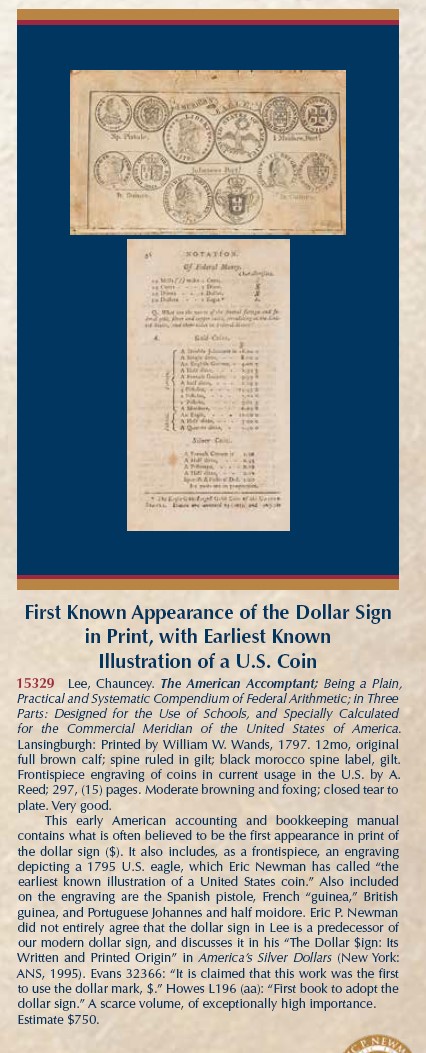 The E-Sylum had a piece on this as well, citing a few other sources: https://nnp.wustl.edu/library/periodical/512177A really fascinating study I agree. "Buy the Book Before You Buy the Coin" - Aaron R. Feldman - "And read it" - Me 2013! ANA Life Member #3288 in good standing since 1981, ANS, Early American Coppers Member (EAC), Colonial Coin Collectors Club member (C4), Conder Token Collector Club member (CTCC), Civil War Token Society (CWTS) member, Liberty Seated Collectors Club (LSCC) & Numismatic Bibliomania Society member (NBS), USMex, Member in good standing, 2¢ variety collector. See my want page: http://goccf.com/t/140440 |
|
Moderator
 United States
198004 Posts |
Very interesting!  |
|
Bedrock of the Community
United States
20753 Posts |
And here all the time I thought it was invented by whoever made the Computer keyboard.  Some thing to put above the 4. Now who can explain the @ or % or the & signs? |
|
Moderator
United States
198004 Posts |
Quote:
And here all the time I thought it was invented by whoever made the Computer keyboard. Funny, but you and I know both you are old enough to remember seeing it on typewriters... manual ones at that!  |
|
Pillar of the Community
United States
3369 Posts |
The dollar symbol has also been attributed to the Potosi mintmark. This 1823 Potosi 8R shows it pretty well. The vertical of the P overlays the S, forming $. The 8R's are the direct ancestor of the US silver dollar, and were interchangeable until the 1850's. https://www.vcoins.com/en/stores/nu...Default.aspx"Two minutes ago I would have sold my chances for a tired dime." Fred Astaire
Edited by thq
12/20/2021 8:51 pm
|
|
Valued Member
United States
157 Posts |
When we went to Mexico around 2005, I was shocked to see they were selling bottles of Coke for $10, and lunch was about $80. But when I asked around, it turned out that the Mexican peso used the same symbol as the US dollar, and at the time they were exchanging ten-to-one. I had no idea that the "dollar sign" had Spanish and Mexican roots.
|
|
Pillar of the Community
United States
1613 Posts |
Thanks for the additional information Westcoin. I'm on the Newman portal quite frequently researching information for weekly blogs I write. I'll look for that.
ANA member - PAN Member - BCCS Member There are no problems only solutions - the late, great John Lennon
|
|
Pillar of the Community
United States
1613 Posts |
Funny, but you and I know both you are old enough to remember seeing it on typewriters... manual ones at that!
Hey now! I still have and use one of those antique contraptions. Finding the ribbons can be tough at times, not to mention costing much more than back in the day.
ANA member - PAN Member - BCCS Member There are no problems only solutions - the late, great John Lennon
Edited by Ballyhoo
12/24/2021 10:25 am
|
|
Valued Member
United States
60 Posts |
Very interesting! I wonder how sure we can be on the origin story though..
|
| |
Replies: 14 / Views: 1,874 |
|




 Posted 12/19/2021 07:34 am





