Coin Community Family of Web Sites Join Thousands of Coin, Bullion, & Money Collectors
300,000 items to help build your collection! Vancouvers #1 Coin and Paper Money Dealer Royal Estate Auctions - $1 Coin AuctionsJoin Thousands of Coin, Bullion, & Money Collectors Specializing in Modern Numismatics Royal Canadian Mint products, Canadian, Polish, American, and world coins and banknotes. Coin, Banknote and Medal Collectors's Online Mall


Username:
Password:
Save Password
Forgot your Password?


This page may contain links that result in small commissions to keep this free site up and running.

Welcome Guest! Registering and/or logging in will remove the anchor (bottom) ads. It's Free!

2021 Quarters What Is The Dull Color?

To participate in the forum you must log in or register.
Author Previous TopicReplies: 27 / Views: 6,531Next Topic
Page: of 2
Valued Member
SunnyNinaD's Avatar
United States
102 Posts
 Posted 01/05/2022  01:23 am Show Profile   Bookmark this topic Add SunnyNinaD to your friends list Get a Link to this Message Number of Subscribers
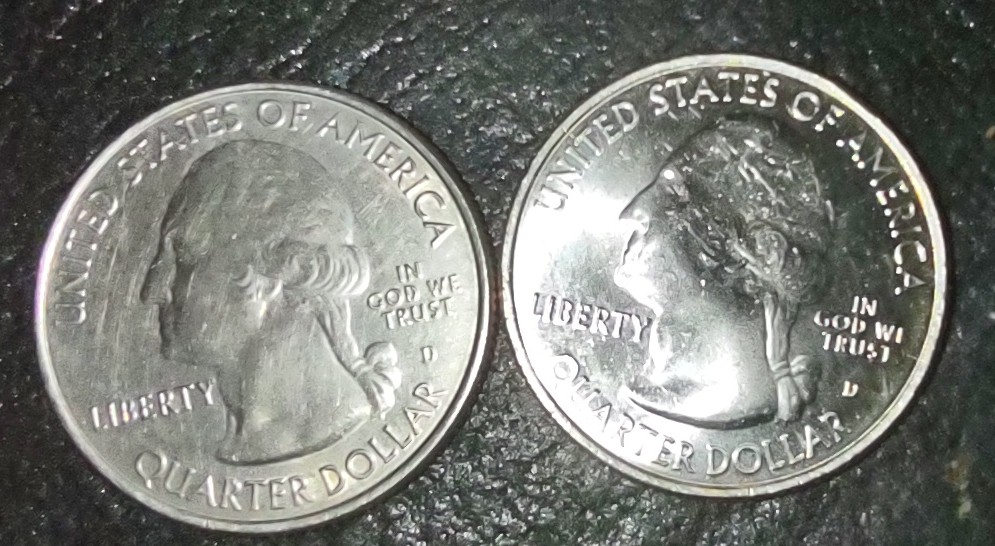
I am confused as to what the difference is in these two quarters. Can someone tell me what the dull quarter is made of? Both weigh 5.7g


2021-Quarters-What-Is-The-Dull-Color?
Bedrock of the Community
merclover's Avatar
United States
10635 Posts
 Posted 01/05/2022  02:37 am  Show Profile   Bookmark this reply Add merclover to your friends list Get a Link to this Reply
Circulation effects colour, the more it's handled, the more it's effected. They are both made of the same materials, so it's just circulation showing, simple as that.

to the CCF!
Valued Member
SunnyNinaD's Avatar
United States
102 Posts
 Posted 01/05/2022  03:11 am  Show Profile   Bookmark this reply Add SunnyNinaD to your friends list Get a Link to this Reply
It looks like pewter at least that's the way it looks and it would be a inconsistent coloring if it was wear and tear. Definitely not wear

Maybe a different angle would help no luster on coin compared to coin on it.
2021-Quarters-What-Is-The-Dull-Color?
Bedrock of the Community
JimmyD's Avatar
Canada
21633 Posts
 Posted 01/05/2022  09:38 am  Show Profile   Bookmark this reply Add JimmyD to your friends list Get a Link to this Reply
Just from circulation wear. All quarters are the same when they are struck but can
change to a variety of finishes after they leave the mint.
Pillar of the Community
fplagge's Avatar
United States
659 Posts
 Posted 01/05/2022  10:05 am  Show Profile   Bookmark this reply Add fplagge to your friends list Get a Link to this Reply
I disagree. I opened an OBW of 2020 Marsh-Billing-Rockefeller quarters and found MANY lusterless, uncirculated quarters.

They HAD to come from the mint that way.

I saved a handful of them because they were so different. Most of the quarters in the roll had normal luster.
Pillar of the Community
HGK3's Avatar
United States
574 Posts
 Posted 01/05/2022  2:34 pm  Show Profile   Bookmark this reply Add HGK3 to your friends list Get a Link to this Reply
There really aren't any "OBW" any longer. Neither the Mint nor the banks wrap coins.

Instead, coins are shipped from the Fed (or the mint on behalf of the Fed) to third parties, mostly armored car companies, in large bags. These third parties use large machines to wrap and box the coins for the banks.

However, when banks have more coins than they need, they also return to the Fed via the same third parties, who just dump them into the same wrapping machine hopper with the new coins they just got they next time they need to wrap and box coins for a client.

It's called "cash logistics" or "cash vault operations" and because of this it's entirely possible to get an "OBW" that contains both uncirculated and circulated coins, such as in this example. The dull coins could have been circulating for as much as one year (based on their date) when mixed with newly minted coins and wrapped, delivered to the bank and then to the coin roll hunter.
Pillar of the Community
fplagge's Avatar
United States
659 Posts
 Posted 01/05/2022  9:44 pm  Show Profile   Bookmark this reply Add fplagge to your friends list Get a Link to this Reply

Quote:
it's entirely possible to get an "OBW" that contains both uncirculated and circulated coins, such as in this example.


When a roll of newly issued quarters, all of the same variety and mintmark, have absolutely no wear on any of them, they are all uncirculated coins, luster or no luster. They could never have been in circulation.
Even if they had been in circulation for a short time the luster would not completely disappear.
They came from the mint/FED that way, such as in this example.
Bedrock of the Community
merclover's Avatar
United States
10635 Posts
 Posted 01/05/2022  10:13 pm  Show Profile   Bookmark this reply Add merclover to your friends list Get a Link to this Reply

Quote:
When a roll of newly issued quarters, all of the same variety and mintmark, have absolutely no wear on any of them, they are all uncirculated coins, luster or no luster. They could never have been in circulation.
Even if they had been in circulation for a short time the luster would not completely disappear.
They came from the mint/FED that way, such as in this example.

You have no way of telling if ANY of this is true or not unless you followed each coin directly from the mint. Once they leave the mint, coins can travel through many, many hands before being rolled by 3rd party compilers and be subject to lots of varying conditions before your bank ever obtains them regardless how minty fresh they might look to you!
Pillar of the Community
silviosi's Avatar
Canada
6244 Posts
 Posted 01/06/2022  12:37 am  Show Profile   Bookmark this reply Add silviosi to your friends list Get a Link to this Reply
To answer to all those suppositions, logical in one way. Except some selected rolls and sets or the first strike (general first minute = 40K coins) the rest of the coins are put in bags by weight and send to some agreed banks or some agreed third party subcontracting. Those bags could be exposed to different environment factors which cause this effect on the surface of the Nickel.

It is not a mint default, it is just environmental.

New Member
United States
8 Posts
 Posted 01/06/2022  07:30 am  Show Profile   Bookmark this reply Add SheriDan4615 to your friends list Get a Link to this Reply
Hello my name is Danny. I can tell you exactly what it is. I'm no expert on coins but I am an expert in metalworking and machining. I have been doing it for 40 years. These coins are being welded on at the mint. They must be using a VERY small wire welding process that's why there are small pieces of wire on these coins. If you look at the more shiny one you can CLEARLY see the L in LIBERTY is a piece of wire on top of the coin. On the dull one there is a weld right down the bridge of the nose. The color is from it being blasted with either sand glass beads or some other medium. You can see on the shiny one that it has black and silver areas right? You can't see that just by eye right? Well they had to do enough welding on the dull one where you could see it so hey blasted it. I have 20 coins that I can CLEARLY see welds on and you can too if you look for them THEY ARE ON LOTS OF QUARTERS
Bedrock of the Community
ijn1944's Avatar
United States
19208 Posts
 Posted 01/06/2022  07:38 am  Show Profile   Bookmark this reply Add ijn1944 to your friends list Get a Link to this Reply
SheriDan4615-- Interesting evaluation. Have you considered sharing your observations and conclusions with mainstream/professional numismatic entities--Coin World, Numismatic News, Coin News, and/others? Perhaps submit one of your best examples to a reputable third party grading/attribution service. Would like to learn/see more about this. Thanks.
New Member
United States
8 Posts
 Posted 01/06/2022  07:44 am  Show Profile   Bookmark this reply Add SheriDan4615 to your friends list Get a Link to this Reply
I forgot to say I'm getting ready to post my own thread about this topic. It is taking forever to upload the photos. Also on he dull coin there is a weld right on top of the man's goggles. Alit of people thought this was a die crack. There are even coins being sold as such. IT'S NOT. THAT IS A WELD. I would stake my 40 years reputation as a 1st class machinist on it. The welds are around the edge on lots of coins too. On the inside of the rim on top of the rim and on the outside of the rim. They are VERY small but also very easy to see once you're looking for them.
New Member
United States
8 Posts
 Posted 01/06/2022  07:50 am  Show Profile   Bookmark this reply Add SheriDan4615 to your friends list Get a Link to this Reply
I myself only finally realized what I was looking at about 2 hours ago. I don't exactly know what to do with the information but I welcome the suggestion. I don't know if I am allowed to post my email. I wish you could see some of my coins. Maybe this evening I will be able to post some of them.
New Member
United States
8 Posts
 Posted 01/06/2022  08:07 am  Show Profile   Bookmark this reply Add SheriDan4615 to your friends list Get a Link to this Reply
There is also welding splatter welding b.b.s and flux on the coins as well as flux hammer marks and lots of little pieces of welding wire everywhere
Pillar of the Community
Chase007's Avatar
United States
7516 Posts
 Posted 01/06/2022  09:18 am  Show Profile   Bookmark this reply Add Chase007 to your friends list Get a Link to this Reply

Quote:
These coins are being welded on at the mint.

I don't think the coins are being welded on at the mint unless you are referring to the equipment repairs,they are rather struck on a blank planchet by a Hammer under extreme pressure! In any event, the following is a good general info.
Coin Production:
Step One: Blanking. Blanks are flat metal discs that will eventually become coins. ...
Step Two: Annealing. Blanks are annealed to prepare them for striking. ...
Step Three: Washing & Drying. ...
Step Four: Upsetting. ...
Step Five: Striking. ...
Step Six: Bagging & Packaging

Article by James Buck ( the spruce craft)

The methods used to make coins has evolved over the years. Coins were first made in the ancient kingdom of Lydia well over two thousand years ago. The minting process for ancient coins was quite simple. A small lump of gold, silver, or copper was placed on a coin die embedded into a solid surface like a rock. The worker would then take a second coin die place it on top of it and strike it with a large hammer.
Medieval mints used preformed round discs of metal and a screw press to manufacture the coins. Although this was a manual process, it was easier and yielded a more consistent quality than the ancient minting process.
Modern coins are minted with hydraulic coining presses that automatically feed the blanks into the machine. When the machine is running at full capacity, rates of over 600 coins per minute can be obtained. This speed is necessary for an operation like the United States Mint that must produce billions of coins every year.
Although the process is complicated because of the automation used to produce billions of coins, there are a few common steps that every mint around the world uses. The United States Mint is the largest mint in the world, and we will focus on its production process.

1. Mining Raw Materials
The minting process begins with the mining of raw materials. Mines from across the United States and around the world supply the gold, silver, copper, or other required metals. The raw metal obtained from these mines contains impurities that are not acceptable for coinage.
In addition to the mining of ore to obtain the required metal, the United States Mint also uses recycled metal reclaimed from various sources. These sources include coins that are no longer "machinable" and are removed from circulation. They are returned to the mint where they are recycled into new coins.
2. Refining, Melting, and Casting
The raw metal is refined to remove almost all impurities. Some coins require an alloy of two or more different types of metals. The refined metal is melted, and the additional metals as required by the specifications are added. For example, the United States Mint makes its five-cent coin from an alloy of 75 percent copper and 25 percent nickel.
Once the proper purity or alloy is achieved, the metal is cast into an ingot. These are large metal bars which contain the proper amount of metal as required by the mint. The metal is checked throughout the process to make sure the right purity is obtained.
3. Rolling
The process of rolling the ingot to the proper thickness can be long and laborious. The ingot is rolled between two hardened steel rollers that are continuously moving closer and closer together. This process will continue until the ingot is rolled into a metal strip that is the proper thickness for the coin being made. Additionally, the rolling process softens the metal and changes the molecular structure which allows it to be struck easier and produces higher quality coins.
4. Blanking
The United States Mint uses rolls of metal that are approximately 13 inches wide and weigh several thousand pounds. The roll of metal is unwound and flattened to remove the curvature from the manufacturing process. It is then passed through a machine that punches out discs of metal that are now the proper thickness and diameter for the coin being made.
5. Riddling
Up to this point, the production process used to fabricate the metal blanks is dirty and is ran in a harsh environment. It is possible for small pieces of waste metal to get mixed in with the coin blanks. The riddling machine separates the properly sized blanks from any foreign matter mixed in with the coin blanks.
6. Annealing and Cleaning
The mint then passes the coin blanks through in the annealing oven to soften the metal in preparation for striking. The blanks are then put through a chemical bath to remove any oil and dirt that may be on the surface of the coin. Any foreign material can become embedded in the coin during the striking process, and it would have to be scrapped.
7. Upsetting
To protect the design that's going to be impressed on the metal coin blank, each coin blank is passed through a machine that has a set of rollers that get a little bit smaller and imparts a raised metal rim on both sides of the coin blank. This process also helps ensure that the coin blank is the proper diameter so it will strike up properly in the coining press. After this process, the coin blank is now called a planchet.
8. Stamping or Striking
Now that the planchets have been properly prepared, softened, and cleaned, they are now ready for striking. Business struck coins are automatically fed into the coining press at a rate that can reach several hundred coins per minute. Proof coins made for collectors are fed by hand into the coining press and receive at least two strikes per coin.
9. Distribution
Coins that pass inspection are now ready for distribution. Business struck coins are packed into bulk storage bags and shipped to The Federal Reserve Bank for distribution to local banks. Collector coins are placed in special holders and boxes and shipped to coin collectors around the world.

This is also educational in plane language:

https://www.google.com/search?q=how...CMtAad66sw29


Edited by Chase007
01/06/2022 10:22 am
Pillar of the Community
silviosi's Avatar
Canada
6244 Posts
 Posted 01/06/2022  7:09 pm  Show Profile   Bookmark this reply Add silviosi to your friends list Get a Link to this Reply
Agrees with the Chase.

@SheryDan, nice hypothetical theorem. Metalwork and Machining do not really apply to the mint process. I welcome you here because always is need experts on different fields. I know very well what you talk about. I suggest you to take first a look at ANA academia where you find how the Mint work. With your experience you will understand very fast.

For the purpose of education I tell to all the members of this Forum: Till the point 4 what Chase mention nothing is done at Mint location from very long time ago.
  Previous TopicReplies: 27 / Views: 6,531Next Topic
Page: of 2

To participate in the forum you must log in or register.


Disclaimer: While a tremendous amount of effort goes into ensuring the accuracy of the information contained in this site, Coin Community assumes no liability for errors. Copyright 2005 - 2026 Coin Community Family- all rights reserved worldwide. Use of any images or content on this website without prior written permission of Coin Community or the original lender is strictly prohibited.
Contact Us  |  Advertise Here  |  Privacy Policy / Terms of Use

Coin Community Forum © 2005 - 2026 Coin Community Forums
It took 0.44 seconds to rattle this change. Forums