Coin Community Family of Web Sites Join Thousands of Coin, Bullion, & Money Collectors
Specializing in Modern Numismatics Royal Canadian Mint products, Canadian, Polish, American, and world coins and banknotes. 300,000 items to help build your collection! Shop for APMEX Bullion on eBay!Vancouvers #1 Coin and Paper Money Dealer Join Thousands of Coin, Bullion, & Money Collectors Coin, Banknote and Medal Collectors's Online Mall


Username:
Password:
Save Password
Forgot your Password?


This page may contain links that result in small commissions to keep this free site up and running.

Welcome Guest! Registering and/or logging in will remove the anchor (bottom) ads. It's Free!

Exciting Brass Contemporary Forgery 1726 Ecu

To participate in the forum you must log in or register.
Author Previous TopicReplies: 21 / Views: 2,395Next Topic
Page: of 2
Pillar of the Community
colonialjohn's Avatar
United States
1757 Posts
 Posted 02/13/2022  2:44 pm  Show Profile   Bookmark this reply Add colonialjohn to your friends list Get a Link to this Reply
Actually silvering is present on your pieces its those darkened areas in/around the motifs. Mercuric silvering as in your piece sometimes is worn away but normally a high end benchtop model can pickup Hg levels down to 0.1%. Mercuric silvering depending on the circumstances can darken as it has on your piece. Its difficult to detect Hg even with a $20K Oxford hand held XRF analyzer. Mercury becomes inert in these situations on the surface based on the mercuric compounds it forms- also no problem handling these without cotton gloves. JPL.
New Member
jimmybob96's Avatar
United States
43 Posts
 Posted 02/13/2022  3:15 pm  Show Profile   Bookmark this reply Add jimmybob96 to your friends list Get a Link to this Reply
Oh I thought that was just the brass. I was comparing it too exactly to Albert's example I reckon, his still looks silver under a microscope and is a nice example.
Pillar of the Community
United States
1915 Posts
 Posted 02/13/2022  7:19 pm  Show Profile   Bookmark this reply Add Albert to your friends list Get a Link to this Reply
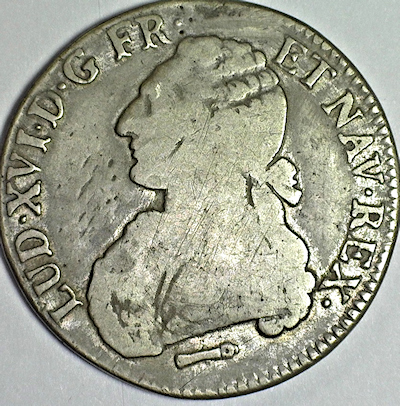
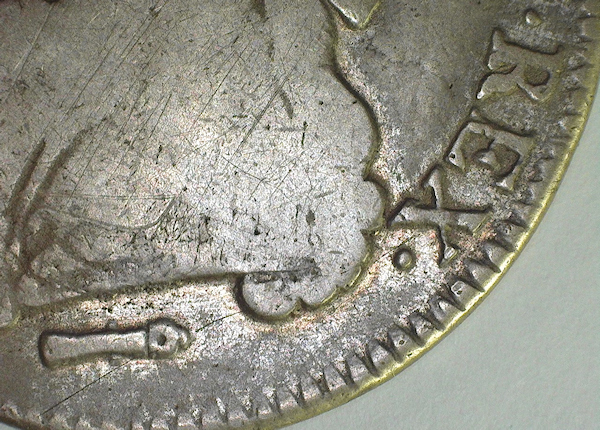
The 1783Q that is shown has no edge lettering.
You can see the remnants of silvering in certain places.
Exciting-Brass-Contemporary-Forgery-1726-Ecu
Edited by Albert
02/13/2022 7:42 pm
New Member
jimmybob96's Avatar
United States
43 Posts
 Posted 02/14/2022  7:46 pm  Show Profile   Bookmark this reply Add jimmybob96 to your friends list Get a Link to this Reply
Awesome coin, thanks for the photos!
Pillar of the Community
colonialjohn's Avatar
United States
1757 Posts
 Posted 02/21/2022  1:13 pm  Show Profile   Bookmark this reply Add colonialjohn to your friends list Get a Link to this Reply
L. Beck on her paper on - Counterfeit coinage of the Holy Roman Empire in the 16th Century: silvering process and archaeo-metallurgical replications discusses the mercuric silvering layer being actually THREE distinct layers. An inner copper core/the MIDDLE mercuric silver layer and the outer copper core. Sometimes with copper reacting with sulfides or chlorides can produce this darken effect I discussed with this coin - not ALL mercuric silvering is silver looking as in the other example. See her discussion where the majority of the coins silvered with mercury were struck in Palatinate whereas those with pure silver come from the city of St. Gallenin Switzerland. The mercuric silvering process in general is universal in its technique.

The examination of the coins has shown two main types of silver plating which can be distinguished by the presence or absence of mercury. In case of mercury detection, microanalysis on cross-section clearly shows the
presence of silver and mercury in the same layer (Fig.
1a). This plating layer is between two copper-rich phases, the inner layer is the corroded copper core of the coin and the external layer is composed of copper corrosion products. The presence of silver and mercury in the same layer is non-destructively confirmed by RBS(Fig. 1b). The typical thickness of this plating layer is between 5 and 10 µm.
When mercury is absent, the silvered layer is very thin(1 - 2 µm) and generally less preserved (Fig. 2).

Mercury silvering

The silver and mercury contents of the amalgam silvered
coins were measured on the surface of the coins, and on the cross sections for two coin fragments (numbers
15-15 and 16-5). The results are presented in Table 1.Except for the coin from the city of Strasbourg, the mercury content of the plating is between 25 and 51 %. For
each coin, the result is a mean of at least 7 surface analyses and the dispersion of the data is due to the
heterogeneity of the alloy. On the cross-section of the fragments, we have observed that the plating has less
mercury on the surface than in the middle of the layer
(Fig. 3) (coin number 15-15: 28 % Hg at the surface -between 45 % and 55 % in the center and coin number16-5 (41 % Hg at the surface - between 50 % and 60 % in the center). This difference is probably due to the preferential evaporation of mercury at the surface of the
coin. All the coins, with exception of the Strasbourg coin and number 21-36, have a core in copper with some
impurities in lead, tin, antimony and arsenic.
Pillar of the Community
colonialjohn's Avatar
United States
1757 Posts
 Posted 02/21/2022  1:20 pm  Show Profile   Bookmark this reply Add colonialjohn to your friends list Get a Link to this Reply
BTW - next time you submit an early Honduras Provisional coin to NGC and it comes back as VF yet has full silvering which is actually a mercuric silvered copper host (JPL XRF -verified) you then have to ask yourself this question with NGC and its grading capability on early Central American Provisional capabilities - "How can a coin with a mercuric silver layer on average measuring 5-10 microns in thickness at the surface have full silvering and NOT be AU or even 50% silvered and be given XF. Shhhhh .... I am still building my Central American collection ... I do not mind buying AU or UNC coins at VF prices. LOL Also the Honduras real pieces have high lead so with all the lead/copper occlusions (i.e., lead has a very low solubility in copper) seen on the surface it can come back as environmental damage and VF!!
I love it .... since I am buying these JEWELS already slabbed. HA! HA! HA!
Edited by colonialjohn
02/21/2022 1:39 pm
  Previous TopicReplies: 21 / Views: 2,395Next Topic
Page: of 2

To participate in the forum you must log in or register.


Disclaimer: While a tremendous amount of effort goes into ensuring the accuracy of the information contained in this site, Coin Community assumes no liability for errors. Copyright 2005 - 2026 Coin Community Family- all rights reserved worldwide. Use of any images or content on this website without prior written permission of Coin Community or the original lender is strictly prohibited.
Contact Us  |  Advertise Here  |  Privacy Policy / Terms of Use

Coin Community Forum © 2005 - 2026 Coin Community Forums
It took 0.23 seconds to rattle this change. Forums