| Author |
 Replies: 9 / Views: 974 Replies: 9 / Views: 974 |
|
|
New Member
United States
7 Posts |
Found this in.a community that disappeared in the 1920's It has what looks likea bow and arrow on one side and a cluster of grapes on the other If it were whole it would be a little bigger tha a US quarter Hope someone recognizes it ![Interesting,-Old-And-Unidentified-Id:-Ancient-India-Kuras-Of-Kolhapur]() 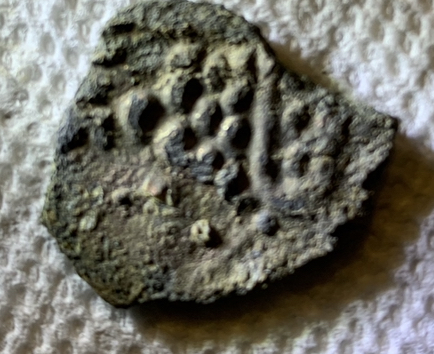 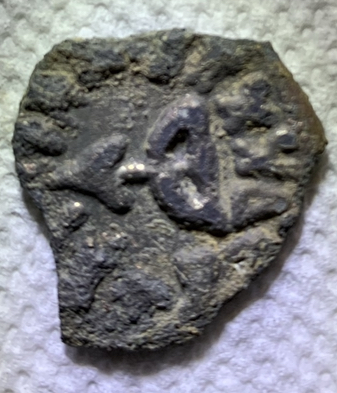 |
|
|
|
Moderator
 United States
56855 Posts |
|
|
Moderator
United States
34572 Posts |
@pac, first welcome to CCF. Second, a few questions for you. Was this found in the US? What is the weight? Is a strong magnet attracted to it?
"If you climb a good tree, you get a push."
-----Ghanaian proverb
"The danger we all now face is distinguishing between what is authentic and what is performed."
-----King Adz
|
|
Pillar of the Community
Canada
5299 Posts |
Hmm. It has the look of a coin from Taxila, ancient India. This is just from memory. Anyone else?
|
|
Pillar of the Community
United States
7067 Posts |
Edited by Kamnaskires
02/20/2022 8:12 pm
|
|
New Member
 United States
7 Posts |
Thanks for the welcomes To answer some questions, yes found in US. Southern West Virginia. It is a one mile walk to get to this old community I found on historic tops maps. I have found with a metal detector many old times, a civil war button, coins and tokens from 1900's through 1940's. Many farming items and coal mining tags and script coins. I have found a Chinese coin of the type that were so devalued they were used often for decorations on lamps and clothing. This coin does appear to match the coin from ancient India referenced in the link above. Mine seems to be a metal (cast non-ferrous) other than the original lead used, but cannot imagine how it came to be in a remote farming community in WV. Maybe jewelery or a button made to look like the coin?
I am glad to know what coin it is supposed to be based on. I cannot believe that it is possibly real
|
|
Moderator
United States
198004 Posts |
 to the Community! |
|
Moderator
Australia
17031 Posts |
I would say that it is likely to be a genuine ancient Indian coin, however unlikely that may seem, simply because these coins were not being counterfeited or copied back then. If it were a famous ancient coin, like a Widow's Mite, a Tribute Penny, or a Jewish shekel, then yes, a replica could be assumed (and old replicas of such things are found all the time by metal detectorists). But these ancient Indian coins are so obscure, no-one would make a copy of one for use as decoration. Plus, they're made of lead, not exactly the most beautiful of decorations for use in jewellery; there are plenty of ancient Indian gold and silver coins that look far more attractive than this.
The way it is broken, makes me wonder if it was originally attached to something like a pendant that broke apart. That may explain it's origin: someone who was in India (perhaps a former British soldier, cashiered out and deciding to seek employment as a British mercenary for one side or the other in the civil war), who came to the US with a souvenir from India they wore around their neck.
Don't say "infinitely" when you mean "very"; otherwise, you'll have no word left when you want to talk about something really infinite. - C. S. Lewis
|
|
Bedrock of the Community
Canada
24885 Posts |
To the Forum. |
|
New Member
United States
7 Posts |
Hey, Thanks again for all of the help. I had mentioned a Chinese Cash Coin I found at the old site, but it was in a different location, maybe 500 yards apart. I know many of our local farm boys served in WW1 and WW2. I have found bus tokens at this site from Ohio. So, even though leaving a community was rare, they did during those wars. Maybe a soilder picked that coin up as a souvineer as proposed above. There gotta be a story there somewhere, but that community was so remote, a search of historical newspaper only mentioned it once in reference to a church meeting at the school.
I need to check and see if it is lead. I was drawing blanks on that but am curious if one of those kits you use to test for lead in paint would work? Any other ideas to determine the metal used?
Thanks for the help again, love the forum
|
| |
Replies: 9 / Views: 974 |
|







 Posted 02/20/2022 7:28 pm


