| Author |
 Replies: 13 / Views: 773 Replies: 13 / Views: 773 |
|
|
Pillar of the Community
United States
2014 Posts |
Recently I have come across a few threads asking for grading opinions for some early US coins (Draped Bust Dimes). I didn't want to hijack those threads so I started this new topic. I find my grading skills lacking even when using PCGS photograde to assess these early treasures. While all grading is subjective to a point, accurate grading of these early examples can only come from experience. Most of us are familiar with grading standards used on 19th Century and above coinage. I suppose a different standard must be applied to 18th Century and earlier coins that were produced with screw presses and limited technology of the period. I believe that I am confusing strike weakness for wear on some of these examples. What are your opinions about a different set of grading standards for early coins? |
|
|
|
Bedrock of the Community
United States
94367 Posts |
Totally impractical in my opinion.
|
|
Bedrock of the Community
United States
12057 Posts |
Grading is grading. It's as subjective as criticism of literature, art, cinema, or music. There are fundamentally no differences between grading a coin struck in 1600 and one struck in 2020. Sharpness, luster, color, strike, defects/damages, eye appeal, and other aspects of grading are equally applicable in both cases. Vast oversimplification incoming here, but generally speaking, there are two or three schools of grading in popular use at the moment here in the US, along with some outlying systems like Rick Snow's 15 point PDS system for Indian Head cents. The TPG's generally -- but not always -- grade on sharpness first and then luster, and will apply Details designations to coins with issues. They grade based on the standard ANA grading system (Poor 1 to Mint State 70) that has been used in some form or another for the last 40-odd years. Once upon a time, TPG's such as ANA/ANACS would "net grade" coins instead of assigning details designations, but that has not been the case since the mid to late 1980s. At the other end of the spectrum lie grading systems like that used by Early American Coppers (EAC) collectors. While the same basic scale is in use (1 to 60) coins are most often net graded based on issues with the coin (as above) but also assigned subjective ratings for things such as eye appeal (e.g. Jack Robinson's choice / average / scudzy) and color. EAC collectors tend to prefer descriptive (auction-style) grading, which is a written explanation of the rationale behind a given grade, or notes about the coin's specific variety or other interesting features such as its color, rarity, or eye appeal. Circling back to the question at hand, there is no difference between the grading of the early dimes being posted lately vs. a brand-new coin struck yesterday. The technology in use at the Mint at the time (early 19th c. and before) made it very difficult to achieve full sharpness, a complete strike, etc. and that many of the planchets (coin blanks) in use for copper and silver issues of the era were of varying metallurgical quality. Whether or not any, all, or none of those issues matters when determining a grade is entirely subjective. I believe that it would be confusing, pointless, entirely unnecessary and an exercise in futility to come up with a different formal grading system based solely on a coin's age. This encourages the concept that older coins should be entitled to more lenient grading simply because they are old. Member ANA - EAC - TNA - SSDC - CCT #890 "Most of the things worth doing in the world had been declared impossible before they were done." -- Louis D. Brandeis Edited by paralyse
03/28/2022 8:49 pm
|
|
Pillar of the Community
 United States
2014 Posts |
Paralyse, by your own admission "The technology in use at the Mint at the time (early 19th c. and before) made it very difficult to achieve full sharpness, a complete strike, etc. and that many of the planchets (coin blanks) in use for copper and silver issues of the era were of varying metallurgical quality." I am not suggesting that a new standard be made to apply to grading these early coins but rather are the TPG's using a different standard due to strike quality. Clearly if you look at the PCGS photograde images, many slabbed examples do not meet their own criteria. |
|
Bedrock of the Community
Australia
21789 Posts |
In almost all cases, professional TPGrading experience is better than for almost all collectors, despite the fact that from time, almost all collectors will strongly disagree with a professional TPG assessment. For most of us, Photograde TPG OK.  Those pictures have a lot to teach an inexperienced collector. That is despite the fact that I much prefer to grade my own coins, and none of the 4,000 or so coins in my collection are slabbed. |
|
Bedrock of the Community
 United States
18873 Posts |
paralyse covered the question very well. i'll also add that photograde is not the end all be all of grading. it can help get into the correct part of the grade scale but not every coin that matches say a VF30 is a VF30. there are too many other coin specific components that can adjust that up or down. one cannot look at a specific area of a coin and base the grade off that. this is what occurs mainly with individuals just learning how to grade. one of the more difficult series to grade imo are buffalos. one can just read some of the comments on them by fortcollins here on CCF to see the finer observations of grading this series. one cannot just look at the horn and say the coin is an XF just based on the amount of horn remaining. the entire coin must be assessed as a whole. this applies to all coins not only 20th century. grading 18th century and early 19th century coins are even more challenging. enhancing ones grading acumen comes from looking at hundreds of coins in a particular series to learn the nuances with that series so that a more accurate grade can be assigned. this can take years. this is why you will see many here on CCF that have a thorough understanding in grading a particular series but not in another. one cannot even count on TPG's to assign the correct grade and that's why you see pretty much everyone here abides by the statement to grade the coin not holder. this is wise advise. i have a good background in grading morgans. I have been grading them for decades. do I get it right every time? no way. When it comes to bust half dollars not so much. however, by reading assessments by collectors that are familiar with the series over a period of years you begin to learn the nuances and can provide a better assessment of them. this is why for a new person to grading it would be wise to select one particular series you are drawn to and learn everything you can about it. one of the best ways to learn how to grade a particular series is to not read any of the comments prior to assigning your grade to it. then read the comments to see how you compared to them. many comments contain detailed information on how they assessed the coin which is invaluable in your quest for grading astuteness |
|
Pillar of the Community
United States
4497 Posts |
Quote:
What are your opinions about a different set of grading standards for early coins? The grading standards should be the same for all series of coins. The TPG's already do tweak the standards on certain dates and series to appease market demand. For example, on the 1921 Peace dollar the strike is overlooked on most grades. On the Classic Head Large Cent the standards change on the XF and below as scratches, pits, cleaning, and damage are more acceptable when compared to other series. The TPG's are more tolerant of problem coins below XF that were minted in the 18th century. |
|
Pillar of the Community
United States
1853 Posts |
Quote:The grading standards should be the same for all series of coins. The TPG's already do tweak the standards on certain dates and series to appease market demand. For example, on the 1921 Peace dollar the strike is overlooked on most grades. On the Classic Head Large Cent the standards change on the XF and below as scratches, pits, cleaning, and damage are more acceptable when compared to other series. The TPG's are more tolerant of problem coins below XF that were minted in the 18th century. This is a great topic! @Slider23 I think your first sentence is not proven with your follow up. I don't see how you can grade a coin made in the early 1800s the same way you could a coin from say the 50s to now. In fact within a series there are different standards. Since diving into CBHs I have found that you need to grade different Overton's differently because of strike, etc (also applies to Morgan's and others as far as strike quality). In CBHs some MS coins don't have full EPU banners and can be missing lettering. I have found that I have to be happy with what I think a coin is worth regardless of the grade by a TPG or anyone else. Also, if you would like me to put on my tinfoil hat, I think that large auction houses and/or famous collections get better grades and/or passes on detailed coins, especially cleaning. I have seen a bunch of CBH straight graded that look like someone took a Brillo pad to them and several in details cleaned holders that I cannot figure out why. |
|
Pillar of the Community
United States
4497 Posts |
Quote:
This is a great topic! @Slider23 I think your first sentence is not proven with your follow up I was not trying to prove the first sentence. I was trying to make a point that the TPG's already change the grading standards for given dates and series. My concern with the TPG's making decision on when to change the grading standards on a given date or series opens the door wider for TPG'S subjective grading. As a collector I want a consistency on grades from the TPG's. When I look at details grade Classic Head large cent and a details grade Matron Head large cent it should be the same details standard. Quote:
if you would like me to put on my tinfoil hat, I think that large auction houses and/or famous collections get better grades and/or passes on detailed coins You should create a thread with this topic as it deserves a full discussion and not hijack this thread. |
|
Pillar of the Community
United States
4497 Posts |
Here is a 1792 Half Dime that PCGS grades straight at F15. The coin clearly has circulation scratches. PCGS makes the decision to not follow grading standards of circulated scratched coins. If a 1792 Half Dime or a 1872 Half Dime or a 1921 D dime is scratched in circulation, it should be equal for the grade. 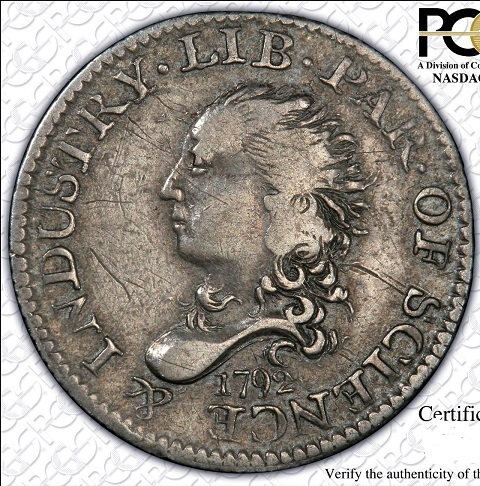 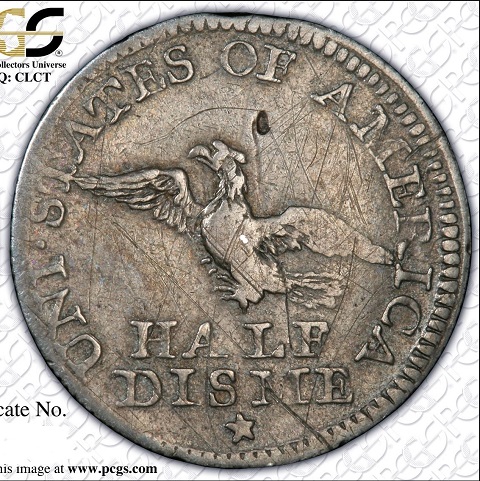 |
|
Bedrock of the Community
United States
12057 Posts |
@Mister T: To the best of my knowledge there is no written policy in place that would require PCGS, NGC, or ANACS to grade early coins differently than more modern issues. But grading is subjective, no matter how much TPG's try to make it objective. Let's say you have two 1809 Large Cents in for grading with a TPG. Both coins have the same level of wear -- let's say mid-VF -- and do not have major defects such as scrapes, gouges, holes, or digs. The first coin is a fully struck example from early dies on a good quality planchet with rich chocolate brown color. The second coin is a late or nearly terminal die state struck with misaligned dies on a poor quality planchet with striations and uneven gray streaks of toning. The coin shows die cracks and chips, and maybe even some minor rust pitting. TPG grader not experienced in early copper looks at coin A and it goes into a VF35 straight grade holder TPG grader not experienced in early copper looks at coin B and it goes into a F Details holder Both coins have the same level of wear (VF30, for the sake of discussion) Second coin gets resubmitted. Now this time the TPG grader who gets it happens to be very experienced with the issues that affected the production of the Classic Head large cents as well as being familiar with things such as early/late die states and weak strikes. In their opinion, the second coin's issues are all strike or die related, not due to PMD or wear, and they put the same coin in a VF30 holder this time. Next you send in two Morgan dollars, both with approximately MS63-MS64 sharpness. The first coin is an 1880-S with booming cartwheel luster, a sharp full strike, and some scattered contact marks with a rough cheek. The second Morgan dollar is a 1901-O with dark streaky toning over the luster, flatly struck from worn dies, but with almost no marks in the fields and a clean cheek. TPG grader puts the 1880-S into an MS65 holder because most of the 1880-S Morgans they see all day long are MS65 or above. TPG grader puts the 1901-O into an MS62, or even AU55 holder, because they don't see that same booming luster hiding under the toning and they confuse the weakly struck New Orleans coin as being worn or circulated despite the clean fields and cheek. Coin #2 gets resubmitted and this time a Morgan dollar aficionado gets to grade it at the TPG. Now it comes back in a MS64 holder because the grader knows about toning and the weak strike common on New Orleans Morgan dollars, but also recognizes that the coin's fields and cheek are clean and free of chatter or contact marks, indicating a higher Mint State grade. Which grader graded the coins "correctly?" I don't think that question can be answered one way or the other. Both graders assigned an honest grade - one based on "what the book/photos say" and the other based on years of experience as a grader. Member ANA - EAC - TNA - SSDC - CCT #890 "Most of the things worth doing in the world had been declared impossible before they were done." -- Louis D. Brandeis Edited by paralyse
03/29/2022 12:51 pm
|
|
Pillar of the Community
United States
2014 Posts |
Valid points by everybody which is why grading will always remain a subjective topic. I just got so frustrated with myself trying to assess a proper grade to those Draped Bust Dimes. Inexperience with the series best sums up my frustration. I will probably never be able to afford high quality Draped Bust and Flowing Hair silvers so the point is really mute to me but I still would like to learn how to properly assess them. Red Book is about worthless for grading description on these. Photograde by Ruddy is somewhat better but still the images are drawings, not photographs and the descriptive language leaves a lot to be desired. Hence, PCGS Photograde for comparison is probably the best I can do, but when a slabbed coin fails to resemble the grade image from their own database it raises concerns especially on high dollar coins. Thank you all for your candid input! |
|
Bedrock of the Community
United States
18873 Posts |
Quote:
I just got so frustrated with myself trying to assess a proper grade to those Draped Bust Dimes. Inexperience with the series best sums up my frustration. almost every series have its quarks and challenges in grading and it does come down to inexperience grading certain series. it can take years to understand the nuances with some of the series especially the 18th century and early 19th. its a constant learning process and it never ends regardless of how long you have been doing it so dont beat yourself up. no one person can know everything about every series ever minted. |
|
Bedrock of the Community
United States
11963 Posts |
I give different grades while alert on Monday morning, rushing to get down at tha club on Friday evening and while hung over on Sunday afternoon. I also grade tougher when my kids are giving me a hard time and when the wife is chiding me to take out the garbage or mow the lawn. Coin remains unchanged in the holder.
IN NECESSARIIS UNITAS - IN DUBIIS LIBERTAS - IN OMNIBUS CARITAS THE MAN IN THE ARENA, Theodore Roosevelt at the Sorbonne Paris on April 23, 1910: " It is not the critic who counts; not the man who points out how the strong man stumbles or where the doer of deeds could have done better. The credit belongs to the man who is actually in the arena, whose face is marred by dust and sweat and blood, who strives valiantly, who errs and comes up short again and again, because there is no effort without error or shortcoming, but who knows the great enthusiasms, the great devotions, who spends himself in a worthy cause; who, at the best, knows, in the end, the triumph of high achievement, and who, at the worst, if he fails, at least he fails while daring greatly, so that his place shall never be with those cold and timid souls who knew neither victory nor defeat." My coin website: https://fairfaxcoins.com |
| |
Replies: 13 / Views: 773 |
|









 Posted 03/28/2022 8:42 pm


