| Author |
 Replies: 17 / Views: 2,678 Replies: 17 / Views: 2,678 |
|
Valued Member
United States
172 Posts |
Hey Everyone, I was about 98% sure this was a penny struck through a die cap. I'm having trouble getting the pictures to show it but you can definitely see Lincoln's bust and what appears to be a 1937 date. It seems to have all the hallmarks of a coin struck through a die cap and no marks to suggest intentional wear/damage. Then I weighed the coin. It came out to 2.71 grams. That completely threw me for a loop. The one edge of the coin that has a clearly defined rim has the same width as a normal penny. The opposite side that doesn't exhibit a rim is much thinner. Theoretically it could be a tapered planchet struck through a die cap but the odds of that scenario happening just seems extremely low. That said, I do have an actual tapered planchet Wheat penny error with a straight clip (posted here previously) that weighs 2.6 grams so I guess it's not impossible. Any ideas?        |
|
|
|
Bedrock of the Community
United States
62064 Posts |
There may have been a split off post strike issue with this coin. My reason for saying that? Note the reverse rims are pretty full. There are some areas of the obverse rim showing. The obverse looks like the peel came off the coin post strike. The full weight was there before the strike (forming the rims) then escaped in circulation. Note on the obverse at 10:00-12.00, you can see the peeled area on that area. The cold rolled metal was probably loosened during the addition of the Proto rim, (setup process turning the blank into a planchet) 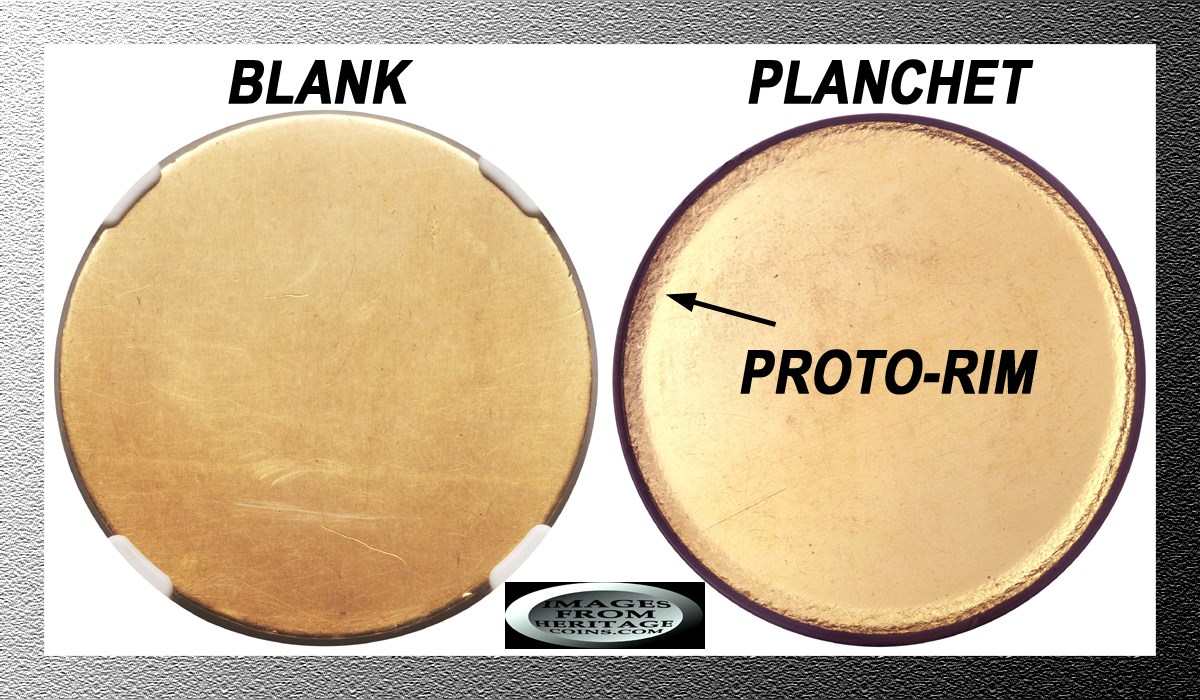 and then after the strike, it peeled off the coin. That is what I'm seeing on your coin. Edited by coop
04/07/2022 12:54 pm
|
|
Valued Member
 United States
172 Posts |
Thanks Coop, so if I'm understanding correctly you believe it's one half of a split planchet after strike error?
That would certainly account for the missing weight.
|
|
Bedrock of the Community
United States
94367 Posts |
Dr. coop knows his stuff.  |
|
Moderator
 United States
105622 Posts |
|
|
Pillar of the Community
United States
586 Posts |
I'm going to go with the die cap/tapered planchet over the post strike planchet split.
I don't see any of the striations normally found on a split planchet on the obverse of this coin.
The inconsistent obverse rim seems more in line with a die cap as well. Every split planchet I've seen splits through the rims but the obverse of this coin shows rims almost fully formed on part of it.
However, I will admit that the well struck reverse leaves me slightly puzzled as a tapered planchet usually results in at least some areas of strike weakness. Perhaps the taper wasn't great enough to affect the strike?
|
|
Bedrock of the Community
United States
62064 Posts |
The striation lines would be from a rolled on scrap metal that was uneven in surface thickness. If the rolled on stock would be even thickness, it would not create the striation lines. It would be adhered to the stock hot rolled stock, but being cool, could fall of at anytime later after the strike.The thickness would have been on the 10:00 thickness of the edge of the coin. Thus when it came apart, it broke off that location of the planchet. 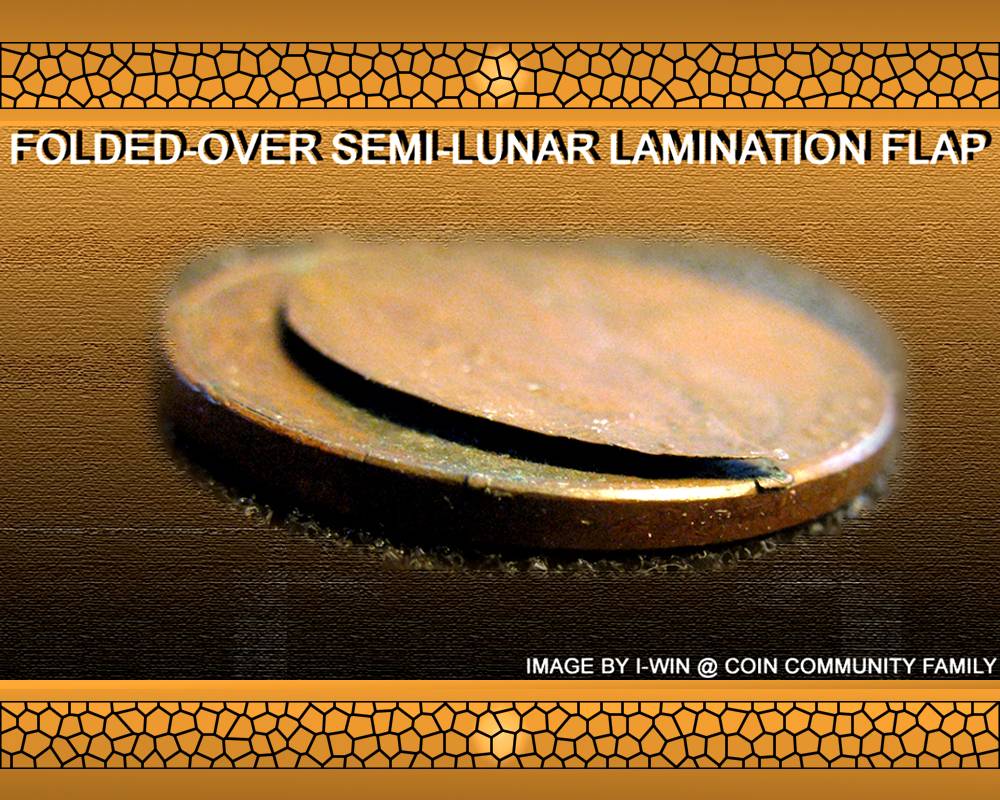 Similar to this coin, but attached on the outer edge instead of the center. 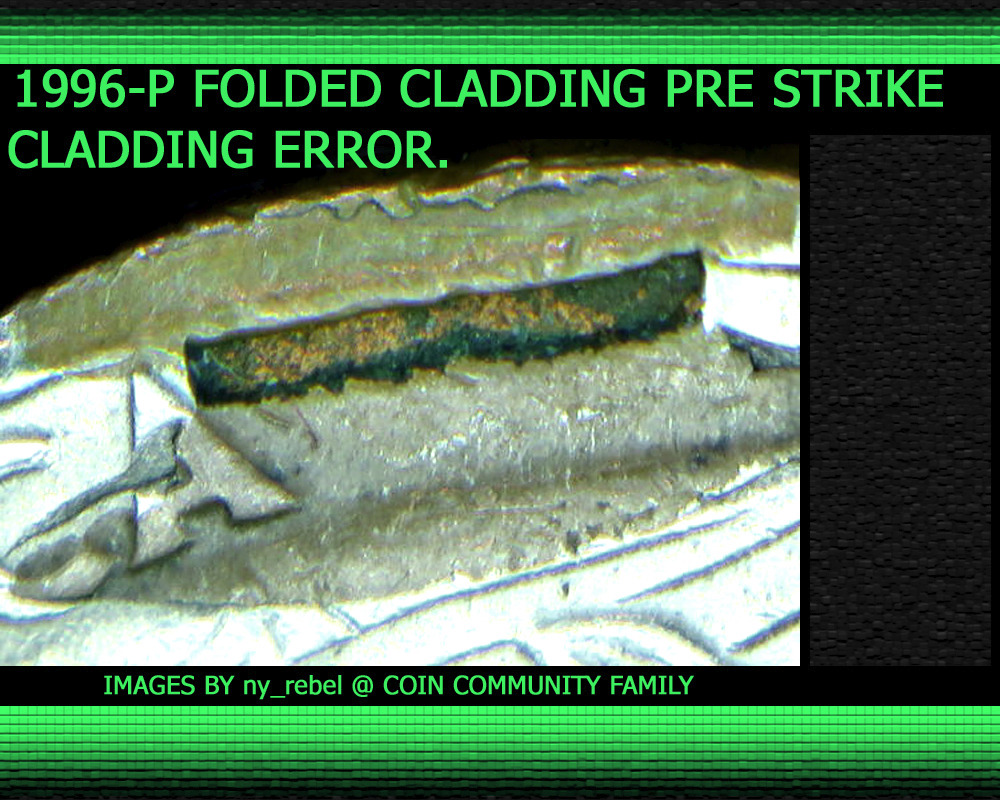 Like a loose clad. Note the edge of the coin? |
|
Pillar of the Community
United States
586 Posts |
So you're saying some scrap metal got rolled onto the stock while it was hot and then after striking it fell off, leaving a smooth surface? Do you have any photos of coins where that has happened? Quote:
If the rolled on stock would be even thickness, it would not create the striation lines. Since the OP says the planchet is thinner on one side, and since one side of the obverse shows some devices but not the other I don't see how we can support the assumption that the rolled on scrap metal was even thus leaving no striation lines. |
|
Valued Member
United States
172 Posts |
Thanks for the lively debate. I always find conversations like this helpful for better understanding how errors like this can potentially occur. One thing I probably should have specified is in the original pictures I posted the coin in question is on the left when I was doing the rim comparisons. So the first rim picture is a comparison of the thick edge of the coin in question (left) to another Wheat penny (right). The second picture still has the coin in question on the left and it compares the thinner rim to another Wheat penny on the right. Let me know if there are other pictures I can provide that would be helpful. Thanks again! |
|
Pillar of the Community
United States
2752 Posts |
I think the OP's original reconstruction of events is correct. This cent was struck through an early-stage uniface die cap. The planchet was either tapered or derived from rolled-thin stock.
Error coin writer and researcher.
|
|
Valued Member
United States
172 Posts |
Hey Everyone,
I wanted to post an update on this coin. I had heard ANACS was pretty good regarding error attribution so I gave them the coin to review. I noted that the coin was likely on a tapered planchet. The coin came back with the following attribution:
1937 1C Struck Through Late Stage Capped Die
AU 58
There was absolutely no mention of a tapered planchet or the low weight. In the same group of coins I sent off another one that had a straight clip on a tapered planchet and that one was attributed as a straight clip and instead of attributing it as a tapered planchet (which I've seen done on their labels) it simply listed the weight as 2.6 grams. I find it odd that the 1937 coin would be confirmed as struck through a die cap but have the 2.71g weight ignored.
If this is indeed a tapered planchet struck through a die cap those combination of events seem exceedingly rare and I'd love to get it attributed as such. Any recommendations? My next thought would be to send it to NGC but I'd hate to spend the money if it won't get attributed with both events.
Thanks!
|
|
Valued Member
United States
70 Posts |
|
|
Pillar of the Community
United States
5869 Posts |
Nice find.
(Missed another one the first time around.)
ANACS may have gotten it wrong on the label, especially if you put the wording in your description on their form.
I would contact them, explain the missing info from the label, and ask them to correct it. You might even provide the link to this thread where Mike confirms your initial attribution.
At the very least they should have included the weight on the label.
As to the discussion in the thread, IMHO, the reason the reverse rims struck up so nicely for a tapered planchet was simply that the die cap provided the additional volume of metal for the reverse rims and probably overlapped the obverse rim, flattening it out.
Words of encouragement are one of the major food groups.
We need to consume them regularly to thrive and grow.
|
|
Valued Member
United States
172 Posts |
Thanks for the recommendation I really appreciate it! I definitely made sure to mention both the struck through die cap and the tapered planchet on the form when I submitted it. I'll take your advice and give them a call. Out of the 7 coins I submitted in the batch I believe at least 3 were mislabeled and possibly up to 5 of them were mislabeled. The actual grades didn't matter to me since all 7 coins were sent for the main purpose of error attribution. I'll likely post a few of the other coins to the forum to get some additional community input before making the call to ANACS.
Thanks again!
|
|
Valued Member
United States
172 Posts |
I called ANACS and they were incredibly nice and offered to take a 2nd look at the coins. Really superb customer service. I'll post an update with the final results.
|
|
Pillar of the Community
United States
5869 Posts |
I called ANACS and they were incredibly nice and offered to take a 2nd look at the coins. Really superb customer service. I'll post an update with the final results.
Really good to hear. Hopefully, they re-evaluate and correct the label.
Just curious but did you happen to mention this thread and Mike's assesment?
Words of encouragement are one of the major food groups.
We need to consume them regularly to thrive and grow.
|
| |
Replies: 17 / Views: 2,678 |










 Posted 04/07/2022 1:08 pm


