



Coin Community Family of Web Sites Join Thousands of Coin, Bullion, & Money Collectors
Royal Canadian Mint products, Canadian, Polish, American, and world coins and banknotes. 300,000 items to help build your collection! Vancouvers #1 Coin and Paper Money Dealer Shop for APMEX Bullion on eBay!Join Thousands of Coin, Bullion, & Money Collectors Coin, Banknote and Medal Collectors's Online Mall Specializing in Modern Numismatics


Username:
Password:
Save Password
Forgot your Password?


This page may contain links that result in small commissions to keep this free site up and running.

Welcome Guest! Registering and/or logging in will remove the anchor (bottom) ads. It's Free!

New Lrb Additions, Gratian And Valens Etc.

To participate in the forum you must log in or register.
Author Previous TopicReplies: 10 / Views: 1,263Next Topic  
Pillar of the Community
Learn More...
Palouche's Avatar
Spain
2752 Posts
 Posted 04/17/2022  6:01 pm Show Profile   Bookmark this topic Add Palouche to your friends list Get a Link to this Message Number of Subscribers
An area my collection lacks in is the later Roman Emperors so decided to fill in a few holes...
Thought I'd share them here and get some feedback.

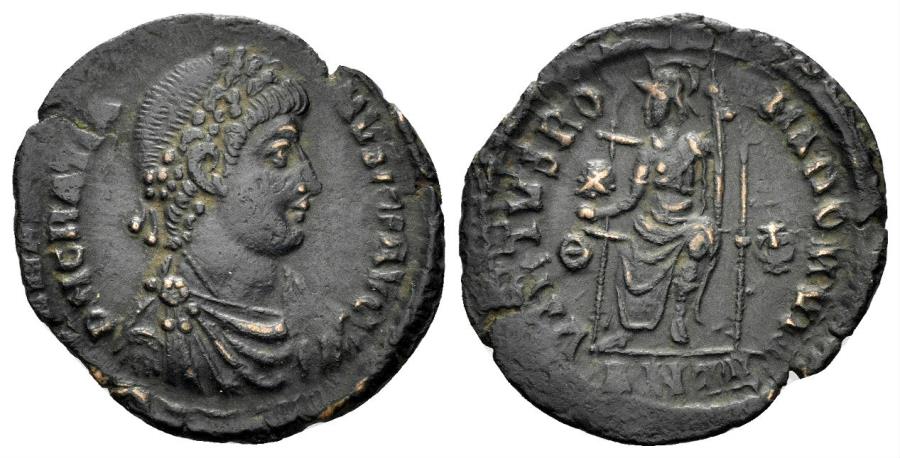
This serene portrait really appealed to me and is actually quite human-like.

Gratian. 375-383 AD. AE Centenionalis (1.59 gm, 20mm). Antioch mint. Struck 378-383 AD.
Obv.: DN GRATIANVS PF AVG, pearl diademed, draped, cuirassed bust right.
Rev.: VIRTVS ROMANORVM, Roma seated facing, head left, holding globe and spear, Θ in left field, Φ in right field. ANTΔ. LRBC 2674; RIC IX Antioch 50b. Slightly double struck, gVF.
New-Lrb-Additions,-Gratian-And-Valens-Etc.
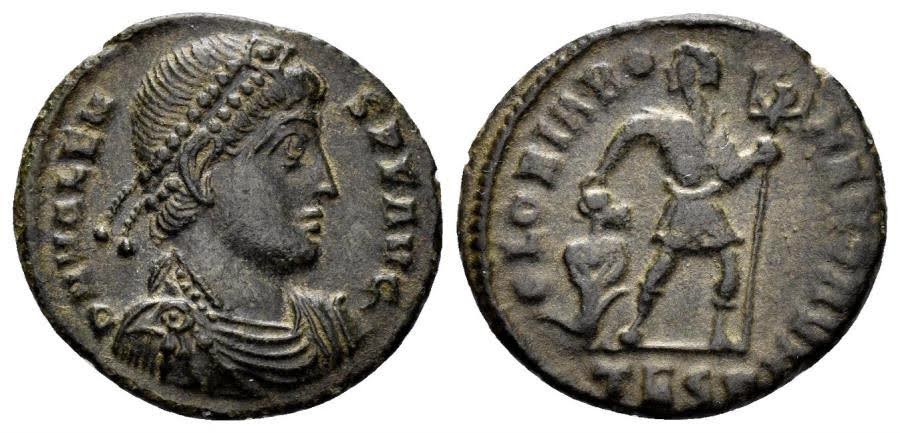
Valens. 364-378 AD. AE Nummus (2.19 gm, 18mm). Thessalonica mint. Struck 364-367 AD.
Obv.: D N VALENS P F AVG, pearl-diademed, draped and cuirassed bust to right.
Rev.: GLORIA ROMANORVM, Emperor walking to right, head to left, holding labarum and dragging captive; TESΓ in exergue.
RIC IX #16b.
New-Lrb-Additions,-Gratian-And-Valens-Etc.
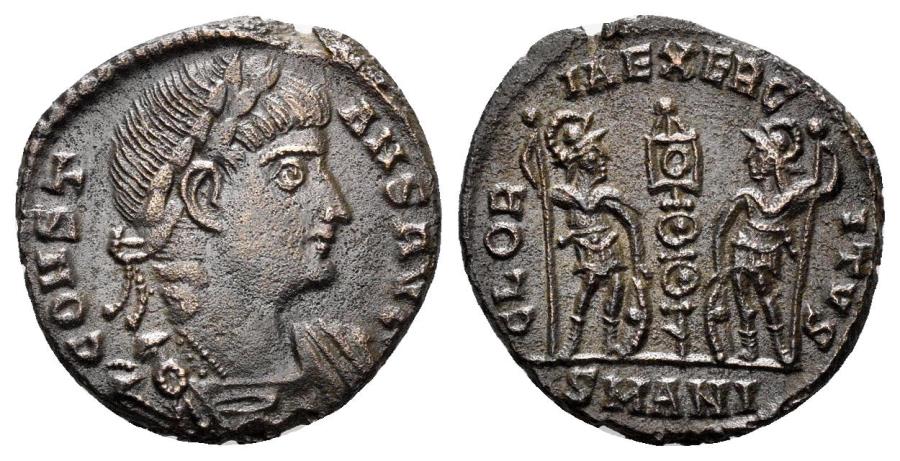
Constans, 337-350 AD. AE Follis (1.70 gm, 15mm). Antioch mint. Struck 337-347 AD.
Obv.: CONSTANS AVG, laureate, draped and cuirassed bust right.
Rev.: GLORIA EXERCITVS / SMANI, two soldiers standing facing each other, each holding inverted spear in his outer hand and placing his inner on shield set on ground; between them, signum. RIC 47. gVF.
New-Lrb-Additions,-Gratian-And-Valens-Etc.
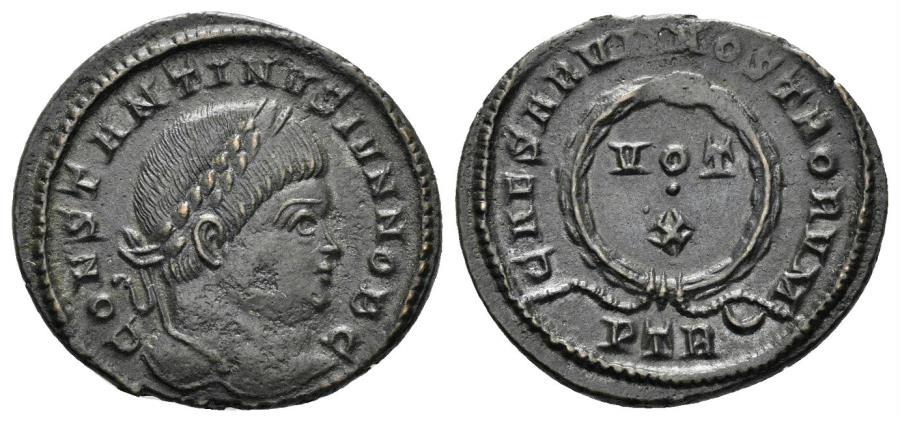
Constantine II, as Caesar. 317-337 AD. AE Follis (2.54 gm, 20mm). Treveri (Trier) mint. Struck 323-324 AD.
Obv.: CONSTANTINVS IVN NOB C, laureate head right.
Rev.: CAESARVM NOSTRORVM, VOT/X in two lines across field; all within wreath; PTR (crescent). RIC VII 441; Schulten Em. 27.
New-Lrb-Additions,-Gratian-And-Valens-Etc.

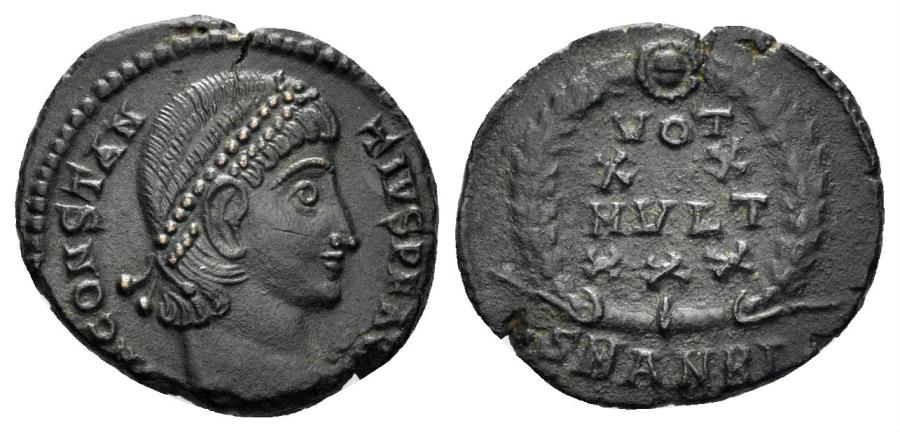
Constantius II. 337-361 AD. AE Nummus (1.57 gm, 16mm). Antioch mint. Struck 347-348 AD.
Obv.: D N CONSTAN TIVS P F AVG, diademed head right.
Rev.: VOT / XX / MVLT / XXX, in laurel wreath below, SMANBT. RIC#113.
New-Lrb-Additions,-Gratian-And-Valens-Etc.
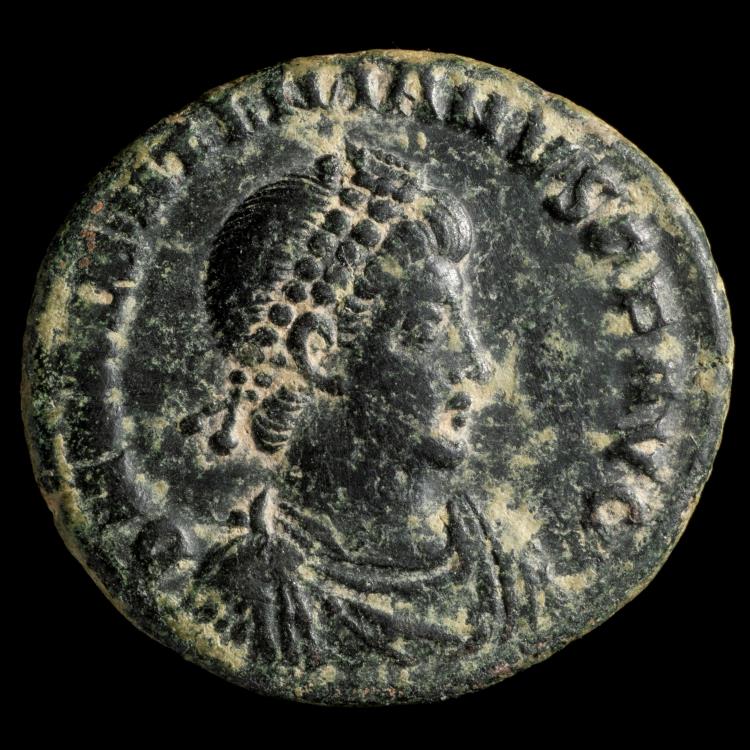
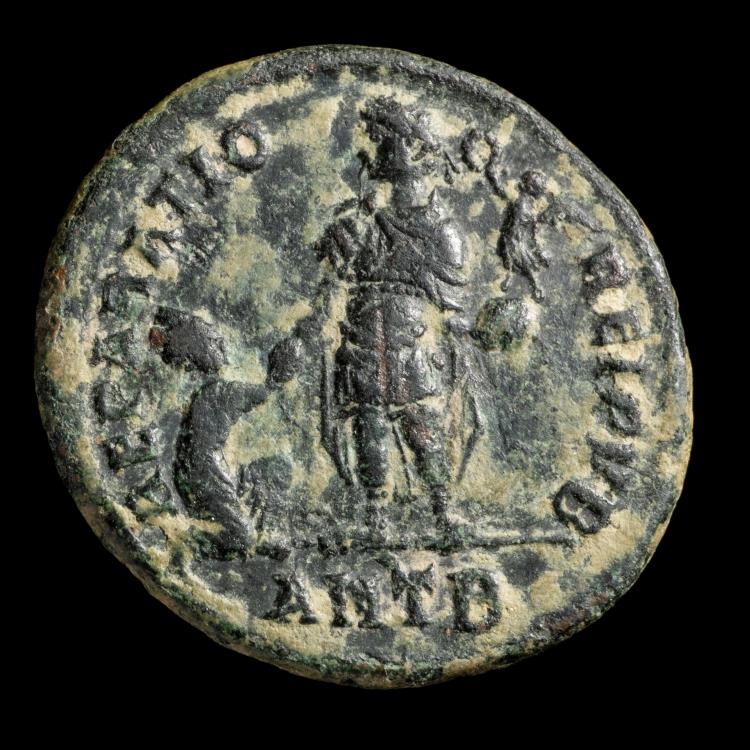
Valentinian II - REPARATIO REIPVB, Antiochia - 24 mm / 5.73 gr.
Obverse: D N VALENTINIANVS P F AVG, Diademed, draped and cuirassed bust of Valentinian right.
Reverse: REPARATIO REIPVB, Valentinian standing left raising kneeling turreted female and holding Victory on globe
Pillar of the Community
Kamnaskires's Avatar
United States
7066 Posts
 Posted 04/17/2022  6:08 pm  Show Profile   Bookmark this reply Add Kamnaskires to your friends list Get a Link to this Reply
An outstanding group of LRB's, Paul. Well done.
Pillar of the Community
Learn More...
Palouche's Avatar
Spain
2752 Posts
 Posted 04/17/2022  6:47 pm  Show Profile   Bookmark this reply Add Palouche to your friends list Get a Link to this Reply
Thanks Bob....
Nothing particularly special here apart from the wonderful realistic portrait of Gratian and the well engraved Roma reverse.
The others appealed for different reasons..

The Valens portrait is nice with both sides reasonably well centred and overall a well balanced piece although lacking detail on the reverse.
The Constans two soldier reverse is very common and I'd never picked one up due to this but this one is nice and I do wonder what they are chatting about?
The Constantine II's youthful chubby portrait and the elegant long features of Constantius II both with their simplistic wreath/ VOT reverses were cheap and pleasing..
The last coin, Valentinian II was just a few bucks and I really liked the detail on the reverse, as you know I'm not a lover of desert patinas so this one is soaking in distilled water....The engraver really caught the leather clothing of the Emperor and a sweet little Victory.
Paul.


Pillar of the Community
JohnConduitt's Avatar
United Kingdom
725 Posts
 Posted 04/18/2022  05:07 am  Show Profile   Bookmark this reply Add JohnConduitt to your friends list Get a Link to this Reply
Yes all very common coins (although you don't see a Gratian Centenionalis every day) but really good ones. It's surprising how few are identifiable down to the mint and officina, or even the emperor, considering how many there are.
Pillar of the Community
Learn More...
Palouche's Avatar
Spain
2752 Posts
 Posted 04/18/2022  6:12 pm  Show Profile   Bookmark this reply Add Palouche to your friends list Get a Link to this Reply
Thanks John...Yes these common LRBs are a Warren of rabbit holes and especially the GLORIA EXERCITVS reverses. Something I'll look into more when I'm retired for sure as they are cheap and a world unto their own.

LRB...Late Roman Bronzes, when does "Late" begin?...
Slightly late, late, or very late?..
I assume we're talking from early 4th Century? Is there a fixed date Anyone?

Paul
Pillar of the Community
Learn More...
Novicius's Avatar
United Kingdom
1168 Posts
 Posted 04/18/2022  7:05 pm  Show Profile   Bookmark this reply Add Novicius to your friends list Get a Link to this Reply
A very nice group of well detailed Romans there, Paul.

I must admit that I'm not awfully keen on "desert patina", though I have a few coins like that. It will be interesting to see how the Valentinian II turns out after it's distilled water bath.
Pillar of the Community
Learn More...
Palouche's Avatar
Spain
2752 Posts
 Posted 04/19/2022  5:19 pm  Show Profile   Bookmark this reply Add Palouche to your friends list Get a Link to this Reply
Thanks Jim....
I'll post a pic when it's cleaned...I'm not sure if the original desert patina is covering up any bad corrosion but the base patina is a lovely dark green colour, let's see.
Paul
Pillar of the Community
Lucky Cuss's Avatar
United States
4883 Posts
 Posted 04/19/2022  6:45 pm  Show Profile   Bookmark this reply Add Lucky Cuss to your friends list Get a Link to this Reply

I really like that Gratian. Whether that's a wly smile or a smirk, I concur that that it lends some humanity to the effigy, this being in a period where coin portraiture was becoming increasingly more generic, leaning more to portraying the position rather than the personal attributes of the emperor.

Colligo ergo sum
Pillar of the Community
JohnConduitt's Avatar
United Kingdom
725 Posts
 Posted 04/20/2022  03:13 am  Show Profile   Bookmark this reply Add JohnConduitt to your friends list Get a Link to this Reply

Quote:
Late Roman Bronzes, when does "Late" begin?

I believe it's generally when the nummus gets reduced to AE3, or perhaps slightly earlier with Diocletian's reforms in 294.

Like defining ancient and medieval there's no official arbiter, so you can pick a date you think works best.
Edited by JohnConduitt
04/20/2022 03:25 am
Pillar of the Community
Russian Federation
5172 Posts
 Posted 04/20/2022  10:48 am  Show Profile   Bookmark this reply Add january1may to your friends list Get a Link to this Reply

Quote:
LRB...Late Roman Bronzes, when does "Late" begin?...
Slightly late, late, or very late?..
I assume we're talking from early 4th Century? Is there a fixed date Anyone?
I like to put the boundary between the Constantinian and Valentinianic dynasties, but (as you can see from the OP coins) there's effectively no stylistic difference between those two periods. So it's more common to push the boundary a few decades earlier, to the end of the Tetrarchy (i.e. ca. 313 AD, or maybe a little later), which does show a sharp stylistic change.
I've never heard of the boundary being placed as early as 294 AD before, but it does make some sense, even if it feels extremely early.

Fortunately the other side of the boundary (i.e. where LRBs end) is much clearer, numismatically speaking: it's 498 AD, the reform of Anastasius introducing the letter-labeled denominations that became a fixture of Byzantine coinage for the next several centuries. IIRC there's some debate on whether the pre-reform issues of Anastasius count as LRB - they are in any case very scarce - but AFAIK it's usually agreed that Leo and Zeno coins do.
Pillar of the Community
Learn More...
Palouche's Avatar
Spain
2752 Posts
 Posted 04/21/2022  08:34 am  Show Profile   Bookmark this reply Add Palouche to your friends list Get a Link to this Reply
Thanks for the feedback guys..
Some interesting points put forward, I like the idea of a cut off date being the end of the Tetrarchy as this does show a distinct style difference...Thanks again Paul.
  Previous TopicReplies: 10 / Views: 1,263Next Topic  

To participate in the forum you must log in or register.


Disclaimer: While a tremendous amount of effort goes into ensuring the accuracy of the information contained in this site, Coin Community assumes no liability for errors. Copyright 2005 - 2026 Coin Community Family- all rights reserved worldwide. Use of any images or content on this website without prior written permission of Coin Community or the original lender is strictly prohibited.
Contact Us  |  Advertise Here  |  Privacy Policy / Terms of Use

Coin Community Forum © 2005 - 2026 Coin Community Forums
It took 0.33 seconds to rattle this change. Forums