This is not one of my typical What If? stories, as it does not tell the tale of a failed commemorative coin proposal. Instead, it's a story of what might have been had an artist's illness not changed the design course of the gold Quarter Eagle that was part of the 1915 Panama-Pacific International Exposition coin program.
Collectors of the series are likely familiar with the issued coin, Its designs are the work of
Charles Barber, the sixth Chief Engraver of the US Mint, and Assistant Engraver George Morgan. As was custom, Barber took responsibility for the coin's obverse and assigned Morgan to the reverse.
The obverse presents the allegorical figure of
Columbia - the personification of the United States - seated on a hippocampus - a fictitious animal that dates to the times of Greek mythology; a hippocampus was said to be an animal that combined the front quarters of a horse with the body and tail of a fish.
Columbia is also shown holding a caduceus in her left hand which is meant to represent the medical triumph over yellow fever that enabled the Panama Canal to be be built/completed.
1915 Panama-Pacific International Exposition Gold $2.50

The coin's reverse depicts a left-facing eagle in mid-stride on a pedestal with its wings elevated but not fully extended. The motto "E PLURIBUS UNUM" presented on the pedestal's plaque was making its co-debut on US commemorative coinage (it simultaneously appeared on the Pan-Pac Expo $50 gold coins).
These classically-influenced designs were replacements for those under development by Evelyn Beatrice Longman..
Per a piece in the June 1915 issue of
The Numismatist, the official publication of the American Numismatic Association (
ANA), Ms. Longman, of New York, was the artist originally selected to design the Panama-Pacific Gold Quarter Eagle coin. She had prepared initial sketches for her designs and was said to be in Washington, DC to discuss them (presumably with the Treasury Department). She took seriously ill during the trip and had to withdraw from the project; the Barber/Morgan team took over the assignment.
Longman studied under Lorado Taft in Chicago, worked with Hermon Atkins MacNeil on sculptural ornamentation for the 1901 Pan-American Exposition in Buffalo, NY and then served as an assistant under Daniel Chester French in New York between 1901 and 1905. (Quite a pedigree!) She was, in fact, French's lone female assistant, and the two developed a collaborative, trusted, long-lasting friendship. She went on to become a noted and in-demand sculptress and was a fitting choice for a designer of a Panama-Pacific coin. During her career, she won multiple prestigious awards for her sculptures.
Evelyn Beatrice Longman Standing in Front of US Naval Academy Chapel Doors That She Sculpted (1909)
One of Longman's most famous works is the
Genius of Telegraphy - a winged allegorical male figure who is holding lightning bolts in his left hand and electrical cables in his right. The large gold-leaf covered bronze statue as commissioned by American Telegraph & Telephone (AT&T), and for many years sat atop the Western Electric headquarters building in New York City. (It has been moved several times since 1980, as AT&T;s corporate structure has changed. It's currently in Dallas, Texas.)
Genius of Telegraphy Statue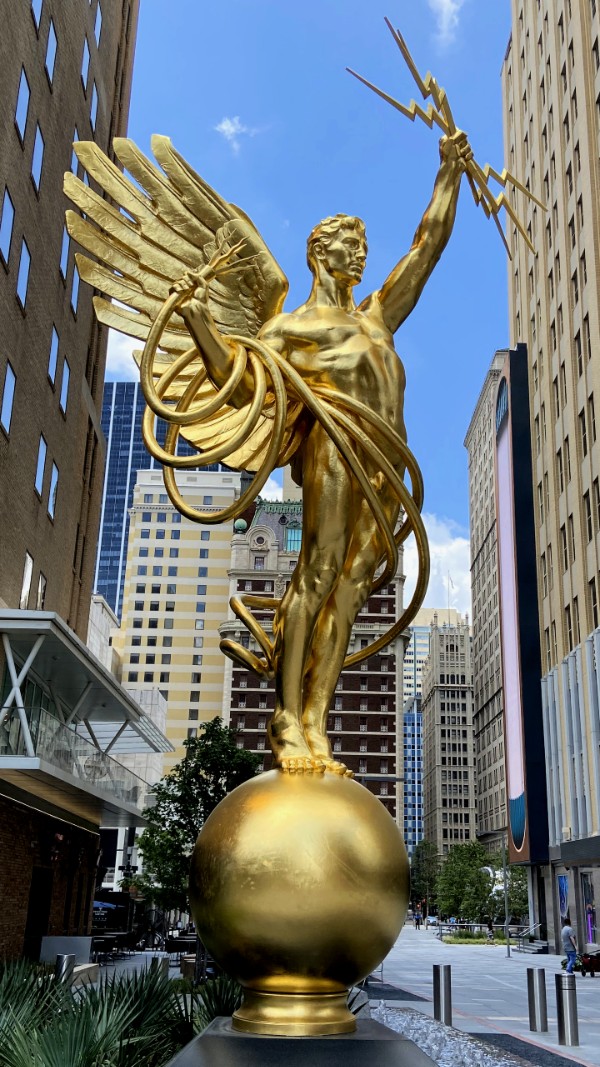 (Image Credit: https://upload.wikimedia.org/wikipe...2C_Texas.jpg
Over its 100+ year existence, the statue has gone by several other names, including
The Genius of Electricity, Electricity and the Spirit of Communication and
Spirit of Electricity.In 1919, Ms. Longman was the first woman sculptor to be elected a full member of the National Academy of Design.
Based on Ms. Longman's style, I feel confident in saying that her designs for the gold coin would have taken a more modern direction and would have been "softer" in their overall aesthetic.
For a bit more on Longman, see:
-
Quick Bits #21 - Women Who Could've Been 1stFor other of my posts about commemorative coins and medals, see:
Commems Collection.






 Posted 06/10/2022 9:01 pm





